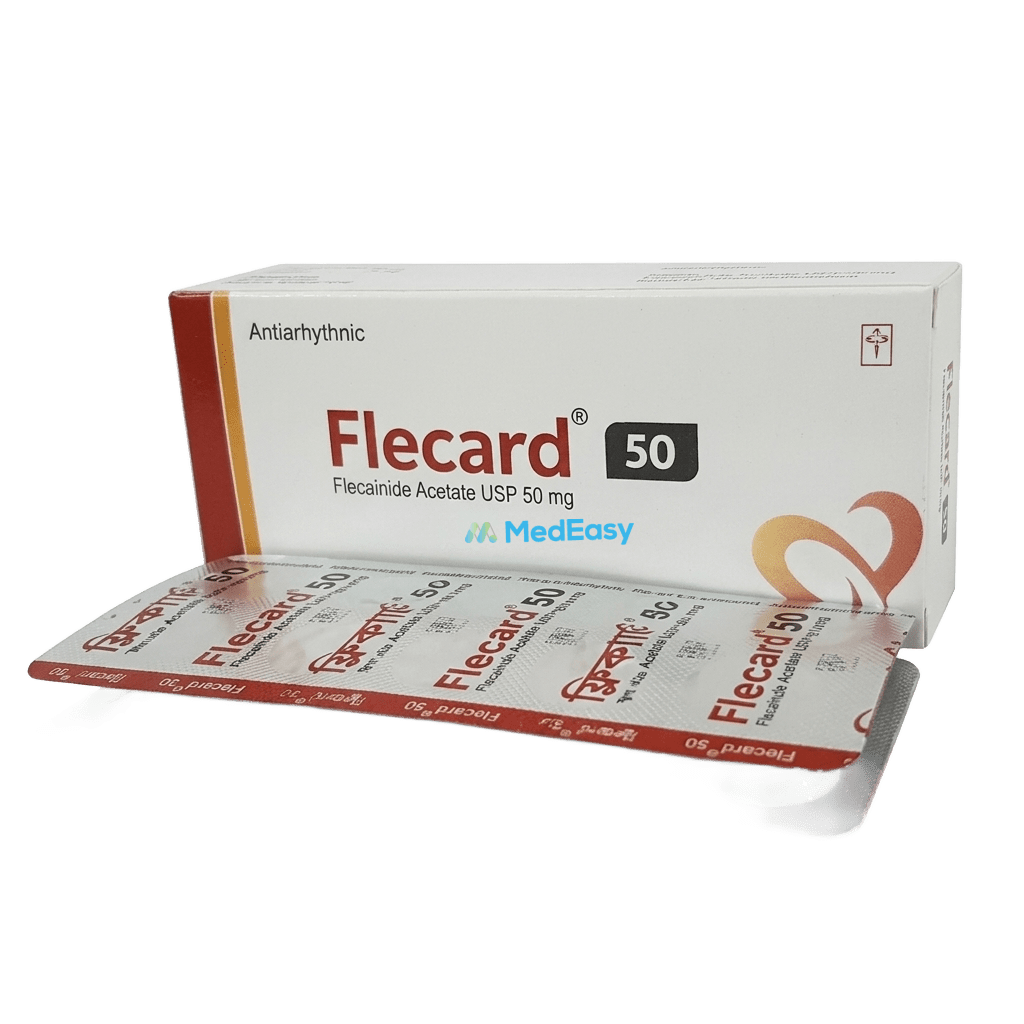
Generic medicine

Flecainide Acetate: Brands, Price & Uses in Bangladesh

Flecainide Acetate is a Class IC antiarrhythmic medicine used to prevent certain abnormal fast heart rhythms.

Forms:Tablet

About Flecainide Acetate

Indications of Flecainide Acetate

Flecainide Acetate is a Class IC antiarrhythmic medicine used to prevent certain abnormal fast heart rhythms. Its use is classified below by strength of evidence.

Established / FDA-approved uses

  • Prevention of paroxysmal supraventricular tachycardia (PSVT) associated with disabling symptoms in patients without structural heart disease, including AV-nodal re-entrant tachycardia and AV re-entrant tachycardia (e.g., via an accessory pathway).
  • Prevention of paroxysmal atrial fibrillation/atrial flutter (PAF) associated with disabling symptoms in patients without structural heart disease.
  • Prevention of documented, life-threatening sustained ventricular arrhythmias (e.g., sustained ventricular tachycardia). Because of an increased risk of proarrhythmia and death shown in patients with structural heart disease, Flecainide Acetate for ventricular arrhythmias is reserved for patients with these severe, life-threatening rhythm disturbances, generally after other options have been considered.

Off-label / specialist uses

  • Used by cardiac electrophysiologists as part of the diagnostic "flecainide challenge" test for suspected Brugada syndrome.
  • Used as an adjunct, in combination with beta-blockers, in selected patients with catecholaminergic polymorphic ventricular tachycardia (CPVT) who remain symptomatic despite beta-blocker therapy.
  • Used in a supervised, physician-directed "pill-in-the-pocket" strategy for termination of infrequent, symptomatic paroxysmal atrial fibrillation in selected patients without structural heart disease (typically combined with an AV-nodal blocking agent).

These off-label uses should only be undertaken under the direct supervision of a cardiologist experienced with Flecainide Acetate therapy.

Dosage & Administration of Flecainide Acetate

Dosing of Flecainide Acetate must be individualized by a physician, generally starting at the lower end of the range with gradual titration, and often initiated in a monitored/hospital setting for patients with sustained ventricular arrhythmias or underlying heart disease.

IndicationAdult starting doseTitrationUsual maximum
Paroxysmal supraventricular tachycardia (PSVT)50 mg every 12 hoursMay increase by 50 mg twice daily every 4 days as needed/tolerated300 mg/day
Paroxysmal atrial fibrillation/flutter (PAF)50 mg every 12 hoursMay increase by 50 mg twice daily every 4 days as needed/tolerated300 mg/day
Life-threatening sustained ventricular arrhythmias100 mg every 12 hoursMay increase by 50 mg twice daily every 4 days as needed/tolerated400 mg/day (typically 300 mg/day in patients with other cardiac disease)

Renal impairment

In patients with significant renal impairment (creatinine clearance ≤ 35 mL/min/1.73 m²), initiate at a lower dose (e.g., 100 mg once daily or 50 mg twice daily) with close clinical, ECG, and, where available, plasma-level monitoring, because clearance of Flecainide Acetate is reduced.

Hepatic impairment

Use with caution and at a reduced starting dose in significant hepatic impairment, with close monitoring of plasma levels where available, as metabolism may be significantly slowed.

See Precautions and Warnings for monitoring requirements and Contraindications for patients in whom Flecainide Acetate must not be used.

Side Effects of Flecainide Acetate

Side effects of Flecainide Acetate range from common and mild to rare but serious.

Common

  • Dizziness or light-headedness
  • Visual disturbances (blurred vision, spots before the eyes)
  • Shortness of breath (dyspnea)
  • Headache
  • Nausea
  • Fatigue or tiredness
  • Tremor
  • Palpitations

Serious (seek prompt medical attention)

  • New or worsened abnormal heart rhythms (proarrhythmia), including fast or slow rhythms
  • Worsening heart failure (swelling of legs/ankles, worsening shortness of breath)
  • Heart block or marked slowing of the heart rate
  • Fainting (syncope)

Contraindications of Flecainide Acetate

Flecainide Acetate is contraindicated in:

  • Pre-existing second-degree or third-degree atrioventricular (AV) block, or right bundle branch block when associated with left hemiblock (bifascicular block), unless the patient has a functioning pacemaker.
  • Cardiogenic shock.
  • Known hypersensitivity to flecainide or any component of the formulation.
  • Significant structural heart disease (e.g., recent myocardial infarction, reduced left ventricular function, or overt heart failure), in whom controlled trial data (the CAST study) demonstrated a markedly increased risk of proarrhythmia and mortality; use of Flecainide Acetate for non-life-threatening arrhythmias is not acceptable in this population.

Frequently Asked Questions about Flecainide Acetate

What is Flecainide Acetate used for?

Flecainide Acetate is used to prevent certain fast, abnormal heart rhythms, including paroxysmal supraventricular tachycardia and paroxysmal atrial fibrillation/flutter in people without significant structural heart disease, and to prevent documented life-threatening ventricular arrhythmias.

Can I take Flecainide Acetate if I have had a heart attack or have heart failure?

Generally no, unless your cardiologist has specifically determined you have a life-threatening ventricular arrhythmia that requires it. In people with significant structural heart disease, Flecainide Acetate has been shown to increase the risk of dangerous new arrhythmias and death, so it is avoided in that setting for non-life-threatening rhythm problems.

What monitoring will I need while taking Flecainide Acetate?

Your physician will typically order periodic ECGs to check your heart's electrical intervals, and may check blood drug levels and kidney/liver function, especially when starting therapy or changing the dose.

Is Flecainide Acetate safe during pregnancy or breastfeeding?

Flecainide Acetate should be used in pregnancy only if clearly needed, since data in humans are limited and animal studies have shown risk at high doses; it also passes into breast milk. Any use during pregnancy or breastfeeding should be individually assessed and supervised by a physician.

What should I do if I miss a dose of Flecainide Acetate?

Take the missed dose as soon as you remember, unless it is almost time for your next dose, in which case skip the missed dose and continue your regular schedule. Do not take a double dose.

What if I take too much Flecainide Acetate?

An overdose of Flecainide Acetate can be dangerous to the heart. Seek emergency medical attention immediately or contact a poison control center; do not try to treat an overdose at home.

Disclaimer

The information provided is accurate to the best of our knowledge, but it does not replace professional medical advice. We cannot guarantee its completeness or accuracy, and the absence of specific information about a drug should not be taken as an endorsement. We are not responsible for any consequences arising from this information, so please consult a healthcare professional for any concerns or questions.

DoctorBlogArticles