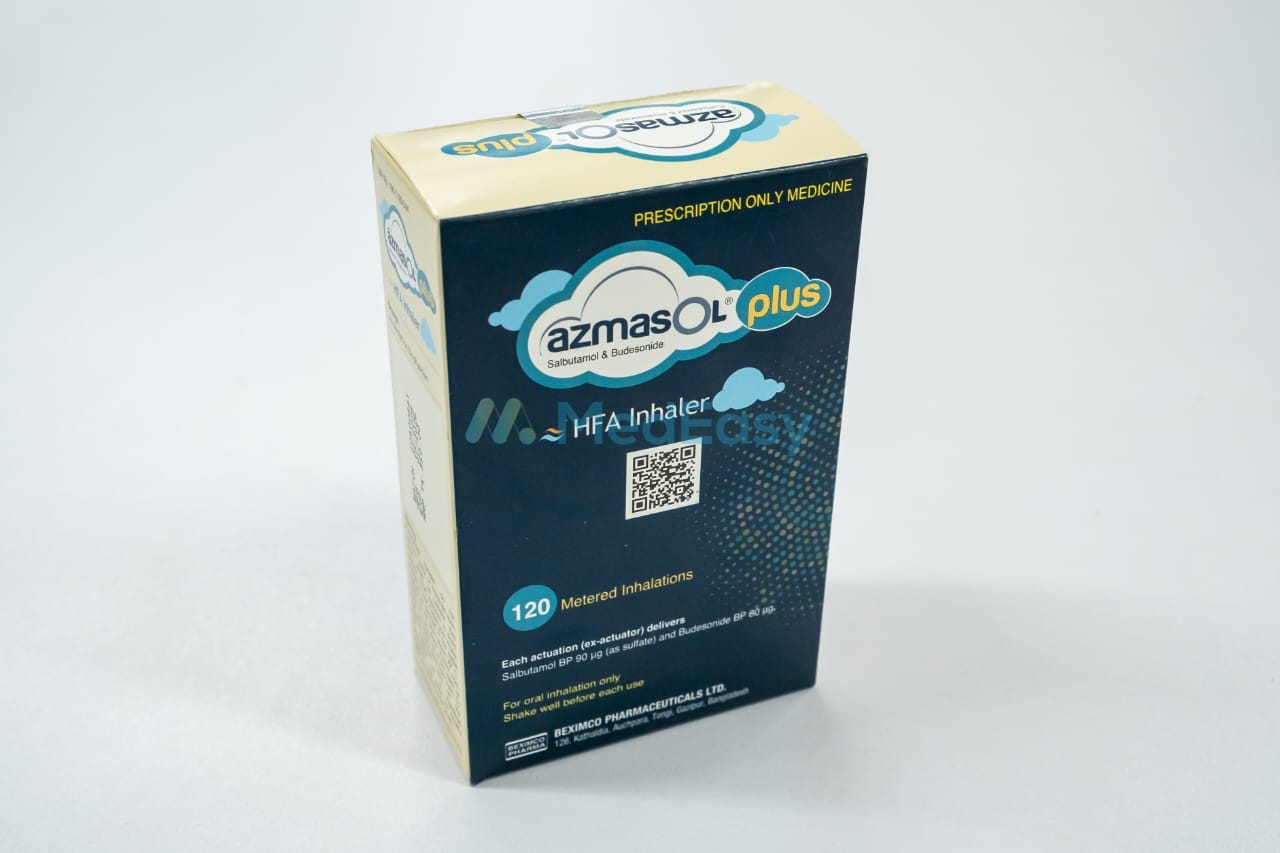
Generic medicine

Salbutamol + Budesonide: Brands, Price & Uses in Bangladesh

Salbutamol + Budesonide is an inhaled combination medicine containing a short-acting beta-2 agonist (salbutamol) and an inhaled corticosteroid (budesonide) and more.

Forms:Inhaler

About Salbutamol + Budesonide

Indications of Salbutamol + Budesonide

Salbutamol + Budesonide is an inhaled combination medicine containing a short-acting beta-2 agonist (salbutamol) and an inhaled corticosteroid (budesonide), used in the management of asthma and other reversible airway obstruction. Because Salbutamol + Budesonide combines rapid symptom relief with anti-inflammatory control in a single inhaled formulation, the approved way to use it depends on the specific product and prescriber's instructions.

Established / approved use

  • As-needed relief and prevention of bronchoconstriction, and reduction of the risk of asthma exacerbations, in adult and adolescent patients (18 years and older) with asthma, when Salbutamol + Budesonide is prescribed as an as-needed rescue combination inhaler.

Guideline-supported / product-dependent use

  • Some formulations of Salbutamol + Budesonide are used as part of a maintenance-and-reliever regimen, while other products are intended only as an add-on reliever alongside a separately prescribed regular maintenance therapy. Always follow the specific product's labeling and your physician's instructions.

Common clinical practice (adjunct/off-label use)

  • Combined nebulization of salbutamol and budesonide solutions is widely used in hospital and emergency settings for acute exacerbations of asthma and, in select cases, chronic obstructive pulmonary disease (COPD), to provide rapid bronchodilation together with an anti-inflammatory effect; this use of Salbutamol + Budesonide should be directed and monitored by a physician.

Salbutamol + Budesonide is not indicated as the primary treatment for a severe, rapidly deteriorating asthma attack requiring emergency care, nor as a substitute for a regular controller therapy prescribed separately, unless the specific product is labeled for that purpose.

Dosage & Administration of Salbutamol + Budesonide

Dosing of Salbutamol + Budesonide depends on the specific product/device dispensed (e.g., a pressurized metered-dose inhaler versus a nebulizer solution) and the prescriber's regimen. The following reflects typical dosing patterns for combination salbutamol/budesonide inhalation therapy; always follow the exact instructions on the product label and from your physician.

Indication / PopulationTypical Dosing
Adults and adolescents (18 years and older) - as-needed relief of asthma symptomsUsually 2 inhalations of Salbutamol + Budesonide taken as needed at the onset of symptoms; doses may be repeated as directed, generally not exceeding 6 dosing episodes (12 inhalations) in a 24-hour period unless a physician advises otherwise.
Acute exacerbation (nebulized use, physician-directed, hospital/clinic setting)Salbutamol and budesonide nebulizer solutions may be administered together via nebulizer at intervals directed by the treating physician, with monitoring of heart rate and clinical response.
Children and adolescents younger than 18 yearsSafety and efficacy of this fixed-dose combination have not been established; pediatric use, if prescribed, must be individualized and supervised by a physician (see Use in Special Populations).
Renal impairmentNo specific dose adjustment is well established; use with routine caution.
Hepatic impairmentBudesonide is metabolized by the liver; significant hepatic impairment may increase systemic exposure - use with caution and physician supervision.

Do not exceed the maximum recommended dose of Salbutamol + Budesonide. An increasing need for extra doses, or symptoms not relieved by the usual dose, may indicate worsening asthma control and requires prompt medical review.

Side Effects of Salbutamol + Budesonide

Side effects of Salbutamol + Budesonide arise from its two components.

Common side effects

  • Tremor, nervousness, headache
  • Palpitations, increased heart rate (tachycardia)
  • Throat irritation, cough, hoarseness (dysphonia)
  • Oral/oropharyngeal candidiasis (thrush) - reduced by rinsing the mouth after use
  • Muscle cramps

Less common but important side effects

  • Paradoxical bronchospasm (worsening of wheeze immediately after use) - discontinue Salbutamol + Budesonide and seek medical attention if this occurs
  • Hypokalemia (low blood potassium), particularly with high or frequent doses
  • Hyperglycemia (mild elevation of blood sugar)
  • Signs of hypersensitivity such as rash, urticaria, angioedema, or bronchospasm
  • With prolonged, high-dose use: features of systemic corticosteroid effect (adrenal suppression, reduced bone mineral density, growth suppression in children, cataracts, or glaucoma) - see Precautions and Warnings

Report persistent or severe side effects from Salbutamol + Budesonide to your physician.

Contraindications of Salbutamol + Budesonide

Salbutamol + Budesonide is contraindicated in patients with a known hypersensitivity to salbutamol, budesonide, or any excipient of the specific product formulation. There are no other well-established absolute contraindications to Salbutamol + Budesonide beyond hypersensitivity; other cautions, such as cardiovascular disease or uncontrolled diabetes, are addressed under Precautions and Warnings rather than as absolute contraindications.

Frequently Asked Questions about Salbutamol + Budesonide

What is Salbutamol + Budesonide used for?

Salbutamol + Budesonide is an inhaled combination medicine used mainly for the as-needed relief and prevention of asthma symptoms (bronchoconstriction) and, in the approved product, to reduce the risk of asthma exacerbations in patients 18 years and older; some formulations may also be used as directed by a physician for maintenance-and-reliever therapy. Always follow your physician's specific instructions and the product label.

How quickly does Salbutamol + Budesonide work?

The salbutamol component of Salbutamol + Budesonide usually starts relieving bronchospasm within about 5 minutes, while the budesonide component works more gradually over hours to days with continued or repeated use to reduce airway inflammation.

Can I use Salbutamol + Budesonide during pregnancy?

Salbutamol + Budesonide should be used in pregnancy only if clearly needed, since uncontrolled asthma itself carries risks to mother and baby; available data have not shown a clear pattern of birth defects, but treatment should always be supervised by a physician who will weigh the benefits and risks for your specific situation.

What side effects should I watch for with Salbutamol + Budesonide?

Common side effects of Salbutamol + Budesonide include tremor, palpitations, headache, throat irritation, hoarseness, and oral thrush (reduced by rinsing your mouth after each use). Seek prompt medical attention if you notice worsening wheeze immediately after use (paradoxical bronchospasm), signs of an allergic reaction, or if you find yourself needing more doses than usual, as this can mean your asthma is not well controlled.

Is Salbutamol + Budesonide safe for children?

The fixed combination Salbutamol + Budesonide has not been established as safe and effective in children under 18 years of age. If a physician wants a child to receive similar treatment, they will typically prescribe the individual components (salbutamol and budesonide) separately, in doses and formulations suitable for the child's age, and will monitor the child closely, particularly for effects on growth with long-term inhaled corticosteroid use.

What should I do if I miss a dose or take too much Salbutamol + Budesonide?

Because Salbutamol + Budesonide is typically used as needed rather than on a fixed schedule, a missed dose usually just means using it when symptoms occur, following your prescribed maximum. If you think you have taken too much Salbutamol + Budesonide, or you develop symptoms such as a fast or irregular heartbeat, severe tremor, or chest pain, seek immediate medical attention or contact emergency services/poison control.

Disclaimer

The information provided is accurate to the best of our knowledge, but it does not replace professional medical advice. We cannot guarantee its completeness or accuracy, and the absence of specific information about a drug should not be taken as an endorsement. We are not responsible for any consequences arising from this information, so please consult a healthcare professional for any concerns or questions.

DoctorBlogArticles