Quick answer: A home pregnancy test strip detects the pregnancy hormone hCG in urine. Test from the first day of a missed period, with first-morning urine, and read the strip within the time printed on the pack. Two lines, even if one is faint, mean positive; a negative test with no period should be repeated after 3–7 days. If positive, start folic acid 400 micrograms daily and book an antenatal visit.
How does a home pregnancy test work?
After a fertilised egg attaches to the wall of the uterus, the developing placenta makes a hormone called human chorionic gonadotropin (hCG), which appears in blood and urine. In early pregnancy the level roughly doubles every two to three days. A test strip contains antibodies that react with hCG: when enough hormone is present, a coloured test line appears. The NHS notes that hCG production starts about six days after fertilisation, but the amount is tiny at first, so timing matters more than brand.
What does “sensitivity” mean?
Sensitivity is the lowest hCG level a strip can detect, in mIU/ml. The MedEasy pages for the Get Sure hCG urine pregnancy test strip and the Prega News strip do not state their sensitivity. Most ordinary strips detect roughly 20–25 mIU/ml, enough from the day a period is missed; check the leaflet in the pack for the exact figure.
When should I do a pregnancy test?
The NHS advises testing from the first day of a missed period. If your cycles are irregular or you do not know when your period is due, wait at least 21 days after the last sex without contraception. Testing earlier is the biggest cause of a false negative. Hormonal contraception such as the pill or injection does not interfere with the test.
Which time of day is best?
First-morning urine is the most concentrated, so hCG is easiest to detect; both packs recommend it. If you test later, avoid drinking a lot for two to three hours beforehand, as dilute urine can hide a low hCG level.
How do I use a pregnancy test strip step by step?
The Get Sure pack says to collect urine in a clean, dry container, dip the strip up to the indicated line for the specified seconds, lay it flat and wait 3 to 5 minutes before reading. The Prega News pack says to test once your period is missed, read after the stated time, use each strip once and confirm a positive with a doctor. A typical routine:
- Check the expiry date and that the foil pouch is intact and dry.
- Wash your hands and collect first-morning urine in a clean, dry cup.
- Open the pouch, hold the strip by the coloured handle and dip the other end into the urine, up to the marked line and not beyond, for the seconds stated.
- Lay the strip flat, set a timer and read within the time printed on the pack (3–5 minutes for Get Sure).
- Discard the strip; it is single use.
Both packs say the strip is for external use only, should be kept away from children and stored in a cool, dry place (2–30 °C for Get Sure). A strip cannot tell where the pregnancy is or whether it is healthy. Browse pregnancy test strips on MedEasy alongside other feminine care products.
How do I read the result?
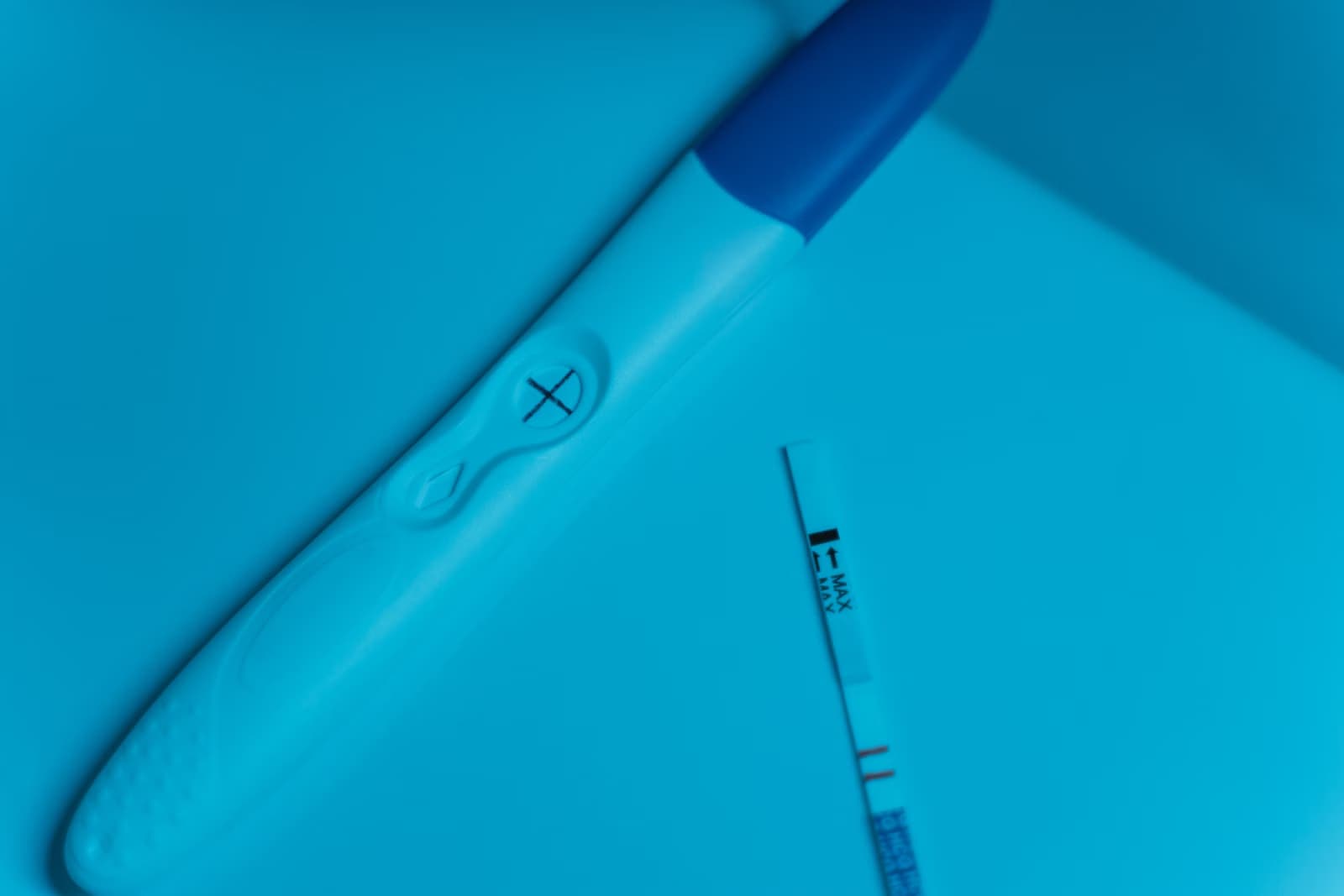
The control line (C) only shows the strip has worked; the test line (T) shows hCG.
| What you see | What it means | What to do |
|---|---|---|
| Two coloured lines, one perhaps faint | hCG detected: positive | Start folic acid; confirm with a doctor |
| One line at C only | No hCG detected: negative | If no period within 3–7 days, repeat |
| No line at C, or a line at T only | Invalid test | Repeat with a new strip |
| Colourless or grey line appearing after the reading window | Evaporation line, not a result | Ignore; retest in 2–3 days |
Faint line or evaporation line?
A faint but coloured test line inside the reading window is a positive; hCG is simply still low, and a repeat two or three days later should be darker. An evaporation line is different: as urine dries, a thin colourless or greyish mark can appear where the test line would be, but only after the reading window has closed. That is why the pack insists on reading at the stated time.
How accurate are home pregnancy tests, and what can go wrong?
Good evidence: MedlinePlus reports that urine tests are 97–99% accurate when done a week or two after a missed period, and the NHS says a positive result is almost certainly correct. Limited evidence: the “99% accurate” claim on boxes reflects ideal conditions; the Mayo Clinic notes that early detection varies between products. No evidence: home-made tests with toothpaste, sugar or salt.
Causes of a false negative
- Testing too early, before hCG is high enough: the most common cause.
- Dilute urine from drinking a lot.
- Reading before the stated time.
- An expired, damp or badly stored strip, or dipping beyond the marked line.
Causes of a false positive
- A very early pregnancy loss soon after implantation (a chemical pregnancy).
- A recent miscarriage or delivery, as hCG takes time to fall after any pregnancy ends.
- Fertility treatment with hCG injections (Mayo Clinic, MedlinePlus).
- Reading an evaporation line as positive.
What should I do after the result?
If the test is positive
- Start folic acid today. The NHS and CDC recommend 400 micrograms daily, ideally from before conception until at least 12 weeks, to prevent neural tube defects such as spina bifida; if you were not taking it, start as soon as you know. Folic acid tablets are listed under vitamins and supplements on MedEasy. Women with diabetes, on epilepsy medicines or with a history of neural tube defects need a 5 mg dose from a doctor.
- Book your first antenatal visit to confirm the pregnancy and due date. Our guide to first-trimester care and warning signs explains what to expect.
- Stop smoking and avoid alcohol completely.
- Review your medicines. Do not stop a prescribed medicine on your own, but tell your doctor or pharmacist you are pregnant so blood-pressure, epilepsy, acne and thyroid medicines can be checked; the NHS also advises avoiding vitamin A (retinol) supplements and cod liver oil.
If the test is negative but your period has not come
Wait 3–7 days and test again with first-morning urine. If it is negative again and your period still has not come, see a doctor: periods can be late because of stress, illness, weight change, breastfeeding, thyroid problems, polycystic ovary syndrome or stopping hormonal contraception.
When should I see a doctor or call 999?
A strip cannot detect an ectopic pregnancy, where the embryo implants outside the uterus, usually in a fallopian tube. The NHS says symptoms usually start between weeks 4 and 12: low tummy pain on one side, vaginal bleeding or brown watery discharge, pain in the tip of the shoulder, and discomfort when passing urine or stool. Call 999 or go to the nearest emergency department at once if a positive test or missed period comes with:
- sudden, sharp, severe pain in the lower abdomen
- dizziness or fainting
- feeling sick or looking very pale
- heavy bleeding
These can mean a ruptured tube, which needs urgent surgery. Also see a doctor within a day or two if a positive test comes with any bleeding or pain, if you became pregnant with an IUD in place or after fertility treatment, or if two tests are negative and your period is over a week late. You can book an online doctor consultation on MedEasy.
Blood test and ultrasound
A blood hCG test measures the exact hormone level and, repeated 48 hours apart, shows whether it is rising normally when ectopic pregnancy or miscarriage is suspected; an early ultrasound then confirms the pregnancy is inside the uterus. Neither is routine after a clear positive strip without symptoms.
Common beliefs and questions in Bangladesh
“You can test with toothpaste, sugar or salt.”
No. These kitchen tests have no evidence behind them: toothpaste foams whatever urine you add. Only a test that detects hCG can show pregnancy.
“A faint line means I am not pregnant.”
A faint coloured line within the reading window is a positive; it usually means you tested early. Repeat in two to three days.
“I can test the day after sex.”
No test can detect pregnancy that soon: implantation and the rise of hCG take time, so a test within days of sex is negative either way. Wait for the missed period, or 21 days after sex if your cycles are irregular. If you are worried about unprotected sex, emergency contraception within 72 hours (sooner is better) is far more useful than an early test.
“Drinking lots of water before testing makes the result clearer.”
The opposite is true: extra water dilutes the urine and lowers the hCG concentration, and can cause a false negative. Use first-morning urine.
References
- Doing a pregnancy test - NHS
- Pregnancy Test - MedlinePlus
- Home pregnancy tests: Can you trust the results? - Mayo Clinic
- Ectopic pregnancy - NHS
- Vitamins, supplements and nutrition in pregnancy - NHS
- About Folic Acid - CDC
This article is for general awareness and is not a substitute for advice from a doctor. The pregnancy test strips mentioned show only whether hCG is present and do not replace a consultation; a positive result, a negative result with a missed period, or any pain or bleeding should be discussed with a doctor. Contraception choices should be discussed with a doctor, pharmacist or family-planning worker.