
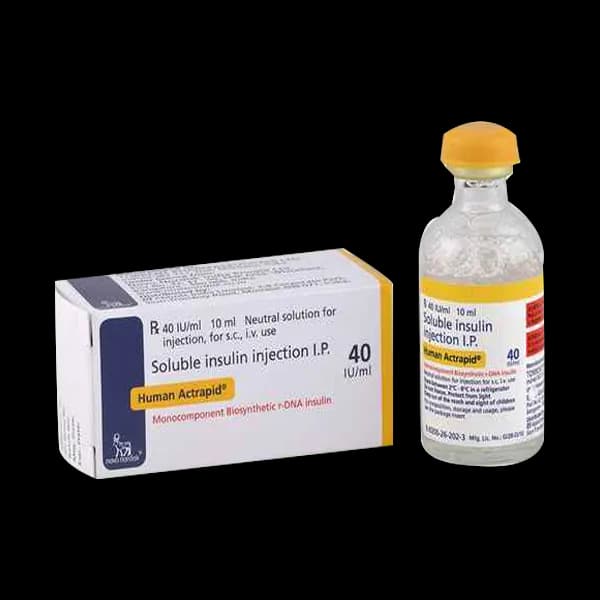

Medicine overview
Indications of Actrapid Vial
Actrapid Vial is a short-acting (regular) biosynthetic human insulin used to improve glycemic control in patients with diabetes mellitus.
Established / FDA-approved uses
- Type 1 diabetes mellitus - as part of a basal-bolus regimen, usually combined with an intermediate- or long-acting insulin.
- Type 2 diabetes mellitus - when oral antidiabetic agents and/or lifestyle measures fail to achieve adequate glycemic control, either alone or combined with other antidiabetic medicines.
Guideline-supported / hospital uses
- Diabetic ketoacidosis (DKA) and hyperosmolar hyperglycemic state - given intravenously under close medical supervision in a hospital setting.
- Perioperative and inpatient glycemic control - for patients with stress hyperglycemia, during surgery, or acute illness, including sliding-scale or IV infusion protocols.
- Gestational diabetes mellitus - when diet and exercise are insufficient to control blood glucose during pregnancy.
Use of Actrapid Vial always requires individualized dosing based on blood glucose monitoring under a physician's supervision.
Composition
Insulin Human [Fast-Acting] is biosynthetic human insulin produced by recombinant DNA technology, structurally identical to insulin secreted by the human pancreas.
It is typically supplied as a clear, colorless, aqueous solution for injection at a strength of 100 IU/mL (U-100), available in vials and/or cartridges/pens, depending on the marketed formulation.
Description
Actrapid Vial is a short-acting (also called "regular" or "soluble") human insulin. After subcutaneous injection its action begins within approximately 30 minutes, peaks between 2 and 4 hours, and lasts about 6 to 8 hours, though the exact profile varies between individuals.
Because of this relatively fast onset, Actrapid Vial is usually injected shortly before a meal to control the post-meal (post-prandial) rise in blood glucose, and can also be given intravenously in hospital settings such as diabetic ketoacidosis.
Therapeutic Class
Antidiabetic agent - Insulin (short-acting/regular human insulin); Actrapid Vial belongs to the class of human insulins used for glycemic control in diabetes mellitus.
Pharmacology
Mechanism of action: Insulin Human [Fast-Acting] binds to insulin receptors on target tissues (primarily skeletal muscle and adipose tissue), stimulating peripheral glucose uptake and utilization. It also inhibits hepatic glucose production (gluconeogenesis and glycogenolysis) and suppresses lipolysis and proteolysis, while promoting protein and glycogen synthesis. The net effect is a lowering of blood glucose concentration.
Pharmacokinetics
| Parameter | Approximate value (subcutaneous) |
|---|---|
| Onset of action | ~30 minutes |
| Peak effect | 2-4 hours |
| Duration of action | 6-8 hours |
The onset, peak, and duration of Insulin Human [Fast-Acting] can vary based on injection site, dose, blood flow, temperature, and individual patient factors.
Dosage & Administration of Actrapid Vial
Dosage of Actrapid Vial must be individualized by the treating physician based on blood glucose monitoring, metabolic needs, meal pattern, and activity level. It is not to be self-adjusted by the patient without medical guidance.
| Indication | Typical approach |
|---|---|
| Type 1 diabetes mellitus | Given subcutaneously as part of a multiple daily injection regimen, combined with an intermediate- or long-acting insulin; dose individualized by physician. |
| Type 2 diabetes mellitus | Individualized subcutaneous dosing, alone or combined with oral antidiabetic agents/other insulins, as directed by physician. |
| Diabetic ketoacidosis / hyperosmolar state | Given intravenously (as infusion or bolus) in a hospital setting, under close medical and laboratory monitoring; dose titrated to blood glucose response. |
| Pediatric patients | Individualized dosing with frequent blood glucose monitoring; safety and dosing require close physician supervision. |
Timing: When given subcutaneously, Actrapid Vial is typically injected approximately 30 minutes before a meal to match its onset of action with the post-meal glucose rise.
Important: Actrapid Vial must never be interchanged with other insulin products, brands, or concentrations unless specifically directed by a physician, as this can require a change in dose. Do not adjust the dose of Actrapid Vial on your own; any change should be made only under medical supervision.
Administration of Actrapid Vial
Actrapid Vial is usually given by subcutaneous injection into the abdomen, thigh, upper arm, or buttock. Injection sites should be rotated systematically within the same body region to reduce the risk of lipodystrophy (lumps or pitting of fat under the skin) and to ensure consistent absorption.
- Inject approximately 30 minutes before a meal unless the physician advises otherwise.
- Do not inject into skin that is bruised, scarred, inflamed, or has lipodystrophy.
- Actrapid Vial may also be given intravenously, but only by trained healthcare professionals in a monitored clinical setting (e.g., for diabetic ketoacidosis).
- Do not mix Actrapid Vial with insulin products other than as specifically directed by a physician or pharmacist, and always check the appearance of the solution (should be clear and colorless) before use.
- Never share needles, syringes, pens, or insulin vials/cartridges between patients, even if the needle is changed.
Interaction of Actrapid Vial
Several medicines can affect the blood-glucose-lowering effect of Actrapid Vial; dose adjustment and closer glucose monitoring may be needed when these are started or stopped.
Medicines that may increase the risk of hypoglycemia with Actrapid Vial
- Other antidiabetic agents (oral or injectable)
- ACE inhibitors and angiotensin II receptor blockers
- Fibrates, salicylates, and sulfonamide antibiotics
- Monoamine oxidase inhibitors (MAOIs)
- Alcohol
Medicines that may reduce the glucose-lowering effect of Actrapid Vial
- Corticosteroids, thiazide diuretics, thyroid hormones
- Estrogens and progestogens (e.g., in oral contraceptives)
- Protease inhibitors, some atypical antipsychotics
- Sympathomimetic agents (e.g., epinephrine, salbutamol)
Other important interactions
Beta-blockers, clonidine, and other sympatholytic drugs can blunt or mask the warning signs of hypoglycemia (such as tremor and palpitations), making low blood sugar harder to recognize.
Contraindications
Insulin Human [Fast-Acting] is contraindicated in:
- Patients with known hypersensitivity to insulin human or any excipient in the formulation.
- During episodes of hypoglycemia (low blood glucose).
Side Effects of Actrapid Vial
The most common and clinically important adverse reaction with Actrapid Vial is hypoglycemia, which can occur with any insulin therapy.
Common
- Hypoglycemia (sweating, tremor, palpitations, hunger, confusion; can be severe and lead to seizures or unconsciousness if untreated)
- Injection site reactions (redness, swelling, itching)
- Lipodystrophy at repeated injection sites
- Weight gain, mild peripheral edema
Less common / serious
- Hypersensitivity reactions, including rare anaphylaxis
- Hypokalemia (low blood potassium)
- Localized cutaneous amyloidosis at injection sites (with repeated use at the same site)
Pregnancy & Lactation
Pregnancy: Human insulin, including Actrapid Vial, does not cross the placenta in clinically significant amounts and is generally considered a preferred option for glycemic control during pregnancy when insulin therapy is required, since poorly controlled maternal diabetes carries risks to both mother and fetus. Insulin requirements often change during pregnancy (may decrease in the first trimester and increase later), so Actrapid Vial should be used only under close medical supervision, with the dose adjusted by a physician based on frequent blood glucose monitoring.
Lactation: Actrapid Vial may be used during breastfeeding under medical supervision; insulin needs may need adjustment during lactation. Mothers should be counseled on monitoring their own blood glucose and watching the infant for any signs of illness, and should consult a physician before use.
Precautions & Warnings
Hypoglycemia: As with all insulins, hypoglycemia is the most common and potentially serious risk of Actrapid Vial therapy (see Side Effects). Patients and caregivers should be educated to recognize early symptoms (sweating, shakiness, confusion, palpitations) and to treat promptly with fast-acting carbohydrate. Severe, unrecognized hypoglycemia can cause seizures, loss of consciousness, or be life-threatening.
Do not interchange insulin products: Actrapid Vial must not be substituted for another insulin product, brand, or concentration without a physician's explicit instruction, as this may require a change in dose.
Individualized, physician-directed dosing: The dose of Actrapid Vial must be determined and adjusted by a physician based on regular blood glucose monitoring. Patients should never change their own dose without medical advice.
Injection site rotation: Rotate injection sites within the same body region at each injection to reduce the risk of lipodystrophy and unpredictable absorption.
Hypokalemia: Actrapid Vial, particularly when given intravenously, can cause a shift of potassium into cells and lower blood potassium; this is monitored and corrected in hospital settings.
Factors affecting insulin needs: Illness (especially with vomiting or reduced oral intake), physical exercise, changes in diet, and alcohol intake can all significantly change insulin requirements with Actrapid Vial; patients should be counseled on adjusting monitoring frequency (not self-adjusting dose) during these situations and to seek medical advice.
Hypersensitivity: Discontinue and seek immediate medical attention if signs of a generalized allergic reaction (rash over the whole body, shortness of breath, wheezing, drop in blood pressure, fast heart rate, or sweating) occur.
Overdose Effects of Actrapid Vial
Excess doses of Actrapid Vial relative to food intake, physical activity, or metabolic need can cause hypoglycemia, and in significant overdose, hypokalemia.
- Mild-to-moderate hypoglycemia can usually be treated promptly with oral glucose or another fast-acting carbohydrate.
- Severe hypoglycemia (with confusion, seizures, or unconsciousness) is a medical emergency - seek immediate medical attention or contact emergency services; treatment typically requires glucagon injection or intravenous glucose administered by trained personnel, with monitoring for hypokalemia.
Do not attempt to manage a severe overdose or unconsciousness at home; always seek urgent professional medical care.
Storage Conditions
Unopened Actrapid Vial (vials, cartridges, or pens): Store refrigerated at 2-8°C. Do not freeze; discard if it has been frozen.
In-use (opened) Actrapid Vial: May be kept at room temperature (below 25-30°C, as specified on the product label), away from direct heat and light, and should generally be used within the period stated on the product labeling (commonly around 4 weeks) after opening, then discarded even if some solution remains.
Keep out of reach of children. Do not use if the solution appears cloudy, discolored, or contains particles - it should be clear and colorless.
Use In Special Populations
Renal impairment: Patients with kidney impairment may have reduced insulin clearance and an increased risk of hypoglycemia with Actrapid Vial; more frequent blood glucose monitoring and dose adjustment may be required.
Hepatic impairment: Patients with liver impairment may have reduced capacity for gluconeogenesis and an increased risk of hypoglycemia; closer monitoring is advised.
Elderly patients: May be at greater risk of hypoglycemia due to declining renal function, comorbidities, or reduced hypoglycemia awareness; conservative dose titration and close monitoring are recommended.
Pediatric patients: Actrapid Vial is approved for use in pediatric patients with diabetes mellitus requiring insulin, with dosing individualized and closely supervised (see Pediatric Uses).
Duration Of Treatment
Duration of treatment with Actrapid Vial depends on the underlying condition. In type 1 diabetes mellitus, insulin therapy including Actrapid Vial is typically lifelong. In type 2 diabetes mellitus, it may be used long-term or added/withdrawn as glycemic control needs change, at the physician's discretion. In hospital settings such as diabetic ketoacidosis or perioperative care, Actrapid Vial is used short-term until the acute condition resolves and glycemic control is transitioned to an outpatient regimen. In gestational diabetes, it is typically used only for the duration of the pregnancy, with reassessment postpartum. Treatment duration should always be determined by the treating physician.
Drug Classes
Insulins; Antidiabetic agents; Short-acting (regular/soluble) human insulin - Insulin Human [Fast-Acting] is classified within this drug class.
Mode Of Action
Insulin Human [Fast-Acting] acts by binding to insulin receptors on the surface of target cells (mainly in skeletal muscle, adipose tissue, and liver), triggering intracellular signaling (via the insulin receptor substrate/PI3K pathway) that promotes translocation of GLUT4 glucose transporters to the cell membrane. This increases cellular uptake of glucose, promotes glycogen synthesis, and inhibits hepatic gluconeogenesis and glycogenolysis, thereby lowering blood glucose concentration. It also has anabolic effects, promoting protein synthesis and inhibiting lipolysis and proteolysis.
Pregnancy
B (legacy FDA pregnancy category for regular human insulin)
Pediatric Uses
Actrapid Vial is indicated for use in pediatric patients with diabetes mellitus requiring insulin therapy. Dosage must be individualized based on the child's metabolic needs, body weight, diet, and activity level, with frequent blood glucose monitoring by a pediatric diabetes care team.
Children and their caregivers should receive thorough education on recognizing and treating hypoglycemia, proper injection technique, and site rotation. Safety and efficacy in very young children should be established and supervised by a pediatrician/endocrinologist, and dosing should never be adjusted by the child or caregiver without medical guidance.
Frequently Asked Questions
Q: What is Actrapid Vial 40IU/10 ml Vial used for?
A: Actrapid Vial 40IU/10 ml Vial is a short-acting (regular) human insulin used to control blood glucose levels in people with type 1 or type 2 diabetes mellitus, and in hospital settings such as diabetic ketoacidosis. It is usually combined with an intermediate- or long-acting insulin for full-day control.
Q: When should I inject Actrapid Vial 40IU/10 ml Vial relative to my meals?
A: Actrapid Vial 40IU/10 ml Vial is typically injected subcutaneously about 30 minutes before a meal, so that its glucose-lowering action matches the rise in blood sugar after eating. Always follow your physician's specific instructions on timing and dose.
Q: What is the biggest risk with Actrapid Vial 40IU/10 ml Vial?
A: The most important risk is hypoglycemia (low blood sugar), which can cause sweating, shakiness, confusion, and in severe cases seizures or unconsciousness. Learn to recognize early symptoms and always carry a fast-acting source of sugar. Severe hypoglycemia is a medical emergency requiring immediate attention.
Q: Can I switch between Actrapid Vial 40IU/10 ml Vial and another insulin brand on my own?
A: No. Actrapid Vial 40IU/10 ml Vial must never be interchanged with another insulin product, brand, or concentration without your physician's explicit guidance, because this can require a change in dose and increases the risk of dosing errors, hypoglycemia, or poor glucose control.
Q: How should I store Actrapid Vial 40IU/10 ml Vial?
A: Store unopened Actrapid Vial 40IU/10 ml Vial in the refrigerator (2-8°C) and do not freeze it. Once in use, it can generally be kept at room temperature away from heat and light and used within the period stated on the label (commonly about 4 weeks), then discarded. Keep it out of reach of children.
Q: Do I need to change my Actrapid Vial 40IU/10 ml Vial dose myself if I am sick, exercising, or drinking alcohol?
A: No, you should not change your dose on your own. Illness, exercise, and alcohol can all significantly change how much insulin your body needs, so monitor your blood glucose more closely in these situations and contact your physician for guidance on managing your Actrapid Vial 40IU/10 ml Vial dose.
Disclaimer
The information provided is accurate to the best of our knowledge, but it does not replace professional medical advice. We cannot guarantee its completeness or accuracy, and the absence of specific information about a drug should not be taken as an endorsement. We are not responsible for any consequences arising from this information, so please consult a healthcare professional for any concerns or questions.
