10% Off
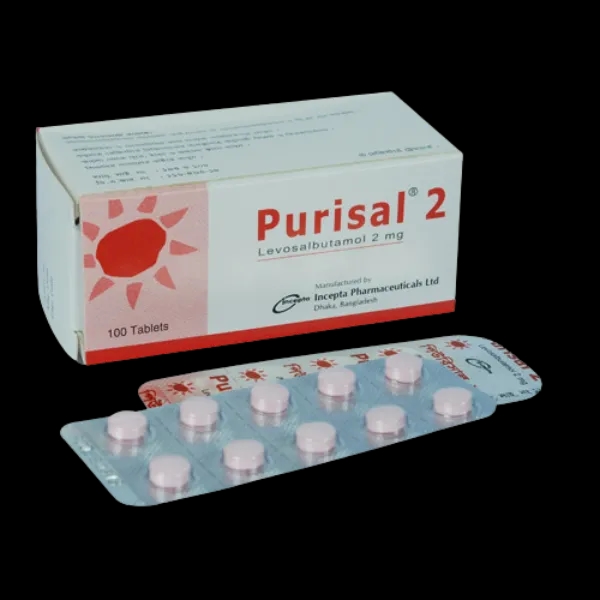
Purisal2 mg
Incepta Pharmaceuticals Ltd.
৳1.80
Add to cart


Aire 2 mg is a fast-acting bronchodilator used for the treatment and prevention of bronchospasm (narrowing of the airways) in adults, adolescents, and children 6 years of age and older who have reversible obstructive airway disease.
It is commonly prescribed for conditions in which the airways constrict and restrict airflow, including:
Aire 2 mg works by relaxing the smooth muscles surrounding the airways, making breathing easier. Medication should always be taken under the guidance of a registered physician.
Short-acting selective & β2-adrenoceptor stimulants
Aire 2 mg (also known as levalbuterol) is the pharmacologically active (R)-enantiomer of racemic salbutamol. It is a short-acting, selective beta₂-adrenoceptor agonist that differs from conventional racemic salbutamol by the elimination of the largely inactive (S)-salbutamol isomer.
By stimulating beta₂-adrenergic receptors in the smooth muscle of the bronchi, Aire 2 mg activates adenylyl cyclase, increasing intracellular cyclic adenosine monophosphate (cAMP). Elevated cAMP levels relax bronchial smooth muscle and inhibit the release of inflammatory mediators from mast cells, producing effective bronchodilation.
Because its primary mechanism of action is not impeded by the (S)-isomer, clinically comparable bronchodilation can be achieved at lower doses than with racemic salbutamol. This may substantially reduce beta-mediated side effects such as tremor and palpitations, while maintaining therapeutic efficacy.
After oral administration, Aire 2 mg is absorbed from the gastrointestinal tract, with the onset of bronchodilator effect typically occurring within minutes and a duration of action lasting several hours.
The dose of Aire 2 mg should be individualized according to the patient’s age, body weight, severity of symptoms, and clinical response. The following are general oral dosing guidelines; a registered physician’s advice should always be followed.
Aire 2 mg may be taken with or without food. Patients should not exceed the prescribed dose or frequency. If symptoms do not improve or worsen, medical advice should be sought promptly rather than increasing the dose independently.
Aire 2 mg may interact with several medicines, potentially altering its effect or increasing the risk of adverse reactions. Caution is advised when it is used together with:
Patients should inform their physician of all prescription drugs, over-the-counter medicines, and supplements they are taking.
Aire 2 mg is contraindicated in patients with a known history of hypersensitivity to Aire 2 mg, salbutamol, or any of the components of the formulation. Signs of an allergic reaction may include skin rash, itching, swelling, or difficulty breathing.
It should be used with particular care, or avoided, in individuals with severe hypersensitivity to sympathomimetic amines. Any previous adverse or allergic reaction to a bronchodilator should be reported to the physician before treatment.
Like all medicines, Aire 2 mg can cause side effects, although not everyone experiences them. Most effects are related to its beta-adrenergic stimulating action and are usually mild and transient.
Commonly reported side effects include:
Rarely, high doses may cause hypokalaemia (low potassium), dizziness, or cardiac rhythm disturbances. Patients should seek prompt medical attention if they experience severe palpitations, chest pain, or signs of an allergic reaction.
Pregnancy: The safety of Aire 2 mg during pregnancy has not been fully established. It should be used during pregnancy only if the potential benefit to the mother clearly justifies the potential risk to the fetus. A physician should assess the risk-benefit balance before prescribing.
Lactation: It is not known whether Aire 2 mg is excreted in human breast milk. Because many drugs pass into breast milk, caution should be exercised when oral Aire 2 mg is administered to a nursing mother. A physician should be consulted before use during breastfeeding.
Aire 2 mg should be used with caution in patients with certain underlying conditions. A physician should be informed of any pre-existing medical problems before starting treatment.
Particular caution is advised in the following situations:
Patients whose symptoms are not adequately controlled, or who need increasing doses, should be reassessed by a physician, as this may indicate worsening of the underlying condition requiring a change in therapy.
Overdosage of Aire 2 mg typically produces symptoms of excessive beta-adrenergic stimulation, which are an exaggeration of the usual side effects. These may include marked palpitations, rapid heartbeat, pronounced tremor, headache, agitation, hypokalaemia (low potassium), and hyperglycaemia (raised blood sugar).
In the event of suspected overdose, medical help should be sought immediately. Management is generally supportive. In cases of serious poisoning, the stomach may be emptied, and if necessary a cardioselective beta-blocker may be administered — but with caution in patients with a history of bronchospasm, as it may provoke airway narrowing. Serum potassium levels should be monitored.
Store in a cool, dry place, protected from light, below 30°C. Keep the medicine in its original container, tightly closed. Do not use after the expiry date printed on the packaging.
Keep all medicines out of the reach of children.
Paediatric use: Aire 2 mg is not recommended for children under 6 years of age, as safety and efficacy have not been established in this group. In children 6 years and older, the dose should be adjusted according to age and monitored by a physician.
Elderly patients: Older adults may be more sensitive to the cardiovascular and metabolic effects of beta₂-agonists. A lower starting dose and careful monitoring are advisable.
Hepatic and renal impairment: Caution is advised in patients with significant liver or kidney impairment, and dosing should be supervised by a physician.
What is Aire 2 mg used for?
Aire 2 mg is a fast-acting bronchodilator used for the treatment and prevention of bronchospasm (narrowing of the airways) in adults, adolescents, and children 6 years of age and older who have reversible obstructive airway disease. It is commonly prescribed for conditions in which the airways constrict and restrict airflow, including: Bronchial asthma – to relieve wheezing, breathlessness, chest …
What is the dosage of Aire 2 mg?
The dose of Aire 2 mg should be individualized according to the patients age, body weight, severity of symptoms, and clinical response. The following are general oral dosing guidelines; a registered physicians advice should always be followed. Formulation Age Group Recommended Dose Tablet Adults & adolescents above 12 years 1–2 mg three times daily Tablet Children (6–11 years) 1 mg three times dai…
What are the side effects of Aire 2 mg?
Like all medicines, Aire 2 mg can cause side effects, although not everyone experiences them. Most effects are related to its beta-adrenergic stimulating action and are usually mild and transient. Commonly reported side effects include: Palpitations and increased heart rate Fine tremor of the skeletal muscle, particularly in the hands Muscle cramps Hypocalcaemia (low blood calcium) Nausea and vomi…
Who should not take Aire 2 mg?
Aire 2 mg is contraindicated in patients with a known history of hypersensitivity to Aire 2 mg, salbutamol, or any of the components of the formulation. Signs of an allergic reaction may include skin rash, itching, swelling, or difficulty breathing. It should be used with particular care, or avoided, in individuals with severe hypersensitivity to sympathomimetic amines. Any previous adverse or all…
What precautions should be taken with Aire 2 mg?
Aire 2 mg should be used with caution in patients with certain underlying conditions. A physician should be informed of any pre-existing medical problems before starting treatment. Particular caution is advised in the following situations: Acute severe asthma – the potassium-lowering effect may be potentiated by hypoxia and by concomitant treatment with xanthine derivatives, steroids, and diuretic…
Is Aire 2 mg safe during pregnancy and breastfeeding?
Pregnancy: The safety of Aire 2 mg during pregnancy has not been fully established. It should be used during pregnancy only if the potential benefit to the mother clearly justifies the potential risk to the fetus. A physician should assess the risk-benefit balance before prescribing. Lactation: It is not known whether Aire 2 mg is excreted in human breast milk. Because many drugs pass into breast …
The information provided is accurate to our best practices, but it does not replace professional medical advice. We cannot guarantee its completeness or accuracy. The absence of specific information about a drug should not be seen as an endorsement. We are not responsible for any consequences resulting from this information, so consult a healthcare professional for any concerns or questions.