

10% Off
Asynta500 mg+100
Square Pharmaceuticals PLC.
৳4.50
Add to cart
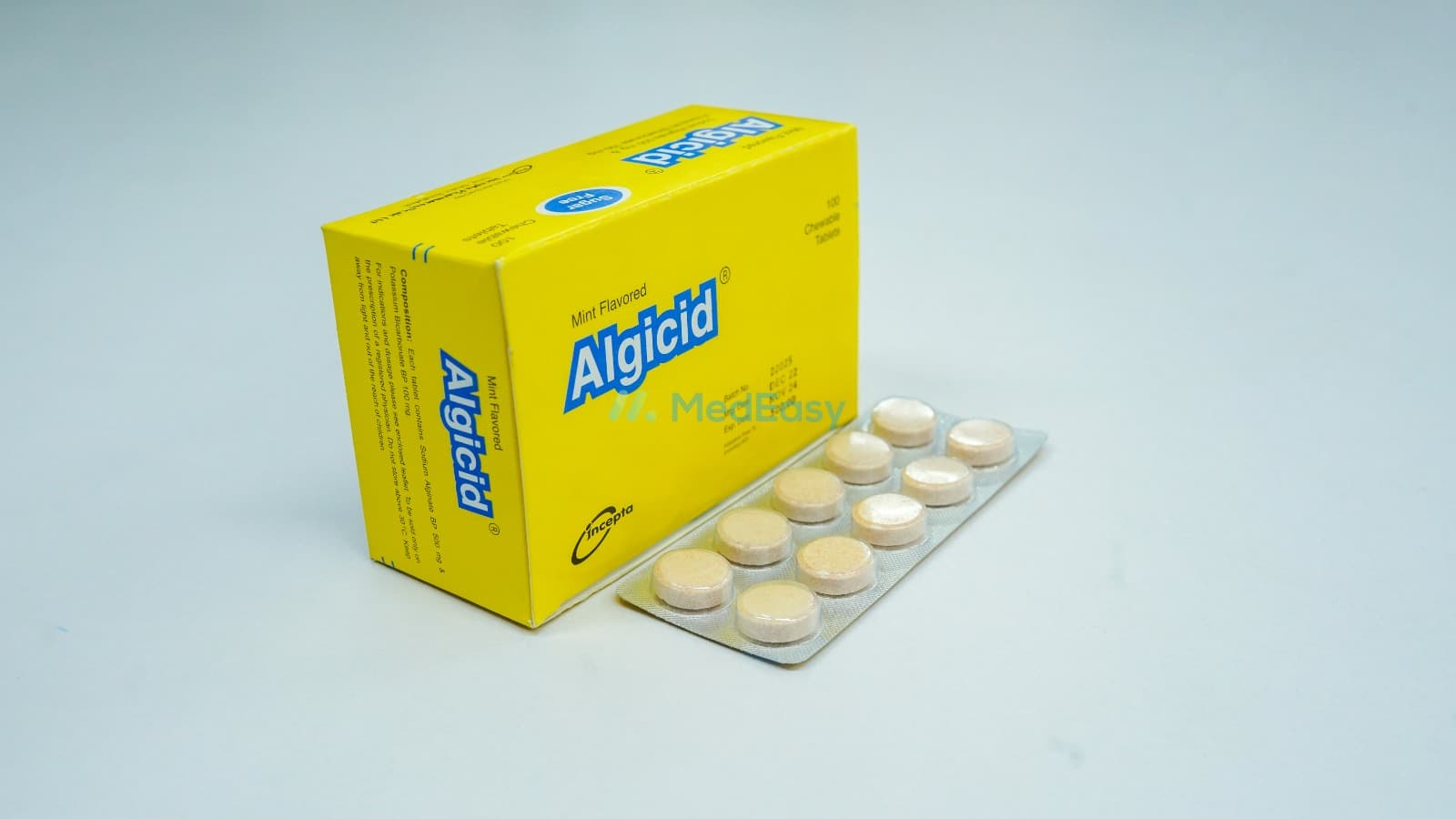

Algicid is indicated for the symptomatic relief of conditions associated with gastro-oesophageal reflux, such as heartburn and acid regurgitation, particularly when these occur secondary to reflux of stomach acid, bile, and pepsin into the oesophagus.
Algicid provides short-term symptomatic relief and is not a substitute for medical evaluation. If symptoms are severe, persistent beyond 7 days, or associated with alarm features such as unintentional weight loss, difficulty swallowing (dysphagia), vomiting blood, or black/tarry stools (suggesting gastrointestinal bleeding), a physician should be consulted promptly for further investigation.
Each unit of Sodium Alginate + Potassium Bicarbonate typically contains Sodium Alginate and Potassium Bicarbonate in a fixed-dose combination, commonly formulated as approximately 500 mg Sodium Alginate with 100 mg Potassium Bicarbonate per tablet or per 5 mL of oral suspension. Exact strengths vary by brand and dosage form; always check the product label for the specific composition dispensed.
Algicid is a fixed-dose combination antacid preparation belonging to the alginate-based, raft-forming class of gastro-oesophageal reflux therapies. Unlike conventional antacids that simply neutralise stomach acid, Algicid works through a distinct physical mechanism: upon contact with gastric acid, the alginate component forms a viscous gel that is converted into a floating, foam-like "raft" by carbon dioxide bubbles generated from the bicarbonate component.
This raft floats on top of the stomach contents, at the gastro-oesophageal junction, acting as a mechanical barrier that reduces the reflux of acid, bile, and pepsin into the oesophagus. Algicid is available as chewable tablets and oral suspension, and is widely used for the short-term relief of heartburn, acid regurgitation, and indigestion, including reflux symptoms occurring during pregnancy.
Algicid belongs to the therapeutic class of antacids and alginate-based anti-reflux (raft-forming) agents, used for the symptomatic management of gastro-oesophageal reflux disease and related upper gastrointestinal symptoms.
Sodium Alginate + Potassium Bicarbonate acts through a physical, non-systemic mechanism rather than classical acid neutralisation or acid-secretion inhibition.
Sodium Alginate + Potassium Bicarbonate acts locally within the gastrointestinal tract; systemic absorption of the alginate component is minimal, and its effect is largely mechanical/physical rather than pharmacological in the systemic sense. The protective raft generally persists for several hours before being gradually broken down and cleared from the stomach.
| Population | Formulation | Typical Dose |
|---|---|---|
| Adults and children over 12 years | Chewable tablet | 1-2 tablets, chewed thoroughly, 3-4 times daily after meals and at bedtime |
| Adults and children over 12 years | Oral suspension | 5-10 mL, 3-4 times daily after meals and at bedtime |
| Children 6-12 years | Chewable tablet | ½-1 tablet, 3-4 times daily after meals and at bedtime |
| Children 2-12 years | Oral suspension | 2.5-5 mL, 3-4 times daily after meals and at bedtime |
| Children under 2 years | Any | Not recommended; safety and efficacy not established |
No dose adjustment is required in hepatic impairment or in the elderly. In renal impairment, Algicid should be used with caution, particularly in patients on a restricted-salt or restricted-potassium diet, due to its sodium and potassium content (see Precautions and Warnings).
Algicid chewable tablets should be chewed thoroughly before swallowing. The oral suspension should be shaken well before each dose and measured using an appropriate measuring device. Algicid is best taken after meals and at bedtime, and should be separated by at least 2 hours from other oral medicines to avoid reduced absorption of those medicines.
Algicid can physically bind to or coat certain co-administered oral drugs in the gastrointestinal tract, or alter local gastric pH, thereby reducing their absorption and clinical effectiveness.
Recommendation: Separate administration of Algicid from other oral medicines by at least 2 hours, whenever possible, to minimise the risk of reduced drug absorption.
Sodium Alginate + Potassium Bicarbonate is contraindicated in patients with known hypersensitivity to sodium alginate, potassium bicarbonate, or any excipient of the specific formulation.
Algicid is generally well tolerated. Reported adverse effects are usually mild and infrequent.
Patients should seek medical advice if side effects are severe or persistent.
Pregnancy: Algicid may be used during pregnancy for the relief of reflux symptoms when clinically indicated, as it is believed to act largely locally within the gastrointestinal tract with minimal systemic absorption. However, as with any medicine in pregnancy, it should be used only if clearly needed, at the lowest effective dose, and after consultation with a physician, since comprehensive controlled safety data are limited.
Lactation: Algicid is generally considered compatible with breastfeeding, with no known adverse effects reported in breastfed infants, given its predominantly local, non-systemic action. Nonetheless, a physician or pharmacist should be consulted before use during breastfeeding, particularly with prolonged or frequent use.
Algicid should be used with caution in the following situations:
Overdose with Algicid is rare given its physical, largely non-systemic mechanism of action. Excessive intake may cause an exaggerated bloating or abdominal distension sensation due to excess carbon dioxide/gel formation, and theoretically could contribute to sodium or potassium imbalance in susceptible individuals (e.g. significant renal impairment) with very high or prolonged overuse. If overdose is suspected, seek immediate medical attention or contact a poison control center; do not attempt specific home treatment.
Store at room temperature (below 30°C), away from light and moisture. Keep out of reach of children.
Algicid is not recommended for children under 2 years of age, as safety and efficacy have not been established in this age group. Reduced doses are used for children aged 2-12 years, based on formulation (see Dosage and Administration). Children over 12 years may use adult dosing.
No dose adjustment of Algicid is required in elderly patients based on age alone; however, elderly patients frequently have coexisting renal impairment or are on multiple medications, so caution regarding drug interactions and renal function is advised.
Use Algicid with caution in patients with significant renal impairment, particularly those on a restricted-salt diet, due to the sodium and potassium content of the combination (see Precautions and Warnings).
No dose adjustment of Algicid is required in hepatic impairment.
Algicid is generally intended for short-term, as-needed symptomatic relief. If symptoms do not improve or continue to recur after 7 days of regular use, treatment should be reviewed by a physician to exclude other underlying causes and to consider alternative or additional therapy.
Antacid; Alginate-based raft-forming anti-reflux agent
Sodium Alginate + Potassium Bicarbonate works by a physical raft-forming mechanism: sodium alginate reacts with gastric acid to form a gel, while potassium bicarbonate releases carbon dioxide that becomes trapped within this gel, causing it to float as a protective "raft" over the stomach contents at the gastro-oesophageal junction, mechanically reducing reflux of acid, bile, and pepsin into the oesophagus.
Algicid may be used in children aged 2 years and above for symptomatic relief of reflux-related heartburn and indigestion, using age-appropriate reduced doses of the oral suspension or chewable tablet formulation (see Dosage and Administration). Algicid is not recommended for children under 2 years of age, as safety and efficacy have not been established in this age group. Parents should consult a physician before use in young children, especially if symptoms are frequent, severe, or associated with poor feeding or growth.
Q: What is Algicid 500 mg+100 mg Chewable Tablet used for?
A: Algicid 500 mg+100 mg Chewable Tablet is used to relieve symptoms of acid reflux, heartburn, acid regurgitation, and indigestion, including symptoms related to gastro-oesophageal reflux disease (GERD), hiatus hernia, and reflux occurring during pregnancy.
Q: How does Algicid 500 mg+100 mg Chewable Tablet work?
A: Algicid 500 mg+100 mg Chewable Tablet works differently from typical antacids. When it reaches the stomach, the alginate component reacts with stomach acid to form a gel, and the potassium bicarbonate component releases carbon dioxide gas that gets trapped inside this gel. This creates a floating "raft" that sits on top of the stomach contents and physically blocks acid, bile, and pepsin from flowing back into the oesophagus.
Q: When should I take Algicid 500 mg+100 mg Chewable Tablet?
A: Algicid 500 mg+100 mg Chewable Tablet is typically taken after meals and at bedtime, 3-4 times daily, since the raft works best when there is food in the stomach for it to float on. Chewable tablets should be chewed thoroughly, and the suspension should be shaken well before use.
Q: Can I take Algicid 500 mg+100 mg Chewable Tablet with my other medicines?
A: Algicid 500 mg+100 mg Chewable Tablet can reduce the absorption of certain other medicines, including tetracycline and fluoroquinolone antibiotics, iron supplements, thyroid hormone (levothyroxine), chloroquine, bisphosphonates, and estramustine. It is recommended to separate Algicid 500 mg+100 mg Chewable Tablet from other oral medicines by at least 2 hours to avoid this interaction.
Q: Is Algicid 500 mg+100 mg Chewable Tablet safe during pregnancy and breastfeeding?
A: Algicid 500 mg+100 mg Chewable Tablet may be used during pregnancy and breastfeeding if clinically needed, since it acts mainly locally in the stomach with minimal systemic absorption. However, it should only be used after consulting a physician, and at the lowest effective dose, as with any medicine used during pregnancy or lactation.
Q: What are the side effects of Algicid 500 mg+100 mg Chewable Tablet?
A: Algicid 500 mg+100 mg Chewable Tablet is generally well tolerated. Possible side effects include nausea, constipation, diarrhoea, headache, and a bloating or fullness sensation, especially with higher-than-recommended doses. Side effects are usually mild; seek medical advice if they are severe or persistent.
Q: When should I see a doctor instead of just taking Algicid 500 mg+100 mg Chewable Tablet?
A: You should see a doctor if your symptoms persist beyond 7 days, keep coming back, or are accompanied by warning signs such as unintentional weight loss, difficulty swallowing, vomiting blood, or black/tarry stools, as Algicid 500 mg+100 mg Chewable Tablet only relieves symptoms and does not treat underlying causes that may need further evaluation.
Disclaimer
The information provided is accurate to the best of our knowledge, but it does not replace professional medical advice. We cannot guarantee its completeness or accuracy, and the absence of specific information about a drug should not be taken as an endorsement. We are not responsible for any consequences arising from this information, so please consult a healthcare professional for any concerns or questions.
