
8% Off
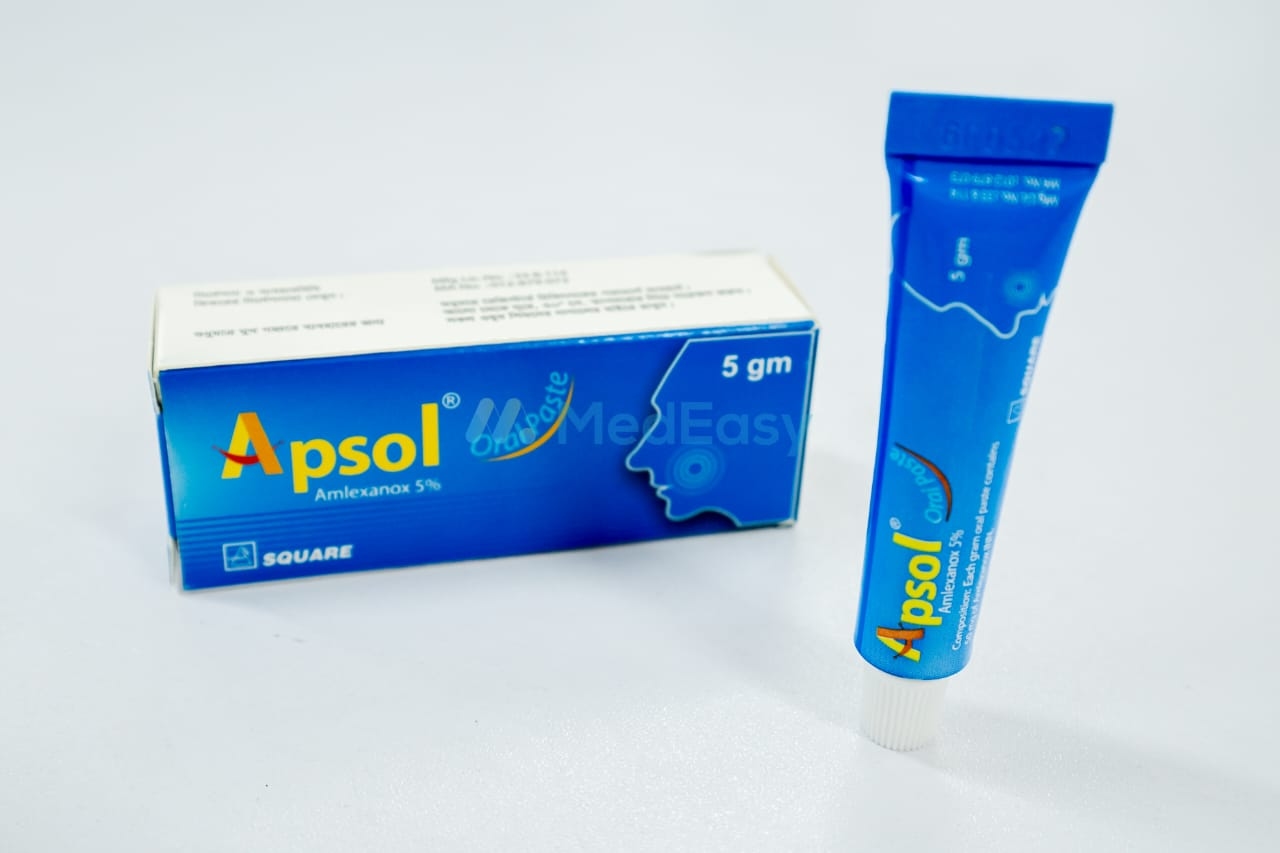
Apsol5%
Square Pharmaceuticals PLC.
৳73.60
Add to cart


Amlex (as a 5% oromucosal paste) is an FDA-approved, evidence-based topical treatment with the following indications:
Amlex paste is not intended for ulcers caused by other conditions (e.g., herpes, trauma, systemic disease); a physician should evaluate ulcers that are unusually large, persistent, or recurrent.
Each gram of Amlexanox oral paste contains Amlexanox 50 mg (5% w/w) in an adhering oromucosal paste base.
In markets where an oral tablet form of Amlexanox exists, tablets typically contain Amlexanox 25 mg or 50 mg per tablet; this formulation is not the standard marketed form in Bangladesh.
Amlex is a synthetic anti-inflammatory and anti-allergic agent chemically classed as an aminoxanthone (anthranilic acid derivative). It is most widely used and marketed as a 5% topical oromucosal (oral) paste for the treatment of aphthous ulcers (canker sores).
Unlike systemic corticosteroids or antibiotics, Amlex acts locally at the site of application with limited systemic absorption when used as directed. It is not an antibiotic and has no antimicrobial action; it works by modulating local inflammatory and immune mediator release at the ulcer site.
Topical anti-inflammatory / anti-allergic agent for oral mucosal ulcers (oromucosal paste)
Amlexanox inhibits the release of pre-formed inflammatory and allergic mediators, including histamine and leukotrienes (e.g., LTC4), from mast cells and other inflammatory cells at the site of the ulcer. It also inhibits the production of certain pro-inflammatory cytokines (such as IL-4 and TNF-alpha) at the local tissue level.
The exact mechanism by which this translates into faster healing and pain reduction of aphthous ulcers is not completely established, but its local anti-inflammatory and mast-cell-stabilizing action is believed to reduce local tissue inflammation, thereby reducing pain and promoting faster ulcer resolution.
When applied topically to the oral mucosa as directed, systemic absorption of Amlexanox is minimal. Any small amount absorbed is metabolized in the liver and excreted mainly via the kidneys.
| Indication | Population | Recommended Dose |
|---|---|---|
| Aphthous ulcers (canker sores) | Adults and adolescents (established use) | Apply approximately a 1/4-inch (0.6 cm) strip of 5% Amlex paste directly onto each ulcer 4 times daily, after oral hygiene (e.g., after breakfast, lunch, dinner, and at bedtime), starting as soon as symptoms/lesions are noticed. |
| Aphthous ulcers (canker sores) | Children under 6 years | Safety and efficacy not established (see Use in Special Populations). |
No specific dose adjustment is established for topical Amlex given its minimal systemic absorption; formal studies in renal or hepatic impairment have not been conducted.
Continue application until the ulcer heals. If healing has not occurred within 10 days of starting Amlex, discontinue use and consult a physician or dentist.
For topical (oromucosal) use only. Not for ophthalmic, injectable, or oral (swallowed) use unless a physician has specifically prescribed a tablet form.
Because Amlex oral paste is applied topically and has minimal systemic absorption, clinically significant drug-drug interactions are not well established or expected.
Amlexanox oral paste is contraindicated in patients with known hypersensitivity to Amlexanox or to any other component of the paste formulation.
Local application-site reactions are the most common side effects of Amlex and are generally mild and transient.
Recurrent, unusually severe, or persistent mouth ulcers that do not respond to Amlex within 10 days should be evaluated by a physician or dentist to exclude other underlying causes.
Pregnancy: Human data on the use of Amlex in pregnancy are limited. Animal reproduction studies with Amlex have not shown adverse fetal effects at doses substantially higher than the human topical exposure, but adequate, well-controlled studies in pregnant women are lacking. Amlex should be used during pregnancy only if clearly needed, and only after consulting a physician who can weigh the potential benefit against any potential risk.
Lactation: It is not known whether topically applied Amlex passes into human breast milk in clinically relevant amounts. Because many drugs are excreted in human milk, caution is advised, and a physician should be consulted before using Amlex while breastfeeding.
Topical overdose with Amlex paste is unlikely given the small quantities used per application and minimal systemic absorption. Applying excessive amounts may increase the likelihood of local irritation, stinging, or mucosal reaction at the application site but is not expected to cause systemic toxicity.
If Amlex paste is accidentally swallowed in a large quantity, or if any signs of a serious reaction occur, seek immediate medical attention or contact a poison control center/emergency services rather than attempting home treatment.
Store at room temperature (below 30°C), away from light and moisture. Keep the tube tightly closed and out of the reach of children.
The safety and efficacy of Amlex oral paste have not been established in children under 6 years of age. Use in this age group should only occur under medical supervision.
No specific dose adjustment is required for elderly patients using topical Amlex; clinical experience has not identified age-specific safety concerns distinct from the general adult population.
Formal studies of Amlex in patients with renal or hepatic impairment have not been conducted; given minimal systemic absorption with topical use, specific dose adjustment is not established as necessary.
Amlex has been studied primarily in patients with a normal immune system; patients who are immunocompromised should consult a physician before use (see Precautions and Warnings).
Apply Amlex paste starting at the first sign of an aphthous ulcer and continue 4 times daily until the ulcer has healed. If there is no improvement or healing within 10 days of starting Amlex, discontinue use and consult a physician or dentist to rule out other causes.
Topical anti-inflammatory/anti-allergic agent (aminoxanthone/anthranilic acid derivative); oromucosal preparation
Amlexanox works locally by inhibiting the release of histamine and leukotrienes from mast cells and other inflammatory cells, and by suppressing local production of certain pro-inflammatory cytokines, at the site of the aphthous ulcer. This local anti-inflammatory and mast-cell-stabilizing action is believed to reduce pain and promote faster healing of the ulcer.
B
The safety and efficacy of Amlex oral paste have not been established in children under 6 years of age. In older children and adolescents in whom aphthous ulcers occur, use of Amlex should be under the guidance of a physician or dentist, following the same application instructions as for adults (a 1/4-inch strip applied to each ulcer 4 times daily). Parents/caregivers should supervise application to avoid swallowing of the paste.
Q: What is Amlex 5% Oral Paste oral paste used for?
A: Amlex 5% Oral Paste oral paste is used to treat aphthous ulcers, commonly known as canker sores, inside the mouth. Applying Amlex 5% Oral Paste at the first sign of an ulcer can help reduce pain and speed up healing.
Q: How do I apply Amlex 5% Oral Paste paste correctly?
A: Gently dry the ulcer with a clean tissue, then use a clean fingertip or cotton swab to apply a small (about 1/4-inch) dab of Amlex 5% Oral Paste paste directly onto the ulcer, 4 times a day (after meals and at bedtime), without rubbing it in. Wash your hands before and after application.
Q: Can I use Amlex 5% Oral Paste during pregnancy or while breastfeeding?
A: Data on Amlex 5% Oral Paste use in pregnancy and breastfeeding are limited. Amlex 5% Oral Paste should be used during pregnancy or lactation only if clearly needed, and only after discussing the potential benefits and risks with your physician.
Q: What are the common side effects of Amlex 5% Oral Paste?
A: The most common side effect of Amlex 5% Oral Paste is a mild, transient stinging or burning sensation at the application site, occurring in about 1-2% of users. Less commonly, local irritation, nausea, or diarrhea may occur. Serious allergic reactions are rare but require immediate discontinuation of Amlex 5% Oral Paste and medical attention.
Q: Who should not use Amlex 5% Oral Paste?
A: Amlex 5% Oral Paste should not be used by anyone with a known hypersensitivity (allergy) to Amlex 5% Oral Paste or to any other ingredient in the paste. This is the only true absolute contraindication.
Q: What should I do if my ulcer does not heal after using Amlex 5% Oral Paste?
A: If your ulcer has not healed within 10 days of starting Amlex 5% Oral Paste, or if it becomes unusually severe, large, or is accompanied by fever or other symptoms, stop using Amlex 5% Oral Paste and consult a physician or dentist, since these features may indicate a cause other than a simple aphthous ulcer.
Disclaimer
The information provided is accurate to the best of our knowledge, but it does not replace professional medical advice. We cannot guarantee its completeness or accuracy, and the absence of specific information about a drug should not be taken as an endorsement. We are not responsible for any consequences arising from this information, so please consult a healthcare professional for any concerns or questions.

