
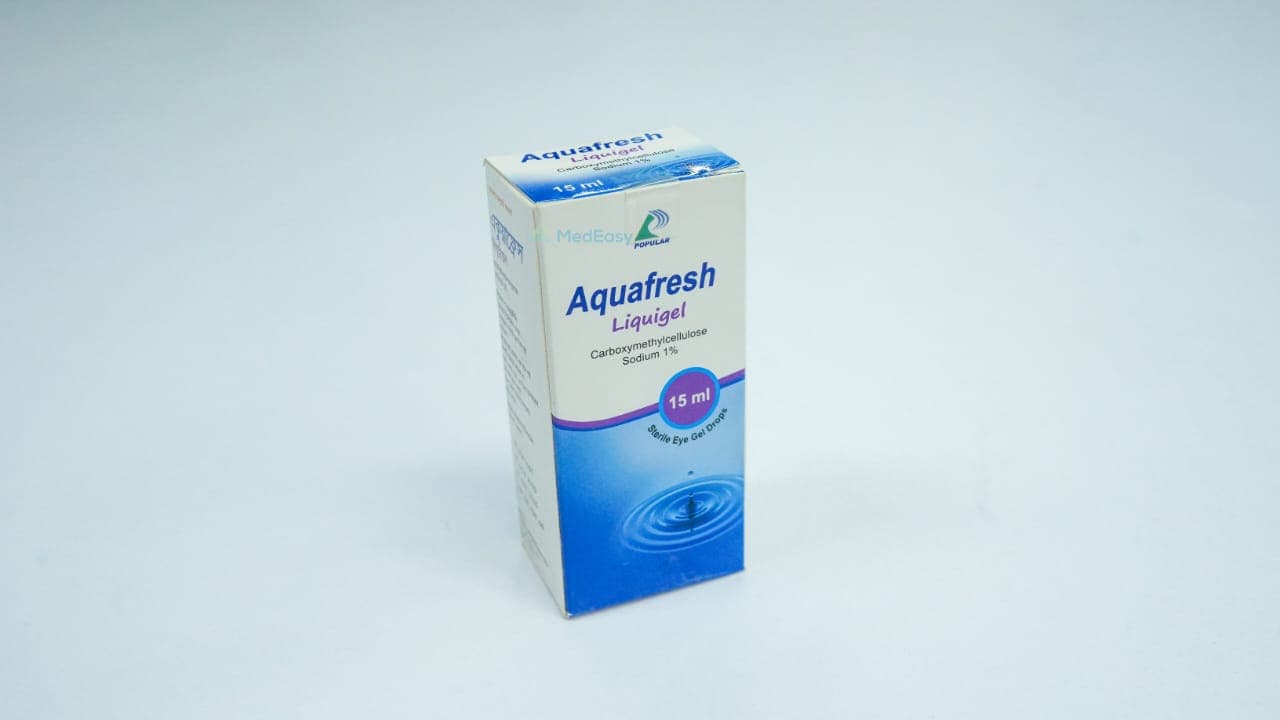

Medicine overview
Indications of Aquafresh
Ophthalmic Lubricant (Artificial Tears)
Aquafresh is indicated for the temporary relief of burning, irritation, and discomfort due to dryness of the eye, and for relief of symptoms caused by minor irritation to the eye or exposure to wind or sun. It acts as a protectant against further irritation.
Bulk-Forming Laxative (Oral Formulations)
In certain oral products, Aquafresh is used as a bulk-forming agent for the short-term relief of occasional constipation.
Wound Care
Aquafresh is also used as an ingredient in certain hydrofiber/hydrogel wound dressings to help maintain a moist wound environment and absorb exudate, as an adjunct to standard care for moderately to heavily exuding wounds (e.g., pressure ulcers, venous leg ulcers) under professional supervision.
Note: Not all formulations of Aquafresh are indicated for all of the above uses; the specific indication depends on the dosage form dispensed (ophthalmic solution, oral powder/tablet, or topical wound dressing).
Composition
Formulations of Carboxymethyl Cellulose Sodium vary by strength and dosage form:
- Ophthalmic solution: Carboxymethyl Cellulose Sodium 0.25% to 1% w/v, as sterile eye drops with or without preservative.
- Oral formulations: Carboxymethyl Cellulose Sodium as a bulk-forming fiber ingredient in powder, tablet, or granule form.
- Topical wound dressings: Carboxymethyl Cellulose Sodium fiber incorporated into a hydrofiber or hydrogel dressing pad.
Refer to the specific product label for exact strength and inactive ingredients (e.g., preservatives such as benzalkonium chloride, buffering and tonicity agents) contained in the dispensed product.
Description
Aquafresh is a water-soluble cellulose derivative widely used in pharmaceutical products as a viscosity-increasing agent, lubricant, and demulcent. It is most commonly formulated as an over-the-counter ophthalmic lubricant (artificial tears) to relieve dryness, irritation, and discomfort of the eyes. It is also used in some oral bulk-laxative products and in specialized topical wound-care dressings. Aquafresh is not significantly absorbed systemically when used as labeled and acts primarily through local, physical mechanisms.
Therapeutic Class
Aquafresh belongs to the therapeutic class of ophthalmic lubricants and demulcents (artificial tear substitutes). Depending on the formulation, it may also be classified under bulk-forming laxatives (oral use) or wound-care dressings (topical use).
Pharmacology
Carboxymethyl Cellulose Sodium is a hydrophilic, high-molecular-weight cellulose polymer. When instilled in the eye, it increases tear film viscosity, prolongs ocular surface contact time, and forms a lubricating, protective layer over the cornea and conjunctiva, reducing friction and relieving symptoms of dryness and irritation. It has no receptor-mediated pharmacologic activity; its effect is physical/mechanical.
When used orally as a bulk-forming agent, Carboxymethyl Cellulose Sodium absorbs water in the intestine, increasing stool bulk and softness and stimulating peristalsis. In topical wound dressings, it absorbs exudate and forms a moist, gel-like matrix supporting the wound-healing environment.
Pharmacokinetics: Carboxymethyl Cellulose Sodium is not appreciably absorbed into the systemic circulation from the eye, gastrointestinal tract, or wound surface when used as directed, and therefore has minimal systemic pharmacokinetic profile.
Dosage & Administration of Aquafresh
Ophthalmic Use
| Population | Dose |
|---|---|
| Adults and children ≥ 2 years (per product labeling) | Instill 1-2 drops of Aquafresh ophthalmic solution into the affected eye(s) as needed, up to the frequency stated on the product label (commonly up to 4 times daily; more often for preservative-free single-use formulations). |
Oral Bulk-Forming Laxative Use
Follow the specific product labeling; typically taken with a full glass of water, once to several times daily as needed for occasional constipation, not exceeding the maximum labeled duration without medical advice.
Topical Wound Dressing Use
Applied directly to the wound bed by, or under the guidance of, a healthcare professional; dressing change frequency is determined by exudate amount and clinical assessment.
See Contraindications and Precautions and Warnings for details relevant to each route of administration.
Administration of Aquafresh
For ophthalmic use, tilt the head back, pull down the lower eyelid to form a pouch, instill the drop(s) of Aquafresh, and close the eye gently for 1-2 minutes without excessive blinking. Avoid touching the dropper tip to the eye or any other surface to prevent contamination. For oral use, take with a full glass of water as directed on the product label. For wound-dressing use, application should be performed by, or under the supervision of, a qualified healthcare professional using aseptic technique.
Interaction of Aquafresh
No clinically significant systemic drug-drug interactions are well established for Aquafresh, as it is not systemically absorbed when used as labeled.
For ophthalmic use, when more than one topical eye medication is used, other eye drops or ointments should generally be administered at least 5-10 minutes apart from Aquafresh to prevent one product from washing out another and to allow adequate ocular contact time for each product.
Contraindications
Carboxymethyl Cellulose Sodium is contraindicated in individuals with known hypersensitivity to Carboxymethyl Cellulose Sodium or to any other component of the specific formulation being used.
Side Effects of Aquafresh
Adverse effects associated with Aquafresh are generally mild and localized:
- Temporary blurred vision immediately after ophthalmic instillation
- Mild ocular stinging, burning, irritation, or a foreign-body sensation
- Eye redness or watering
- Rarely, hypersensitivity reactions (eyelid swelling, itching, or rash) in predisposed individuals
- With oral bulk-forming use: bloating, flatulence, or abdominal cramping, particularly with inadequate fluid intake
- With wound-dressing use: local skin irritation around the wound margin in sensitive individuals
Persistent eye pain, marked vision changes, or worsening redness/irritation are not expected and warrant discontinuation and medical evaluation (see Precautions and Warnings).
Pregnancy & Lactation
Aquafresh is not significantly absorbed systemically when used as an ophthalmic lubricant, oral bulk-forming agent, or topical wound dressing as labeled, and is generally considered acceptable for use during pregnancy and breastfeeding. However, as with any product, Aquafresh should be used during pregnancy and lactation only if clearly needed, and it is advisable to consult a physician or pharmacist before use, particularly for oral or wound-care formulations.
Precautions & Warnings
Before using Aquafresh, note the following precautions:
- For ophthalmic use, contact lenses should generally be removed before instillation of Aquafresh and may be reinserted after the period stated on the product label, unless the product is specifically labeled safe for use with lenses in place.
- Temporary blurred vision immediately after instillation is common and expected; avoid driving or operating machinery until vision clears.
- Preservative-containing ophthalmic formulations of Aquafresh may cause more irritation with frequent, long-term use than preservative-free single-use formulations; patients using drops many times daily should consider a preservative-free product and discuss this with their physician.
- Do not use if the solution changes color, becomes cloudy, or if the container is damaged; discard single-use (preservative-free) vials after one use and do not save for later use.
- Discontinue Aquafresh and seek medical evaluation if eye pain, vision changes, redness, or irritation persists or worsens beyond what is expected from simple dryness, or if symptoms do not improve after 72 hours of use.
- For oral bulk-laxative use, adequate fluid intake is important with Aquafresh to avoid worsening constipation or causing esophageal or intestinal obstruction; do not use in patients with difficulty swallowing, intestinal obstruction, or fecal impaction without medical supervision.
- Avoid touching the dropper tip or dressing to the eye, skin, or any other surface to prevent contamination.
Overdose Effects of Aquafresh
Significant overdose or toxicity with Aquafresh is unlikely given its topical/local use and minimal systemic absorption. Excessive ophthalmic use may cause temporary blurred vision or increased eye irritation. If a large amount of an oral Aquafresh product is ingested accidentally, or if any concerning symptoms occur after use, seek immediate medical attention or contact a poison control center; do not attempt specific home treatment beyond general supportive measures.
Storage Conditions
Store at room temperature (below 30°C), away from light and moisture. Keep out of reach of children. Keep the container tightly closed when not in use, and discard single-use preservative-free vials of Aquafresh after one use as directed on the label.
Use In Special Populations
Elderly: No special dose adjustment is generally required for Aquafresh in elderly patients when used as an ophthalmic lubricant.
Renal/Hepatic Impairment: No dose adjustment is expected given the minimal systemic absorption of Aquafresh; specific studies in these populations are limited.
Children: See Pediatric Uses.
Contact Lens Wearers: See Precautions and Warnings regarding lens removal.
Duration Of Treatment
For ophthalmic use, Aquafresh may be used as needed for symptom relief; if symptoms do not improve within 72 hours, or worsen, a physician should be consulted. For oral bulk-laxative use, short-term use for occasional constipation is typical; consult a physician if constipation persists beyond one week. For wound-care use, duration is determined by the treating clinician based on wound-healing progress.
Drug Classes
Carboxymethyl Cellulose Sodium is classified as an ophthalmic lubricant/demulcent and, depending on formulation, may also fall under bulk-forming laxatives or topical wound-care agents (hydrofiber/hydrogel dressings).
Mode Of Action
Carboxymethyl Cellulose Sodium works through a physical/mechanical mode of action rather than a pharmacologic (receptor-based) one. On the ocular surface, it increases tear film viscosity and residence time, coats and lubricates the cornea and conjunctiva, and helps stabilize the tear film to relieve dryness and irritation. In the gut, it absorbs water to increase stool bulk and promote bowel movement. In wound dressings, it absorbs exudate and forms a moist gel that supports wound healing.
Pediatric Uses
For ophthalmic use, Aquafresh eye drops are generally considered suitable for use in children as directed by product labeling or a physician, typically from 2 years of age for over-the-counter products; use in infants and younger children should be supervised by a pediatrician. Safety and efficacy of oral bulk-laxative formulations of Aquafresh in young children have not been well established, and a pediatrician should be consulted before use. Topical wound-dressing formulations of Aquafresh should be used in children only under professional medical supervision.
Frequently Asked Questions
Q: What is Aquafresh 15 ml Eye Drop used for?
A: Aquafresh 15 ml Eye Drop is most commonly used as an ophthalmic lubricant (artificial tears) to relieve dryness, burning, and irritation of the eyes. Some formulations are also used as a bulk-forming laxative or as an ingredient in wound-care dressings.
Q: Can I use Aquafresh 15 ml Eye Drop eye drops with contact lenses?
A: Contact lenses should generally be removed before instilling Aquafresh 15 ml Eye Drop eye drops and may be reinserted after the waiting period stated on the product label, unless the product is specifically labeled safe for use with lenses in place.
Q: Is it normal for my vision to blur after using Aquafresh 15 ml Eye Drop?
A: Yes, temporary blurred vision immediately after instillation of Aquafresh 15 ml Eye Drop is common and expected. If blurred vision or discomfort persists or worsens, stop use and consult a physician.
Q: Is Aquafresh 15 ml Eye Drop safe during pregnancy and breastfeeding?
A: Aquafresh 15 ml Eye Drop is not significantly absorbed into the bloodstream when used as an eye drop, oral bulk-forming agent, or wound dressing, and is generally considered acceptable during pregnancy and breastfeeding. Even so, it should be used only if clearly needed, and a physician or pharmacist should be consulted before use.
Q: Can Aquafresh 15 ml Eye Drop be used every day for dry eyes?
A: Yes, many formulations of Aquafresh 15 ml Eye Drop are intended for regular, ongoing use in chronic dry eye. However, preservative-containing formulations may cause more irritation with frequent use, so patients using drops many times daily should consider preservative-free single-use vials and discuss this with their physician.
Q: What should I do if I accidentally swallow Aquafresh 15 ml Eye Drop eye drops?
A: Accidental ingestion of a small amount of Aquafresh 15 ml Eye Drop ophthalmic solution is unlikely to cause harm, but if a large amount is swallowed or any concerning symptoms occur, seek immediate medical attention or contact a poison control center.
Disclaimer
The information provided is accurate to the best of our knowledge, but it does not replace professional medical advice. We cannot guarantee its completeness or accuracy, and the absence of specific information about a drug should not be taken as an endorsement. We are not responsible for any consequences arising from this information, so please consult a healthcare professional for any concerns or questions.
