
7% Off
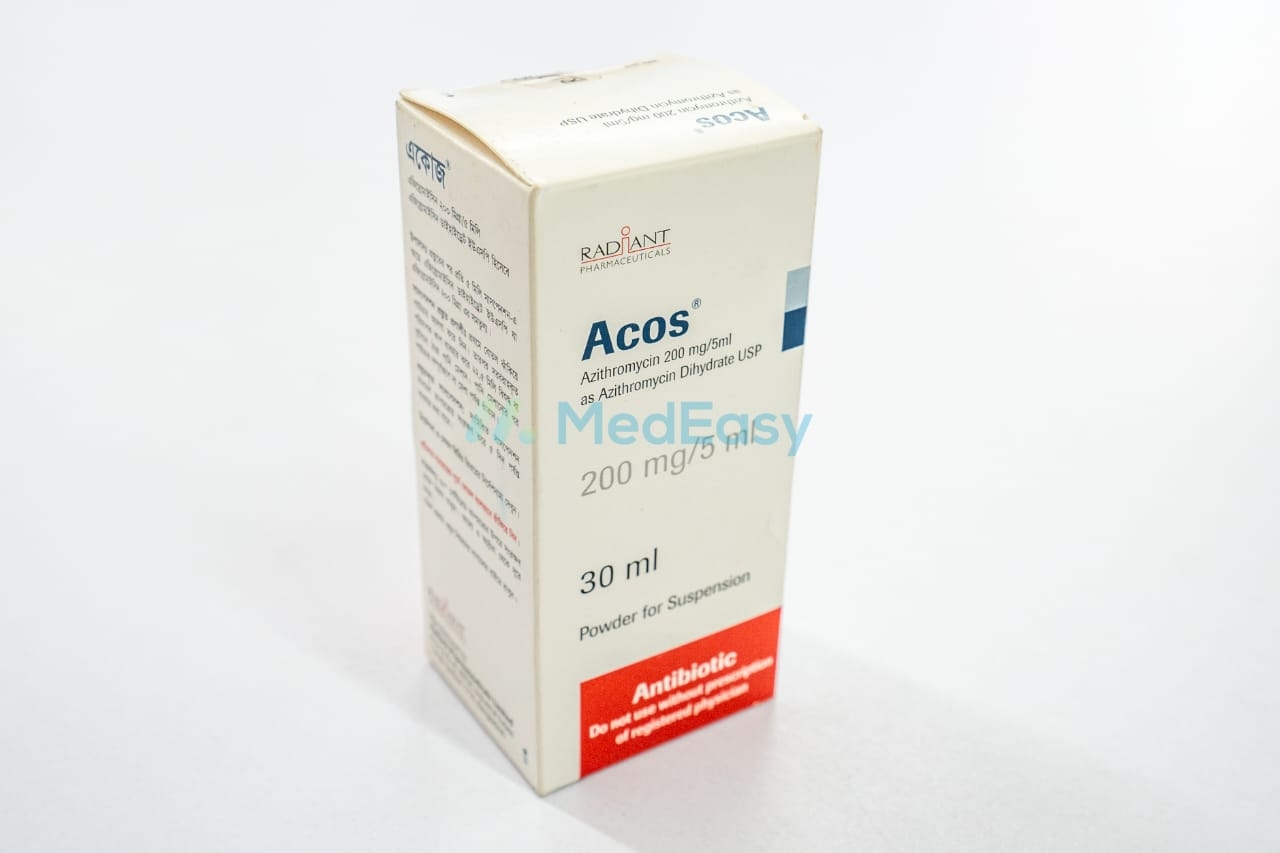
Acos30 ml
Radiant Pharmaceuticals Ltd.
৳176.70
Add to cart


Azyth is a macrolide antibiotic used to treat a range of bacterial infections caused by susceptible organisms. Indications vary in the strength of supporting evidence:
Azyth should be used only for infections proven or strongly suspected to be caused by susceptible bacteria.
Each tablet/capsule of Azithromycin typically contains Azithromycin Dihydrate equivalent to 250 mg or 500 mg of azithromycin base. Oral powder for suspension, when reconstituted, provides 200 mg/5 mL. Injectable formulations provide Azithromycin for intravenous infusion (e.g., 500 mg per vial). Strengths and available forms may vary by manufacturer.
Azyth is a semi-synthetic macrolide antibiotic belonging to the azalide subclass. It is derived from erythromycin but has an expanded spectrum of activity, improved tissue penetration, a longer half-life allowing shorter treatment courses, and better gastrointestinal tolerability compared with older macrolides. Azyth is available as tablets, oral suspension, and an intravenous formulation for the treatment of susceptible bacterial infections.
Macrolide antibiotic (azalide subclass)
Azithromycin inhibits bacterial protein synthesis by binding to the 50S ribosomal subunit, blocking translocation of peptidyl tRNA and thereby arresting bacterial growth (bacteriostatic; can be bactericidal at higher concentrations against some organisms).
Following oral administration, Azithromycin is rapidly absorbed and widely distributed into tissues, with concentrations in many tissues substantially exceeding plasma levels due to extensive intracellular and tissue uptake. It undergoes limited hepatic metabolism and is primarily eliminated unchanged in bile, with a small proportion excreted renally. Its terminal elimination half-life is long (2–4 days), which permits once-daily dosing and short treatment courses.
Azyth dosing is indication-specific. Representative adult and pediatric regimens are summarized below; the prescribing physician's instructions should always take precedence.
| Indication | Adult Dose | Pediatric Dose |
|---|---|---|
| Respiratory tract infections (bronchitis, sinusitis, pneumonia, pharyngitis) | 500 mg on Day 1, then 250 mg once daily on Days 2–5; or 500 mg once daily for 3 days | 10 mg/kg (max 500 mg) on Day 1, then 5 mg/kg once daily on Days 2–5 (children ≥6 months, per physician guidance) |
| Acute otitis media | Not typically indicated | 10 mg/kg once daily for 3 days, or 10 mg/kg on Day 1 then 5 mg/kg on Days 2–5 |
| Uncomplicated skin/skin-structure infections | 500 mg on Day 1, then 250 mg once daily on Days 2–5 | Weight-based, per physician |
| Chlamydial urethritis/cervicitis | 1 g as a single oral dose | Not routinely used; specialist guidance required |
| Chancroid | 1 g as a single oral dose | Not applicable |
| Enteric (typhoid) fever* | 500 mg once daily for 7 days | 10–20 mg/kg once daily (max 500 mg/day) for 7 days, per local guidelines |
| Community-acquired pneumonia (IV-to-oral) | 500 mg IV once daily for at least 2 days, then 500 mg orally to complete a 7–10 day course | Specialist/hospital guidance |
*Where used for enteric fever, treatment should be guided by local antimicrobial susceptibility patterns and physician judgment.
Tablets and suspension may be taken with or without food, although the suspension may be better tolerated with food in some patients. Doses should be taken at approximately the same time each day.
Antibiotic stewardship: Take Azyth exactly as prescribed by your physician; do not stop, extend, skip doses, or share this medicine with others without medical advice, even if symptoms improve before the course is completed.
Azyth tablets should be swallowed whole with a glass of water. The oral suspension should be shaken well before each use and measured with an accurate dosing device. Azyth may be taken with or without food; taking it with food can reduce stomach upset. Antacids containing aluminum or magnesium should not be taken at the same time as Azyth — separate dosing by at least 2 hours. If a dose is missed, it should be taken as soon as remembered unless it is almost time for the next dose, in which case the missed dose should be skipped; doses should never be doubled.
Azyth has fewer clinically significant CYP3A4-mediated interactions than other macrolides, but the following are well-established and clinically important:
Always inform the physician or pharmacist of all other medicines being used before starting Azyth.
Azithromycin is contraindicated in:
Most adverse effects associated with Azyth are mild to moderate and gastrointestinal in nature.
Pregnancy: Available human data have not shown an increased risk of major birth defects with Azyth use in pregnancy; however, data remain limited. Azyth should be used during pregnancy only if clearly needed and the potential benefit justifies the potential risk to the fetus. A physician should always be consulted before use in pregnancy.
Lactation: Azyth is present in breast milk. It should be used with caution during breastfeeding, and the infant should be monitored for gastrointestinal effects such as diarrhea or rash. Consult a physician before using Azyth while breastfeeding.
QT Prolongation: Azyth can prolong the QT interval and has been associated with a small increased risk of cardiovascular death, particularly torsades de pointes, in some studies. Use with caution in patients with known QT prolongation, uncorrected electrolyte abnormalities (hypokalemia, hypomagnesemia), bradycardia, or concomitant use of other QT-prolonging drugs.
Hepatotoxicity: Rare cases of severe, sometimes fatal, hepatotoxicity have been reported. Discontinue Azyth promptly if signs or symptoms of hepatitis occur.
Clostridioides difficile-Associated Diarrhea: May occur during or up to several weeks after therapy with Azyth; evaluate if persistent or severe diarrhea develops.
Myasthenia Gravis: Rare exacerbation of myasthenia gravis symptoms has been reported with Azyth; use with caution in this population.
Infantile Hypertrophic Pyloric Stenosis: Reported with macrolide use in infants; caution advised with use of Azyth in neonates and young infants.
Antibiotic stewardship: Take Azyth exactly as prescribed by your physician; do not stop, extend, skip doses, or share this medicine with others without medical advice.
Overdose with Azyth may cause exaggerated gastrointestinal symptoms such as severe nausea, vomiting, and diarrhea, and rarely, reversible hearing loss. If an overdose of Azyth is suspected, seek immediate medical attention or contact a poison control center/emergency services. Treatment is general symptomatic and supportive care; there is no specific antidote.
Store Azyth tablets/capsules at room temperature (below 30°C), away from light and moisture. Keep out of reach of children. Reconstituted oral suspension of Azyth should be stored as directed on the label (typically at room temperature, away from excessive heat) and discarded after 10 days if unused.
Renal impairment: No dose adjustment is generally required for mild-to-moderate renal impairment with Azyth; caution and physician guidance are advised in severe renal impairment.
Hepatic impairment: Use Azyth with caution in patients with hepatic impairment; it is contraindicated in those with a prior history of cholestatic jaundice/hepatic dysfunction related to its use (see Contraindications).
Elderly: Older adults may be more susceptible to QT-prolongation-related arrhythmias with Azyth; use with caution, particularly with concomitant cardiac risk factors.
Cardiac disease: Caution advised when using Azyth in patients with pre-existing QT prolongation or significant cardiac disease (see Precautions and Warnings).
Treatment duration with Azyth is typically short, ranging from a single dose (e.g., for chlamydial urethritis/cervicitis or chancroid) to 3–5 days for most respiratory and skin infections, owing to its long tissue half-life. Certain indications, such as enteric fever, may require 7 days or longer, and IV-to-oral regimens for pneumonia may total 7–10 days. The exact duration of Azyth therapy should always follow the prescribing physician's instructions and should not be shortened or extended without medical advice.
Azyth oral suspension powder should be reconstituted by adding the specified amount of water to the bottle as indicated on the label, then shaking well to form a uniform suspension. Once reconstituted, the suspension typically provides 200 mg/5 mL and should be shaken before each dose. Reconstituted Azyth suspension should be stored as directed (usually at room temperature) and any unused portion discarded after 10 days.
Macrolide antibiotics; Azalides
Azithromycin exerts its antibacterial effect by binding to the 23S rRNA of the bacterial 50S ribosomal subunit, inhibiting RNA-dependent protein synthesis by blocking translocation of peptidyl tRNA during translation. This action is primarily bacteriostatic, arresting bacterial growth and replication, though Azithromycin can be bactericidal against certain highly susceptible organisms at achievable concentrations.
B
Azyth is approved for use in children 6 months of age and older for acute otitis media and community-acquired pneumonia, and (in children 2 years and older) pharyngitis/tonsillitis, using weight-based dosing as directed by a physician. Safety and efficacy of Azyth for other indications in infants younger than 6 months have not been established. Caution is advised in neonates given a reported association between macrolide exposure and infantile hypertrophic pyloric stenosis. Pediatric dosing of Azyth must always be calculated by a physician based on the child's weight and the specific infection being treated.
Q: What is Azyth 30 ml Powder for Suspension used for?
A: Azyth 30 ml Powder for Suspension is an antibiotic used to treat bacterial infections of the respiratory tract, skin, ears, and certain sexually transmitted infections, among other susceptible bacterial infections, as directed by a physician.
Q: How should I take Azyth 30 ml Powder for Suspension?
A: Azyth 30 ml Powder for Suspension should be taken exactly as prescribed, at the same time each day, with or without food. Complete the full course even if you feel better before finishing it, unless your physician advises otherwise.
Q: Can I take Azyth 30 ml Powder for Suspension during pregnancy?
A: Azyth 30 ml Powder for Suspension should be used during pregnancy only if clearly needed and if the potential benefit justifies the potential risk to the fetus. Always consult your physician before use during pregnancy.
Q: What are the common side effects of Azyth 30 ml Powder for Suspension?
A: The most common side effects of Azyth 30 ml Powder for Suspension include diarrhea, nausea, abdominal pain, vomiting, and headache. Most are mild and resolve on their own; contact your physician if symptoms are severe or persistent.
Q: Who should not take Azyth 30 ml Powder for Suspension?
A: Azyth 30 ml Powder for Suspension should not be taken by anyone with a known allergy to Azyth 30 ml Powder for Suspension or other macrolide antibiotics, or by anyone with a history of liver problems (cholestatic jaundice) caused by previous use of Azyth 30 ml Powder for Suspension.
Q: What should I do if I miss a dose or take too much Azyth 30 ml Powder for Suspension?
A: If you miss a dose of Azyth 30 ml Powder for Suspension, take it as soon as you remember unless it is almost time for the next dose. If you suspect an overdose of Azyth 30 ml Powder for Suspension, seek immediate medical attention or contact a poison control center right away.
Disclaimer
The information provided is accurate to the best of our knowledge, but it does not replace professional medical advice. We cannot guarantee its completeness or accuracy, and the absence of specific information about a drug should not be taken as an endorsement. We are not responsible for any consequences arising from this information, so please consult a healthcare professional for any concerns or questions.
