

8% Off
Bactoderm15 gm
Unimed Unihealth MFG. Ltd.
৳165.60
Add to cart
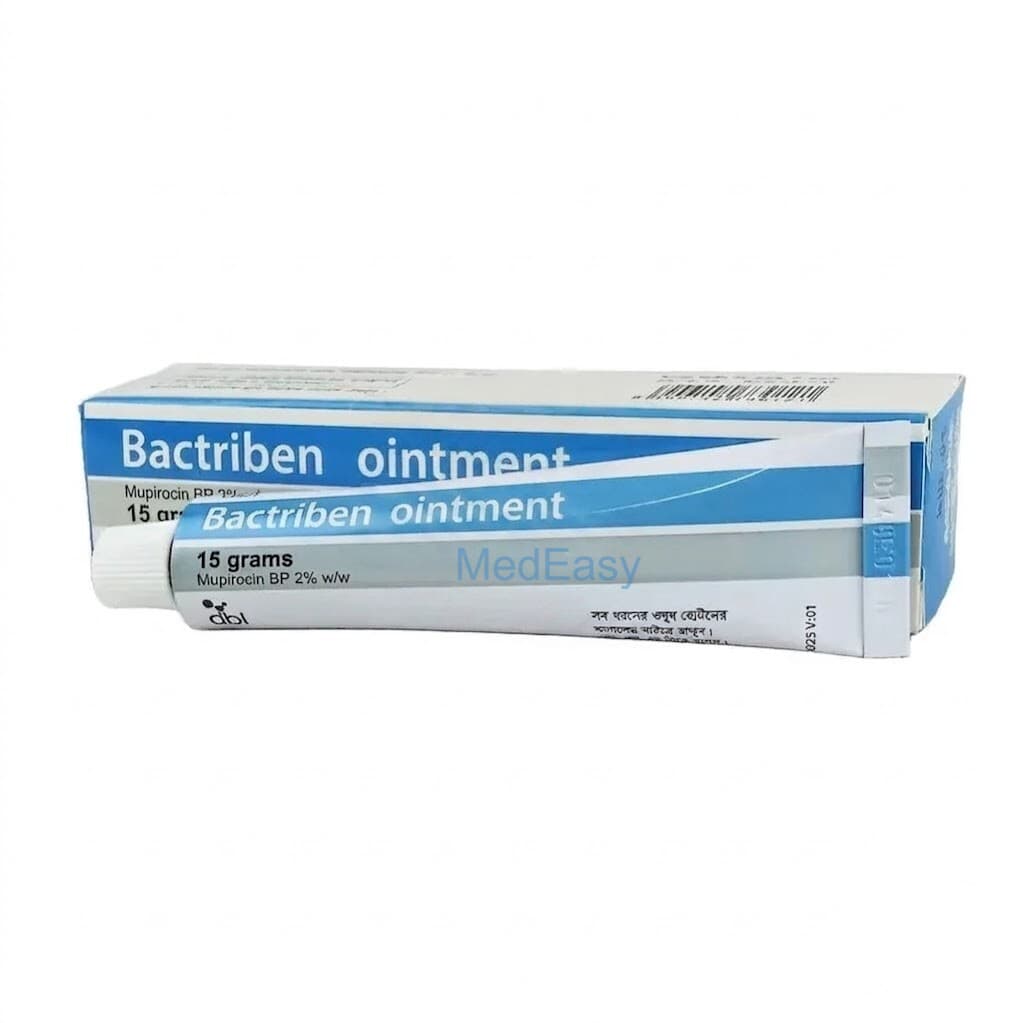
Bactriben 15 gm Ointment is available on MedEasy for ৳162.00 per 15 gm tube, with home delivery anywhere in Bangladesh. It is manufactured by DBL Pharmaceuticals Ltd. Its generic name is Mupirocin.

Bactriben is not effective against fungal or viral skin infections and should not be used for these conditions.
Each gram of Mupirocin ointment/cream (topical) contains Mupirocin 20 mg (2% w/w) in a water-miscible or paraffin-based ointment/cream vehicle. The nasal ointment form contains Mupirocin calcium equivalent to 2% mupirocin free acid in a white soft paraffin (petrolatum) base.
Bactriben is a topical antibacterial agent originally derived by fermentation from Pseudomonas fluorescens. It is chemically distinct from other antibiotic classes (a pseudomonic acid derivative), which means it does not show cross-resistance with commonly used systemic or topical antibiotics.
Bactriben is formulated as a 2% ointment or cream for application to the skin, and as a specialized 2% nasal ointment (using the calcium salt) for application inside the nostrils. It is used only externally/topically and is not taken by mouth or injected.
Topical Antibacterial / Topical Antibiotic (Pseudomonic Acid Class)
Mechanism of action: Mupirocin inhibits bacterial protein synthesis by binding reversibly and specifically to bacterial isoleucyl-transfer RNA synthetase, the enzyme responsible for incorporating isoleucine into bacterial proteins. This blocks isoleucine incorporation into protein chains, halting further bacterial RNA and protein synthesis.
Spectrum of activity: Mupirocin is active against many Gram-positive bacteria, including methicillin-susceptible and methicillin-resistant Staphylococcus aureus and beta-hemolytic streptococci (e.g. Streptococcus pyogenes), as well as some Gram-negative organisms relevant to skin flora.
Resistance: Because its mechanism and chemical structure differ from other antibiotic classes, Mupirocin generally shows no cross-resistance with other antimicrobials; however, resistant strains of S. aureus can emerge, particularly with prolonged or repeated use.
Absorption: Systemic absorption through intact skin is minimal. Absorption may increase when applied to damaged skin or mucous membranes, or over large surface areas; any absorbed drug is rapidly metabolized to inactive monic acid and excreted mainly by the kidneys.
| Indication | Formulation | Dose & Frequency | Duration |
|---|---|---|---|
| Impetigo / minor infected skin lesions | Bactriben 2% ointment or cream | Apply a small amount to the affected area 3 times daily | Up to 10 days; re-evaluate if no improvement in 3-5 days |
| Nasal MRSA decolonization | Bactriben calcium 2% nasal ointment | Apply approximately half of a single-use tube into each nostril twice daily, then gently press the nostrils together for about 1 minute to spread the ointment | 5 days |
Topical (skin) ointment/cream: Clean and dry the affected area. Apply a small amount of Bactriben directly to the lesion, or with a cotton swab/gauze pad, then may be covered with a gauze dressing. Avoid contact with the eyes, mouth, and nose.
Nasal ointment: Apply about half the contents of one single-use tube into each nostril. Close the nostrils by pressing the sides of the nose together and gently release; repeat several times to distribute the ointment throughout the nostril. Discard the tube after a single use (one tube is for one application to both nostrils).
Because systemic absorption of Bactriben through intact skin is minimal, clinically significant systemic drug interactions are uncommon. Documented/relevant interaction points include:
Mupirocin is contraindicated in patients with a known history of hypersensitivity to Mupirocin or to any other component of the specific ointment or cream formulation being used.
Serious but rare reactions include severe allergic reactions (anaphylaxis, hives, angioedema/facial swelling) — see Precautions and Warnings.
Pregnancy: There is minimal systemic absorption of Bactriben after topical application to intact skin, and animal reproduction studies have not shown evidence of fetal harm. However, adequate, well-controlled studies in pregnant women are limited. Bactriben should be used during pregnancy only if clearly needed and if the potential benefit justifies the potential risk to the fetus; consult a physician before use.
Lactation: It is not known whether topically applied Bactriben passes into human breast milk in clinically significant amounts. As a precaution, avoid applying Bactriben directly to the breast/nipple area before breastfeeding, and consult a physician before using it while breastfeeding.
Because Bactriben is applied externally and systemic absorption is minimal, overdose from normal topical or nasal use is unlikely. If Bactriben is accidentally swallowed in significant amount, applied to a very large area, or if signs of an adverse reaction occur after excessive use, seek immediate medical attention or contact a poison control center/emergency services rather than attempting home treatment. Bring the product packaging with you if seeking medical care.
Store at room temperature (below 30°C / 86°F), away from light and moisture. Do not freeze. Keep the tube tightly closed when not in use, and keep out of reach of children.
For impetigo and other minor skin infections, Bactriben ointment/cream is typically applied for up to 10 days; if there is no clinical improvement within 3-5 days, the patient should be re-evaluated by a physician. For nasal MRSA decolonization, the nasal ointment course is 5 days. Treatment should not be extended beyond the prescribed duration without medical advice.
Topical Antibacterial; Pseudomonic Acid (unique class, non-cross-resistant with other antibiotic classes)
Mupirocin selectively and reversibly binds bacterial isoleucyl-transfer RNA synthetase, blocking incorporation of isoleucine into bacterial proteins and thereby inhibiting bacterial protein and RNA synthesis, which is bactericidal at the concentrations achieved with topical application.
Bactriben 2% ointment/cream (topical, for impetigo and minor skin infections) has established safety and efficacy in infants and children 2 months of age and older, through 16 years, at the same application regimen used in adults.
Safety and efficacy of Bactriben ointment/cream in infants younger than 2 months of age have not been established.
The Bactriben nasal ointment (for nasal MRSA decolonization) is approved for adults and adolescents 12 years of age and older; its safety and efficacy in children younger than 12 years have not been established, and it should be used in this age group only under direct physician supervision.
Q: What is Bactriben 15 gm Ointment used for?
A: Bactriben 15 gm Ointment is a topical antibiotic used to treat impetigo and other minor superficial bacterial skin infections. A separate nasal ointment form of Bactriben 15 gm Ointment is used to reduce or eliminate MRSA (methicillin-resistant Staphylococcus aureus) carried inside the nose, usually as part of an infection-control program.
Q: How should I apply Bactriben 15 gm Ointment ointment or cream on the skin?
A: Clean and dry the affected area, then apply a small amount of Bactriben 15 gm Ointment to the area 3 times a day for up to 10 days, as directed by your physician. The area may be covered with a gauze dressing if advised. Avoid contact with the eyes.
Q: How is the Bactriben 15 gm Ointment nasal ointment used differently from the skin ointment?
A: The nasal ointment is a specially formulated, more concentrated presentation for use only inside the nostrils, not on the skin. About half of one single-use tube is placed in each nostril twice daily for 5 days, and the nostrils are pressed together afterward to spread the ointment. It is not interchangeable with the skin ointment/cream.
Q: Can Bactriben 15 gm Ointment be used during pregnancy or while breastfeeding?
A: Systemic absorption of Bactriben 15 gm Ointment from the skin is minimal and animal studies have not shown fetal harm, but data in pregnant women are limited, so it should be used during pregnancy only if clearly needed and if the potential benefit justifies the potential risk to the fetus. It is not known whether Bactriben 15 gm Ointment passes into breast milk in significant amounts; avoid applying it directly to the breast/nipple area before nursing, and consult a physician before use while breastfeeding.
Q: What are the common side effects of Bactriben 15 gm Ointment?
A: The most common side effects of the skin ointment/cream are burning, stinging, itching, or mild irritation at the application site. The nasal ointment may cause headache, a runny or irritated nose, nasal congestion, or sore throat. Discontinue Bactriben 15 gm Ointment and consult a physician if severe irritation, rash, or an allergic reaction occurs.
Q: Is it safe to use Bactriben 15 gm Ointment for longer than prescribed or on large wounds?
A: No. Bactriben 15 gm Ointment should be taken exactly as prescribed; do not stop, extend, skip doses, or share this medicine with others without medical advice. It should not be applied to large areas of broken skin or mucous membranes for prolonged periods, since certain formulations contain a polyethylene glycol vehicle that can be absorbed and affect kidney function, especially in people with kidney impairment. Using it for longer than directed can also encourage antibiotic-resistant bacteria to grow.
Disclaimer
The information provided is accurate to the best of our knowledge, but it does not replace professional medical advice. We cannot guarantee its completeness or accuracy, and the absence of specific information about a drug should not be taken as an endorsement. We are not responsible for any consequences arising from this information, so please consult a healthcare professional for any concerns or questions.