
Key facts
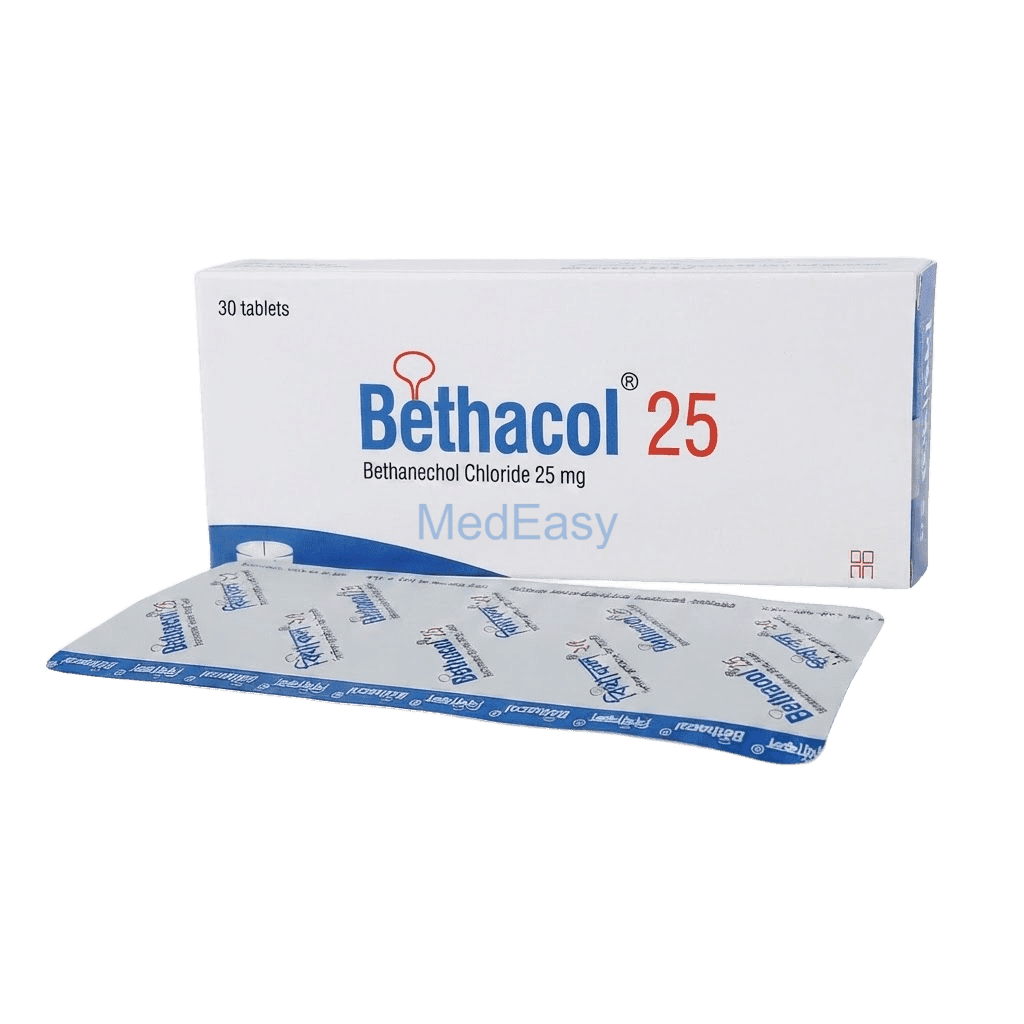
Bethacol 25 mg Tablet is available on MedEasy for ৳180.00 per 10's Strip, with home delivery anywhere in Bangladesh. It is manufactured by Unimed Unihealth MFG. Ltd. Its generic name is Bethanechol Chloride.
- Pack sizes
- 10's Strip, 30's Pack
- Prescription
- Required. Upload a valid doctor's prescription at checkout; a MedEasy pharmacist verifies it before dispatch.
- Delivery
- Home delivery across Bangladesh. Same-day delivery in Dhaka, Chattogram, Sylhet and Bogura city areas; 2-3 days elsewhere.
- Payment
- Cash on delivery, bKash, cards and mobile banking.
- Brand
- Bethacol
- Generic name
- Bethanechol Chloride
- Manufacturer
- Unimed Unihealth MFG. Ltd.
- Form & strength
- Tablet 25 mg
- Availability
- Currently out of stock
- Authenticity
- Sourced from licensed suppliers and the manufacturer's authorised distributors in Bangladesh.

Medicine overview
Indications of Bethacol
Bethacol is a cholinergic (parasympathomimetic) agent used to stimulate the smooth muscle of the urinary bladder and gastrointestinal tract. Its evidence-based uses are:
- Established/approved use: Treatment of acute non-obstructive (functional) urinary retention, particularly postoperative and postpartum urinary retention, when catheterization is undesirable or contraindicated.
- Established/approved use: Treatment of urinary retention associated with neurogenic atony of the bladder (e.g., in diabetic bladder disease) with retention.
- Off-label/limited use (not routinely recommended): Bethacol has in the past been tried for gastroesophageal reflux and gastroparesis-type symptoms to promote gastric and esophageal motility, but this use is not well supported by current evidence and is not a standard indication.
Bethacol is only effective for non-obstructive retention; it must never be used when a mechanical obstruction is present.
Composition
Each tablet contains Bethanechol Chloride as the active pharmaceutical ingredient, commonly available in strengths such as 10 mg, 25 mg, and 50 mg, along with standard pharmaceutical excipients (diluents, binders, disintegrants, and lubricants) used to formulate the tablet.
Description
Bethacol is a synthetic ester of choline and a direct-acting cholinergic (parasympathomimetic) agent. Unlike acetylcholine, Bethacol is structurally resistant to hydrolysis by acetylcholinesterase, which gives it a longer duration of action and relatively selective muscarinic (rather than nicotinic) activity.
Bethacol is used clinically to restore detrusor muscle tone and promote bladder emptying in patients with non-obstructive urinary retention.
Therapeutic Class
Cholinergic Agonist (Parasympathomimetic) – Urinary Cholinergic Agent; Bethacol belongs to this class.
Pharmacology
Bethanechol Chloride is a direct-acting cholinergic agonist that selectively stimulates muscarinic receptors with minimal nicotinic activity, and is largely resistant to breakdown by cholinesterase enzymes, giving it a more predictable and prolonged effect compared to acetylcholine.
Mechanism of action: By stimulating muscarinic receptors on the detrusor muscle of the bladder, Bethanechol Chloride increases detrusor tone and contraction while promoting coordinated relaxation of the trigone and external sphincter, resulting in more complete bladder emptying. It also increases gastrointestinal smooth muscle tone and peristalsis, gastric motility, and salivary and gastric secretions.
Onset and duration: After oral administration, effects typically begin within 30–90 minutes and may last up to 6 hours.
Dosage & Administration of Bethacol
Adult Dosage
| Indication | Recommended Dose |
|---|---|
| Postoperative/postpartum non-obstructive urinary retention; neurogenic bladder atony | 10 mg to 50 mg orally, 3 to 4 times daily. Therapy is usually started at a low dose (e.g., 10–25 mg) and increased gradually (e.g., in 5–10 mg increments at hourly intervals during initial titration under medical supervision) until a satisfactory response is obtained, up to a usual maximum of 50 mg per dose. |
Pediatric Dosage
Safety and efficacy of Bethacol have not been established in children; pediatric use is not recommended outside specialist supervision (see Use in Special Populations).
Renal/Hepatic Impairment
No well-established formal dose adjustment exists for renal or hepatic impairment; use with caution and close monitoring in these populations.
Administration Instructions
- Take Bethacol on an empty stomach (1 hour before or 2 hours after meals) to reduce the likelihood of nausea and vomiting.
- Swallow tablets whole with water; do not crush unless advised by a physician.
- Bethacol must never be given by intramuscular or intravenous injection — severe cholinergic reactions, including cardiac arrest, have occurred with these routes (see Precautions and Warnings).
- Take exactly as prescribed by your physician; do not stop, extend, skip doses, or share this medicine with others without medical advice.
Administration of Bethacol
Bethacol is administered orally only, on an empty stomach (1 hour before or 2 hours after meals) to minimize gastrointestinal side effects. It must not be given by intramuscular or intravenous injection under any circumstance.
Interaction of Bethacol
- Other cholinergic agents (e.g., cholinesterase inhibitors such as neostigmine or pyridostigmine): Concurrent use with Bethacol can produce additive cholinergic effects (excessive salivation, bradycardia, hypotension, GI cramping); concomitant use is generally avoided.
- Ganglionic blocking agents (e.g., mecamylamine): Bethacol may cause a critical and sudden fall in blood pressure, usually with severe abdominal symptoms, when given with ganglionic blocking agents; this combination should be avoided.
- Anticholinergic/antimuscarinic drugs (e.g., atropine): These agents pharmacologically antagonize the effects of Bethacol; atropine is in fact used as the antidote for Bethacol overdose (see Overdose).
- Drugs that may unmask or worsen cholinergic sensitivity (e.g., in patients with asthma or cardiac disease) should be used cautiously together with Bethacol (see Precautions and Warnings).
Contraindications
Bethanechol Chloride is contraindicated in the following situations:
- Mechanical gastrointestinal or genitourinary (urinary tract) obstruction — cholinergic stimulation against an obstruction can cause perforation or rupture; this is a critical absolute contraindication.
- Situations where the strength or integrity of the gastrointestinal or bladder wall is questionable, including recent gastrointestinal surgery or bowel/bladder anastomosis.
- Active bronchial asthma.
- Peptic ulcer disease or other active inflammatory gastrointestinal lesions.
- Hyperthyroidism.
- Cardiac disease or coronary artery disease (including marked bradycardia or hypotension).
- Marked vagotonia.
- Pronounced bradycardia or hypotension.
- Known hypersensitivity to Bethanechol Chloride or any component of the formulation.
Bethanechol Chloride must never be given by intramuscular or intravenous injection (see Precautions and Warnings).
Side Effects of Bethacol
Side effects of Bethacol are generally dose-related, resulting from its cholinergic activity, and often improve with dose adjustment. Common and important effects include:
- Excessive salivation, sweating, and flushing (feeling of warmth)
- Abdominal cramping/discomfort, nausea, vomiting, diarrhea, borborygmi (increased bowel sounds)
- Urinary urgency
- Headache and malaise
- Hypotension, reflex tachycardia, or bradycardia
- Blurred vision and miosis (pupil constriction)
- Bronchospasm or asthmatic attack (uncommon, more likely in susceptible individuals — see Contraindications)
Patients should report severe or persistent side effects to their physician promptly.
Pregnancy & Lactation
Pregnancy: Adequate, well-controlled studies of Bethacol in pregnant women are lacking. Bethacol should be used during pregnancy only if clearly needed and if the potential benefit justifies the potential risk to the fetus; a physician should be consulted before use.
Lactation: It is not well established whether Bethacol passes into human breast milk. Because of the potential for cholinergic effects in a nursing infant, Bethacol should be used during breastfeeding only under medical advice, weighing the benefits of treatment against potential risk to the infant.
Precautions & Warnings
- Route of administration: Bethacol must not be given by intramuscular or intravenous injection — severe cholinergic reactions, including profound hypotension, shock, and cardiac arrest, have been associated with parenteral use outside the approved oral route. Strict adherence to the approved oral route and dosing is essential.
- Respiratory disease: Use with caution in patients with any respiratory disease, even without a formal diagnosis of asthma, due to the risk of bronchospasm (active bronchial asthma is an absolute contraindication — see Contraindications).
- Cardiovascular effects: Bethacol can cause bradycardia and hypotension through its cholinergic action; use with particular caution in patients with underlying cardiovascular disease.
- Cholinergic side effects: Excessive salivation, sweating, flushing, abdominal cramping, diarrhea, and urinary urgency are dose-related and often improve with dose reduction (see Side Effects).
- Antidote availability: Atropine should be readily available as a specific antidote in case of a cholinergic (muscarinic) overdose or excessive response to Bethacol.
- Use with caution in elderly patients and in those with a history of epilepsy or Parkinsonism, as cholinergic stimulation may aggravate these conditions.
Overdose Effects of Bethacol
Overdose of Bethacol produces signs of cholinergic (muscarinic) excess, including excessive salivation, sweating, flushing, abdominal cramps, nausea, vomiting, diarrhea, involuntary defecation or urination, bronchospasm, marked bradycardia, hypotension, and, in severe cases, cardiovascular collapse.
In case of suspected overdose, seek immediate medical attention or contact emergency services/poison control. Atropine is the specific antidote and should be administered by a healthcare professional as needed, along with supportive care (e.g., airway management, cardiovascular support) in a medical facility. Do not attempt to manage a suspected overdose at home.
Storage Conditions
Store at room temperature (below 30°C), away from light and moisture. Keep out of reach of children.
Use In Special Populations
- Elderly: Use Bethacol with caution; start at the lower end of the dosing range and monitor closely for cardiovascular and cholinergic side effects.
- Renal impairment: No well-established formal dose adjustment; use with caution and monitor for excessive cholinergic effects.
- Hepatic impairment: No well-established formal dose adjustment; use with caution.
- Pediatric patients: Safety and efficacy have not been established (see Pediatric Uses).
- Cardiac, respiratory, or GI disease: See Contraindications and Precautions and Warnings, as several of these conditions are absolute contraindications to Bethacol.
Duration Of Treatment
Duration of treatment with Bethacol is individualized by the treating physician based on clinical response. For postoperative or postpartum non-obstructive urinary retention, treatment is typically short-term, continued only until normal voiding function is restored. For chronic neurogenic bladder atony, Bethacol may be used longer-term under close medical supervision, with periodic reassessment of continued need and tolerability.
Drug Classes
Cholinergic agonist; Parasympathomimetic; Urinary cholinergic agent
Mode Of Action
Bethanechol Chloride is a direct-acting muscarinic cholinergic agonist. Structural modification of the choline ester renders Bethanechol Chloride resistant to hydrolysis by acetylcholinesterase, unlike endogenous acetylcholine, allowing it to act more selectively and for a longer duration at muscarinic receptors with minimal nicotinic (ganglionic) activity. Stimulation of muscarinic receptors on bladder detrusor smooth muscle increases contractility and tone, while promoting coordinated sphincter relaxation, thereby facilitating bladder emptying. It similarly increases gastrointestinal smooth muscle tone and peristaltic activity.
Pregnancy
C
Pediatric Uses
The safety and efficacy of Bethacol have not been established in pediatric patients. Use in children should be undertaken only under specialist supervision when a physician determines the potential benefit justifies the potential risk, with close monitoring for cholinergic side effects.
Frequently Asked Questions
Q: What is Bethacol 25 mg Tablet used for?
A: Bethacol 25 mg Tablet is a cholinergic medicine used mainly to treat non-obstructive (functional) urinary retention, especially after surgery or childbirth, and urinary retention caused by neurogenic bladder atony, by helping the bladder muscle contract and empty more effectively.
Q: How should I take Bethacol 25 mg Tablet?
A: Take Bethacol 25 mg Tablet exactly as prescribed by your physician, usually 3–4 times a day, on an empty stomach (1 hour before or 2 hours after meals) to reduce nausea. Do not stop, change, or share your dose without medical advice.
Q: Can Bethacol 25 mg Tablet be given as an injection?
A: No. Bethacol 25 mg Tablet must only be taken by mouth. It should never be given by intramuscular or intravenous injection, as this can cause severe cholinergic reactions, including a dangerous drop in blood pressure and cardiac arrest.
Q: Who should not take Bethacol 25 mg Tablet?
A: Bethacol 25 mg Tablet should not be used by people with a mechanical blockage of the urinary or gastrointestinal tract, active bronchial asthma, peptic ulcer disease, hyperthyroidism, significant heart disease, marked slow heart rate or low blood pressure, recent bowel/bladder surgery, or known hypersensitivity to the drug.
Q: What are the common side effects of Bethacol 25 mg Tablet?
A: Common side effects include excessive salivation, sweating, flushing, abdominal cramps, diarrhea, nausea, and a sudden urge to urinate. These effects are usually dose-related and often improve if your doctor adjusts your dose.
Q: Is Bethacol 25 mg Tablet safe during pregnancy or breastfeeding?
A: Bethacol 25 mg Tablet should be used during pregnancy or breastfeeding only if your physician determines it is clearly needed, since safety data are limited. Always consult your doctor before using Bethacol 25 mg Tablet if you are pregnant, planning pregnancy, or breastfeeding.
Disclaimer
The information provided is accurate to the best of our knowledge, but it does not replace professional medical advice. We cannot guarantee its completeness or accuracy, and the absence of specific information about a drug should not be taken as an endorsement. We are not responsible for any consequences arising from this information, so please consult a healthcare professional for any concerns or questions.
