
7% Off
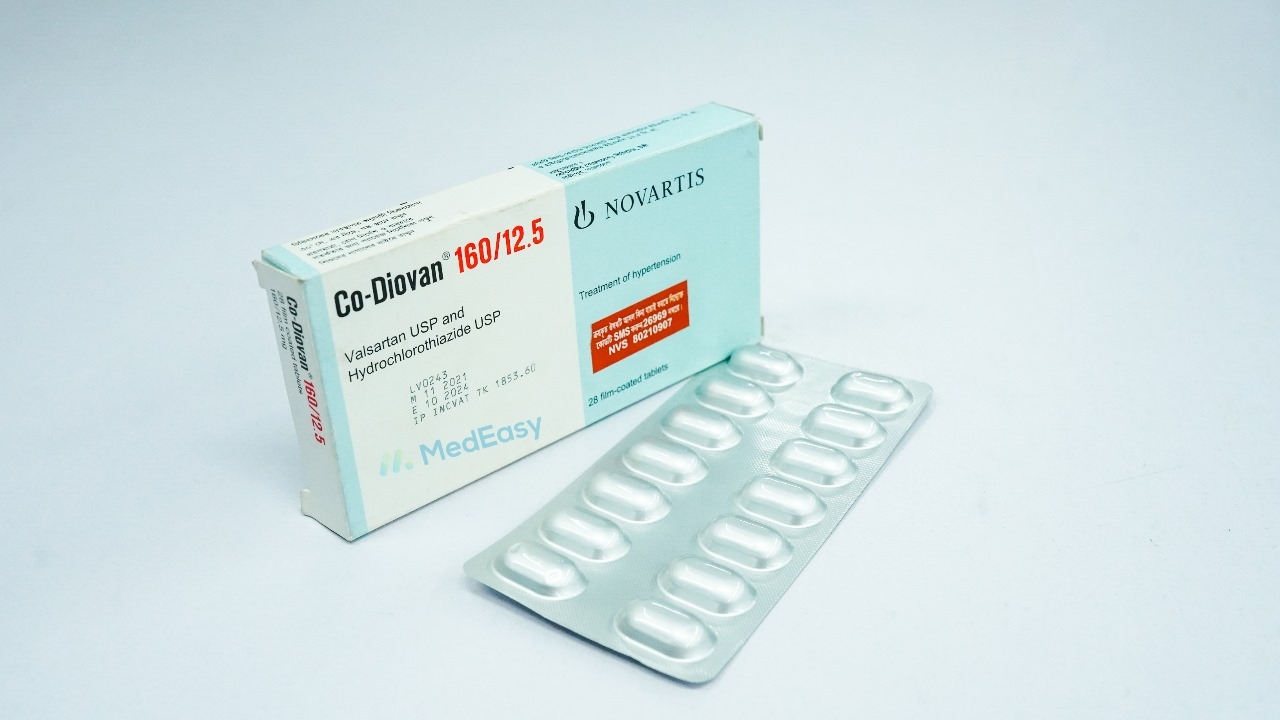
Co-Diovan160 mg+12.
Novartis (Bangladesh) Ltd.
৳862.11
Add to cart


Cardovan Plus is a fixed-dose combination antihypertensive (an angiotensin receptor blocker plus a thiazide diuretic) indicated for:
Cardovan Plus is not indicated for the initial treatment of hypertension in patients who are volume-depleted, nor as a substitute for the individual components when initiating therapy. It lowers blood pressure but has not been specifically studied to demonstrate reduction of cardiovascular morbidity or mortality; benefit is inferred from blood pressure lowering. Use should be individualized by a physician based on response to and tolerability of the individual components.
Each tablet of Valsartan + Hydrochlorothiazide contains valsartan, an angiotensin II receptor blocker (ARB), combined with hydrochlorothiazide, a thiazide diuretic, in fixed-dose strengths such as 80 mg/12.5 mg, 160 mg/12.5 mg, and 160 mg/25 mg, depending on the manufacturer's formulation. Exact strength combinations vary by brand; refer to the specific product label for the strength dispensed.
Cardovan Plus is a fixed-dose combination oral tablet that brings together an angiotensin II receptor blocker (valsartan) and a thiazide-type diuretic (hydrochlorothiazide) in a single dosage form for the management of hypertension. Valsartan blocks the vasoconstrictive and aldosterone-secreting effects of angiotensin II, while hydrochlorothiazide promotes renal sodium and water excretion, reducing plasma volume. Combining agents from these two complementary classes typically produces greater blood pressure reduction than either component alone, and the diuretic component can also blunt the compensatory fluid retention sometimes seen with ARB monotherapy. Cardovan Plus is taken once daily and is intended for long-term management of hypertension under regular medical supervision.
Cardovan Plus belongs to the therapeutic class of combination antihypertensive agents, specifically an angiotensin II receptor blocker (ARB) combined with a thiazide diuretic. It is classified under fixed-dose combination antihypertensives used for the management of essential hypertension.
Valsartan + Hydrochlorothiazide combines two agents with complementary but distinct mechanisms of blood pressure lowering.
Valsartan is a selective antagonist of the angiotensin II type 1 (AT1) receptor. By blocking AT1 receptors, valsartan prevents the vasoconstriction, aldosterone release, and sympathetic activation normally triggered by angiotensin II, resulting in vasodilation and reduced blood pressure without significantly affecting heart rate. Unlike ACE inhibitors, valsartan does not inhibit kininase II, so it does not typically cause a dry cough related to bradykinin accumulation.
Hydrochlorothiazide is a thiazide diuretic that acts on the distal convoluted tubule of the nephron, inhibiting the sodium-chloride symporter and thereby increasing excretion of sodium, chloride, and water while increasing potassium and magnesium loss. The resulting reduction in plasma volume contributes to blood pressure lowering; with chronic use, a component of peripheral vasodilation also contributes to the antihypertensive effect. The diuresis from hydrochlorothiazide activates the renin-angiotensin-aldosterone system, and the valsartan component blunts this compensatory response, giving the combination synergistic antihypertensive activity.
Pharmacokinetically, valsartan reaches peak plasma concentration in about 2-4 hours with an elimination half-life of approximately 6 hours and is largely eliminated unchanged in bile/feces, while hydrochlorothiazide reaches peak plasma concentration in 1-2 hours with a half-life of 6-15 hours and is eliminated primarily unchanged by the kidney.
| Clinical scenario | Typical Adult Dose | Notes |
|---|---|---|
| Not controlled on monotherapy (add-on/substitution) | One tablet once daily; strength individualized (e.g., 80/12.5 mg, 160/12.5 mg, or 160/25 mg) | Titrate no sooner than 2-4 weeks after starting a given dose, based on blood pressure response |
| Initial therapy in patients likely to need multiple drugs | Lowest available strength once daily, titrated upward as needed | Not recommended as first-line therapy for volume-depleted patients |
| Maximum dose | Valsartan 320 mg/hydrochlorothiazide 25 mg once daily | Higher doses of hydrochlorothiazide are not usually associated with additional blood pressure benefit |
Safety and efficacy of Cardovan Plus as a fixed-dose combination have not been established in children; it is not recommended for pediatric use (see Pediatric Uses).
Cardovan Plus is not recommended in patients with severe renal impairment (estimated glomerular filtration rate below 30 mL/min/1.73m²) because thiazides may be ineffective and can precipitate azotemia in this population; the drug is contraindicated in anuria. Caution and monitoring of renal function are advised in mild-to-moderate renal impairment.
No dose adjustment of valsartan is generally required in mild-to-moderate hepatic impairment without cholestasis; Cardovan Plus should be used cautiously in hepatic impairment because minor alterations in fluid and electrolyte balance may precipitate hepatic coma.
If a dose of Cardovan Plus is missed, it should be taken as soon as remembered unless it is nearly time for the next dose, in which case the missed dose should be skipped; doses should not be doubled.
Cardovan Plus is taken orally, once daily, at approximately the same time each day, with or without food. The tablet should be swallowed whole with a glass of water and should not be crushed or chewed unless a physician or pharmacist specifically advises otherwise. Blood pressure should be monitored regularly while taking Cardovan Plus, and adequate hydration should be maintained unless a physician advises fluid restriction.
Cardovan Plus has clinically significant interactions with the following:
Always inform the physician or pharmacist of all other medicines being taken before starting Cardovan Plus.
Valsartan + Hydrochlorothiazide is contraindicated in:
Side effects of Cardovan Plus arise from its two components.
Patients should seek prompt medical advice for severe dizziness, fainting, muscle cramps or weakness, palpitations, marked reduction in urination, or swelling of the face/lips/tongue while taking Cardovan Plus.
Cardovan Plus can cause fetal harm and even death when administered to a pregnant woman, because drugs that act directly on the renin-angiotensin system (such as the valsartan component) can cause injury and death to the developing fetus, including oligohydramnios, fetal growth restriction, renal failure, skull hypoplasia, and death, particularly when used in the second and third trimesters. Cardovan Plus is contraindicated in pregnancy; it should be discontinued as soon as possible once pregnancy is detected, and an alternative antihypertensive should be selected by the physician for ongoing management.
It is not known whether valsartan is excreted in human milk; hydrochlorothiazide is excreted in breast milk in small amounts. Because of the potential for adverse effects in a nursing infant, a decision should be made by the physician whether to discontinue breastfeeding or discontinue Cardovan Plus, taking into account the importance of the drug to the mother.
Fetal toxicity: See the boxed warning under Pregnancy and Lactation - Cardovan Plus must be discontinued as soon as pregnancy is detected.
Hypotension in volume- or salt-depleted patients: Symptomatic hypotension may occur after the first dose in patients who are volume- or salt-depleted (e.g., from prior diuretic therapy, dietary salt restriction, vomiting, or diarrhea); correct volume/salt depletion before starting Cardovan Plus, or begin under close medical supervision.
Renal function: As with other agents affecting the renin-angiotensin system, deterioration of renal function may occur, particularly in patients whose renal function depends on the renin-angiotensin-aldosterone system (e.g., severe heart failure or renal artery stenosis). Cardovan Plus is not recommended in severe renal impairment and is contraindicated in anuria.
Electrolyte imbalance: Periodic monitoring of serum electrolytes is recommended to detect hypokalemia, hyponatremia, or hyperkalemia; the net effect on potassium varies because hydrochlorothiazide wastes potassium while valsartan can raise it.
Hyperuricemia/gout: The thiazide component may raise serum uric acid and precipitate attacks of gout in susceptible individuals.
Diabetes/glycemic control: Thiazides may alter glucose tolerance and raise blood glucose; monitor glycemic control in diabetic patients on Cardovan Plus.
Sulfonamide allergy: Hydrochlorothiazide is a sulfonamide-derived drug; patients with a history of allergy to sulfonamide drugs may show cross-reactivity and should be monitored for hypersensitivity reactions.
Hepatic impairment: Use with caution, as minor fluid and electrolyte alterations from the hydrochlorothiazide component may precipitate hepatic coma in patients with impaired hepatic function or progressive liver disease.
Lupus erythematosus: Thiazide diuretics have been reported to cause exacerbation or activation of systemic lupus erythematosus.
Driving/operating machinery: Cardovan Plus may cause dizziness, especially after the first dose; caution is advised when driving or operating machinery.
Overdose with Cardovan Plus is most likely to cause pronounced hypotension and dizziness from the valsartan component, and electrolyte depletion (hypokalemia, hyponatremia) with dehydration from the hydrochlorothiazide component; bradycardia or tachycardia may also occur. Any suspected overdose of Cardovan Plus is a medical emergency - seek immediate medical attention or contact a poison control center/emergency services right away. Management must be carried out under medical supervision, typically with supportive care, monitoring of vital signs and electrolytes, and correction of fluid/electrolyte imbalance; do not attempt to treat an overdose at home.
Store at room temperature (below 30°C), away from light and moisture. Keep out of reach of children.
No overall dose adjustment is generally required in elderly patients, but they may be more sensitive to the blood-pressure-lowering effects of Cardovan Plus; start at the lowest appropriate dose and titrate slowly.
Not recommended in severe renal impairment; contraindicated in anuria. See Dosage and Administration.
Use with caution; see Precautions and Warnings and Dosage and Administration.
Not recommended as a fixed-dose combination; safety and efficacy not established (see Pediatric Uses).
Contraindicated in pregnancy (fetal toxicity); see Pregnancy and Lactation section for full details.
Cardovan Plus is generally used long-term, often for months to years, as part of ongoing management of chronic hypertension. It should be continued for as long as the treating physician advises, with periodic review of blood pressure control, renal function, and electrolytes.
Angiotensin II receptor blocker (valsartan) combined with a thiazide diuretic (hydrochlorothiazide); combination antihypertensive.
Valsartan + Hydrochlorothiazide lowers blood pressure through two complementary mechanisms: valsartan selectively blocks the angiotensin II type 1 (AT1) receptor, preventing angiotensin II-mediated vasoconstriction and aldosterone release, while hydrochlorothiazide inhibits sodium-chloride reabsorption in the distal convoluted tubule, increasing sodium and water excretion and reducing plasma volume. The diuresis-induced activation of the renin-angiotensin system is blunted by the concurrent AT1 blockade, producing an antihypertensive effect greater than either component alone.
D
The safety and efficacy of Cardovan Plus as a fixed-dose combination have not been established in pediatric patients. Use in children and adolescents is not recommended. Hypertension in children, when present, should be evaluated and managed by a pediatric specialist using age-appropriate, individually titrated therapy rather than fixed-dose adult combination products such as Cardovan Plus.
Q: What is Cardovan Plus 160 mg+12.5 mg Tablet used for?
A: Cardovan Plus 160 mg+12.5 mg Tablet is a combination medicine used to treat high blood pressure (hypertension), particularly when blood pressure is not adequately controlled with a single blood-pressure medicine alone, or as initial therapy in people likely to need more than one drug.
Q: How should I take Cardovan Plus 160 mg+12.5 mg Tablet?
A: Cardovan Plus 160 mg+12.5 mg Tablet is usually taken once daily by mouth, with or without food, at about the same time each day. Swallow the tablet whole with water. Do not change your dose or stop taking it without talking to your physician.
Q: Can I take Cardovan Plus 160 mg+12.5 mg Tablet if I am pregnant or breastfeeding?
A: No. Cardovan Plus 160 mg+12.5 mg Tablet is contraindicated in pregnancy because it can cause serious injury or death to the developing fetus, especially in the second and third trimesters. If you become pregnant while taking Cardovan Plus 160 mg+12.5 mg Tablet, stop the medicine and contact your physician immediately so an alternative treatment can be arranged. Small amounts of the hydrochlorothiazide component pass into breast milk, so use during breastfeeding should only be under medical advice.
Q: What are the common side effects of Cardovan Plus 160 mg+12.5 mg Tablet?
A: Common side effects include dizziness, headache, tiredness, and mild lowering of blood pressure, especially after the first few doses. It can also affect blood potassium and sodium levels, raise uric acid (risking gout), and affect blood sugar control. Contact your physician if you notice severe dizziness, fainting, muscle cramps or weakness, a marked decrease in urination, or swelling of the face, lips, or tongue.
Q: Who should not take Cardovan Plus 160 mg+12.5 mg Tablet?
A: Cardovan Plus 160 mg+12.5 mg Tablet should not be used by people who are hypersensitive to valsartan, hydrochlorothiazide, or sulfonamide-derived drugs, by pregnant women, by patients with anuria (absence of urine production), or together with aliskiren in patients with diabetes. Tell your physician about all your medical conditions and medicines before starting treatment.
Q: What should I do if I miss a dose or take too much Cardovan Plus 160 mg+12.5 mg Tablet?
A: If you miss a dose, take it as soon as you remember unless it is almost time for your next dose, in which case skip the missed dose - do not double up. If you or someone else has taken too much Cardovan Plus 160 mg+12.5 mg Tablet, this is a medical emergency: seek immediate medical attention or contact emergency services/poison control right away.
Disclaimer
The information provided is accurate to the best of our knowledge, but it does not replace professional medical advice. We cannot guarantee its completeness or accuracy, and the absence of specific information about a drug should not be taken as an endorsement. We are not responsible for any consequences arising from this information, so please consult a healthcare professional for any concerns or questions.
