
8% Off
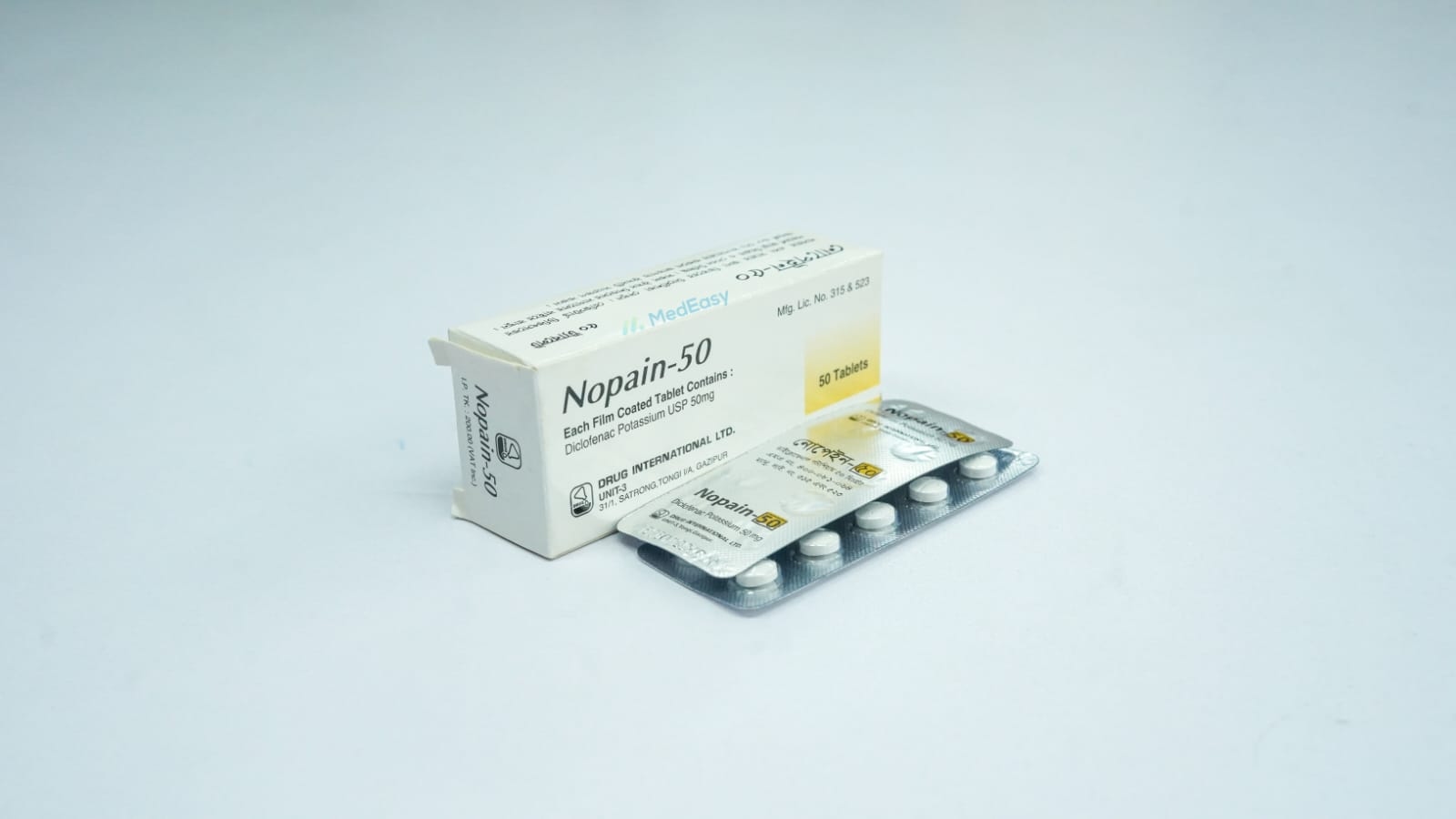
Nopain50 mg
Drug International Ltd.
৳36.80
Add to cart

Cataflam 50 mg Tablet is available on MedEasy for ৳74.59 per 10's Strip, with home delivery anywhere in Bangladesh. It is manufactured by Novartis (Bangladesh) Ltd. Its generic name is Diclofenac Potassium.

Cataflam is a fast-acting, non-steroidal anti-inflammatory drug (NSAID) formulated as a potassium salt for rapid dissolution and onset of action. It is indicated for the following:
Cataflam is intended for short-term, symptomatic relief; it does not alter the underlying course of chronic inflammatory disease. The lowest effective dose should be used for the shortest duration consistent with individual treatment goals.
Each tablet contains Diclofenac Potassium as the active pharmaceutical ingredient, commonly available in strengths of 25 mg and 50 mg, together with standard pharmaceutical excipients that permit rapid disintegration and dissolution for fast-onset pain relief.
Cataflam is the potassium salt of diclofenac, a phenylacetic acid derivative belonging to the non-steroidal anti-inflammatory drug (NSAID) class. Compared with diclofenac sodium, the potassium salt formulation is more water-soluble and is designed for faster disintegration and absorption, making it suitable for the rapid relief of acute pain and inflammation.
Cataflam possesses analgesic, anti-inflammatory, and antipyretic properties, and is used both as a stand-alone analgesic and as part of the management of musculoskeletal inflammatory disorders.
Cataflam belongs to the non-steroidal anti-inflammatory drug (NSAID) class, specifically the phenylacetic acid derivative group of non-selective cyclooxygenase (COX-1 and COX-2) inhibitors.
Diclofenac Potassium exerts its analgesic, anti-inflammatory, and antipyretic effects primarily through non-selective inhibition of the cyclooxygenase (COX-1 and COX-2) enzymes, which reduces the synthesis of prostaglandins involved in pain, inflammation, and fever.
| Indication | Typical adult dose |
|---|---|
| Mild to moderate acute pain / post-traumatic or post-operative pain | 50 mg 2–3 times daily; some regimens use an initial 50 mg loading dose followed by 25–50 mg every 8 hours as needed |
| Primary dysmenorrhea | 50 mg three times daily, starting at the earliest onset of symptoms |
| Acute migraine attack | 50 mg at onset; may repeat 25–50 mg after 2 hours if needed, up to a maximum of 150 mg/day |
| Osteoarthritis | 100–150 mg/day in 2–3 divided doses |
| Rheumatoid arthritis | 150–200 mg/day in 3–4 divided doses |
Maximum recommended dose is generally 150 mg/day for most indications unless otherwise directed by a physician. Tablets should be swallowed whole with water and, where possible, taken on an empty stomach for faster onset; taking with food may reduce gastrointestinal upset but slows absorption.
Safety and efficacy of Cataflam have not been established in children for most indications (see Use in Special Populations). In some markets it is used in adolescents over 14 years at doses up to 75 mg/day in divided doses, only under medical supervision.
No specific dose adjustment is established for mild-to-moderate renal impairment, but Cataflam should be used with caution and at the lowest effective dose; it should be avoided in severe renal impairment. In hepatic impairment, use the lowest effective dose and monitor liver function, as diclofenac is extensively hepatically metabolized.
Cataflam tablets are for oral use only. Swallow the tablet whole with a full glass of water. For fastest onset of pain relief, it may be taken on an empty stomach; if stomach upset occurs, it may be taken with food or milk, which may slightly delay onset. Do not crush or chew the tablet unless specifically directed.
Cataflam has the following well-documented, clinically significant drug interactions:
Diclofenac Potassium is contraindicated in the following situations (true absolute contraindications):
The following adverse effects have been reported with Cataflam:
Patients should seek prompt medical attention for signs of GI bleeding (black stools, vomiting blood), chest pain, sudden weakness or slurred speech, unusual bruising/bleeding, jaundice, or severe skin reactions.
Pregnancy: Cataflam should be avoided during pregnancy unless clearly necessary and only if the potential benefit justifies the potential risk to the fetus; use should be discussed with a physician. Use of NSAIDs, including Cataflam, is contraindicated starting at 30 weeks gestation (third trimester) because of the risk of premature closure of the fetal ductus arteriosus. Use between approximately 20 and 30 weeks gestation should be limited to the lowest effective dose for the shortest possible duration, as it may cause fetal renal dysfunction leading to oligohydramnios; if use beyond 48 hours is needed, ultrasound monitoring of amniotic fluid may be considered.
Lactation: Diclofenac passes into breast milk in small amounts. Cataflam should be used during breastfeeding only if clearly needed, with the infant monitored for potential adverse effects; consult a physician before use while breastfeeding.
Overdose of Cataflam may cause lethargy, drowsiness, nausea, vomiting, epigastric pain, gastrointestinal bleeding, and, in severe cases, hypertension, acute kidney injury, respiratory depression, or coma. There is no specific antidote.
In case of suspected overdose, seek immediate medical attention or contact a poison control center / emergency services right away. Management is supportive and may include measures such as activated charcoal if given soon after ingestion, under medical supervision; do not attempt to induce vomiting or manage a suspected overdose at home without professional guidance.
Store at room temperature (below 30°C), away from light and moisture. Keep out of reach of children.
Cataflam is generally intended for short-term use for acute pain, dysmenorrhea, or migraine (typically a few days). For chronic conditions such as osteoarthritis or rheumatoid arthritis, it may be used longer under regular medical supervision, with periodic reassessment of the need for continued therapy, monitoring for GI, renal, hepatic, and cardiovascular safety, and use of the lowest effective dose for the shortest duration consistent with treatment goals.
Diclofenac Potassium belongs to the following drug classification groups:
Diclofenac Potassium works by non-selectively inhibiting the cyclooxygenase enzymes COX-1 and COX-2, which are responsible for converting arachidonic acid into prostaglandins and thromboxanes. By reducing prostaglandin synthesis, Diclofenac Potassium decreases inflammation, pain sensitization, and fever. Its potassium salt form allows for faster dissolution and gastric absorption compared with diclofenac sodium, giving it a quicker onset of analgesic action.
Category C (Category D from approximately 30 weeks gestation / the third trimester)
The safety and efficacy of Cataflam have not been established in pediatric patients for most indications in major regulatory labeling. In some countries, Cataflam is used in adolescents older than 14 years at doses up to 75 mg/day in divided doses for short-term pain relief, but only under medical supervision. Cataflam should not be used in children below this age unless specifically directed by a pediatrician, given the lack of established safety data and the potential for the same GI, renal, and hepatic risks seen in adults.
Q: What is Cataflam 50 mg Tablet used for?
A: Cataflam 50 mg Tablet is a fast-acting NSAID used for the short-term relief of mild to moderate acute pain, painful menstrual cramps (dysmenorrhea), acute migraine attacks, and for managing the signs and symptoms of osteoarthritis and rheumatoid arthritis.
Q: How quickly does Cataflam 50 mg Tablet start working?
A: Because it is formulated as a potassium salt that dissolves rapidly, Cataflam 50 mg Tablet is generally absorbed faster than diclofenac sodium, with pain relief often beginning within 20–60 minutes when taken on an empty stomach.
Q: Can I take Cataflam 50 mg Tablet during pregnancy?
A: Cataflam 50 mg Tablet should be avoided during pregnancy unless clearly necessary and only if a physician determines that the benefit outweighs the risk. It is contraindicated from about 30 weeks gestation (third trimester) onward because it can cause premature closure of a blood vessel in the fetal heart (the ductus arteriosus), and its use between 20–30 weeks should be limited to the lowest dose for the shortest time due to the risk of reduced amniotic fluid. Always consult your doctor before use during pregnancy.
Q: Who should not take Cataflam 50 mg Tablet?
A: Cataflam 50 mg Tablet should not be used by people with a known allergy to diclofenac, aspirin, or other NSAIDs; those who have had asthma, urticaria, or allergic reactions after taking aspirin or other NSAIDs; patients undergoing perioperative pain management around coronary artery bypass graft (CABG) surgery; and women in the third trimester of pregnancy.
Q: What are the most serious risks of Cataflam 50 mg Tablet?
A: Cataflam 50 mg Tablet, like other NSAIDs, carries a boxed warning for an increased risk of serious cardiovascular events such as heart attack and stroke, and for serious gastrointestinal problems such as bleeding, ulcers, and perforation of the stomach or intestines, which can occur without warning and can be fatal. It should be used at the lowest effective dose for the shortest time necessary, and any signs of chest pain, black or bloody stools, or vomiting blood require urgent medical attention.
Q: Can I take Cataflam 50 mg Tablet with other pain relievers or blood thinners?
A: Cataflam 50 mg Tablet should not be combined with other NSAIDs or aspirin, as this increases the risk of stomach bleeding without added benefit. Combining it with anticoagulants (like warfarin), other antiplatelet drugs, or SSRIs also increases bleeding risk. Always tell your doctor or pharmacist about all medicines you are taking before starting Cataflam 50 mg Tablet.
Disclaimer
The information provided is accurate to the best of our knowledge, but it does not replace professional medical advice. We cannot guarantee its completeness or accuracy, and the absence of specific information about a drug should not be taken as an endorsement. We are not responsible for any consequences arising from this information, so please consult a healthcare professional for any concerns or questions.
