
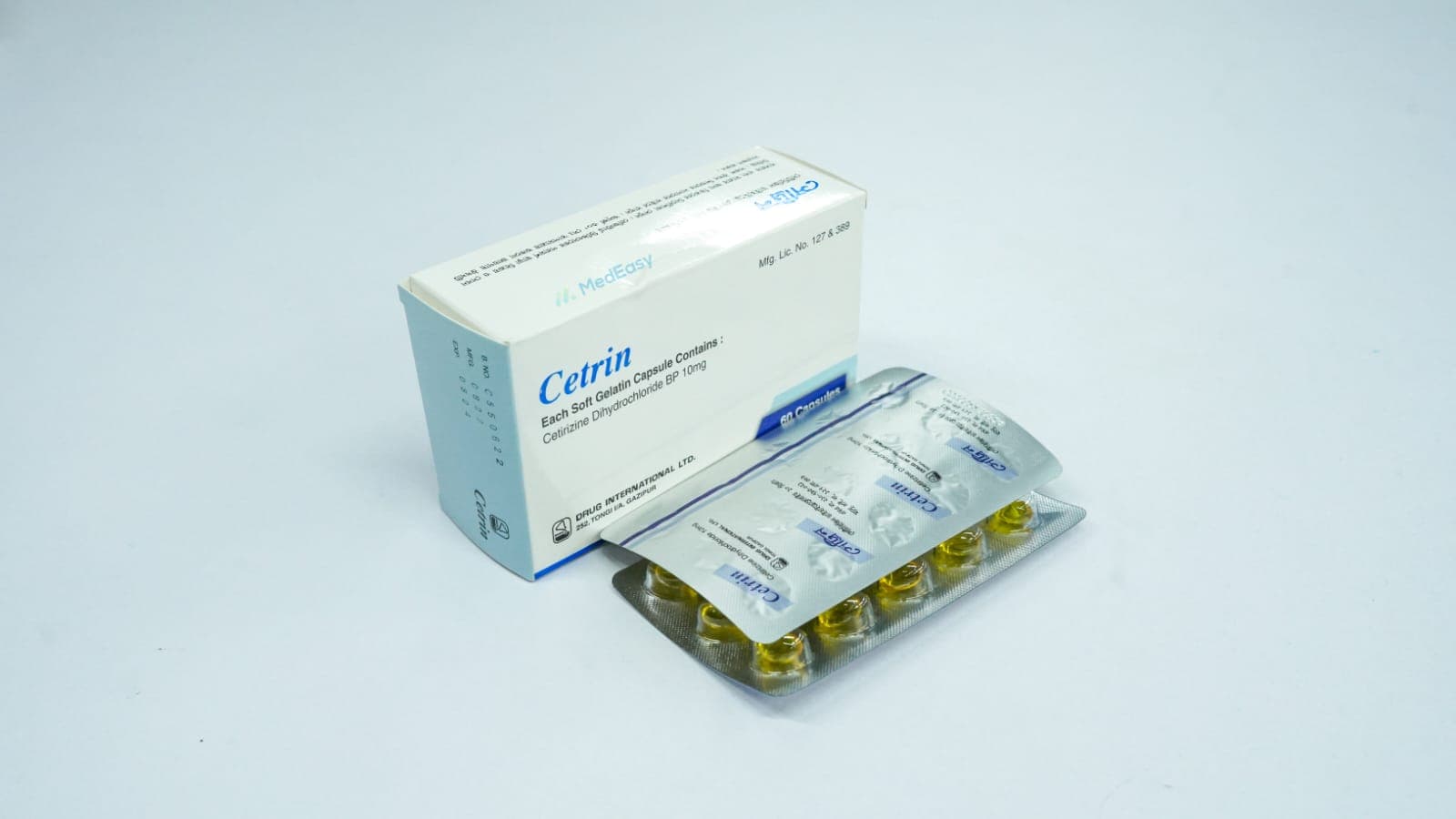

Medicine overview
Indications of Cetrin
Cetrin is a second-generation (relatively non-sedating) H1-antihistamine used for the relief of allergic symptoms.
Established / FDA-approved uses
- Seasonal allergic rhinitis (hay fever) - relief of sneezing, rhinorrhea, nasal itching/congestion, itchy and watery eyes, and itchy throat/palate.
- Perennial allergic rhinitis - year-round allergic nasal symptoms due to indoor allergens (dust mites, pet dander, mold).
- Chronic idiopathic urticaria (hives) - reduces the number, size, and pruritus of hives.
Guideline-supported / commonly used indications
- Allergic conjunctivitis - relief of ocular itching and watering associated with allergy (oral use as an adjunct; a separate ophthalmic formulation of Cetrin also exists for direct eye use).
- Acute urticaria and insect-bite or contact-allergen reactions - symptomatic relief of itching and wheals.
Adjunct / off-label use
- Sometimes used as an adjunct with other antihistamines or in combination with a nasal corticosteroid for allergic rhinitis not controlled by a single agent; used off-label for pruritus of other causes (e.g., atopic dermatitis) under physician supervision, though this is not an approved primary indication.
Composition
Each film-coated tablet typically contains Cetirizine Hydrochloride 10 mg (or 5 mg for lower-strength tablets) as the active ingredient. Oral solutions/syrups commonly contain Cetirizine Hydrochloride 5 mg per 5 mL. Other formulations available in some markets include chewable tablets, orally disintegrating tablets, and pediatric drops. Excipients vary by manufacturer and formulation.
Description
Cetrin is a piperazine-derivative, second-generation H1-receptor antagonist (antihistamine) derived from hydroxyzine. Unlike first-generation antihistamines, it penetrates the blood-brain barrier only minimally, giving it a comparatively low (though not negligible) sedation profile at usual doses. It is widely used for symptomatic relief of allergic conditions such as allergic rhinitis and chronic urticaria and is available over-the-counter as well as on prescription in most markets, including Bangladesh, in tablet, syrup, and drop formulations.
Therapeutic Class
Cetrin belongs to the class of second-generation (non-sedating/low-sedating) H1-antihistamines, specifically the piperazine derivative subgroup.
Pharmacology
Cetirizine Hydrochloride is a potent and selective antagonist (inverse agonist) at peripheral histamine H1-receptors. By competitively blocking H1-receptors, it inhibits histamine-mediated effects such as vasodilation, increased vascular permeability, and stimulation of sensory nerve endings, thereby reducing sneezing, itching, rhinorrhea, and wheal-and-flare responses. It has minimal anticholinergic and antiserotonergic activity and, because it crosses the blood-brain barrier only to a limited extent, it produces less central sedation than first-generation antihistamines, though somnolence can still occur in some individuals.
After oral administration, Cetirizine Hydrochloride is rapidly absorbed, with peak plasma concentrations reached in about 1 hour. It is highly protein bound (~93%), undergoes minimal hepatic metabolism, and is eliminated primarily unchanged via the kidneys, with an elimination half-life of approximately 8-10 hours in adults.
Dosage & Administration of Cetrin
Dosing of Cetrin is individualized by age, indication, and renal/hepatic function. It may be taken once daily due to its prolonged duration of action.
| Population | Recommended dose |
|---|---|
| Adults and children ≥12 years | 5-10 mg once daily, depending on symptom severity; maximum 10 mg/day |
| Children 6-11 years | 5-10 mg once daily (or 5 mg twice daily for some formulations); maximum 10 mg/day |
| Children 2-5 years | 2.5 mg once daily, may increase to a maximum of 5 mg/day (as 2.5 mg twice daily or 5 mg once daily) per physician guidance |
| Children 6 months-23 months | 2.5 mg once daily (physician-directed use only) |
| Elderly (≥65 years) | Start at 5 mg once daily; increase cautiously only if well tolerated |
| Renal impairment (moderate, CrCl 11-31 mL/min) and hemodialysis patients | 5 mg once daily |
| Hepatic impairment (moderate-severe) | 5 mg once daily |
See Use in Special Populations and Precautions and Warnings for further detail on dose adjustment in organ impairment and in children.
Administration of Cetrin
Cetrin tablets may be taken with or without food, swallowed whole with a glass of water; chewable tablets should be chewed thoroughly before swallowing. Oral solution/syrup should be measured with an accurate measuring device (not a household spoon) and the bottle shaken well before use if the label indicates a suspension. It is generally taken once daily, preferably at the same time each day (evening dosing may be preferred if drowsiness is noted).
Interaction of Cetrin
Cetrin has a relatively low interaction potential, but the following are clinically relevant:
- CNS depressants (alcohol, sedatives, tranquilizers, opioids): concurrent use may cause additive drowsiness/psychomotor impairment; caution is advised and combined use should generally be avoided or supervised.
- Theophylline: co-administration has been reported to modestly reduce the clearance of Cetrin; not usually clinically significant at standard doses but caution is reasonable.
- Ritonavir and other drugs that inhibit renal or metabolic clearance: may increase plasma levels of Cetrin; monitor for increased sedation.
No clinically significant interaction has been demonstrated with pseudoephedrine, azithromycin, ketoconazole, or erythromycin in controlled studies.
Contraindications
Cetirizine Hydrochloride is contraindicated in patients with known hypersensitivity to cetirizine, hydroxyzine, or any other piperazine derivative, or to any excipient of the formulation used.
Side Effects of Cetrin
Common side effects of Cetrin (generally mild) include:
- Somnolence/drowsiness (more frequent than with some other second-generation antihistamines, though still less than first-generation agents)
- Dry mouth
- Fatigue
- Headache
- Pharyngitis and dizziness (reported more often in children)
- Gastrointestinal upset (nausea, abdominal discomfort) - occasionally
Because somnolence can occur, caution with driving/operating machinery is warranted (see Precautions and Warnings). Rare but serious effects include hypersensitivity reactions such as angioedema, dyspnea, and anaphylaxis - seek immediate medical attention if these occur.
Pregnancy & Lactation
Pregnancy: Cetrin should be used during pregnancy only if clearly needed and if the potential benefit justifies the potential risk to the fetus; a physician should be consulted before use. It has been classified under the older FDA pregnancy category system as Category B (animal studies have not shown fetal risk, but adequate, well-controlled human studies are lacking).
Lactation: Cetrin is excreted into human breast milk. Because of the potential for sedation or other effects in a nursing infant, a decision should be made whether to discontinue nursing or discontinue the drug, taking into account the importance of the drug to the mother; consult a physician before use while breastfeeding.
Precautions & Warnings
- Drowsiness/psychomotor impairment: although Cetrin is a relatively low-sedating antihistamine, somnolence can occur in some individuals, especially at higher doses. Patients should assess their own response before driving, operating machinery, or performing other tasks requiring mental alertness, and should avoid concurrent alcohol or other CNS depressants.
- Renal impairment: Cetrin is primarily renally eliminated; dose reduction is required in moderate-to-severe renal impairment and in hemodialysis patients (see Dosage and Administration).
- Hepatic impairment: dose reduction is recommended in patients with significant hepatic impairment (see Dosage and Administration).
- Elderly patients: may be more sensitive to sedative and anticholinergic-type effects; start at the lower end of the dosing range.
- Use with caution in patients with a history of seizures, as antihistamines may theoretically lower the seizure threshold, and in patients with urinary retention or narrow-angle glaucoma, due to mild anticholinergic activity.
Overdose Effects of Cetrin
Overdose with Cetrin may cause somnolence, restlessness and irritability (especially in children), confusion, tachycardia, urinary retention, and, rarely, other anticholinergic-type effects. If overdose is suspected, seek immediate medical attention or contact a poison control center/emergency services right away. Treatment is supportive and symptomatic (e.g., gastric decontamination if appropriate and performed early, and general supportive measures); there is no specific antidote. Do not attempt unsupervised home treatment for a suspected overdose.
Storage Conditions
Store at room temperature (below 30°C), away from light and moisture. Keep out of reach of children.
Use In Special Populations
- Pediatric patients: approved for use down to 6 months of age for certain allergic symptoms under physician guidance, with age-based dosing (see Dosage and Administration); safety and efficacy in infants under 6 months have not been established.
- Elderly: generally well tolerated but may need a lower starting dose due to increased sensitivity to sedative effects and reduced renal clearance with age.
- Renal impairment: dose adjustment required; see Dosage and Administration and Precautions and Warnings.
- Hepatic impairment: dose adjustment required; see Dosage and Administration and Precautions and Warnings.
- Pregnancy and lactation: use only if clearly needed; see Pregnancy and Lactation section for full detail.
Duration Of Treatment
Duration of treatment with Cetrin depends on the indication: for seasonal allergic rhinitis, it is typically used for the duration of allergen exposure/symptom season; for perennial allergic rhinitis or chronic idiopathic urticaria, it may be used continuously for weeks to months under physician guidance, with periodic reassessment of ongoing need. It should not be used longer than necessary without medical review.
Drug Classes
Cetirizine Hydrochloride belongs to the second-generation H1-antihistamine drug class (piperazine derivatives), which also includes related agents such as levocetirizine (its active enantiomer).
Mode Of Action
Cetirizine Hydrochloride acts as a selective, peripherally-acting H1-receptor inverse agonist/antagonist. It competitively inhibits the binding of histamine to H1-receptors on effector cells (blood vessels, sensory nerve endings, mucosal glands), thereby blocking histamine-mediated vasodilation, increased capillary permeability, and pruritus that underlie allergic rhinitis, conjunctivitis, and urticaria. Its limited penetration of the blood-brain barrier accounts for its comparatively low incidence of central sedative effects relative to first-generation antihistamines.
Pregnancy
B
Pediatric Uses
Cetrin is approved for use in children as young as 6 months for physician-directed relief of allergic symptoms, and from 2 years of age for standard indications such as allergic rhinitis and chronic urticaria, using age-appropriate, weight-based dosing (see Dosage and Administration). Safety and efficacy in infants under 6 months of age have not been established, and Cetrin should not be used in this age group except under direct physician supervision. Younger children may be more prone to somnolence, irritability, or paradoxical excitability; parents/caregivers should monitor for these effects and use only the pediatric formulation/dose appropriate for the child's age and weight.
Frequently Asked Questions
Q: What is Cetrin 10 mg Capsule used for?
A: Cetrin 10 mg Capsule is mainly used to relieve symptoms of seasonal and perennial allergic rhinitis (sneezing, runny/itchy nose, itchy watery eyes) and to reduce the itching and hives of chronic idiopathic urticaria. It is also used for allergic conjunctivitis and other allergic itching/hive conditions.
Q: How quickly does Cetrin 10 mg Capsule work and how long does it last?
A: Cetrin 10 mg Capsule typically starts working within about 20-60 minutes and its effect lasts approximately 24 hours, which is why it is usually taken once daily.
Q: Can I take Cetrin 10 mg Capsule every day for a long time?
A: Cetrin 10 mg Capsule can be used for extended periods (weeks to months) for chronic conditions such as perennial allergic rhinitis or chronic urticaria, but ongoing need should be reviewed periodically with a physician; it should not be continued indefinitely without medical follow-up.
Q: Does Cetrin 10 mg Capsule make you drowsy, and is it safe to drive?
A: Cetrin 10 mg Capsule causes less drowsiness than older (first-generation) antihistamines, but some people still feel sleepy, especially at higher doses. You should know how you personally respond to Cetrin 10 mg Capsule before driving or operating machinery, and avoid combining it with alcohol or other sedating medicines.
Q: Is Cetrin 10 mg Capsule safe during pregnancy or breastfeeding?
A: Cetrin 10 mg Capsule should be used in pregnancy only if clearly needed, after consulting a physician, since adequate human safety data are limited; it is classified under the older category system as Pregnancy Category B. It passes into breast milk, so a nursing mother should consult her physician before use, as it may cause drowsiness or other effects in the infant.
Q: Who should not take Cetrin 10 mg Capsule?
A: Cetrin 10 mg Capsule should not be taken by anyone with a known allergy (hypersensitivity) to cetirizine, hydroxyzine, or other piperazine-derivative antihistamines. People with significant kidney or liver impairment need a reduced dose and should use it only under medical supervision.
Disclaimer
The information provided is accurate to the best of our knowledge, but it does not replace professional medical advice. We cannot guarantee its completeness or accuracy, and the absence of specific information about a drug should not be taken as an endorsement. We are not responsible for any consequences arising from this information, so please consult a healthcare professional for any concerns or questions.
