

8% Off
Cicloson50 mcg/spr
Incepta Pharmaceuticals Ltd.
৳322.00
Add to cart
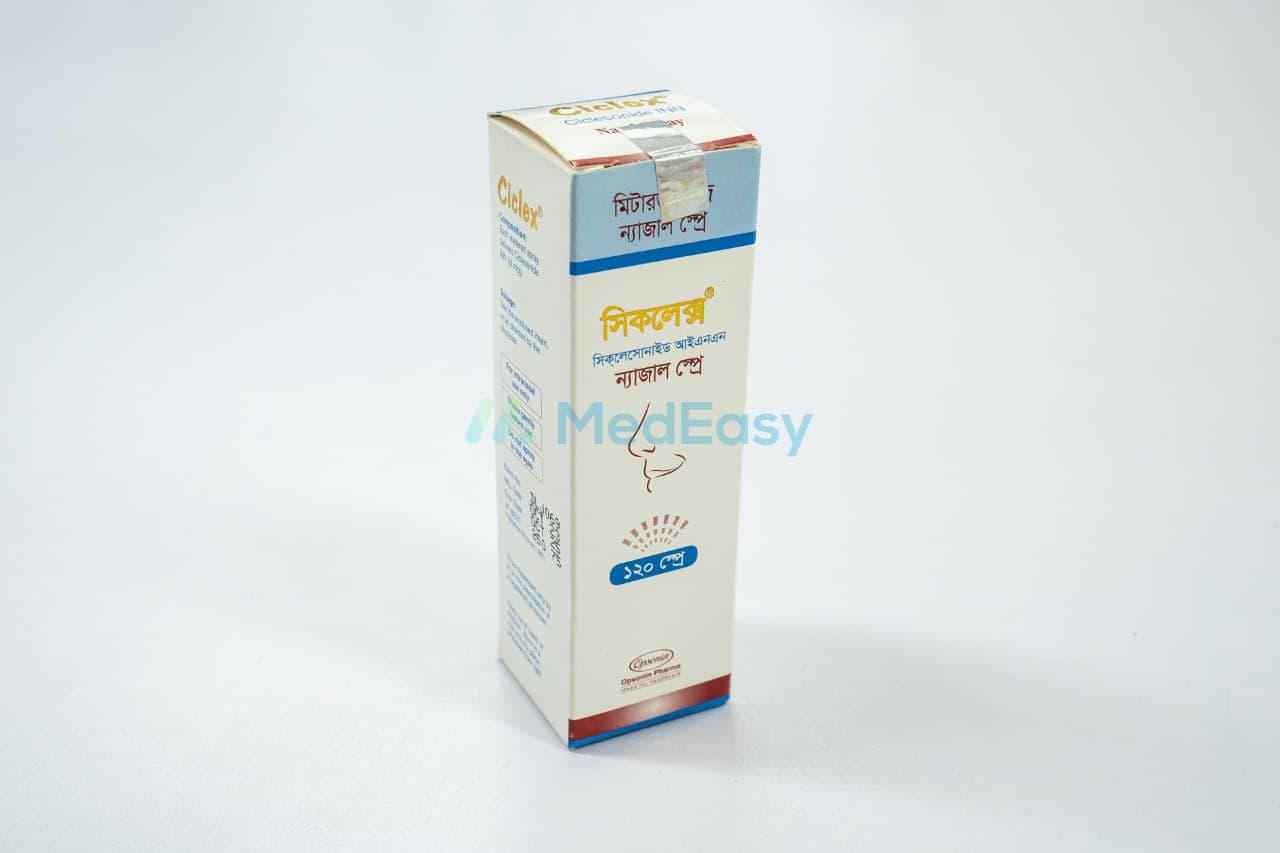
Ciclex 50 mcg/spray Nasal Spray is available on MedEasy for ৳225.68 per 120 metered sprays, with home delivery anywhere in Bangladesh. It is manufactured by Opsonin Pharma Ltd. Its generic name is Ciclesonide.

Ciclex is an inhaled corticosteroid (prodrug) used for long-term maintenance and prophylactic treatment of two separate conditions, depending on the formulation used:
Important: Ciclex is not indicated for the relief of acute bronchospasm or status asthmaticus. It is a controller medicine, not a rescue inhaler, and must be used together with a separate fast-acting (rescue) bronchodilator for sudden asthma symptoms.
Ciclex has also been studied off-label for other allergic and inflammatory airway conditions, but such uses are not established by regulatory labeling and should only be undertaken under direct physician guidance.
Each dose of Ciclesonide inhalation aerosol or nasal spray contains Ciclesonide as the active pharmaceutical ingredient, formulated as a hydrofluoroalkane (HFA)-propelled solution aerosol (for oral inhalation) or as an aqueous suspension (for nasal spray). Strengths available include 80 mcg and 160 mcg per actuation for the oral inhaler, and 50 mcg per spray for the nasal formulation. Refer to the specific product label for the exact strength and inactive ingredients of the dispensed product.
Ciclex is a synthetic, non-halogenated inhaled corticosteroid (ICS) that acts as a prodrug. After deposition in the lung or nasal mucosa, it is enzymatically hydrolyzed by esterases to its pharmacologically active metabolite, des-Ciclex, which has potent local anti-inflammatory activity. Because activation occurs mainly at the site of delivery, Ciclex is designed to reduce oropharyngeal deposition of active drug and associated local side effects compared with some older inhaled steroids. It is available as a pressurized metered-dose inhaler for asthma and as an aqueous nasal spray for allergic rhinitis.
Ciclex belongs to the pharmacological class of inhaled corticosteroids (glucocorticoids), used as anti-inflammatory agents for chronic airway and nasal allergic disease. It is classified therapeutically as an anti-asthmatic / anti-allergic agent for local (topical) respiratory use.
Ciclesonide is a prodrug that, upon deposition in lung or nasal tissue, is converted by esterase enzymes into its active metabolite, des-ciclesonide. Des-ciclesonide binds with high affinity to the glucocorticoid receptor (approximately 120 times greater affinity than the parent compound), suppressing multiple inflammatory cell types (mast cells, eosinophils, lymphocytes) and mediators involved in the allergic and asthmatic inflammatory cascade, thereby reducing airway/nasal mucosal inflammation, hyperresponsiveness, and symptoms.
| Prior Therapy | Starting Dose | Maximum Dose |
|---|---|---|
| Bronchodilators alone | 80 mcg twice daily | 160 mcg twice daily |
| Inhaled corticosteroids | 80 mcg twice daily | 320 mcg twice daily |
| Oral corticosteroids | 320 mcg twice daily | 320 mcg twice daily |
The lowest dose that maintains asthma control should be used. Maximum benefit may take 4 weeks or longer to appear.
Ciclex is not approved for use in children younger than 6 years (nasal spray) or younger than 12 years (oral inhaler). It is not a substitute for a rescue bronchodilator and must not be used to treat an acute asthma attack.
Do not swallow Ciclex and do not use it more often or in higher doses than prescribed. Ciclex must always be used together with a separate fast-acting rescue inhaler for sudden breathing difficulty; it does not relieve acute symptoms itself.
Ciclex (via its active metabolite, des-Ciclex) is metabolized mainly by the CYP3A4 enzyme system. Clinically significant interactions are limited but include:
Inform the prescribing physician of all other medicines, including antifungals, protease inhibitors, and other corticosteroids, before starting Ciclex.
Systemic corticosteroid-related effects (adrenal suppression, reduced growth velocity in children, decreased bone mineral density, glaucoma/cataracts) are discussed under Precautions and Warnings, as they relate mainly to long-term or high-dose use of Ciclex rather than typical short-term adverse events.
There are no adequate and well-controlled studies of Ciclex in pregnant women. As with other inhaled corticosteroids, Ciclex should be used during pregnancy only if the potential benefit to the mother (i.e., maintaining adequate control of asthma or allergic rhinitis) justifies the potential risk to the fetus. Uncontrolled asthma during pregnancy carries its own risks to mother and fetus, so Ciclex therapy should not be stopped without medical advice. Always consult a physician before using Ciclex during pregnancy.
It is not known whether Ciclex or its active metabolite passes into human breast milk in clinically significant amounts. Because many corticosteroids are excreted in breast milk to some degree, caution is advised, and Ciclex should be used during breastfeeding only if clearly needed and under medical supervision, weighing the benefits of treatment against any possible risk to the nursing infant.
Acute overdose with Ciclex is unlikely to cause immediate danger given its topical mode of delivery and low oral bioavailability, but chronic overdosage or use of excessive doses of Ciclex over a prolonged period may lead to systemic corticosteroid effects (hypercorticism/Cushingoid features), including adrenal suppression. There is no specific antidote. If an overdose is suspected, or if a child has accidentally ingested or inhaled a large amount of Ciclex, seek immediate medical attention or contact a poison control center/emergency services rather than attempting home treatment. Long-term use of Ciclex at doses higher than prescribed should be avoided; adrenal function may need to be monitored after excessive or prolonged use.
Store Ciclex at room temperature (below 30°C), away from direct light, heat, and moisture. Do not freeze the nasal spray. Do not puncture, break, or incinerate the inhaler canister, and avoid exposure to temperatures above 49°C (120°F). Keep the cap on when not in use and discard nasal spray bottles after the labeled number of actuations or per the expiry indicated on the label. Keep out of reach and sight of children.
Safety and efficacy of the Ciclex oral inhaler have been established for asthma maintenance therapy in patients 12 years and older; it has not been established in children below 12 years of age. The Ciclex nasal spray is approved from 6 years of age for seasonal allergic rhinitis and from 12 years for perennial allergic rhinitis; safety and efficacy in younger children have not been established. Growth velocity should be monitored periodically in pediatric patients on long-term Ciclex therapy.
Clinical studies of Ciclex did not include sufficient numbers of patients aged 65 years and older to determine whether they respond differently from younger adults. Dose selection for an elderly patient should generally start at the lower end of the dosing range, reflecting the greater frequency of comorbidities and concomitant medication use in this population.
Specific dose adjustments for Ciclex have not been established for renal or hepatic impairment; because systemic exposure is low, clinically important effects are not expected, but Ciclex should be used with caution and under medical supervision in patients with significant hepatic impairment, given the drug's hepatic metabolism.
Ciclex is intended for regular, ongoing (maintenance) use rather than short-term or as-needed treatment. For asthma, Ciclex should be used daily even when symptoms are absent, as it works to prevent inflammation and flare-ups over time; noticeable improvement may take up to 4 weeks. For allergic rhinitis, Ciclex is typically used throughout the relevant allergy season or as long as year-round symptoms persist. The duration of Ciclex treatment should be determined by the prescribing physician based on symptom control, and therapy should not be stopped or the dose changed without medical advice, especially in patients who have been on higher doses for a prolonged period.
Inhaled Corticosteroid (Glucocorticoid); Anti-asthmatic and Anti-allergic (Nasal) agent.
Ciclesonide is a prodrug that undergoes activation by esterase enzymes in lung and nasal tissue to form its active metabolite, des-ciclesonide. Des-ciclesonide binds to the glucocorticoid receptor with high affinity, suppressing the transcription of pro-inflammatory genes and inflammatory cell activity (eosinophils, mast cells, lymphocytes, cytokines) in the airway or nasal mucosa. This reduces mucosal inflammation, edema, and mucus secretion, thereby controlling asthma symptoms and allergic rhinitis symptoms with continued regular use of Ciclesonide.
Ciclex oral inhaler is approved for asthma maintenance therapy in patients 12 years of age and older; safety and efficacy have not been established for asthma in children under 12. The Ciclex nasal spray is approved for seasonal allergic rhinitis in children 6 years and older, and for perennial allergic rhinitis from 12 years of age; it has not been shown effective for perennial rhinitis in children younger than 12, and safety/efficacy of Ciclex below the approved ages have not been established. As with other inhaled corticosteroids, growth velocity should be monitored periodically in children on long-term Ciclex therapy, and the lowest dose that controls symptoms should be used.
Q: What is Ciclex 50 mcg/spray Nasal Spray used for?
A: Ciclex 50 mcg/spray Nasal Spray is an inhaled corticosteroid used as a maintenance (long-term controller) medicine. As an oral inhaler, it prevents asthma symptoms and flare-ups in patients 12 years and older. As a nasal spray, it relieves nasal symptoms of seasonal allergic rhinitis (from age 6) and perennial allergic rhinitis (from age 12).
Q: Can I use Ciclex 50 mcg/spray Nasal Spray to treat a sudden asthma attack?
A: No. Ciclex 50 mcg/spray Nasal Spray is not a rescue medicine and will not relieve sudden breathing difficulty or an acute asthma attack. It must always be used together with a separate fast-acting (rescue) bronchodilator inhaler for acute symptoms, and should not be used as the sole treatment for status asthmaticus or acute bronchospasm.
Q: Does Ciclex 50 mcg/spray Nasal Spray cause thrush (oral yeast infection)?
A: Ciclex 50 mcg/spray Nasal Spray is designed as a prodrug that activates mainly in the lung, which lowers the risk of oral thrush compared with some other inhaled steroids, but the risk is not eliminated. Rinsing the mouth with water (without swallowing) after each use of the Ciclex 50 mcg/spray Nasal Spray inhaler is recommended as a precaution to further reduce this risk.
Q: Is Ciclex 50 mcg/spray Nasal Spray safe to use during pregnancy or breastfeeding?
A: There is limited human data on Ciclex 50 mcg/spray Nasal Spray in pregnancy and breastfeeding. Ciclex 50 mcg/spray Nasal Spray should be used during pregnancy only if the potential benefit (such as maintaining asthma control) justifies the potential risk to the fetus, and during breastfeeding only if clearly needed, always under a physician's guidance. Uncontrolled asthma itself can be risky in pregnancy, so Ciclex 50 mcg/spray Nasal Spray treatment should not be stopped without medical advice.
Q: Can children use Ciclex 50 mcg/spray Nasal Spray?
A: The Ciclex 50 mcg/spray Nasal Spray oral inhaler is approved for asthma in children 12 years and older; it is not established as safe and effective below that age. The Ciclex 50 mcg/spray Nasal Spray nasal spray is approved from 6 years of age for seasonal allergic rhinitis and from 12 years for perennial allergic rhinitis. Growth should be monitored in children using Ciclex 50 mcg/spray Nasal Spray long-term, as with other inhaled corticosteroids.
Q: What should I do if I miss a dose or think I have taken too much Ciclex 50 mcg/spray Nasal Spray?
A: If a dose of Ciclex 50 mcg/spray Nasal Spray is missed, take it as soon as remembered unless it is almost time for the next dose; do not double the dose. Ciclex 50 mcg/spray Nasal Spray should be taken exactly as prescribed. If an overdose is suspected, especially in a child, seek immediate medical attention or contact emergency services/poison control rather than treating it at home.
Disclaimer
The information provided is accurate to the best of our knowledge, but it does not replace professional medical advice. We cannot guarantee its completeness or accuracy, and the absence of specific information about a drug should not be taken as an endorsement. We are not responsible for any consequences arising from this information, so please consult a healthcare professional for any concerns or questions.