
10% Off
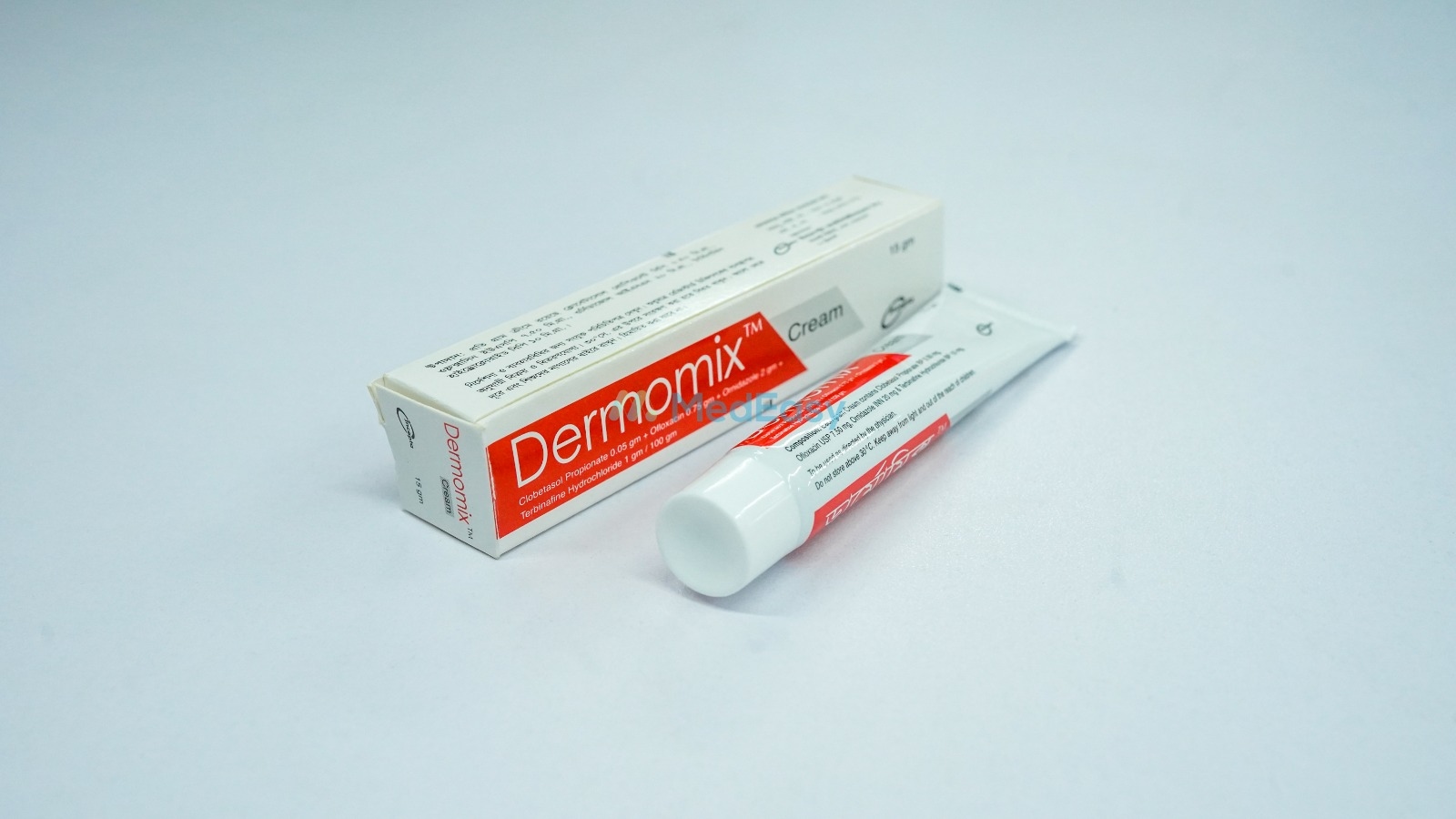
Dermomix15 gm
Incepta Pharmaceuticals Ltd.
৳180.00
Add to cart
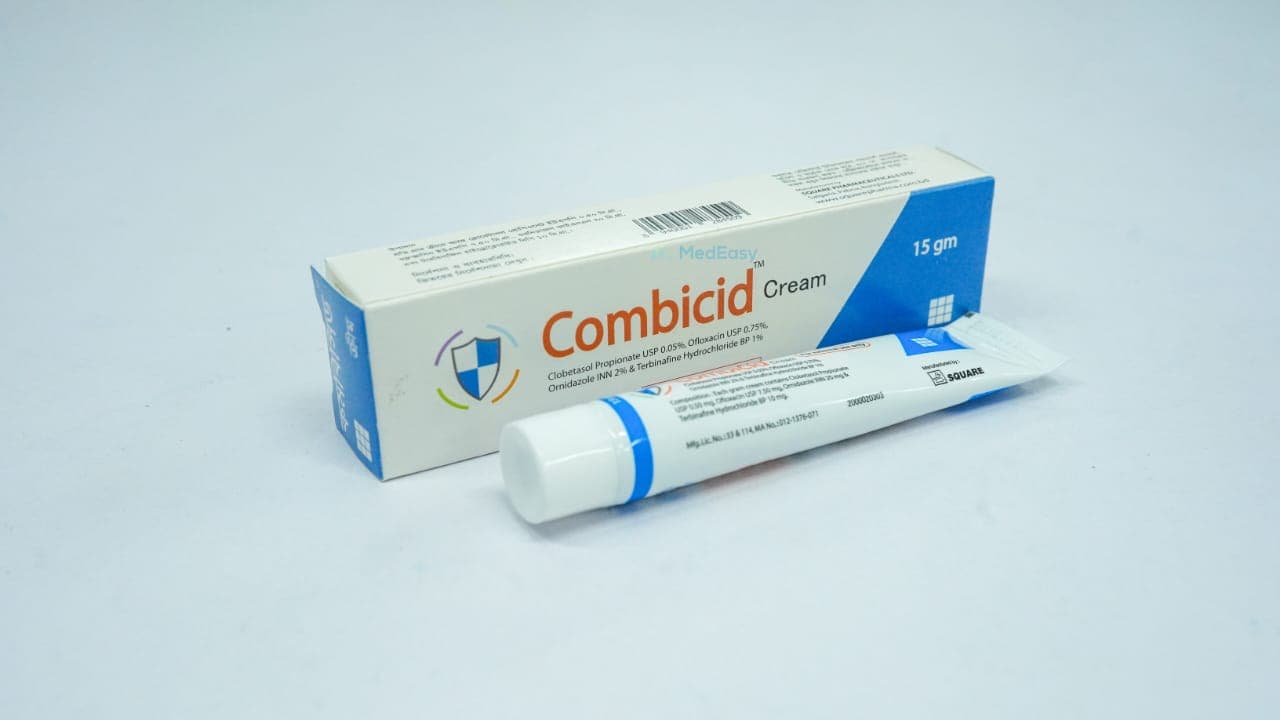

Combicid is a fixed-dose topical combination used for short-term treatment of mixed and complicated skin infections that involve fungal, bacterial and inflammatory components together.
Each gram of Clobetasol Propionate + Ofloxacin + Ornidazole + Terbinafine cream typically contains Clobetasol Propionate USP 0.05% w/w (0.5 mg), Ofloxacin USP 0.75% w/w (7.5 mg), Ornidazole INN 2% w/w (20 mg) and Terbinafine Hydrochloride BP 1% w/w (10 mg), formulated in a topical cream base.
Combicid is a topical fixed-dose combination product that brings together an ultra-potent topical corticosteroid (clobetasol propionate), a broad-spectrum fluoroquinolone antibacterial (ofloxacin), a nitroimidazole antiprotozoal/antianaerobic agent (ornidazole) and an allylamine antifungal (terbinafine) in a single cream.
It is intended for short, targeted courses in patients with mixed skin infections where fungal, bacterial and inflammatory elements coexist, rather than for routine or prolonged treatment of simple fungal or inflammatory skin conditions.
Combicid belongs to the topical combination therapeutic class comprising a corticosteroid, a fluoroquinolone antibacterial, a nitroimidazole antiprotozoal/antibacterial and an allylamine antifungal, used for combined anti-inflammatory, antibacterial, antiprotozoal and antifungal action on the skin.
Clobetasol Propionate + Ofloxacin + Ornidazole + Terbinafine combines four active substances with complementary mechanisms:
Together these actions allow Clobetasol Propionate + Ofloxacin + Ornidazole + Terbinafine to address inflammation, bacterial superinfection, anaerobic/protozoal contribution and dermatophyte infection concurrently for the duration of a short topical course.
Combicid is for external (topical) use only.
| Population | Recommended use |
|---|---|
| Adults and adolescents | Apply a thin film to the affected area and adjacent margin, gently rubbing in, twice daily (morning and night), typically for 1-2 weeks. Do not exceed 2-4 weeks of continuous use without medical reassessment. |
| Children | Not generally recommended; if prescribed by a physician for a child, use the smallest effective amount for the shortest possible duration under close supervision (see Use in special populations). |
Take Combicid exactly as prescribed by your physician; do not stop, extend, skip applications, use more frequently than directed, or share this medicine with others without medical advice, as inappropriate use of the antimicrobial and steroid components can promote resistant or steroid-modified infections.
If there is no visible improvement within 2 weeks, or if the condition worsens, stop use and consult a physician for reassessment rather than continuing or repeating the course independently.
To apply Combicid correctly:
Because Combicid is applied topically and systemic absorption is normally low, clinically significant drug interactions are uncommon with correct, limited use. Documented or theoretical concerns include:
Clobetasol Propionate + Ofloxacin + Ornidazole + Terbinafine is contraindicated in:
Most side effects of Combicid are local and mild when the product is used correctly for a short course:
With prolonged, excessive, or inappropriate use (larger areas, occlusion, sensitive sites), additional effects may occur:
Combicid should be used in pregnancy only if clearly needed and if the potential benefit justifies the potential risk to the fetus; safety of this specific fixed-dose combination in pregnancy has not been established in controlled studies. If use is necessary, the smallest effective amount should be applied for the shortest possible duration, avoiding large areas and occlusion, and only under medical advice.
It is not known whether topically applied components of Combicid are excreted in human breast milk in clinically significant amounts. As a precaution, breastfeeding mothers should avoid applying this cream to the breast/nipple area and should consult a physician before use elsewhere on the body during lactation.
Combicid is for external use only and should be used exactly as prescribed by your physician; do not stop, extend, skip applications, or share this medicine with others without medical advice, as inappropriate use of its antimicrobial components can contribute to resistant or steroid-modified skin infections.
Topical overdose of Combicid is unlikely with correct use, but excessive or prolonged application over large areas, or under occlusion, may lead to increased systemic absorption of clobetasol, ofloxacin, ornidazole and terbinafine, with a risk of systemic corticosteroid effects (such as HPA-axis suppression) and, rarely, other systemic adverse effects.
If accidental ingestion occurs, or if signs of systemic toxicity or significant local reaction develop after excessive application, stop use immediately and seek immediate medical attention or contact a poison control centre; do not attempt specific home treatment without professional guidance.
Store below 30°C, away from light and moisture. Do not freeze. Keep out of reach of children.
Children: Safety and efficacy of Combicid have not been well established in children, particularly under 12 years of age. If a physician prescribes it for a child, the smallest effective amount should be used for the shortest possible time, avoiding occlusive dressings and diaper/nappy areas, due to a proportionally greater risk of systemic absorption and HPA-axis suppression in children compared with adults.
Elderly: No specific dose adjustment is established, but elderly patients often have thinner, more fragile skin and may be more susceptible to corticosteroid-related atrophy; use the lowest effective amount for the shortest duration.
Renal/hepatic impairment: No formal studies exist for this topical combination; systemic absorption is expected to be minimal with correct, limited use, but caution is advised with extensive application in patients with significant hepatic or renal impairment.
A typical course of Combicid lasts about 1-2 weeks. Treatment should be reassessed by a physician if there is no improvement within 2 weeks, and continuous use beyond 2-4 weeks should only continue under direct medical supervision, since prolonged use of the potent steroid component increases the risk of skin atrophy, systemic absorption and steroid-modified infection.
Clobetasol Propionate + Ofloxacin + Ornidazole + Terbinafine is a fixed-dose topical combination of an ultra-high-potency corticosteroid (clobetasol propionate), a fluoroquinolone antibacterial (ofloxacin), a nitroimidazole antiprotozoal/antibacterial (ornidazole), and an allylamine antifungal (terbinafine).
Clobetasol Propionate + Ofloxacin + Ornidazole + Terbinafine acts through four simultaneous mechanisms: clobetasol propionate suppresses inflammation via glucocorticoid receptor-mediated anti-inflammatory pathways; ofloxacin kills susceptible bacteria by inhibiting DNA gyrase and topoisomerase IV; ornidazole disrupts anaerobic bacterial and protozoal DNA through reduced nitro-radical intermediates; and terbinafine kills dermatophyte fungi by inhibiting squalene epoxidase and blocking ergosterol synthesis in the fungal cell membrane.
The safety and efficacy of Combicid have not been well established in children. Because children have a greater skin-surface-area-to-body-weight ratio, they may absorb topical corticosteroids and antimicrobials more readily, increasing the risk of HPA-axis suppression and other systemic effects. If a physician determines that use in a child is necessary, the smallest effective amount should be applied for the shortest possible duration, avoiding occlusive dressings and diaper areas, with close monitoring for local and systemic effects.
Q: What is Combicid 15 gm Cream cream used for?
A: Combicid 15 gm Cream is a topical cream used for short courses to treat mixed skin infections that involve fungal, bacterial and inflammatory components together, such as extensive or inflamed tinea infections with secondary bacterial involvement. It is not intended for simple, uncomplicated fungal infections.
Q: How long can I use Combicid 15 gm Cream?
A: Most courses of Combicid 15 gm Cream last about 1-2 weeks. Do not use it continuously for more than 2-4 weeks without your physician reassessing you, because prolonged use of the steroid component increases the risk of skin thinning and other side effects.
Q: Can I use Combicid 15 gm Cream on my face or groin?
A: Combicid 15 gm Cream should be used on the face, groin, or axillae only under a physician's direction and only for a short duration, because these are thin-skinned areas where the ultra-potent steroid component can cause atrophy, striae, and increased absorption into the body; prolonged use at these sites is contraindicated.
Q: Is Combicid 15 gm Cream safe during pregnancy or breastfeeding?
A: Combicid 15 gm Cream should be used in pregnancy only if clearly needed and only under medical advice, since its safety has not been established in controlled studies. Breastfeeding mothers should avoid applying it to the breast area and should consult a physician before using it elsewhere.
Q: What are the common side effects of Combicid 15 gm Cream?
A: Common side effects include burning, itching, irritation, dryness, and redness at the application site. Prolonged or excessive use can cause skin thinning, stretch marks, or a masked/steroid-modified fungal infection, so it should only be used as directed by a physician.
Q: What should I do if I miss an application or use too much Combicid 15 gm Cream?
A: If you miss a dose, simply apply it at the next scheduled time; do not double up. If you or a child accidentally swallows Combicid 15 gm Cream, or if excessive application causes concerning symptoms, seek immediate medical attention or contact a poison control centre.
Disclaimer
The information provided is accurate to the best of our knowledge, but it does not replace professional medical advice. We cannot guarantee its completeness or accuracy, and the absence of specific information about a drug should not be taken as an endorsement. We are not responsible for any consequences arising from this information, so please consult a healthcare professional for any concerns or questions.

