
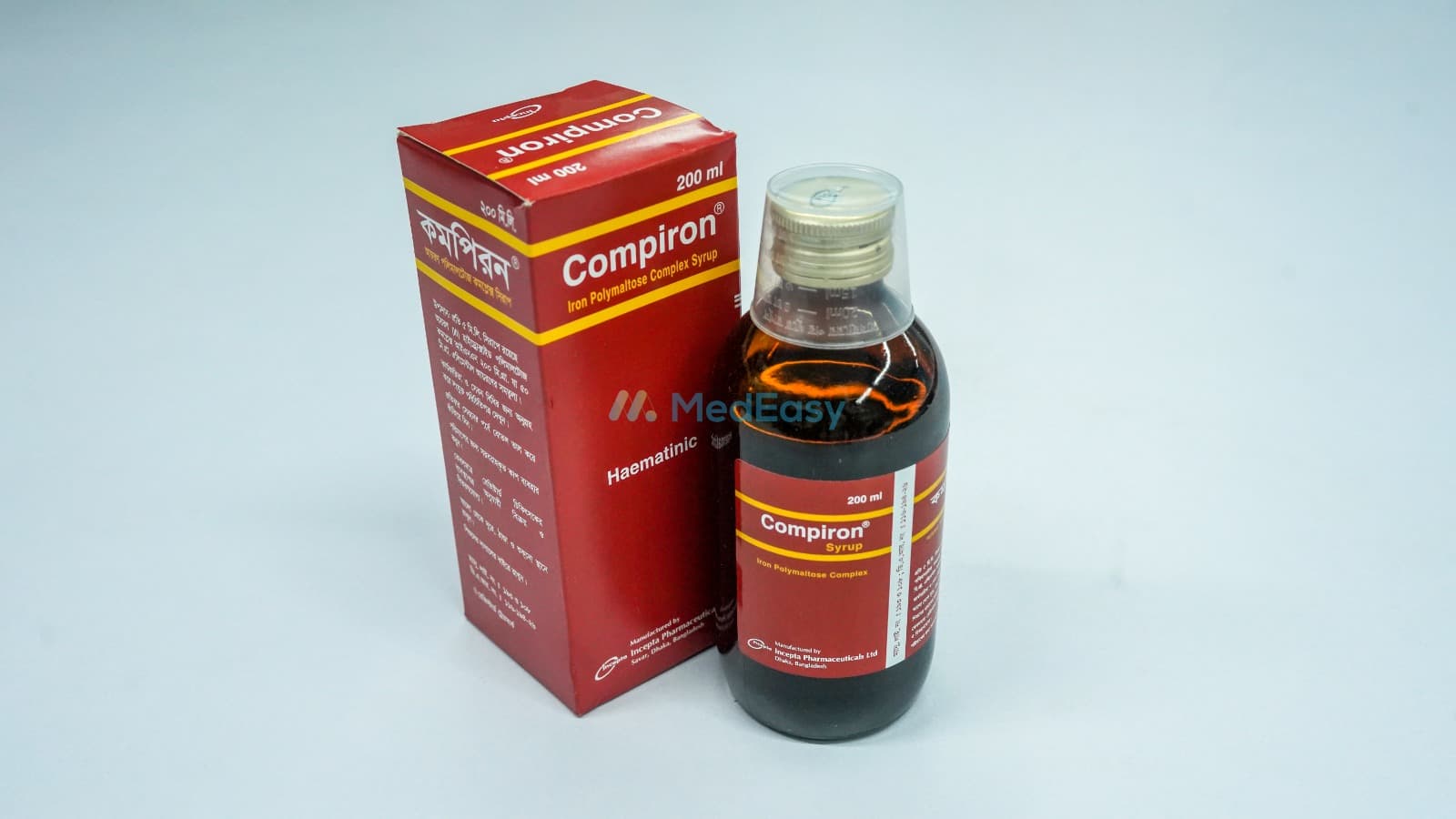

Medicine overview
Indications of Compiron
Compiron is indicated for the treatment and prevention of iron-deficiency anemia and latent (non-anemic) iron deficiency, particularly in patients who cannot tolerate simple ferrous iron salts.
Established uses
- Treatment of confirmed iron-deficiency anemia in adults and children.
- Prevention and treatment of iron-deficiency anemia before, during, and after pregnancy, as advised by a physician.
- Nutritional iron deficiency due to inadequate dietary intake or increased physiological requirements (growth, menstrual blood loss, blood donation).
Adjunct / supportive use
- As an oral iron-replacement option in patients with a history of gastrointestinal intolerance to ferrous salts (ferrous sulfate, ferrous fumarate).
- Adjunct to correction of the underlying cause of iron deficiency (e.g., menorrhagia, occult GI blood loss), which must be separately investigated and treated.
Compiron is not effective for anemias that are not caused by iron deficiency (e.g., anemia of chronic disease with normal iron stores, hemolytic anemia, or megaloblastic anemia due to vitamin B12/folate deficiency) and should not be used empirically without confirming iron deficiency where feasible.
Composition
Iron Polymaltose Complex (also known as iron(III)-hydroxide polymaltose complex) is a macromolecular complex of ferric hydroxide and polymaltose (a partially hydrolyzed starch derivative). Each complex molecule surrounds a core of ferric oxyhydroxide with polymaltose molecules, which stabilizes the iron in a non-ionic, controlled-release form.
Iron Polymaltose Complex is formulated as oral drops, syrup, chewable tablets, and film-coated tablets, and, in some markets, as a solution for intramuscular injection, with strength expressed as elemental iron content.
Description
Compiron is a synthetic, non-ionic macromolecular complex consisting of polynuclear ferric hydroxide surrounded by covalently bound polymaltose chains. This structure is designed to closely resemble the natural iron-storage protein ferritin, allowing iron to be absorbed through an active, regulated process across the intestinal mucosa rather than through passive diffusion of free ferric or ferrous ions.
Because the iron in Compiron is bound within a stable complex rather than existing as free ionic iron, it is associated with less gastrointestinal irritation, less metallic taste, and a lower risk of free-radical-mediated oxidative damage compared with conventional ferrous iron salts, while still allowing effective repletion of iron stores.
Therapeutic Class
Compiron belongs to the class of oral (and, in some formulations, parenteral) iron-replacement agents, specifically the non-ionic trivalent iron-carbohydrate complexes, distinguishing it from simple ionic ferrous salt preparations (e.g., ferrous sulfate, ferrous fumarate, ferrous gluconate).
Pharmacology
Iron Polymaltose Complex delivers iron in the trivalent (ferric, Fe3+) state bound within a stable polymaltose shell. Unlike ferrous salts, which release free Fe2+ ions that diffuse passively across the gut mucosa, iron from Iron Polymaltose Complex is taken up by an active, receptor-mediated (transferrin/DMT1-independent, ferritin-like) absorption process at the brush border of the duodenum and proximal jejunum.
This controlled uptake means absorption is partly regulated by the body's existing iron stores, and the complex does not readily generate free radicals or catalyze oxidative reactions in the gut lumen, which underlies its improved gastrointestinal tolerability. Absorbed iron is transported bound to transferrin, stored as ferritin/hemosiderin in the liver, spleen, and bone marrow, and utilized for hemoglobin synthesis in developing erythrocytes.
Dosage & Administration of Compiron
Dosing of Compiron is expressed in terms of elemental iron and should be individualized based on the degree of iron deficiency, age, and body weight, under medical supervision.
| Population / Indication | Typical Dose |
|---|---|
| Adults and adolescents (iron-deficiency anemia) | 100–200 mg elemental iron (equivalent to approximately 10–20 mL syrup or 1–2 tablets) once or twice daily, in divided doses |
| Pregnant women (prevention/treatment) | As advised by the treating physician, typically 100 mg elemental iron once or twice daily |
| Children 6–12 years | Approximately 5–10 mL syrup/drops daily, or as directed by a pediatrician based on weight |
| Children 2–6 years | Approximately 5 mL syrup/drops daily, or as directed by a pediatrician |
| Infants | Approximately 3–6 mg elemental iron/kg body weight/day, using pediatric drops, only under medical supervision |
Treatment duration for anemia typically continues for 2–3 months after hemoglobin normalizes to replenish iron stores; see Duration of Treatment. Doses should be adjusted and monitored by a physician based on response (hemoglobin, ferritin) and tolerability.
Administration of Compiron
Compiron oral drops and syrup may be taken with or after meals to further improve gastrointestinal tolerability (unlike ferrous salts, absorption is not significantly reduced by food). Tablets should be swallowed whole or chewed as directed on the product label, with a glass of water or juice.
Pediatric drops should be measured using the calibrated dropper/measuring device provided and may be mixed with food, juice, or infant formula immediately before administration. Where a parenteral (injectable) form of Compiron is prescribed, it must be administered only by a qualified healthcare professional in a setting equipped to manage hypersensitivity reactions, following the specific product's administration instructions.
Interaction of Compiron
A key pharmacological advantage of Compiron is that, because its iron is bound within a stable non-ionic complex, it does not dissociate into free ionic iron in the gut. This means Compiron generally shows fewer clinically significant interactions with food, tea, coffee, calcium, antacids, or tetracycline/fluoroquinolone antibiotics than conventional ferrous iron salts, which typically require dose separation from such substances.
Despite this improved profile, caution and dose separation (by at least 1–2 hours) are still reasonably advised when Compiron is co-administered with:
- Oral tetracyclines or fluoroquinolone antibiotics — theoretical reduction in antibiotic absorption via chelation, although the effect is much less pronounced than with ferrous salts.
- Levothyroxine — iron products may reduce absorption of thyroid hormone; separate administration is prudent.
- Other oral iron supplements or multivitamin-mineral products containing iron — concurrent use may increase the risk of iron overload; avoid unless directed by a physician.
Contraindications
Iron Polymaltose Complex is contraindicated in patients with:
- Known hypersensitivity to Iron Polymaltose Complex or any component of the formulation.
- Iron overload states, including hereditary hemochromatosis and hemosiderosis.
- Anemias not due to iron deficiency (e.g., hemolytic anemia, thalassemia without concurrent iron deficiency, sideroblastic anemia, or anemia of chronic disease with normal/high iron stores), where iron administration would be inappropriate and potentially harmful.
Side Effects of Compiron
Compiron is generally better tolerated than ferrous iron salts. Reported adverse effects include:
- Common: mild gastrointestinal discomfort, nausea, epigastric fullness, constipation, or diarrhea; dark or black-colored stools (an expected, harmless effect of unabsorbed iron, not to be mistaken for gastrointestinal bleeding).
- Less common: vomiting, abdominal pain, temporary staining of teeth with liquid formulations (minimized by diluting the drops/syrup or using a straw).
- Rare (mainly with parenteral forms): hypersensitivity reactions ranging from mild rash to, rarely, severe anaphylactoid reactions; injection-site pain or discoloration.
Pregnancy & Lactation
Compiron is commonly used for the prevention and treatment of iron-deficiency anemia during pregnancy under medical supervision, and iron in general is an essential nutrient in pregnancy. However, as with any medicine used in pregnancy, Compiron should be used only if clearly needed, at the lowest effective dose, and after the potential benefit is judged by a physician to justify any potential risk; routine antenatal use should follow the prescriber's or national guideline's recommendation.
During breastfeeding, iron is excreted into breast milk in only small, clinically insignificant amounts, and Compiron is generally considered compatible with breastfeeding when used as directed. A physician or pharmacist should nonetheless be consulted before use in both pregnancy and lactation.
Precautions & Warnings
Compiron should be used with caution in patients with active peptic ulcer disease, inflammatory bowel disease, or other active gastrointestinal inflammatory conditions, as iron may still cause local irritation despite its improved tolerability profile.
Use with caution in patients with acute infections; some evidence suggests that supplemental iron may favor the growth of certain pathogens, so clinicians may choose to defer non-urgent iron replacement until an acute infection resolves.
Iron overload is a distinct risk with excessive, prolonged, or inappropriate use (see Contraindications); periodic monitoring of hemoglobin and iron studies is advised during prolonged therapy. Parenteral formulations of Compiron, where available, carry a risk of hypersensitivity reactions, including rare anaphylaxis, and must be given only under direct medical supervision with resuscitation facilities available. Keep out of reach of children, as accidental ingestion of iron-containing products by children can be dangerous (see Overdose).
Overdose Effects of Compiron
Compared with ferrous iron salts, Compiron has a lower risk of acute toxicity because iron is released in a controlled manner from the complex; however, iron overload and toxicity can still occur with excessive, prolonged, or inappropriate use, or accidental ingestion of large amounts, particularly by children.
Symptoms of significant iron overdose may include nausea, vomiting, abdominal pain, diarrhea, and, in severe cases, drowsiness, metabolic acidosis, or circulatory collapse. In case of suspected overdose, seek immediate medical attention or contact a poison control center/emergency services; do not attempt specific home treatment. Management is supportive and should be carried out in a hospital setting.
Storage Conditions
Store at room temperature (below 30°C), away from light and moisture. Keep out of reach of children.
Use In Special Populations
Pediatric use: Compiron is used in infants, children, and adolescents for iron-deficiency anemia and its prevention, with dosing based on age and body weight (see Dosage and Administration); it should be given under pediatric medical supervision, particularly in infants.
Elderly: No specific dose adjustment is generally required for Compiron in elderly patients, but the underlying cause of iron deficiency (e.g., occult gastrointestinal blood loss, malabsorption) should be investigated, as should renal and cardiac status if higher doses or parenteral forms are considered.
Renal impairment: Compiron may be used in patients with chronic kidney disease-associated iron-deficiency anemia; dosing should be individualized by the treating physician, often alongside erythropoiesis-stimulating agents where indicated.
Hepatic impairment: No well-established specific dose adjustment is required, but caution is advised given the liver's role in iron storage; use under medical supervision.
Duration Of Treatment
Treatment with Compiron for iron-deficiency anemia is typically continued for 8–12 weeks (2–3 months) after hemoglobin levels return to normal, in order to replenish depleted iron stores (ferritin). Total treatment duration is therefore usually several months and should be guided by periodic blood tests (hemoglobin, serum ferritin) as directed by the treating physician, who will also determine when it is appropriate to stop.
Drug Classes
Oral and parenteral iron-replacement agents; non-ionic trivalent iron-carbohydrate (iron-polymaltose) complexes; antianemic preparations.
Mode Of Action
Iron Polymaltose Complex works by supplying iron in a stable, non-ionic ferric-polymaltose complex that closely mimics the body's natural iron-storage molecule, ferritin. Iron is released from the complex and absorbed across the intestinal mucosa through a controlled, active uptake process, then transported by transferrin to the bone marrow, where it is incorporated into hemoglobin for red blood cell production, and to storage sites (liver, spleen) as ferritin and hemosiderin.
Pediatric Uses
Compiron is used in the pediatric population, from infancy through adolescence, for the treatment and prevention of iron-deficiency anemia and nutritional iron deficiency, using age- and weight-based dosing (see Dosage and Administration).
Formal safety and efficacy data in very young infants (under 6 months) are more limited than in older children, so Compiron should be used in infants only under direct pediatric medical supervision, with the dose calculated carefully based on body weight. Liquid formulations (drops, syrup) are generally preferred in younger children for ease of accurate dosing.
Frequently Asked Questions
Q: What is Compiron 200 ml Syrup used for?
A: Compiron 200 ml Syrup is used to treat and prevent iron-deficiency anemia and low iron stores, including during pregnancy, in children, and in adults who have not tolerated other iron supplements well.
Q: Why does Compiron 200 ml Syrup cause dark or black stools?
A: Dark or black stools are a common, expected, and harmless effect of unabsorbed iron passing through the digestive tract while taking Compiron 200 ml Syrup. It does not indicate bleeding, but if you notice true black, tarry, foul-smelling stools together with dizziness or weakness, contact your doctor to rule out gastrointestinal bleeding.
Q: Is Compiron 200 ml Syrup safer for the stomach than iron tablets like ferrous sulfate?
A: Yes. Because the iron in Compiron 200 ml Syrup is bound in a stable, non-ionic complex rather than existing as free ionic iron, it tends to cause less nausea, stomach upset, constipation, and metallic taste compared with conventional ferrous salts, although mild gastrointestinal effects can still occur.
Q: Can Compiron 200 ml Syrup be taken during pregnancy or while breastfeeding?
A: Compiron 200 ml Syrup is commonly used during pregnancy to treat and prevent iron-deficiency anemia, and only small, clinically insignificant amounts pass into breast milk during lactation. However, it should be used in pregnancy and breastfeeding only as advised by a physician, who will confirm the need and appropriate dose.
Q: Who should not take Compiron 200 ml Syrup?
A: Compiron 200 ml Syrup should not be used by people with iron overload conditions such as hemochromatosis or hemosiderosis, by those with anemia not caused by iron deficiency (such as certain thalassemias or hemolytic anemia), or by anyone with a known hypersensitivity to Compiron 200 ml Syrup or its ingredients.
Q: What should I do if too much Compiron 200 ml Syrup is taken, especially by a child?
A: Accidental overdose of Compiron 200 ml Syrup, particularly in children, can be serious. Seek immediate medical attention or contact a poison control center/emergency services right away; do not try to treat it at home.
Disclaimer
The information provided is accurate to the best of our knowledge, but it does not replace professional medical advice. We cannot guarantee its completeness or accuracy, and the absence of specific information about a drug should not be taken as an endorsement. We are not responsible for any consequences arising from this information, so please consult a healthcare professional for any concerns or questions.
