
8% Off
Reef-D Vita600 mg+400
Healthcare Pharmaceuticals Ltd.
৳234.60
Add to cart
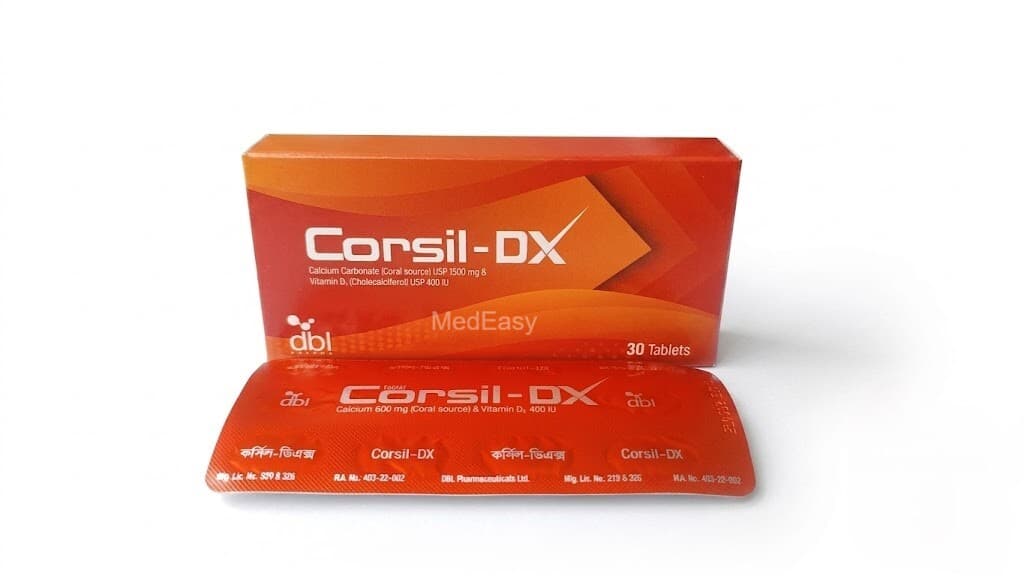
Corsil-DX 600 mg+400 IU Tablet is available on MedEasy for ৳144.00 per 10's Strip, with home delivery anywhere in Bangladesh. It is manufactured by DBL Pharmaceuticals Ltd. Its generic name is Coral Calcium + Vitamin D3.

Corsil-DX is a calcium and vitamin D3 combination supplement (calcium carbonate derived from a coral/marine source, combined with cholecalciferol) used for the following indications:
Note: Corsil-DX is a calcium carbonate source; claims that coral-derived calcium has superior absorption or therapeutic benefit compared with standard calcium carbonate are not well supported by robust clinical evidence, and it should be regarded as a conventional calcium carbonate/vitamin D3 supplement rather than a uniquely superior formulation.
Each dosage unit of Coral Calcium + Vitamin D3 typically contains calcium carbonate derived from a coral (marine) source, standardized to provide a defined amount of elemental calcium (commonly 500 mg or 600 mg elemental calcium per unit in marketed formulations), together with vitamin D3 (cholecalciferol), commonly 200 IU or 400 IU. Strengths and the tablet/effervescent-tablet form vary by manufacturer and market; always check the specific product label for exact elemental calcium and vitamin D3 content.
Corsil-DX is an oral mineral-vitamin combination supplement. The calcium component is calcium carbonate sourced from fossilized coral (a marine-derived form of calcium carbonate), while the vitamin D3 component is cholecalciferol. Calcium is essential for bone mineralization, nerve conduction, muscle contraction, and blood clotting, while vitamin D3 promotes intestinal absorption of calcium and phosphate and supports normal bone mineralization. Corsil-DX is used to correct or prevent calcium and vitamin D insufficiency and as part of the overall management of metabolic bone disorders such as osteoporosis and osteomalacia.
Corsil-DX belongs to the therapeutic class of calcium supplements combined with vitamin D3 (calcium and vitamin D combination preparations), used in the prevention and treatment of calcium/vitamin D deficiency and metabolic bone disease.
The calcium in Coral Calcium + Vitamin D3 is absorbed mainly in the small intestine through both active vitamin D-dependent transport and passive diffusion, and is essential for normal function of nerves, muscles, and the skeletal system, as well as for blood coagulation. Vitamin D3 (cholecalciferol) is hydroxylated in the liver and kidney to its active metabolite, calcitriol, which increases intestinal absorption of calcium and phosphate, promotes renal tubular reabsorption of calcium, and works with parathyroid hormone to regulate bone mineralization and resorption. Together, the two components of Coral Calcium + Vitamin D3 help maintain normal serum calcium levels and support bone mineral density. Coral-sourced calcium carbonate is chemically similar to other forms of calcium carbonate; while it has been marketed on the basis of its similarity to bone mineral structure, controlled clinical evidence does not establish superior absorption or efficacy over conventional calcium carbonate.
| Indication/Population | Typical Dose of Corsil-DX |
|---|---|
| Calcium/vitamin D supplementation in adults | One tablet once or twice daily (dose depends on elemental calcium/vitamin D3 content of the specific product), taken with plenty of water, preferably with or after meals to enhance absorption and reduce gastrointestinal upset. |
| Prevention/adjunct treatment of osteoporosis | One tablet once or twice daily as directed by the physician, generally combined with adequate dietary calcium intake, weight-bearing exercise, and, where indicated, specific anti-osteoporotic therapy. |
| Effervescent tablet formulations | Dissolve one tablet completely in a glass of water and drink; do not chew or swallow the effervescent tablet whole. |
| Pregnancy and lactation | As advised by the physician, generally not exceeding recommended daily calcium and vitamin D intake limits (see Pregnancy and Lactation section). |
The exact dose of Corsil-DX should be individualized based on baseline calcium/vitamin D status, dietary intake, and the specific product's elemental calcium and vitamin D3 content; always follow the treating physician's instructions or the product label.
Corsil-DX tablets should be taken orally with a full glass of water, preferably with or immediately after meals to improve absorption and minimize stomach upset. Effervescent tablets must be fully dissolved in water before drinking. If more than one calcium-containing product or other interacting medication is being taken, doses should be separated in time as advised by a physician or pharmacist (see Interactions).
Corsil-DX has the following clinically significant interactions:
Coral Calcium + Vitamin D3 is contraindicated in patients with:
The most common side effects of Corsil-DX are gastrointestinal and generally mild:
Less common effects include diarrhea, dry mouth, headache, and drowsiness. Rarely, allergic reactions (skin rash, itching) can occur. With prolonged high-dose use or in predisposed patients, hypercalcemia can develop, presenting with symptoms such as constipation, anorexia, thirst, and, in severe cases, irregular heartbeat (see Overdose Effects and Precautions).
Corsil-DX should be used during pregnancy and lactation only if clearly needed, at doses that do not exceed recommended daily calcium and vitamin D intake, and the potential benefit should justify any potential risk; a physician should be consulted before use. Excessive maternal calcium or vitamin D intake during pregnancy has been associated with a risk of fetal hypercalcemia and should be avoided. At recommended supplemental doses used to correct deficiency, Corsil-DX has not been shown to be teratogenic. Both calcium and vitamin D pass into breast milk; while use during breastfeeding at recommended doses is generally considered acceptable when there is a genuine calcium/vitamin D deficiency, the total maternal intake (including supplements given directly to the infant) should be taken into account, and a physician should guide dosing.
The following precautions apply to Corsil-DX:
Overdose of Corsil-DX can lead to hypervitaminosis D and hypercalcemia. Symptoms may include loss of appetite, excessive thirst, nausea, vomiting, constipation, abdominal pain, muscle weakness, fatigue, confusion or other mental disturbances, increased urination, bone pain, and, in severe or prolonged cases, kidney stones, nephrocalcinosis, cardiac arrhythmias, and irreversible renal or soft-tissue calcification. If an overdose of Corsil-DX is suspected, discontinue the product immediately and seek immediate medical attention or contact a poison control center/emergency services; do not attempt specific home treatment. Management is supportive and should be carried out under medical supervision, with monitoring of serum calcium, renal function, and cardiac status as needed.
Store at room temperature (below 30°C), away from light and moisture. Keep out of reach of children.
Corsil-DX may be used in children for supplementation of calcium/vitamin D deficiency, rickets, or inadequate dietary intake, with the dose adjusted according to age, weight, and the child's baseline calcium/vitamin D status; a pediatrician should determine the appropriate dose and formulation for young children.
Elderly patients, particularly those with reduced renal function or those taking cardiac glycosides or diuretics, should use Corsil-DX under closer medical supervision, with periodic monitoring of serum calcium and renal function.
Patients with severe renal insufficiency should avoid Corsil-DX due to impaired vitamin D metabolism and increased risk of hypercalcemia and soft-tissue calcification (see Contraindications); patients with mild-to-moderate renal impairment require dose individualization and monitoring.
No well-established dose adjustment is defined for hepatic impairment; since vitamin D3 requires hepatic hydroxylation for activation, patients with significant liver disease should use Corsil-DX cautiously and under medical supervision.
The duration of treatment with Corsil-DX depends on the indication: short-term supplementation may be adequate for correcting mild dietary insufficiency, while long-term or ongoing use (often months to years) is typical for osteoporosis prevention/management or chronic deficiency states. Duration should be determined by the treating physician based on periodic assessment of calcium/vitamin D status, bone health, and renal function.
Coral Calcium + Vitamin D3 belongs to the drug class of calcium supplements in fixed combination with vitamin D3 (calcium and vitamin D3 combination products).
Coral Calcium + Vitamin D3 works through two complementary mechanisms: the calcium component provides elemental calcium that is absorbed in the intestine to maintain serum calcium levels needed for bone mineralization, nerve transmission, and muscle contraction, while the vitamin D3 component is converted in the liver and kidney to calcitriol, the active hormone that increases intestinal absorption of calcium and phosphate and regulates calcium homeostasis together with parathyroid hormone.
In children, Corsil-DX is used for prevention and treatment of calcium and vitamin D deficiency, including nutritional rickets, when dietary intake or sunlight exposure is inadequate, with dosing individualized by age, weight, and severity of deficiency under pediatric medical supervision. Safety and efficacy of specific fixed-dose combination strengths of Corsil-DX have not been separately established for very young infants, and a pediatrician should select an appropriate age-specific calcium/vitamin D product and dose for infants and young children.
Q: What is Corsil-DX 600 mg+400 IU Tablet used for?
A: Corsil-DX 600 mg+400 IU Tablet is used to prevent and treat calcium and vitamin D deficiency, and as part of the prevention and management of osteoporosis, osteomalacia, and rickets, alongside diet and other prescribed therapies.
Q: Is coral-sourced calcium better absorbed than regular calcium carbonate?
A: No strong clinical evidence shows that the coral (marine) source of calcium in Corsil-DX 600 mg+400 IU Tablet is absorbed better or works better than standard calcium carbonate; it should be considered a conventional calcium carbonate and vitamin D3 supplement.
Q: Can I take Corsil-DX 600 mg+400 IU Tablet with antibiotics?
A: Calcium in Corsil-DX 600 mg+400 IU Tablet can reduce absorption of tetracycline and fluoroquinolone antibiotics. Take these antibiotics at least 2 hours before or 4-6 hours after Corsil-DX 600 mg+400 IU Tablet, or as advised by your physician.
Q: Is Corsil-DX 600 mg+400 IU Tablet safe during pregnancy?
A: Corsil-DX 600 mg+400 IU Tablet should be used in pregnancy only if clearly needed and at doses that do not exceed recommended daily calcium and vitamin D intake, since excessive intake may cause fetal hypercalcemia; consult a physician before use.
Q: Who should not take Corsil-DX 600 mg+400 IU Tablet?
A: People with hypercalcemia, hypervitaminosis D, hypercalciuria/kidney stones, severe renal impairment, or known hypersensitivity to calcium carbonate or vitamin D3 should not take Corsil-DX 600 mg+400 IU Tablet (see Contraindications).
Q: What happens if I take too much Corsil-DX 600 mg+400 IU Tablet?
A: Overdose of Corsil-DX 600 mg+400 IU Tablet can cause hypercalcemia and hypervitaminosis D, with symptoms like nausea, constipation, excessive thirst, confusion, and, in severe cases, kidney damage or irregular heartbeat. Stop the product and seek immediate medical attention if overdose is suspected.
Disclaimer
The information provided is accurate to the best of our knowledge, but it does not replace professional medical advice. We cannot guarantee its completeness or accuracy, and the absence of specific information about a drug should not be taken as an endorsement. We are not responsible for any consequences arising from this information, so please consult a healthcare professional for any concerns or questions.
