
8% Off
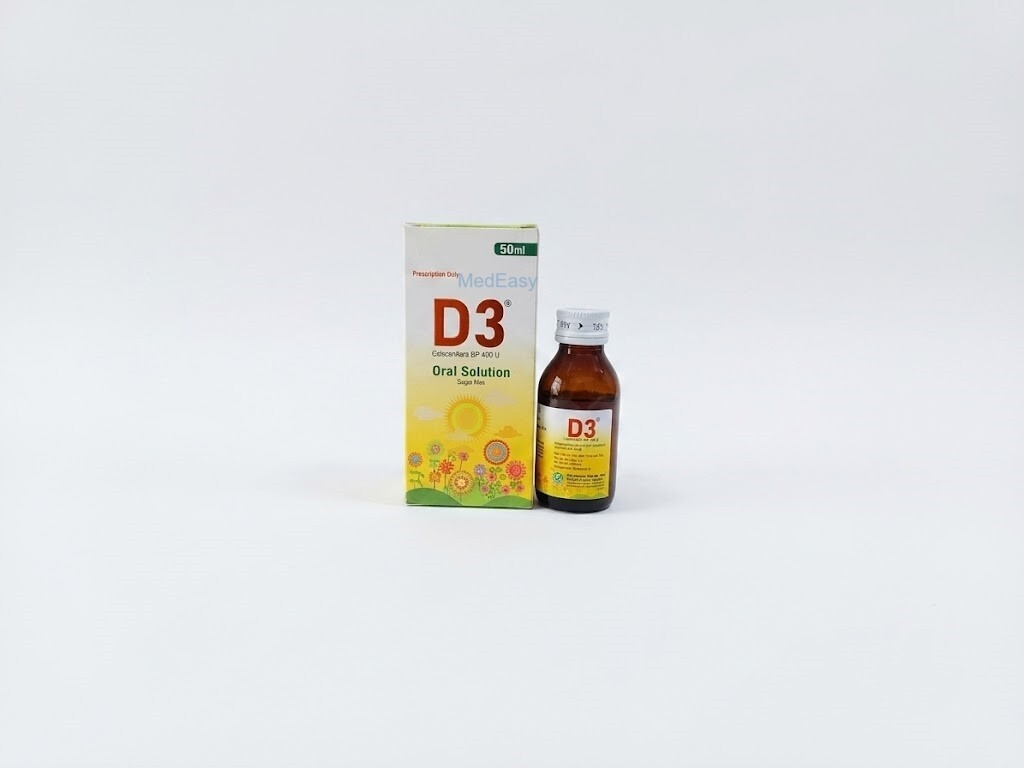
D3 400 IU/ml50 ml
ACI Limited
৳230.00
Add to cart


D-Rise 50ml is indicated for the following:
The specific dose and duration depend on baseline vitamin D status, age, and underlying condition, and should be determined by a physician.
Each formulation of Cholecalciferol [Vitamin D3] contains cholecalciferol (vitamin D3) as the active ingredient, available in various strengths and dosage forms, including tablets, capsules, oral drops/solution, and injections. Strength is commonly expressed in International Units (IU) or micrograms (mcg); 1 mcg cholecalciferol = 40 IU vitamin D3. Common available strengths include low-dose daily formulations (e.g., 400 IU, 1000 IU) as well as high-dose weekly/monthly formulations (e.g., 20,000 IU, 40,000 IU, 50,000 IU, 100,000 IU). Excipients vary by manufacturer and formulation.
D-Rise 50ml is a fat-soluble secosteroid and the naturally occurring form of vitamin D, produced in human skin upon exposure to ultraviolet-B (UV-B) sunlight and also obtained from dietary sources and supplements. It is biologically inactive until it undergoes sequential hydroxylation in the liver (to 25-hydroxyvitamin D, calcifediol) and then in the kidney (to 1,25-dihydroxyvitamin D, calcitriol), the active hormonal form.
D-Rise 50ml plays a central role in calcium and phosphate homeostasis, supporting intestinal absorption of calcium and phosphorus, normal bone mineralization, and neuromuscular function. It is widely used as a dietary supplement and therapeutic agent for the prevention and treatment of vitamin D deficiency and associated bone disorders.
D-Rise 50ml belongs to the therapeutic class of Vitamins, specifically fat-soluble vitamin D analogues/supplements, used for the prevention and treatment of vitamin D deficiency and related bone metabolism disorders.
Mechanism of action: Cholecalciferol [Vitamin D3] is converted in the liver to 25-hydroxyvitamin D (calcifediol), the major circulating and storage form, and then in the kidney to the biologically active hormone 1,25-dihydroxyvitamin D (calcitriol). Calcitriol binds to the vitamin D receptor (VDR) in target tissues (intestine, bone, kidney, parathyroid gland), regulating gene transcription to:
Pharmacokinetics: Cholecalciferol [Vitamin D3] is absorbed in the small intestine (absorption is enhanced by dietary fat and bile) and undergoes enterohepatic circulation. It is transported bound to vitamin D-binding protein, stored mainly in adipose tissue and muscle, and has a long half-life (serum 25-hydroxyvitamin D half-life is approximately 2-3 weeks), which allows for both daily and intermittent (weekly/monthly) high-dose regimens. It is metabolized in the liver and kidney and eliminated primarily in bile/feces.
Dosing of D-Rise 50ml depends on the indication, age, baseline vitamin D status, and formulation (daily low-dose vs. intermittent high-dose). The following is general guidance; the treating physician's prescribed regimen should always be followed.
| Indication / Population | Typical Dosing |
|---|---|
| Vitamin D deficiency (adults) | Commonly 50,000 IU once weekly for 6-8 weeks (or equivalent daily high dose), followed by a maintenance dose of 1,000-2,000 IU daily, as directed by a physician. |
| Maintenance / prevention of deficiency (adults) | Typically 600-2,000 IU daily, individualized based on risk factors and physician guidance. |
| Infants (0-12 months) | 400 IU daily (breastfed infants and those with limited fortified formula intake) as advised by a pediatrician. |
| Children and adolescents (1-18 years) | 600-1,000 IU daily, or higher physician-directed replacement doses for confirmed deficiency, followed by maintenance dosing. |
| Nutritional rickets (children) | Physician-directed treatment courses using higher replacement doses over a defined period, followed by maintenance dosing. |
| Osteoporosis prevention (adjunct) | Usually 800-2,000 IU daily combined with adequate calcium intake, as directed by a physician. |
D-Rise 50ml is generally administered orally as tablets, capsules, or oral drops, taken with or without food (preferably with a meal containing fat to enhance absorption). High-dose weekly/monthly products must be taken exactly at the prescribed interval — not more frequently. Injectable forms are given intramuscularly by a healthcare provider. Do not chew or crush formulations unless specifically labeled for that use.
D-Rise 50ml has the following clinically significant interactions:
Cholecalciferol [Vitamin D3] is contraindicated in:
At recommended doses, D-Rise 50ml is generally well tolerated and side effects are uncommon. Adverse effects are primarily associated with excessive intake leading to hypercalcemia. Reported effects include:
D-Rise 50ml at recommended dietary allowance (RDA) doses is generally considered safe during pregnancy and lactation and is often recommended as part of routine prenatal supplementation. However, high-dose supplementation beyond physician-recommended amounts should be avoided, as excessive maternal vitamin D intake has been associated with fetal harm (hypercalcemia) in animal studies at high doses. D-Rise 50ml should be used during pregnancy and breastfeeding only in doses recommended by a physician; use only if clearly needed, with the dose individualized based on baseline vitamin D status and clinical judgment. D-Rise 50ml is excreted in breast milk; a physician should guide dosing in nursing mothers and their infants.
The following precautions apply to the use of D-Rise 50ml:
Overdose of D-Rise 50ml can cause vitamin D toxicity, primarily manifesting as hypercalcemia. Symptoms may include nausea, vomiting, decreased appetite, constipation, weakness, fatigue, confusion, excessive thirst, increased urination, and, in severe or prolonged cases, kidney injury, nephrocalcinosis, or cardiac arrhythmias. If overdose is suspected, seek immediate medical attention or contact a poison control center/emergency services. Treatment is supportive and may include discontinuation of vitamin D and calcium intake, hydration, and other measures directed by a physician in a medical facility; do not attempt specific home treatment beyond seeking urgent medical care.
Store at room temperature (below 30°C), away from light and moisture. Keep out of reach of children.
Renal impairment: Use D-Rise 50ml with caution in patients with significant renal impairment; conversion to active vitamin D is reduced and there is increased risk of hyperphosphatemia and hypercalcemia. Physician supervision and monitoring are advised.
Hepatic impairment: Since hepatic 25-hydroxylation is required for activation, patients with significant liver disease may have reduced efficacy and should be monitored; dose adjustment may be needed under physician guidance.
Elderly: Commonly used in older adults for bone health and fracture-risk reduction; standard doses are generally well tolerated, but periodic monitoring is reasonable, especially with high-dose regimens or concurrent calcium supplementation.
Obesity/malabsorption: Individuals with obesity, malabsorption syndromes, or after bariatric surgery may require higher doses of D-Rise 50ml under physician supervision due to sequestration in fat tissue or reduced absorption.
Duration of therapy with D-Rise 50ml depends on the indication: short, defined high-dose replacement courses (e.g., 6-8 weeks) are typically used to correct confirmed deficiency, followed by long-term (often indefinite) maintenance dosing to prevent recurrence, particularly in individuals with ongoing risk factors. For general bone health maintenance, low-dose daily or equivalent weekly/monthly supplementation may be continued long-term as advised by a physician, with periodic reassessment of vitamin D status.
Cholecalciferol [Vitamin D3] is classified as a fat-soluble vitamin (Vitamin D analogue), used therapeutically as a vitamin D supplement/bone metabolism agent.
Cholecalciferol [Vitamin D3] is hydroxylated in the liver to 25-hydroxyvitamin D and subsequently in the kidney to the active hormone 1,25-dihydroxyvitamin D (calcitriol), which binds nuclear vitamin D receptors to increase intestinal calcium and phosphate absorption, promote renal calcium reabsorption, and support normal bone mineralization, thereby maintaining calcium-phosphate homeostasis and skeletal health.
D-Rise 50ml is approved for use in infants, children, and adolescents for the prevention and treatment of vitamin D deficiency and rickets. The American Academy of Pediatrics (AAP) recommends 400 IU/day for all breastfed and partially breastfed infants beginning shortly after birth, continued until the infant is weaned to at least 1 liter/day of vitamin D-fortified formula or milk, and 400-600 IU/day for older infants, children, and adolescents depending on dietary intake. Higher, physician-directed replacement doses are used for confirmed deficiency or rickets, followed by maintenance dosing. Dosing should always be guided by a pediatrician, particularly for high-dose or injectable formulations, which are not routinely used in young infants without specific medical indication.
Q: What is D-Rise 50ml 50 ml Oral Solution used for?
A: D-Rise 50ml 50 ml Oral Solution is used to prevent and treat vitamin D deficiency, support bone health, and treat or prevent conditions like rickets and osteomalacia. It is also used as an adjunct with calcium in the prevention and management of osteoporosis, as directed by a physician.
Q: Can I take a high-dose weekly or monthly D-Rise 50ml 50 ml Oral Solution supplement without a doctor's advice?
A: No. High-dose formulations of D-Rise 50ml 50 ml Oral Solution (such as 50,000 IU or higher) should only be taken exactly as prescribed and spaced as directed by a physician. Because D-Rise 50ml 50 ml Oral Solution is a fat-soluble vitamin, it can accumulate in the body, and taking high doses too frequently or without medical supervision can lead to vitamin D toxicity and hypercalcemia, with symptoms such as nausea, weakness, and kidney problems.
Q: Is D-Rise 50ml 50 ml Oral Solution safe during pregnancy and breastfeeding?
A: At doses recommended by a physician (typically standard prenatal supplementation doses), D-Rise 50ml 50 ml Oral Solution is generally considered safe during pregnancy and breastfeeding and is commonly included in prenatal vitamins. However, it should be used only in the dose advised by a physician, since excessive high-dose supplementation is not recommended during pregnancy or lactation. Always consult your physician before starting or adjusting the dose.
Q: What are the signs of D-Rise 50ml 50 ml Oral Solution overdose or toxicity?
A: Overdose of D-Rise 50ml 50 ml Oral Solution can cause vitamin D toxicity with hypercalcemia, presenting as nausea, vomiting, loss of appetite, constipation, weakness, confusion, excessive thirst, and increased urination; severe or prolonged cases can affect the kidneys and heart rhythm. If you suspect an overdose, seek immediate medical attention or contact emergency services/poison control rather than attempting home treatment.
Q: Who should avoid taking D-Rise 50ml 50 ml Oral Solution?
A: D-Rise 50ml 50 ml Oral Solution should be avoided by anyone with a known hypersensitivity to it, and by those with existing hypervitaminosis D or hypercalcemia. It should be used with caution and under close medical supervision in people with sarcoidosis or other granulomatous diseases, significant kidney impairment, or hyperparathyroidism, since these conditions increase the risk of hypercalcemia.
Q: Can children take D-Rise 50ml 50 ml Oral Solution?
A: Yes, D-Rise 50ml 50 ml Oral Solution is commonly used in infants, children, and adolescents to prevent and treat vitamin D deficiency and rickets, following age-appropriate dosing guidance (for example, 400 IU/day is often recommended for breastfed infants). The dose should always be determined by a pediatrician, especially for higher-strength or injectable formulations.
Disclaimer
The information provided is accurate to the best of our knowledge, but it does not replace professional medical advice. We cannot guarantee its completeness or accuracy, and the absence of specific information about a drug should not be taken as an endorsement. We are not responsible for any consequences arising from this information, so please consult a healthcare professional for any concerns or questions.
