

10% Off
Clavuran200 mg+125
Drug International Ltd.
৳31.63
Add to cart
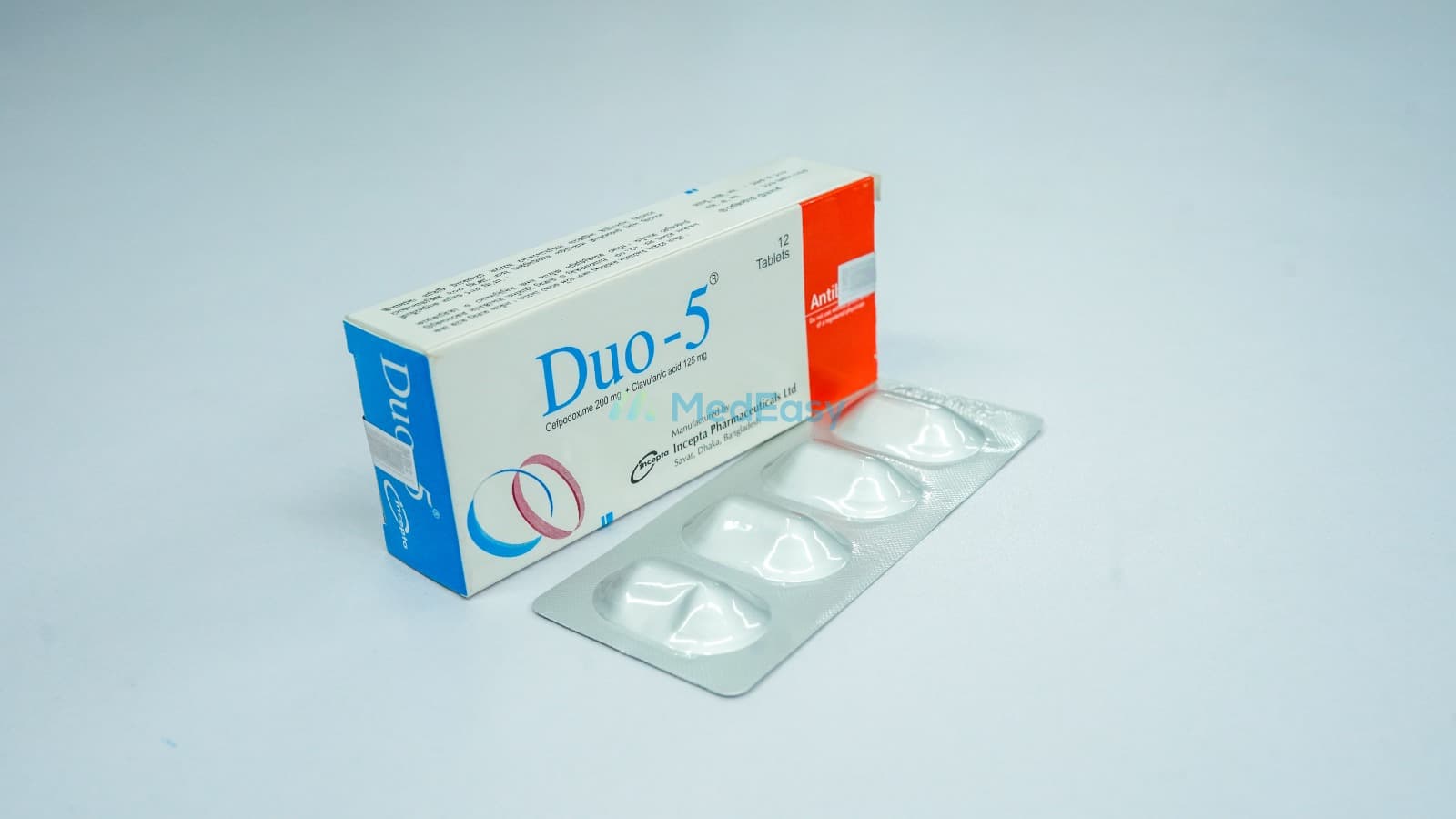
Duo-5 200 mg+125 mg Tablet is available on MedEasy for ৳45.00 per piece, with home delivery anywhere in Bangladesh. It is manufactured by Incepta Pharmaceuticals Ltd. Its generic name is Cefpodoxime Proxetil + Clavulanic Acid.

Duo-5 is a combination antibiotic used to treat bacterial infections caused by organisms that produce beta-lactamase enzymes, which would otherwise make the infection resistant to cefpodoxime alone. The clavulanic acid component blocks these enzymes, restoring the effectiveness of cefpodoxime against a broader range of bacteria.
Duo-5 should only be used for infections confirmed or strongly suspected to be caused by susceptible bacteria. It is not effective against viral infections such as the common cold or flu.
Cefpodoxime Proxetil + Clavulanic Acid is a fixed-dose combination containing two active ingredients:
Common strengths marketed include tablets (e.g. cefpodoxime 200 mg with clavulanic acid 125 mg) and oral suspension for pediatric use (e.g. cefpodoxime 50 mg with clavulanic acid per 5 mL after reconstitution). Exact strengths vary by manufacturer and market.
Duo-5 combines a third-generation cephalosporin antibiotic with a beta-lactamase inhibitor. Cefpodoxime alone is active against many gram-positive and gram-negative bacteria, but some strains produce beta-lactamase enzymes that destroy the drug before it can act. Clavulanic acid inhibits these enzymes, allowing cefpodoxime to remain active against a wider range of resistant organisms.
Duo-5 is available as film-coated tablets and as a powder for oral suspension that must be reconstituted with water before use. It is taken by mouth and is used only for bacterial infections diagnosed or strongly suspected by a physician.
Duo-5 belongs to the class of third-generation cephalosporin antibiotics combined with a beta-lactamase inhibitor, a combination class analogous to amoxicillin-clavulanate but built on a cephalosporin backbone. It is used for the treatment of susceptible bacterial infections.
Cefpodoxime, the active component of Cefpodoxime Proxetil + Clavulanic Acid, inhibits bacterial cell wall synthesis by binding to penicillin-binding proteins (PBPs), which interferes with the final transpeptidation step of peptidoglycan cross-linking. This leads to cell wall instability and bacterial cell death (bactericidal action).
Many bacteria produce beta-lactamase enzymes that hydrolyze the beta-lactam ring of cephalosporins, inactivating them before they can reach their target. Clavulanic acid is a suicide inhibitor of many beta-lactamase enzymes: it binds irreversibly to the enzyme, protecting cefpodoxime from degradation and extending its spectrum of activity to include many beta-lactamase-producing strains of Staphylococcus aureus, Haemophilus influenzae, Moraxella catarrhalis, and certain Enterobacteriaceae.
Cefpodoxime proxetil is an inactive prodrug that is hydrolyzed by intestinal esterases to active cefpodoxime during absorption. Absorption is enhanced by an acidic gastric environment and by food. Cefpodoxime is widely distributed in body tissues and fluids and is eliminated mainly unchanged by the kidneys, with a plasma half-life of approximately 2 to 3 hours in adults with normal renal function. Clavulanic acid is also well absorbed orally, metabolized in the liver, and excreted renally.
The dose of Duo-5 depends on the type and severity of infection, age, and renal function. It should always be taken exactly as prescribed by a physician.
| Indication | Typical Adult Dose | Typical Duration |
|---|---|---|
| Respiratory tract infections (sinusitis, bronchitis, pneumonia) | Cefpodoxime 200 mg component twice daily | 7-14 days |
| Uncomplicated urinary tract infection | Cefpodoxime 100-200 mg component twice daily | 7-10 days |
| Skin and soft tissue infection | Cefpodoxime 200 mg component twice daily | 7-14 days |
| ENT infections (pharyngitis, otitis media) | Cefpodoxime 100-200 mg component twice daily (weight-based in children) | 5-10 days |
Renal impairment: In patients with significantly reduced kidney function (creatinine clearance below approximately 30 mL/min), the dosing interval is generally extended (e.g. to once daily) under a physician's guidance, since cefpodoxime is eliminated mainly by the kidneys.
Hepatic impairment: No specific dose adjustment is generally required for cefpodoxime in hepatic impairment, but caution is advised given the association of the clavulanic acid component with hepatic effects (see Precautions and Warnings).
Administration: Take Duo-5 tablets with food to enhance absorption and reduce stomach upset. Shake the reconstituted oral suspension well before each dose and use the provided measuring device. Space doses evenly (e.g. every 12 hours). Take exactly as prescribed by your physician; do not stop, extend, skip doses, or share this medicine with others without medical advice. Completing the full prescribed course is essential even if symptoms improve early, to prevent relapse and antibiotic resistance.
Duo-5 tablets should be swallowed whole with food; do not crush or chew unless a specific formulation permits it. The oral suspension must be reconstituted with the correct amount of water as directed on the label, shaken well before each use, and measured with an accurate oral syringe or measuring cup - not a household spoon. Try to take doses at evenly spaced intervals (e.g. every 12 hours) to maintain steady drug levels. If a dose is missed, take it as soon as remembered unless it is nearly time for the next dose; do not double the dose.
Duo-5 can interact with the following medicines; inform your physician about all medications you are taking:
Cefpodoxime Proxetil + Clavulanic Acid is contraindicated in patients with:
Like all medicines, Duo-5 can cause side effects, though not everyone experiences them.
Seek urgent medical attention for signs of a severe allergic reaction (swelling of the face/throat, difficulty breathing, severe rash), watery or bloody diarrhea that does not improve, or yellowing of the skin/eyes.
Pregnancy: Cephalosporins as a class are generally considered to carry a comparatively lower risk profile among antibiotics in pregnancy, but adequate, well-controlled studies specifically on Duo-5 in pregnant women are limited. Duo-5 should be used during pregnancy only if clearly needed and if the potential benefit justifies the potential risk to the fetus, and only under a physician's direction.
Lactation: Cefpodoxime and clavulanic acid are excreted in small amounts into breast milk. Use during breastfeeding should be discussed with a physician, weighing the benefit of treatment against the possibility of effects on the nursing infant (e.g. diarrhea or thrush), and the infant should be monitored if the mother is treated with Duo-5.
Overdose with Duo-5 may cause pronounced gastrointestinal symptoms (nausea, vomiting, diarrhea, abdominal pain) and, in some cases, disturbances of fluid and electrolyte balance or neuromuscular excitability/seizures, particularly in patients with renal impairment. There is no specific antidote.
If an overdose is suspected, seek immediate medical attention or contact a poison control center / emergency services. Treatment is supportive; hemodialysis can help remove cefpodoxime from the body in severe cases of renal impairment. Do not attempt to manage a suspected overdose at home.
Store at room temperature (below 30°C), away from light and moisture. Keep out of reach of children. Reconstituted oral suspension should be stored as directed on the label (typically in a refrigerator, not frozen) and any unused portion discarded after the labeled period, usually 14 days.
Duo-5 oral suspension is used in children for approved indications (e.g. acute otitis media, pharyngitis, sinusitis, skin infections) caused by beta-lactamase-producing organisms, dosed by body weight according to the physician's prescription. Safety and efficacy in neonates and infants under a few months of age have not been well established; use in this group should be guided by a pediatrician.
No specific dose adjustment is generally required in elderly patients with normal renal function, but since renal function often declines with age, kidney function should be assessed and the dose adjusted accordingly.
Dose interval should be extended in patients with significant renal impairment (see Dosage and Administration).
Use with caution; monitor liver function, especially with prolonged treatment.
The typical duration of Duo-5 treatment ranges from 5 to 14 days depending on the type and severity of infection (see the dosing table in Dosage and Administration). The full course prescribed by the physician should always be completed, even if symptoms resolve earlier, to ensure the infection is fully cleared and to reduce the risk of relapse and antibiotic resistance.
The oral suspension form of Duo-5 is supplied as a dry powder that must be reconstituted with a specified amount of clean drinking water before use, as directed on the product label. After adding water, shake the bottle vigorously until the powder is fully and evenly dispersed. Store the reconstituted suspension in a refrigerator (do not freeze) and shake well before each dose. Discard any unused suspension after the period stated on the label (commonly 14 days after reconstitution), and do not use it beyond that period even if it appears unchanged.
Third-generation cephalosporin antibiotic + beta-lactamase inhibitor combination
The cefpodoxime component of Cefpodoxime Proxetil + Clavulanic Acid binds to penicillin-binding proteins in the bacterial cell wall, blocking the final cross-linking step of peptidoglycan synthesis; this weakens the cell wall and causes bacterial cell lysis and death. The clavulanic acid component has minimal intrinsic antibacterial activity but irreversibly inhibits many bacterial beta-lactamase enzymes, preventing them from destroying cefpodoxime. Together, this combination restores and extends cefpodoxime's activity against beta-lactamase-producing bacterial strains that would otherwise be resistant.
Duo-5 oral suspension may be prescribed by a pediatrician for children with confirmed or strongly suspected bacterial infections caused by beta-lactamase-producing organisms, such as acute otitis media, streptococcal pharyngitis/tonsillitis, sinusitis, and certain skin/soft tissue infections. Dosing is calculated based on the child's body weight and the specific infection being treated.
Safety and efficacy have not been formally established in neonates and very young infants, and Duo-5 should only be used in this age group under close pediatric supervision. Parents/caregivers should complete the full prescribed course and should not adjust the dose or stop treatment early without consulting the physician.
Q: What is Duo-5 200 mg+125 mg Tablet used for?
A: Duo-5 200 mg+125 mg Tablet is a combination antibiotic used to treat bacterial infections of the respiratory tract, urinary tract, skin/soft tissue, and ear-nose-throat (ENT) region that are caused by bacteria producing beta-lactamase enzymes, which would otherwise resist treatment with cefpodoxime alone. It should be used only for bacterial infections confirmed or suspected by a physician, not for viral illnesses such as colds or flu.
Q: How should I take Duo-5 200 mg+125 mg Tablet?
A: Take Duo-5 200 mg+125 mg Tablet exactly as prescribed by your physician, generally twice daily with food to improve absorption and reduce stomach upset. If using the oral suspension, shake it well before each dose and measure it with the provided device. Complete the full course even if you feel better early, and do not stop, extend, skip doses, or share this medicine with others without medical advice.
Q: Can I take antacids or acid-reducing medicines with Duo-5 200 mg+125 mg Tablet?
A: Antacids, H2-blockers (like ranitidine or famotidine), and proton pump inhibitors (like omeprazole) reduce stomach acid, which can significantly lower the absorption of the cefpodoxime component of Duo-5 200 mg+125 mg Tablet and make it less effective. If you must take these medicines, space them as far apart from your Duo-5 200 mg+125 mg Tablet doses as possible and inform your physician.
Q: Is Duo-5 200 mg+125 mg Tablet safe during pregnancy or breastfeeding?
A: Duo-5 200 mg+125 mg Tablet should be used in pregnancy only if your physician determines it is clearly needed and the potential benefit outweighs the potential risk to the fetus, as adequate studies in pregnant women are limited. Small amounts pass into breast milk, so breastfeeding mothers should use Duo-5 200 mg+125 mg Tablet only under medical advice, with monitoring of the infant for effects such as diarrhea or thrush.
Q: What side effects can Duo-5 200 mg+125 mg Tablet cause?
A: The most common side effects of Duo-5 200 mg+125 mg Tablet are diarrhea, nausea, vomiting, abdominal discomfort, and skin rash. Less commonly, it can cause allergic reactions, severe diarrhea due to Clostridioides difficile infection, or liver problems such as jaundice. Seek urgent medical attention for signs of a severe allergic reaction (swelling, difficulty breathing), persistent watery/bloody diarrhea, or yellowing of the skin or eyes.
Q: Who should not take Duo-5 200 mg+125 mg Tablet?
A: Duo-5 200 mg+125 mg Tablet should not be taken by anyone with a known allergy to cefpodoxime, other cephalosporin antibiotics, or clavulanic acid, or by those with a history of severe allergic reaction to penicillins (due to possible cross-reactivity), or a prior history of jaundice/liver problems caused by a similar beta-lactamase inhibitor combination. Always tell your physician about any drug allergies before starting Duo-5 200 mg+125 mg Tablet.
Disclaimer
The information provided is accurate to the best of our knowledge, but it does not replace professional medical advice. We cannot guarantee its completeness or accuracy, and the absence of specific information about a drug should not be taken as an endorsement. We are not responsible for any consequences arising from this information, so please consult a healthcare professional for any concerns or questions.