
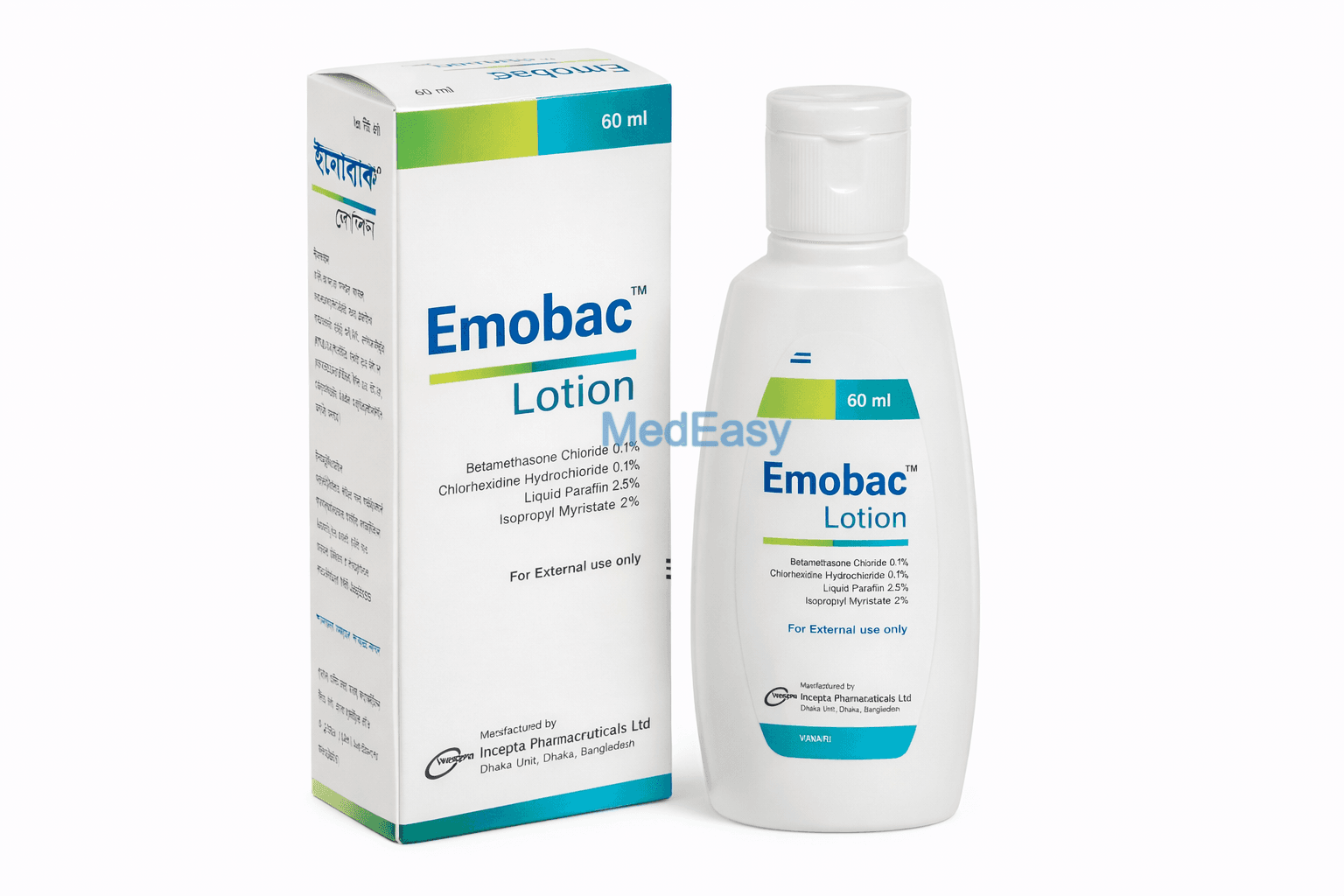
Emobac60 ml

Medicine overview
Indications of Emobac
Emobac is an antimicrobial emollient preparation indicated for:
Established use
- Management of dry, scaling, and pruritic (itchy) skin conditions, particularly eczema and dermatitis, where an emollient with antimicrobial protection is required.
- Use as a leave-on moisturizer applied directly to affected areas of the skin.
- Use as a soap substitute during bathing or showering in place of ordinary soap, which can be drying and irritating to eczema-prone skin.
Adjunct use
Emobac may be used as part of a broader eczema/dermatitis management plan alongside other prescribed topical treatments (e.g., topical corticosteroids), applied at a different time rather than mixed together, to help maintain the skin barrier and reduce the risk of secondary bacterial skin infection from scratching.
Emobac is not intended as a stand-alone treatment for infected, broken, or severely inflamed skin, which requires separate medical assessment.
Composition
Liquid Paraffin + Benzalkonium Chloride + Chlorhexidine + Isopropyl Myristate is formulated as a topical lotion and cream containing the following per gram:
| Ingredient | Lotion (per g) | Cream (per g) |
|---|---|---|
| Liquid Paraffin BP | 25 mg | 100 mg |
| Benzalkonium Chloride USP | 1 mg | 1 mg |
| Chlorhexidine Hydrochloride BP | 1 mg | 1 mg |
| Isopropyl Myristate BP | 25 mg | 100 mg |
Description
Emobac is a fixed-dose topical combination of two antiseptic agents (benzalkonium chloride and chlorhexidine) and two emollient agents (liquid paraffin and isopropyl myristate). It is formulated as a lotion or cream that both moisturizes dry, irritated skin and provides mild antimicrobial protection against bacteria that can colonize skin damaged by scratching, as commonly occurs in eczema and dermatitis. It can be applied directly to the skin or used as a soap substitute for daily skin cleansing.
Therapeutic Class
Emobac belongs to the therapeutic class of topical antimicrobial emollients (miscellaneous topical skin preparations), combining antiseptic and skin-barrier-protective actions in a single formulation.
Pharmacology
Liquid Paraffin + Benzalkonium Chloride + Chlorhexidine + Isopropyl Myristate combines two complementary mechanisms of action:
Antimicrobial components
Benzalkonium chloride is a quaternary ammonium antiseptic that disrupts bacterial cell membranes, while chlorhexidine (as chlorhexidine hydrochloride) binds to and disrupts the bacterial cell wall, producing a broad-spectrum antibacterial effect. Together they help reduce bacterial colonization of skin that has been damaged by scratching, lowering the risk of secondary skin infection.
Emollient components
Liquid paraffin and isopropyl myristate are occlusive/emollient agents that form a thin protective film on the skin surface, reducing transepidermal water loss, softening the stratum corneum, and helping to relieve dryness, scaling, and associated itching.
Dosage & Administration of Emobac
Emobac dosing is applied topically and is not weight- or age-dosed in the way oral medicines are; instead, frequency and amount are guided by symptom severity.
| Use | Recommended use |
|---|---|
| Direct application (adults and children) | Apply a thin layer to affected dry or itchy areas of skin as often as needed, and massage gently until absorbed. May be used several times a day. |
| Soap substitute | Use in place of soap during bathing or showering; apply to wet or dry skin, then rinse. |
| Combined with other topical medicines | If another topical treatment (e.g., a corticosteroid) has been prescribed, apply Emobac at a separate time rather than mixing the two products together. |
Regular, consistent use is generally required to obtain maximum benefit for dry and eczema-prone skin.
Administration of Emobac
Emobac is for external (topical) use only.
- Apply a small amount to clean, affected skin and massage gently until it is absorbed.
- When used as a soap substitute, apply during bathing/showering and rinse off with water.
- Wash hands after application unless the hands are the area being treated.
- Do not apply to broken, infected, or weeping skin without medical advice.
- Avoid the eyes, mouth, nose, and other mucous membranes.
Interaction of Emobac
Emobac is applied topically and is not known to interact with orally or systemically administered medicines. No clinically significant drug-drug interactions have been established.
To avoid reducing the effectiveness of either product, Emobac should not be mixed directly with other topical medicines (such as topical corticosteroids or other prescription skin treatments); instead, apply them at separate times.
Contraindications
Liquid Paraffin + Benzalkonium Chloride + Chlorhexidine + Isopropyl Myristate is contraindicated in patients with known hypersensitivity to benzalkonium chloride, chlorhexidine, liquid paraffin, isopropyl myristate, or any other excipient in the formulation.
Side Effects of Emobac
Emobac is generally well tolerated. Reported side effects include:
- Local skin reactions such as redness, stinging, irritation, or itching at the site of application, particularly with excessive use or in skin folds.
- Contact dermatitis in sensitive individuals (rare).
Rare but serious: signs of a serious allergic reaction — swelling of the face, lips, or throat; widespread rash or hives; difficulty breathing; dizziness; an unusual metallic taste; or collapse — require immediate medical attention and discontinuation of Emobac.
Pregnancy & Lactation
Emobac has a long history of topical use during pregnancy and breastfeeding, and its emollient/antiseptic ingredients are not significantly absorbed systemically when used on intact skin. However, formal controlled clinical trials in pregnant or breastfeeding women have not been conducted. As with any topical product, Emobac should be used during pregnancy and lactation only if clearly needed, avoiding application to the nipple/areola area before breastfeeding, and a physician or pharmacist should be consulted if there is any concern.
Precautions & Warnings
The following precautions apply to the use of Emobac:
- Eyes and mucous membranes: avoid contact, especially when applying to the face; chlorhexidine can cause serious eye irritation or injury if it enters the eye. Rinse thoroughly with water if accidental contact occurs.
- Fire/flammability risk: Emobac contains paraffin-based emollients. Fabric (clothing, bedding, dressings) that has been in contact with the product can become a fire hazard if exposed to naked flames or smoking materials, even after washing. Keep away from fire, flames, and lit cigarettes, and avoid smoking while the product is on the skin or clothing.
- Sensitive skin: a small test application is advisable before first use in individuals with known sensitive skin.
- Broken or infected skin: do not apply to severely broken, weeping, or clinically infected skin without medical advice, as this differs from routine dry-skin care.
- Slip hazard: when used as a soap substitute or emollient in the bath/shower, surfaces can become slippery; take care to avoid falls.
- Some formulations contain cetostearyl alcohol, which may rarely trigger local contact reactions in susceptible individuals.
Overdose Effects of Emobac
Emobac is intended for external use only, and significant systemic toxicity from topical over-application is unlikely. Excessive or prolonged use may increase the likelihood of local skin irritation. If Emobac is accidentally swallowed, or if it comes into contact with the eyes and causes persistent irritation, seek immediate medical attention or contact a poison control center rather than attempting home treatment.
Storage Conditions
Store Emobac at room temperature (below 30°C), away from direct sunlight, heat sources, naked flames, and moisture. Keep the container tightly closed and out of the reach of children.
Use In Special Populations
Pediatric patients: Emobac is commonly used for dry skin and eczema in children as well as adults; however, use in very young infants (particularly neonates) should only be under the guidance of a physician. See Pediatric Uses for details.
Elderly patients: No special dose adjustment is required; general precautions regarding skin sensitivity and application to broken skin apply as in adults.
Renal/hepatic impairment: Because Emobac is applied topically with minimal systemic absorption, no dose adjustment is required in renal or hepatic impairment.
Duration Of Treatment
Emobac is generally intended for regular, ongoing use as part of daily skin care for chronic or recurring dry-skin conditions such as eczema, rather than a short fixed course. If there is no improvement in skin symptoms after 1-2 weeks of regular use, or if the skin worsens, becomes infected, or a new reaction develops, a physician should be consulted to reassess the treatment plan.
Drug Classes
Liquid Paraffin + Benzalkonium Chloride + Chlorhexidine + Isopropyl Myristate falls under the drug class of topical antiseptic-emollient combinations, within the broader category of miscellaneous topical dermatological preparations.
Mode Of Action
Liquid Paraffin + Benzalkonium Chloride + Chlorhexidine + Isopropyl Myristate acts by two combined mechanisms: the antiseptic agents (benzalkonium chloride and chlorhexidine) reduce surface bacterial load on the skin, lowering the risk of secondary infection from scratching, while the emollient agents (liquid paraffin and isopropyl myristate) form a protective, occlusive layer over the skin that reduces water loss and softens dry, scaly skin.
Pediatric Uses
Emobac is used in children, including for eczema and dry-skin conditions, applied in the same manner as in adults — a thin layer to affected skin or as a soap substitute. As with adults, it should not be applied to broken, infected, or weeping skin without medical advice. For very young infants (especially neonates), Emobac should be used only on the advice of a physician, since formal safety and efficacy data for this specific age group are limited. Parents/caregivers should supervise application and keep the product out of reach of children to prevent accidental ingestion or eye contact.
Frequently Asked Questions
Q: What is Emobac 60 ml Lotion used for?
A: Emobac 60 ml Lotion is an antimicrobial emollient lotion/cream used to manage dry, scaling, and itchy skin conditions such as eczema and dermatitis. It can be applied directly to affected skin or used as a soap substitute during bathing/showering.
Q: Can I use Emobac 60 ml Lotion together with a steroid cream my doctor prescribed?
A: Yes, Emobac 60 ml Lotion can be used alongside other prescribed topical treatments such as topical corticosteroids, but the two products should not be mixed together on the skin. Apply them at separate times of day as advised by your physician or pharmacist.
Q: Is Emobac 60 ml Lotion safe to use during pregnancy or while breastfeeding?
A: Emobac 60 ml Lotion has a long history of topical use in pregnancy and breastfeeding and is minimally absorbed through intact skin, but formal clinical trials in pregnant or breastfeeding women have not been done. It should be used only if clearly needed, avoiding the nipple/areola area before feeding, and you should consult your physician or pharmacist if you have concerns.
Q: What side effects can Emobac 60 ml Lotion cause?
A: Most people tolerate Emobac 60 ml Lotion well. Mild redness, stinging, or itching at the application site can occur, especially with excessive use in skin folds. Rarely, a serious allergic reaction can occur — swelling of the face or throat, widespread rash, breathing difficulty, dizziness, or collapse — which requires immediate medical attention.
Q: Can Emobac 60 ml Lotion catch fire?
A: Emobac 60 ml Lotion contains paraffin-based emollients, and fabric such as clothing or bedding that has been in contact with the product can become a fire hazard if exposed to naked flames or cigarettes, even after washing. Avoid smoking or being near open flames while the product is on your skin or clothes.
Q: Can Emobac 60 ml Lotion be used on a baby's skin?
A: Emobac 60 ml Lotion is commonly used for dry skin and eczema in children, applied the same way as in adults. However, for very young infants, especially newborns, it should only be used on a physician's advice, since safety data specific to this age group are limited.
Disclaimer
The information provided is accurate to the best of our knowledge, but it does not replace professional medical advice. We cannot guarantee its completeness or accuracy, and the absence of specific information about a drug should not be taken as an endorsement. We are not responsible for any consequences arising from this information, so please consult a healthcare professional for any concerns or questions.
