8% Off
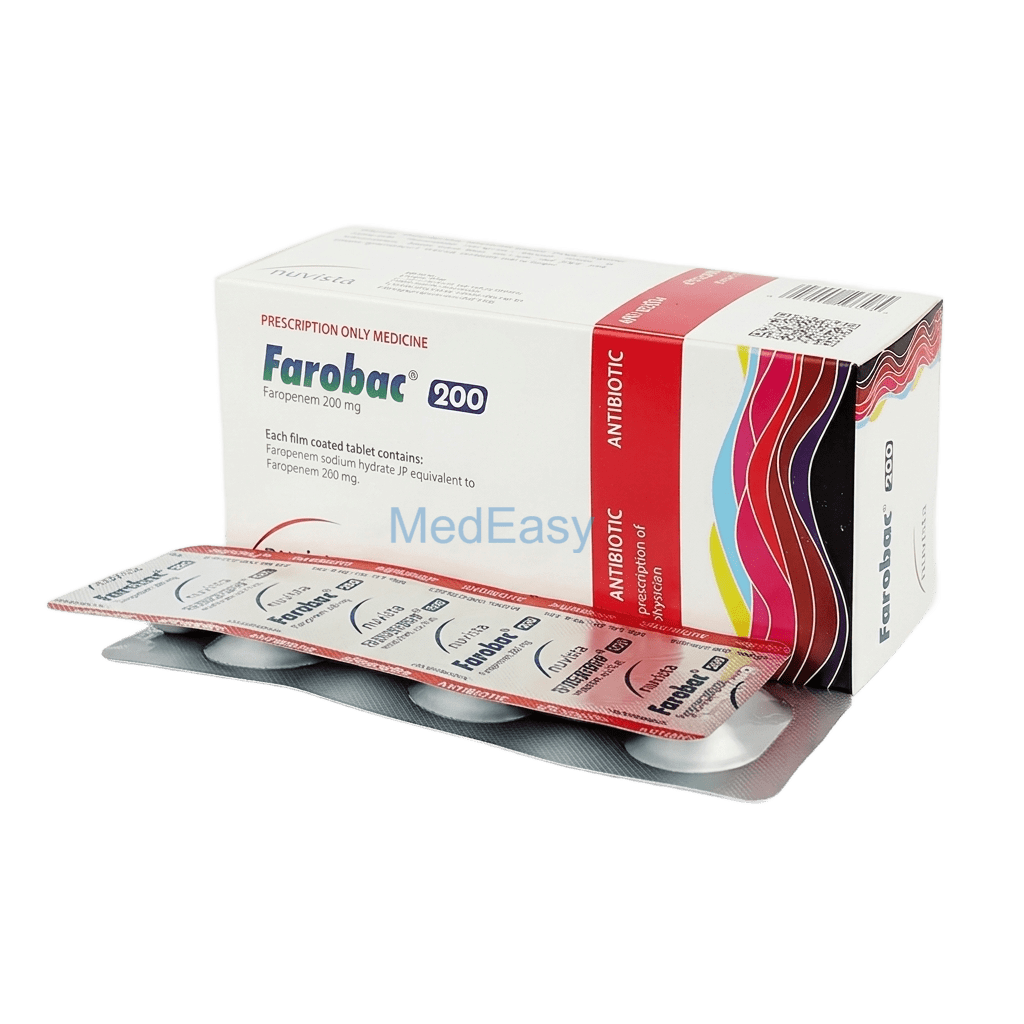
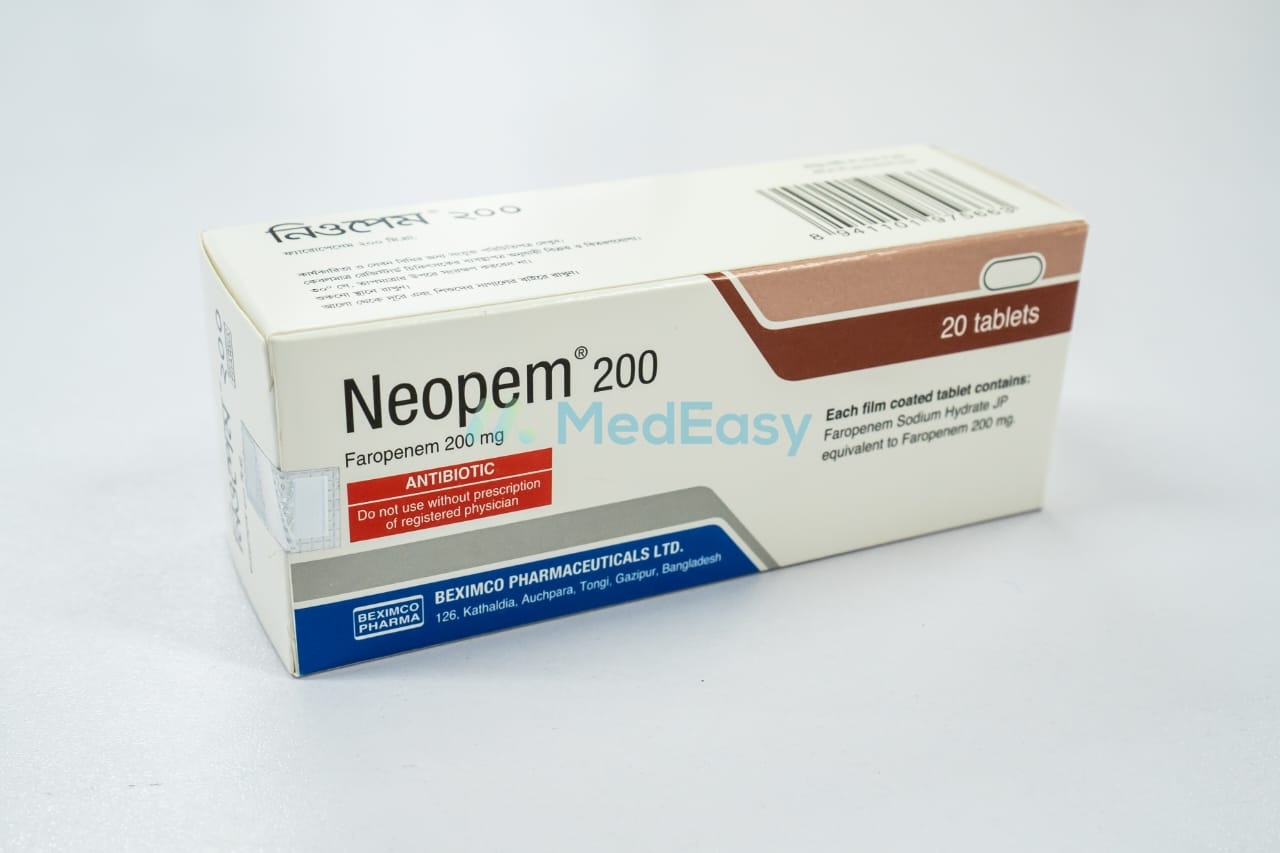
Neopem200 mg
Beximco Pharmaceuticals Ltd.
৳349.60
Add to cart


Farobest is an oral penem-class (beta-lactam) antibiotic used for the treatment of mild-to-moderate bacterial infections caused by susceptible organisms. It is marketed and used in several countries (including Bangladesh, India and Japan) for the indications below; it has not been approved by the US FDA and is not available in the United States.
Farobest should only be used for infections proven or strongly suspected to be caused by susceptible bacteria; it is not effective against viral infections.
Each tablet of Faropenem typically contains Faropenem (as faropenem sodium or faropenem medoxomil, depending on the manufacturer) as the active ingredient, commonly available in 150 mg and 200 mg strengths, along with standard pharmaceutical excipients.
Farobest is a synthetic oral penem antibiotic, structurally related to the carbapenem class of beta-lactam antibiotics. It has a broad spectrum of activity covering many aerobic and anaerobic Gram-positive and Gram-negative bacteria, and it retains activity against a number of organisms that produce beta-lactamase enzymes because it is relatively stable to hydrolysis by many of these enzymes.
Farobest is administered orally, which makes it useful as a step-down or outpatient option for infections that would otherwise require a parenteral beta-lactam.
Farobest belongs to the penem class of beta-lactam antibiotics, a group structurally related to both penicillins and carbapenems.
Faropenem is bactericidal. Like other beta-lactam antibiotics, it acts by binding to penicillin-binding proteins (PBPs) located in the bacterial cell wall, thereby inhibiting the final transpeptidation step of peptidoglycan synthesis. This weakens the bacterial cell wall, leading to cell lysis and death.
Faropenem has high affinity for several PBPs and demonstrates relative stability against many beta-lactamase enzymes, which broadens its activity against certain resistant organisms compared to older oral beta-lactams.
Farobest is for oral use only. Dosage should be individualized based on the type and severity of infection, and the recommended treatment course should be completed in full.
| Indication | Usual adult dose |
|---|---|
| Upper respiratory tract infection (pharyngitis/tonsillitis) | 150 mg three times daily (up to 200 mg three times daily in more severe cases) |
| Acute bacterial sinusitis / other ENT infections | 200 mg three times daily (up to 300 mg three times daily) |
| Lower respiratory tract infection / community-acquired pneumonia | 200 mg three times daily (up to 300 mg three times daily) |
| Skin and soft tissue infection | 150 mg three times daily (up to 200 mg three times daily) |
| Urinary tract infection (cystitis, pyelonephritis, prostatitis) | 200 mg three times daily (up to 300 mg three times daily) |
| Gynecological infection | 150 mg three times daily (up to 200 mg three times daily) |
Typical treatment duration is 5-10 days depending on the infection and clinical response; the physician's prescribed duration should always be followed.
Renal impairment: Because Farobest is renally eliminated, plasma levels and half-life increase in patients with reduced kidney function; a lower dose or extended dosing interval is recommended in moderate-to-severe renal impairment, as advised by the prescribing physician.
Hepatic impairment: No dosage adjustment is generally required for hepatic impairment alone, but caution is advised in patients with significant liver disease.
Antibiotic stewardship: Take Farobest exactly as prescribed by your physician; do not stop, extend, skip doses, or share this medicine with others without medical advice, even if symptoms improve before the course is finished.
Farobest tablets are taken by mouth, generally with a full glass of water. It may be taken with or without food, although taking it with food may help reduce stomach upset. Doses should be spaced evenly through the day (e.g., every 8 hours for a three-times-daily regimen) and the full course should be completed even if symptoms improve early.
Farobest has the following clinically significant interactions:
Always inform your physician or pharmacist of all medicines, supplements, and herbal products being used before starting Farobest.
Faropenem is contraindicated in:
Farobest is generally well tolerated. Reported side effects include:
Patients should seek medical attention promptly if severe rash, difficulty breathing, swelling of the face/throat, or persistent severe diarrhea occurs while taking Farobest.
Pregnancy: Adequate and well-controlled studies of Farobest in pregnant women are lacking, and safety during pregnancy has not been established. Farobest should be used during pregnancy only if clearly needed and if the potential benefit to the mother justifies the potential risk to the fetus; a physician should always be consulted before use.
Lactation: Farobest is known to pass into breast milk in small amounts. It should be used during breastfeeding only if the expected benefit outweighs the potential risk to the infant, and only under medical advice; the infant should be monitored for possible effects such as diarrhea or thrush.
Use Farobest with caution in the following situations:
Antibiotic stewardship: Take Farobest exactly as prescribed by your physician; do not stop, extend, skip doses, or share this medicine with others without medical advice.
There is no specific antidote for Farobest overdose. In case of a suspected overdose, seek immediate medical attention or contact a poison control center/emergency services. Management is supportive and symptomatic; since Farobest is eliminated renally, adequate hydration and monitoring of renal function are generally recommended, and hemodialysis may assist elimination in severe cases if clinically indicated.
Store at room temperature (below 30°C), away from light and moisture. Keep out of reach of children.
Duration of treatment with Farobest typically ranges from 5 to 10 days depending on the type and severity of infection and clinical response, as determined by the treating physician. Patients should complete the full prescribed course even if they start to feel better before it is finished, to reduce the risk of relapse and antibiotic resistance.
Faropenem is classified as an oral penem antibiotic, part of the broader beta-lactam antibiotic family that also includes penicillins, cephalosporins, and carbapenems.
Faropenem exerts its bactericidal effect by binding to penicillin-binding proteins (PBPs) in the bacterial cell wall, inhibiting peptidoglycan cross-linking (the final step of cell wall synthesis). This disrupts cell wall integrity and leads to bacterial cell lysis and death. Faropenem also shows relative stability against many beta-lactamase enzymes, extending its activity against some resistant bacteria.
Safety and efficacy of Farobest in pediatric patients have not been well established through adequate controlled studies. As a result, Farobest is generally not recommended for routine use in children, and should only be used in pediatric patients if specifically prescribed by a physician who has judged the benefits to outweigh the uncertainties, with close monitoring for adverse effects.
Q: What is Farobest 200 mg Tablet used for?
A: Farobest 200 mg Tablet is an oral antibiotic used to treat bacterial infections of the respiratory tract, sinuses, throat, urinary tract, skin, and certain gynecological infections caused by susceptible bacteria. It only works against bacterial infections, not viral illnesses like the common cold or flu.
Q: How should I take Farobest 200 mg Tablet?
A: Farobest 200 mg Tablet is taken by mouth, usually two to three times a day as prescribed, with or without food. Take it exactly as directed by your physician, at evenly spaced intervals, and complete the full course even if you feel better early — do not stop, extend, skip doses, or share this medicine with others without medical advice.
Q: Who should not take Farobest 200 mg Tablet?
A: Farobest 200 mg Tablet should not be taken by anyone with a known allergy to Farobest 200 mg Tablet or to other beta-lactam antibiotics such as penicillins, cephalosporins, or carbapenems, or by anyone who has had a severe (anaphylactic) allergic reaction to a beta-lactam antibiotic in the past.
Q: What are the common side effects of Farobest 200 mg Tablet?
A: The most common side effects of Farobest 200 mg Tablet are gastrointestinal, including diarrhea, nausea, abdominal pain, and vomiting. Headache and skin rash may also occur. Most side effects are mild, but you should seek medical attention if you notice severe rash, difficulty breathing, facial swelling, or severe or persistent diarrhea.
Q: Is Farobest 200 mg Tablet safe during pregnancy or breastfeeding?
A: Safety of Farobest 200 mg Tablet during pregnancy has not been firmly established, so it should be used in pregnancy only if clearly needed and if your doctor decides the benefit outweighs the potential risk to the baby. Farobest 200 mg Tablet passes into breast milk in small amounts, so it should be used while breastfeeding only under medical advice, with the baby monitored for effects such as diarrhea.
Q: Can Farobest 200 mg Tablet be given to children?
A: Safety and effectiveness of Farobest 200 mg Tablet in children have not been well established. It is generally not recommended for routine use in children and should only be given if a doctor specifically prescribes it after weighing the benefits and uncertainties.
Disclaimer
The information provided is accurate to the best of our knowledge, but it does not replace professional medical advice. We cannot guarantee its completeness or accuracy, and the absence of specific information about a drug should not be taken as an endorsement. We are not responsible for any consequences arising from this information, so please consult a healthcare professional for any concerns or questions.