

10% Off
Frutifol100 ml
Incepta Pharmaceuticals Ltd.
৳45.00
Add to cart
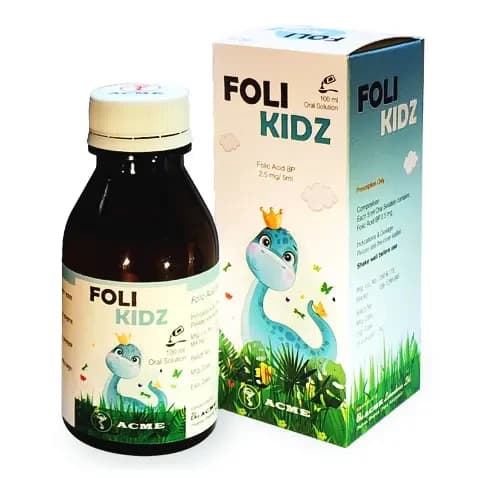
Foli Kidz 100 ml Oral Solution is available on MedEasy for ৳46.00 per 100 ml bottle, with home delivery anywhere in Bangladesh. It is manufactured by ACME Laboratories Ltd. Its generic name is Folic Acid.

Folic acid (vitamin B9) is indicated for the following:
Folic acid is not indicated as sole therapy for pernicious anemia or other vitamin B12-deficiency anemias (see Contraindications).
Each tablet typically contains Folic acid USP 1 mg or 5 mg; lower-strength preparations (e.g. 400 mcg / 0.4 mg) are also available as over-the-counter prenatal/dietary supplements. Formulations may vary by manufacturer; refer to the specific product label for exact strength and excipients.
Folic acid is the synthetic, oxidized form of vitamin B9, a water-soluble B-complex vitamin that the body cannot synthesize and must obtain from diet or supplementation. It is essential for DNA synthesis, cell division, and the formation of red blood cells. In the body, Folic acid is converted to its active metabolite, tetrahydrofolate, which participates in one-carbon transfer reactions required for nucleotide synthesis and amino acid metabolism. Folic acid is available as an oral tablet and is used both as a dietary supplement and as a therapeutic agent for folate-deficiency conditions.
Folic acid belongs to the vitamin B-complex group; specifically, it is classified as a hematinic agent / water-soluble vitamin (vitamin B9) used in the management of folate-deficiency anemias and as a nutritional supplement.
Folic acid itself is pharmacologically inactive and must be reduced in the body to tetrahydrofolate (via dihydrofolate reductase), the metabolically active form. Tetrahydrofolate and its derivatives act as coenzymes in single-carbon transfer reactions essential for:
Folate deficiency impairs DNA synthesis in rapidly dividing cells, most notably erythroid precursors in bone marrow, leading to megaloblastic anemia. Adequate folate status around conception is also critical for neural tube closure in the developing embryo, which is why periconceptional supplementation with Folic acid reduces neural tube defect risk.
Absorption: readily absorbed from the proximal small intestine (jejunum). Distribution: stored mainly in the liver; also present in plasma and cerebrospinal fluid. Metabolism: reduced to tetrahydrofolate in the liver and intestinal mucosa. Excretion: excess amounts are excreted largely unchanged in urine.
| Indication | Typical Dose |
|---|---|
| Folate-deficiency anemia (treatment) | 1 mg orally once daily (up to 5 mg daily in severe deficiency or malabsorption), until hematologic recovery and correction of the underlying cause |
| Folate-deficiency maintenance / general supplementation | 400 mcg (0.4 mg) orally once daily |
| Periconceptional / pregnancy (average risk) | 400–800 mcg orally once daily, started at least 1 month before conception and continued through the first trimester |
| Periconceptional (high risk, e.g. prior neural tube defect pregnancy) | 4–5 mg orally once daily, as advised by a physician, starting at least 1 month before conception |
| Adjunct to low-dose methotrexate | 1–5 mg orally once daily or once weekly (on non-methotrexate days), as directed by the prescribing physician |
| Age | Typical Dose |
|---|---|
| Infants | 0.1 mg (100 mcg) orally once daily |
| Children 1–3 years | 0.3 mg (300 mcg) orally once daily |
| Children 4 years and older | 0.4 mg (400 mcg) orally once daily; up to 1 mg daily may be used for diagnosed folate-deficiency anemia under medical supervision |
Folic acid tablets may be taken with or without food, generally at the same time each day. Swallow the tablet whole with a glass of water unless the product is labeled as chewable or dispersible.
No specific dose adjustment is well-established for renal or hepatic impairment; patients on hemodialysis may require supplemental folate due to dialysis-related losses — dose as directed by a physician.
Folic acid is taken orally, with or without food, once daily unless otherwise directed by a physician. Consistent daily timing helps maintain steady folate levels.
Folic acid has the following well-established clinically significant interactions:
Folic acid is contraindicated in:
Folic acid is generally very well tolerated at recommended doses. Reported side effects are uncommon and include:
Seek medical attention if signs of an allergic reaction (rash, swelling, difficulty breathing) occur.
Folic acid is well established as beneficial and is routinely recommended during pregnancy. Adequate periconceptional and first-trimester intake of Folic acid (typically 400–800 mcg daily, or higher in high-risk women as advised by a physician) significantly reduces the risk of fetal neural tube defects and is considered standard-of-care prenatal supplementation. Folic acid is also considered safe during breastfeeding at recommended nutritional doses and is commonly included in postnatal/lactation supplements to support maternal folate stores and milk folate content. Women who are pregnant, breastfeeding, or planning pregnancy should still consult a physician to confirm the appropriate dose for their individual risk factors.
Before starting Folic acid, patients should be evaluated for underlying vitamin B12 deficiency, since Folic acid can mask the hematologic signs of B12 deficiency while neurological damage progresses (see Contraindications). Folic acid should be used with caution, and only under medical supervision, in patients on phenytoin or other antiepileptic drugs, due to the potential for reduced seizure control (see Interactions). Patients undergoing hemodialysis or with malabsorption syndromes may have increased folate requirements. High-dose Folic acid supplementation without medical guidance is not recommended, as it can complicate the diagnosis of B12 deficiency and is not proven to provide additional benefit beyond recommended doses in most patients.
Folic acid has low toxicity as it is water-soluble and excess amounts are excreted in the urine; significant toxicity from oral overdose is rare. However, if a substantially excessive dose has been taken, or if any unusual symptoms occur, seek immediate medical attention or contact a poison control center/emergency services. Do not attempt to manage a suspected overdose with home remedies; bring the product packaging when seeking medical care.
Store at room temperature (below 30°C), away from light and moisture. Keep out of reach of children.
Folic acid is recommended and considered beneficial during pregnancy for prevention of neural tube defects (see Pregnancy and Lactation).
Folic acid is considered safe at recommended nutritional doses during breastfeeding (see Pregnancy and Lactation).
No specific dose adjustment is required for elderly patients; however, folate deficiency should not be treated with Folic acid alone until vitamin B12 deficiency has been ruled out, as B12 deficiency is more common in this age group.
Patients on hemodialysis may have increased folate requirements due to dialysis losses; dosing should be individualized by a physician.
No well-established dose adjustment is required; use as directed by a physician.
Duration depends on the indication: folate-deficiency anemia is typically treated until hematologic values normalize and the underlying cause is corrected (often several weeks to a few months); periconceptional supplementation with Folic acid is continued from at least one month before conception through the first trimester of pregnancy; adjunct use with methotrexate is continued for as long as methotrexate therapy continues, as directed by the prescribing physician.
Vitamin B-complex agent; water-soluble vitamin (vitamin B9); hematinic.
Folic acid is converted in the body to tetrahydrofolate, an essential coenzyme for one-carbon transfer reactions required for purine and pyrimidine (DNA/RNA) synthesis and amino acid metabolism, thereby supporting normal cell division and red blood cell maturation.
A
Folic acid is used in children for the treatment and prevention of folate-deficiency anemia, with dosing individualized by age and severity of deficiency (see Dosage and Administration for pediatric dosing). Safety and efficacy of high-dose Folic acid regimens (as used in certain adult indications, e.g. high-risk periconceptional supplementation) have not been established in children; pediatric use should be guided by a physician based on diagnosed deficiency or specific clinical need.
Q: What is Folic acid used for?
A: Folic acid is used to treat and prevent folate-deficiency anemia, to support healthy fetal neural tube development when taken before and during early pregnancy, and as an adjunct with low-dose methotrexate to reduce side effects in conditions like rheumatoid arthritis.
Q: Can I take Folic acid during pregnancy?
A: Yes. Folic acid is well established as beneficial during pregnancy and is routinely recommended, typically 400–800 mcg daily starting before conception and continuing through the first trimester, to reduce the risk of neural tube defects. Higher doses may be advised for women at higher risk; consult a physician to confirm the right dose for you.
Q: Can Folic acid alone treat vitamin B12 deficiency anemia?
A: No. Folic acid should not be used alone to treat anemia caused by vitamin B12 deficiency or pernicious anemia, because it can correct the blood abnormalities while underlying nerve damage from B12 deficiency continues to progress unnoticed. Vitamin B12 levels should be checked and treated appropriately alongside or before starting Folic acid.
Q: What are the side effects of Folic acid?
A: Folic acid is generally very well tolerated. Rarely, it may cause mild nausea, bloating, altered taste, or allergic reactions such as rash or itching. Seek medical attention if you notice signs of a severe allergic reaction such as swelling or difficulty breathing.
Q: Does Folic acid interact with any medicines?
A: Yes. Folic acid may reduce blood levels of phenytoin (used for seizures), which could affect seizure control, and it may antagonize methotrexate when methotrexate is used for cancer treatment (though it is often intentionally combined with low-dose methotrexate for other conditions under medical supervision). Sulfasalazine may also reduce folate absorption. Tell your doctor about all medicines you are taking before starting Folic acid.
Q: What should I do if I miss a dose or take too much Folic acid?
A: If you miss a dose, take it as soon as you remember unless it is almost time for the next dose; do not double up. Folic acid has low toxicity, but if a substantially excessive amount has been taken or you notice unusual symptoms, seek immediate medical attention or contact a poison control center.
Disclaimer
The information provided is accurate to the best of our knowledge, but it does not replace professional medical advice. We cannot guarantee its completeness or accuracy, and the absence of specific information about a drug should not be taken as an endorsement. We are not responsible for any consequences arising from this information, so please consult a healthcare professional for any concerns or questions.
