
10% Off
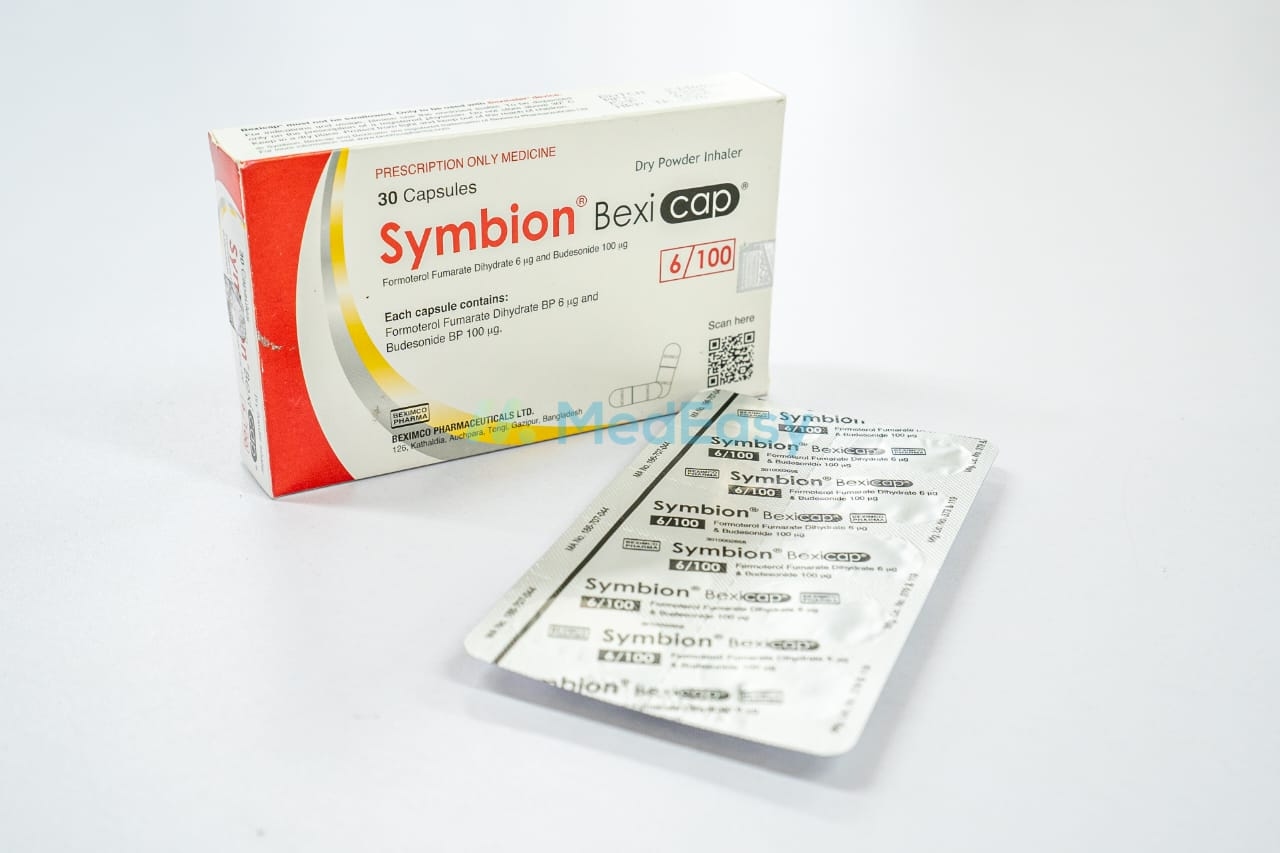
Symbion100 mcg+6
Beximco Pharmaceuticals Ltd.
৳81.00
Add to cart

Formocort 100 mcg+6 mcg Inhalation Capsule is available on MedEasy for ৳6.44 per piece, with home delivery anywhere in Bangladesh. It is manufactured by Healthcare Pharmaceuticals Ltd. Its generic name is Budesonide + Formoterol Fumarate Dihydrate.

Formocort is an inhaled combination of a corticosteroid and a long-acting beta2-agonist (LABA) used for the long-term, regular (maintenance) treatment of certain chronic airway diseases. It is not a rescue medicine for sudden breathing difficulty.
Formocort is not indicated for the relief of acute bronchospasm or acute asthma/COPD symptoms. A separate fast-acting (rescue) inhaler should be used for sudden shortness of breath, and patients should carry one at all times, unless a specific product/regimen has been separately labeled and prescribed by a physician for combined maintenance-and-reliever use. Do not use Formocort as a substitute for oral or inhaled corticosteroids that a patient is being weaned from.
Budesonide + Formoterol Fumarate Dihydrate is a fixed-dose combination product. Each dose combines:
In Bangladesh, Budesonide + Formoterol Fumarate Dihydrate is available as a dry powder inhaler (DPI) in strengths such as 100 mcg/6 mcg, 200 mcg/6 mcg, and 400 mcg/12 mcg (budesonide/formoterol per dose), and as a pressurized metered-dose inhaler (MDI) in strengths such as 80 mcg/4.5 mcg and 160 mcg/4.5 mcg per actuation. The exact strengths and device type available may vary by brand.
Formocort combines two medicines that work together to control chronic airway inflammation and keep the airways open. Budesonide reduces inflammation and swelling in the airways over time, while formoterol fumarate dihydrate relaxes the muscles around the airways, allowing air to move more freely. Used together and taken regularly, they help prevent asthma and COPD symptoms such as wheezing, chest tightness, shortness of breath, and cough, and help reduce the frequency of flare-ups (exacerbations).
Formocort is delivered directly to the lungs by inhalation, which allows it to act locally at lower doses than an equivalent oral medicine, with reduced (though not absent) risk of body-wide (systemic) side effects.
Budesonide + Formoterol Fumarate Dihydrate acts through the combined, complementary mechanisms of its two components.
Budesonide is a glucocorticosteroid with strong local anti-inflammatory activity in the airways. It reduces the production and release of inflammatory mediators, decreases airway hyperresponsiveness, and reduces mucosal edema and mucus secretion. These effects reduce the frequency and severity of asthma/COPD symptoms and exacerbations, though the full anti-inflammatory benefit may take days to weeks to become fully apparent.
Formoterol is a selective beta2-adrenergic receptor agonist that relaxes bronchial smooth muscle, producing bronchodilation. It has a relatively rapid onset of action (within minutes) and a long duration of effect (approximately 12 hours), which supports its role in twice-daily maintenance dosing.
When combined, the corticosteroid component addresses the underlying airway inflammation while the LABA component provides sustained bronchodilation, together improving lung function and symptom control more effectively than either agent alone in appropriately selected patients.
Formocort must be taken exactly as prescribed, on a regular schedule - not just when symptoms occur - because its benefit depends on consistent anti-inflammatory and bronchodilator control, not on-demand relief.
| Indication | Typical Dosing |
|---|---|
| Asthma - Adults and adolescents (12 years and above) | 1-2 inhalations twice daily (approximately 12 hours apart), with strength selected by the prescribing physician based on asthma severity and prior therapy. |
| Asthma - Children (approximately 6 to 11 years) | Lower-strength formulations only, typically 2 inhalations twice daily of the lowest approved strength, as directed by a pediatrician; not all strengths are approved for this age group. |
| COPD - Adults | Typically 2 inhalations twice daily of a higher-strength formulation, as directed by the physician. |
Formocort is for oral inhalation only and must not be swallowed as a tablet or injected. Read and follow the device-specific patient instructions supplied with the inhaler, as technique differs between metered-dose inhalers and dry powder inhalers. Correct inhaler technique is essential for the medicine to reach the lungs effectively; a physician or pharmacist can demonstrate proper technique. Always rinse the mouth with water after use and spit it out. Keep the inhaler clean and dry, and track the dose counter (if present) to know when a refill is needed.
Before using Formocort, tell the physician about all other medicines being used, including the following clinically significant interactions:
Budesonide + Formoterol Fumarate Dihydrate is contraindicated in:
Side effects of Formocort may arise from either the budesonide (corticosteroid) or formoterol (LABA) component.
Report any severe, persistent, or worsening symptoms to a physician promptly.
Pregnancy: There are no adequate and well-controlled studies of Formocort in pregnant women. As with other asthma/COPD medicines, Formocort should be used during pregnancy only if the potential benefit to the mother (including maintaining adequate control of asthma/COPD, since poorly controlled disease itself carries risk to the pregnancy) justifies the potential risk to the fetus. Use only if clearly needed, and only under medical supervision.
Lactation: Budesonide is known to be present in human breast milk in small amounts; it is not established whether formoterol passes into breast milk. A decision to continue or discontinue breastfeeding, or to continue or discontinue Formocort, should be made by weighing the benefit of breastfeeding against the mother's clinical need for Formocort, in consultation with a physician.
Overdose of Formocort may cause exaggerated effects of its components, particularly from formoterol: symptoms such as chest pain, rapid or irregular heartbeat, tremor, nervousness, headache, nausea, muscle cramps, low blood potassium, high blood sugar, and, rarely, seizures. Overdose of the budesonide component with chronic excessive use may increase the risk of systemic corticosteroid effects.
If an overdose is suspected, seek immediate medical attention or contact a poison control center/emergency services. Do not attempt to manage a suspected overdose at home. Cardiac monitoring and supportive care are generally required; a physician will determine whether specific treatment, such as a cardioselective beta-blocker, is appropriate, weighing the risk of bronchospasm.
Store at room temperature (below 30°C), away from direct light, heat, and moisture. Do not puncture, break, or burn the inhaler canister or capsules, and avoid storing near open flame or in a car on a hot day. Keep the mouthpiece clean and dry, and keep out of reach and sight of children.
Renal impairment: No specific dose adjustment of Formocort has been established as necessary in renal impairment; however, systemic corticosteroid effects should be monitored, as with any patient.
Hepatic impairment: Because budesonide is metabolized in the liver, patients with significant hepatic impairment may have increased systemic exposure to budesonide; use with caution and monitor for corticosteroid-related side effects.
Elderly: No overall differences in safety or effectiveness have been established between elderly and younger adult patients, but age-related cardiovascular disease may warrant additional caution with the formoterol component.
Pregnancy and lactation: See Pregnancy and Lactation section above.
Pediatric use: See Pediatric Uses section below.
Formocort is intended for long-term, regular maintenance use in chronic asthma or COPD, not for short courses. The duration of treatment is determined by the prescribing physician based on ongoing disease control, and therapy is typically continued indefinitely as part of a step-wise asthma/COPD management plan, with periodic review (e.g., every 3-6 months) to consider stepping down therapy once control is achieved, or stepping up if control is inadequate. Do not discontinue treatment on your own even if symptoms improve, without medical guidance.
Inhaled Corticosteroid (ICS); Long-Acting Beta2-Adrenergic Agonist (LABA); Combination Anti-Asthmatic/Anti-COPD Agent
Budesonide + Formoterol Fumarate Dihydrate works through two complementary actions: budesonide, a corticosteroid, suppresses airway inflammation by reducing the activity of inflammatory cells and mediators in the lungs, decreasing airway swelling, mucus production, and hyperresponsiveness. Formoterol fumarate dihydrate, a long-acting beta2-adrenergic agonist, binds to beta2-receptors on airway smooth muscle, activating a signaling cascade that relaxes the muscle and widens (dilates) the airways for approximately 12 hours per dose. Together, these actions reduce airway inflammation and maintain open airways, improving airflow and reducing the frequency of asthma/COPD symptoms and exacerbations.
C
The approved pediatric age range for Formocort depends on the specific product strength and formulation, and is determined by the prescribing physician:
Q: What is Formocort 100 mcg+6 mcg Inhalation Capsule used for?
A: Formocort 100 mcg+6 mcg Inhalation Capsule is a combination inhaler used for the regular, long-term maintenance treatment of asthma and chronic obstructive pulmonary disease (COPD). It is not used to relieve a sudden asthma attack.
Q: Can I use Formocort 100 mcg+6 mcg Inhalation Capsule for a sudden asthma attack or shortness of breath?
A: No. Formocort 100 mcg+6 mcg Inhalation Capsule is not indicated for the relief of acute bronchospasm. It has a maintenance role, and most patients need to keep a separate fast-acting rescue inhaler on hand for sudden symptoms, unless a physician has specifically prescribed a different, clearly labeled regimen. Seek urgent medical care if breathing difficulty is severe.
Q: Why do I need to rinse my mouth after using Formocort 100 mcg+6 mcg Inhalation Capsule?
A: Rinsing the mouth with water and spitting it out after each dose helps prevent oral thrush (candidiasis) and hoarseness, which can occur because the corticosteroid component (budesonide) can deposit in the mouth and throat during inhalation.
Q: Can I stop taking Formocort 100 mcg+6 mcg Inhalation Capsule suddenly if I feel better?
A: No. Formocort 100 mcg+6 mcg Inhalation Capsule should not be stopped abruptly, as this can lead to worsening of asthma or COPD symptoms. Any change in dose or discontinuation should be done gradually and only under a physician's guidance.
Q: Is Formocort 100 mcg+6 mcg Inhalation Capsule safe to use during pregnancy or while breastfeeding?
A: Formocort 100 mcg+6 mcg Inhalation Capsule should be used during pregnancy or breastfeeding only if clearly needed and only under medical supervision, since well-controlled human safety data are limited; poorly controlled asthma itself can pose risks in pregnancy, so the physician will weigh the benefits and risks. Do not start or stop Formocort 100 mcg+6 mcg Inhalation Capsule during pregnancy or breastfeeding without consulting a physician.
Q: What are the most common side effects of Formocort 100 mcg+6 mcg Inhalation Capsule?
A: The most common side effects include oral thrush, hoarseness, headache, throat irritation, tremor, palpitations, and upper respiratory infections. Rinsing the mouth after use and using correct inhaler technique can reduce some of these risks. Contact a physician if side effects are severe or persistent.
Disclaimer
The information provided is accurate to the best of our knowledge, but it does not replace professional medical advice. We cannot guarantee its completeness or accuracy, and the absence of specific information about a drug should not be taken as an endorsement. We are not responsible for any consequences arising from this information, so please consult a healthcare professional for any concerns or questions.
