
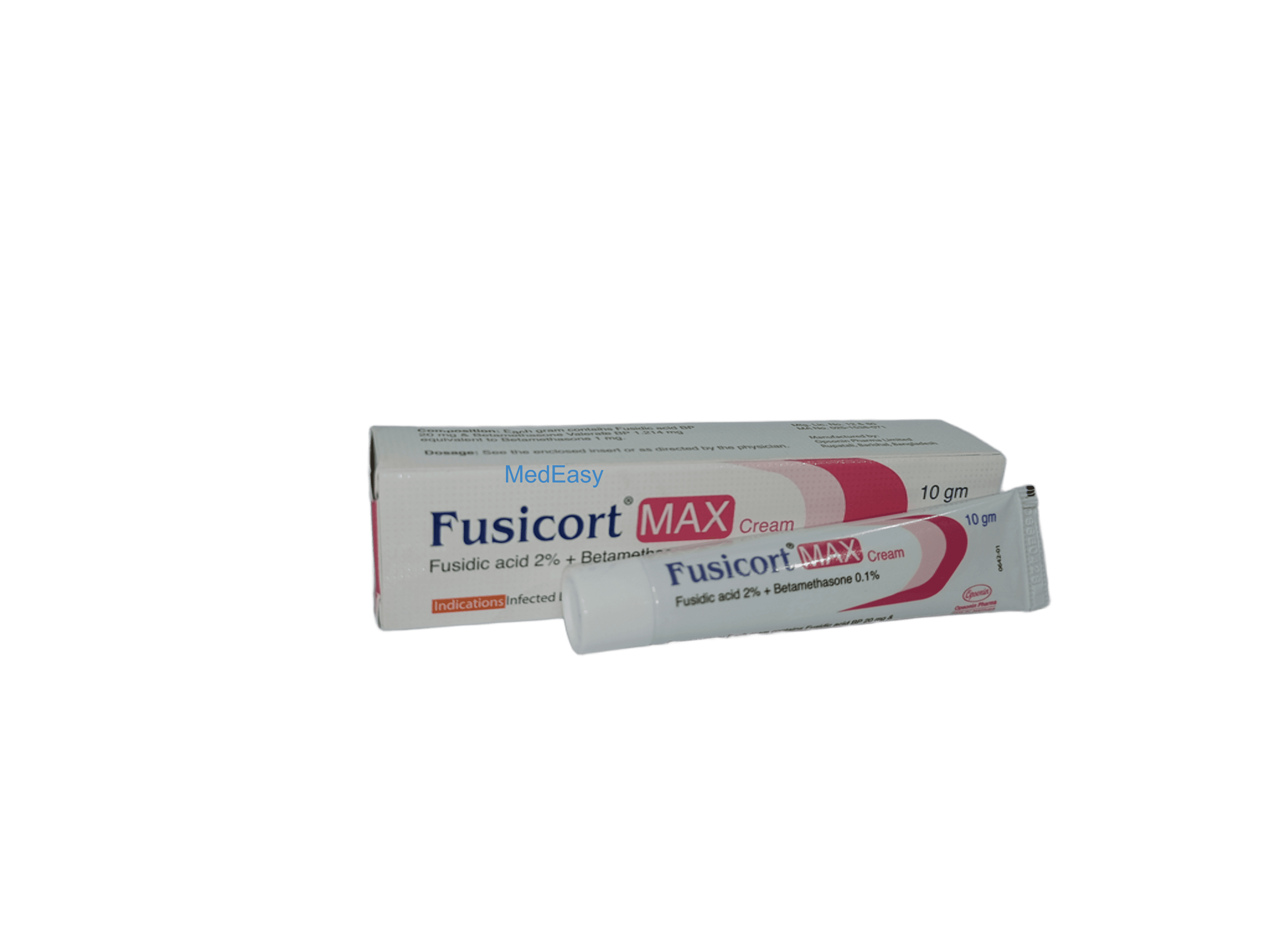

Medicine overview
Indications of Fusicort Max
Indications
Fusicort Max is indicated for the short-term treatment of inflammatory skin conditions (such as atopic dermatitis, eczema, and other steroid-responsive dermatoses) that are infected, or likely to become infected, with organisms susceptible to fusidic acid (mainly Staphylococcus aureus).
- Established use: Infected or potentially infected inflammatory dermatoses (e.g., infected eczema, infected contact dermatitis, infected atopic dermatitis) where both anti-inflammatory and antibacterial action are needed.
- Not indicated for primary skin infections without an inflammatory component, or for long-term/maintenance therapy of chronic dermatoses.
Fusicort Max combines a topical antibiotic with a corticosteroid and should be reserved for cases where infection and inflammation coexist; a corticosteroid alone or an antibiotic alone is preferred when only one problem is present.
Composition
Each gram of Fusidic acid + Betamethasone cream/ointment typically contains Fusidic acid 20 mg (2% w/w, as fusidic acid or sodium fusidate) and Betamethasone 1 mg (0.1% w/w, as betamethasone valerate), in a suitable cream or ointment base.
Description
Fusicort Max is a fixed-dose combination topical preparation that pairs a bacteriostatic antibiotic (fusidic acid) with a mid-to-high potency synthetic corticosteroid (betamethasone). It is formulated as a cream or ointment for dermatological use and is designed to treat inflamed skin lesions that are infected or at risk of secondary bacterial infection, addressing both the underlying inflammation and the bacterial component in a single product.
Therapeutic Class
Fusicort Max belongs to the therapeutic class of topical antibacterial-corticosteroid combinations used in dermatology for infected inflammatory skin disorders.
Pharmacology
Fusidic acid + Betamethasone combines two agents with complementary actions. Fusidic acid is a steroidal antibiotic that inhibits bacterial protein synthesis by blocking the translocation step (interfering with elongation factor G), producing a bacteriostatic effect predominantly against Staphylococcus aureus, including many penicillin-resistant strains. Betamethasone (as the valerate ester) is a synthetic corticosteroid with anti-inflammatory, antipruritic, and vasoconstrictive properties, acting by inducing phospholipase A2-inhibiting proteins (lipocortins) that reduce the release of inflammatory mediators. Following topical application of Fusidic acid + Betamethasone, systemic absorption through intact skin is normally low, but increases with application to broken skin, large surface areas, occlusive dressings, or prolonged use.
Dosage & Administration of Fusicort Max
Fusicort Max should be applied as a thin layer to the affected skin area(s), usually two times daily (morning and evening), or as directed by the physician. Treatment is generally continued for up to 7–14 days and should not exceed 2 weeks of continuous use without medical reassessment.
| Indication | Typical adult dose | Typical duration |
|---|---|---|
| Infected inflammatory dermatoses (e.g., infected eczema) | Apply thin layer twice daily to affected area | Up to 7–14 days |
Use Fusicort Max exactly as prescribed by the physician; do not stop, extend, skip applications, or share this medicine with others without medical advice, since fusidic acid resistance and rebound skin flare can develop with inappropriate use.
Administration of Fusicort Max
Fusicort Max is for external (topical) use only. Wash and dry the affected area, then apply a thin film and gently rub in. Wash hands after application unless the hands are the treated area. Avoid contact with the eyes, mouth, and mucous membranes. Do not cover the treated area with an occlusive (airtight/waterproof) dressing unless specifically instructed by the physician, as this increases systemic absorption. Fusicort Max must not be swallowed, applied inside the nose, or used in the eyes.
Interaction of Fusicort Max
Clinically significant drug interactions with topical Fusicort Max are uncommon because systemic absorption is normally minimal. However:
- Concurrent use of other topical corticosteroids or systemic corticosteroids may increase the total corticosteroid burden.
- Use with other topical products on the same area (e.g., other antibacterials, keratolytics, or irritant preparations) may alter local absorption or increase irritation.
- Extensive application under occlusion or over large body-surface areas can increase systemic absorption of betamethasone, theoretically influencing drugs affected by corticosteroids (e.g., antidiabetic agents) — clinically relevant mainly with prolonged, extensive use.
Contraindications
Fusidic acid + Betamethasone is contraindicated in the following situations:
- Known hypersensitivity to fusidic acid, betamethasone, other corticosteroids, or any excipient of the product.
- Primary cutaneous viral infections, including herpes simplex, chickenpox (varicella), and vaccinia.
- Primary bacterial skin infections without an accompanying inflammatory dermatosis (a plain antibiotic, not Fusidic acid + Betamethasone, is appropriate here).
- Fungal skin infections (e.g., tinea, candidiasis) and tuberculous skin lesions.
- Rosacea, perioral dermatitis, and acne vulgaris.
Side Effects of Fusicort Max
Side effects of Fusicort Max are usually local and mild:
- Common: burning, stinging, itching, or irritation at the application site; localized dryness.
- Less common: allergic contact dermatitis, folliculitis, hypertrichosis.
- With prolonged or extensive use: skin atrophy, striae (stretch marks), telangiectasia (visible blood vessels), perioral dermatitis, hypopigmentation, and, rarely, systemic corticosteroid effects (e.g., Cushingoid features) due to absorption.
Pregnancy & Lactation
Data on the use of Fusicort Max in human pregnancy are limited, particularly for prolonged or extensive application. Topical corticosteroids have been associated with an increased risk of low birth weight when used extensively during pregnancy. Fusicort Max should be used during pregnancy only if clearly needed and if the potential benefit justifies the potential risk to the fetus; use the smallest effective amount for the shortest possible duration, and consult a physician before use. During breastfeeding, avoid applying Fusicort Max to the breast/nipple area to prevent inadvertent ingestion by the infant; otherwise, use only under medical advice.
Precautions & Warnings
Observe the following precautions when using Fusicort Max:
- For external skin use only; not for ophthalmic, intranasal, intravaginal, or intra-oral use.
- Avoid use on the face for prolonged periods, and avoid application near the eyes, due to increased sensitivity to corticosteroid-induced skin thinning and the risk of glaucoma/cataract if it reaches the eye.
- Do not use for longer than the physician-recommended duration (generally up to 2 weeks); prolonged or repeated use increases the risk of skin atrophy, striae, telangiectasia, and development of resistance to fusidic acid.
- Avoid use under occlusive dressings, on broken or extensively damaged skin, or over large body-surface areas unless specifically directed, as these increase systemic corticosteroid absorption.
- Discontinue and seek medical advice if signs of hypersensitivity, worsening infection, or skin irritation develop.
- Use with caution in children, the elderly, and patients with pre-existing skin infections, given the increased risk of systemic absorption and thinner skin.
Overdose Effects of Fusicort Max
Overdose with topical Fusicort Max is unlikely with normal use but may occur with excessive or prolonged application, or accidental ingestion. Excessive or prolonged use of Fusicort Max may lead to systemic corticosteroid effects (e.g., adrenal suppression, Cushingoid features) or marked local skin changes. If overdose or accidental ingestion is suspected, discontinue use and seek immediate medical attention or contact a poison control center; do not attempt specific home treatment.
Storage Conditions
Store Fusicort Max at room temperature (below 30°C), away from light and moisture. Do not freeze. Keep the tube tightly closed and out of the reach and sight of children.
Use In Special Populations
Pediatric: Fusicort Max should be used in children only under close medical supervision, at the lowest effective amount, for the shortest duration, because children have a higher skin-surface-area-to-body-weight ratio and are more susceptible to systemic corticosteroid absorption and HPA-axis suppression. Safety and efficacy for prolonged use in infants and young children are not established.
Elderly: No specific dose adjustment is generally required, but elderly patients often have thinner skin and should be monitored for atrophic changes with prolonged use of Fusicort Max.
Renal/hepatic impairment: No specific dose adjustment is established for topical Fusicort Max, as systemic exposure is normally minimal; caution is still advised with extensive or prolonged application.
Duration Of Treatment
Treatment with Fusicort Max is generally limited to short courses of about 7 to 14 days. Continuous use beyond 2 weeks is not recommended without medical reassessment, because of the increased risk of skin atrophy and fusidic acid resistance with longer courses.
Drug Classes
Fusidic acid + Betamethasone combines two drug classes: fusidic acid, a fusidane-class steroidal antibiotic, and betamethasone valerate, a synthetic mid-to-high potency topical corticosteroid (glucocorticoid).
Mode Of Action
In Fusidic acid + Betamethasone, fusidic acid acts by binding to bacterial elongation factor G (EF-G), blocking the translocation step of bacterial protein synthesis and thereby exerting a bacteriostatic effect mainly against Staphylococcus aureus. Betamethasone acts intracellularly on glucocorticoid receptors, inducing synthesis of lipocortins that inhibit phospholipase A2, thereby reducing the production of inflammatory mediators (prostaglandins, leukotrienes) and producing anti-inflammatory, antipruritic, and vasoconstrictive effects on the skin.
Pediatric Uses
Fusicort Max may be used in children for short-term treatment of infected inflammatory dermatoses, but only under medical supervision. Because children absorb topical corticosteroids more readily than adults (due to a higher skin-surface-to-body-weight ratio), Fusicort Max should be applied sparingly, for the shortest effective duration, avoiding occlusive dressings. Prolonged or extensive use in children may cause growth suppression or adrenal suppression from systemic corticosteroid absorption. Safety and efficacy for long-term or extensive use in infants have not been established.
Frequently Asked Questions
Q: What is Fusicort Max 2%+0.1% Cream used for?
A: Fusicort Max 2%+0.1% Cream is used to treat inflamed skin conditions, such as eczema or dermatitis, that are infected or likely to become infected with bacteria (mainly Staphylococcus aureus).
Q: How long can I use Fusicort Max 2%+0.1% Cream?
A: Fusicort Max 2%+0.1% Cream should generally be used for no more than 7 to 14 days. Using it for longer than prescribed can increase the risk of skin thinning and antibiotic resistance, so always follow your physician's instructions.
Q: Can I use Fusicort Max 2%+0.1% Cream on my face?
A: Fusicort Max 2%+0.1% Cream should be used on the face only if specifically prescribed by a physician and for a short duration, since facial skin is thin and more prone to side effects such as thinning, perioral dermatitis, or steroid rosacea. Avoid contact with the eyes.
Q: Is Fusicort Max 2%+0.1% Cream safe during pregnancy?
A: Fusicort Max 2%+0.1% Cream should be used during pregnancy only if clearly needed and if the potential benefit justifies the potential risk to the fetus. Use the smallest amount for the shortest time and consult your physician before use.
Q: What are the common side effects of Fusicort Max 2%+0.1% Cream?
A: Common side effects of Fusicort Max 2%+0.1% Cream include burning, stinging, itching, or dryness at the application site. Prolonged use can cause skin thinning, stretch marks, or visible blood vessels, so it should not be used longer than prescribed.
Q: Can Fusicort Max 2%+0.1% Cream be used for fungal infections like ringworm?
A: No. Fusicort Max 2%+0.1% Cream is not effective against fungal infections and should not be used for tinea (ringworm), candidiasis, or other fungal skin conditions, as the corticosteroid component can worsen a fungal infection.
Disclaimer
The information provided is accurate to the best of our knowledge, but it does not replace professional medical advice. We cannot guarantee its completeness or accuracy, and the absence of specific information about a drug should not be taken as an endorsement. We are not responsible for any consequences arising from this information, so please consult a healthcare professional for any concerns or questions.
