
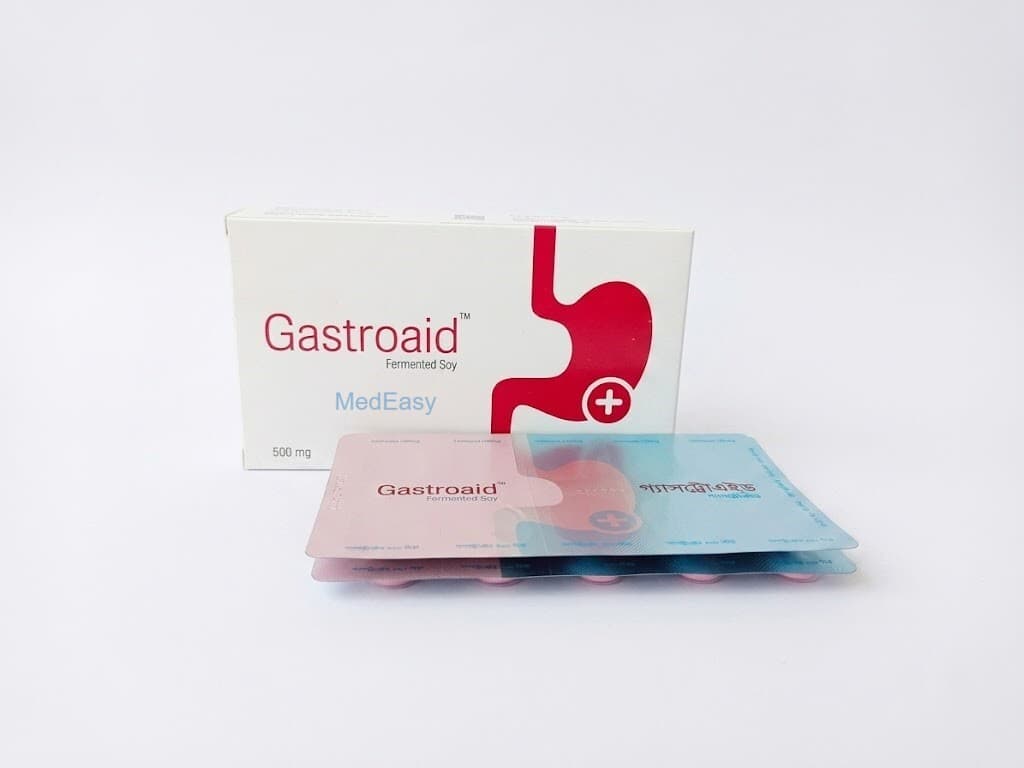

Medicine overview
Indications of Gastroaid
Gastroaid is a fermented-food-derived probiotic dietary supplement. It is intended as a dietary supplement to help support gut microbiota balance and general digestive health.
- Supplement-level use (not an approved drug indication): to support digestive comfort and a balanced intestinal flora as part of a general wellness or nutritional program.
- Adjunct use: may be used alongside a balanced diet, particularly after disruption of normal gut flora (e.g., following a course of antibiotics); evidence for specific clinical outcomes with this particular product is limited and product-specific.
Because Gastroaid is marketed as a dietary/food supplement rather than a drug with regulator-approved therapeutic claims, it should not be relied upon to treat, cure, or prevent any specific disease. Consult a physician for diagnosis and treatment of any digestive or gastrointestinal condition.
Composition
Each unit of Fermented soy [Lactobacillus Delbrueckii] contains a fermented soy substrate combined with a standardized quantity of the probiotic bacterial strain Lactobacillus delbrueckii. The exact bacterial count (CFU) and excipients vary by manufacturer and product presentation; refer to the specific product label/pack insert for the exact formulation.
Description
Gastroaid is a probiotic dietary supplement prepared by fermenting a soy-based substrate with the lactic-acid-producing bacterium Lactobacillus delbrueckii. Fermentation with lactobacilli species is a traditional food-processing method used to produce fermented soy foods and probiotic supplements intended to introduce live beneficial bacteria into the gastrointestinal tract.
Gastroaid is generally categorized as a dietary/nutritional supplement rather than a conventional pharmaceutical drug, and is used by individuals seeking general digestive and gut-health support.
Therapeutic Class
Gastroaid belongs to the probiotic dietary supplement class (fermented-food-derived live microbial supplements), rather than a conventional pharmacological drug class.
Pharmacology
Fermented soy [Lactobacillus Delbrueckii] supplies live Lactobacillus delbrueckii organisms grown on a fermented soy substrate. Lactobacilli are lactic-acid-producing bacteria that, when ingested, may transiently colonize the gastrointestinal tract and contribute to the intestinal microbial ecosystem.
Proposed mechanisms include competitive exclusion of potentially pathogenic organisms, production of lactic acid and other metabolites that lower local pH, modulation of intestinal barrier function, and interaction with gut-associated lymphoid tissue. Clinical evidence for these mechanisms translating into specific health outcomes is limited and varies by strain, dose, and product; effects should be considered general and supportive rather than a proven therapeutic effect for the treatment of disease.
Dosage & Administration of Gastroaid
| Population | Suggested Use |
|---|---|
| Adults | Take as directed on the product label, typically once daily, or as advised by a physician or pharmacist. |
| Children | Use only under medical or product-label guidance; safety and efficacy of specific dosing in children have not been formally established through regulatory trials. |
Doses and CFU counts vary by manufacturer; always follow the specific product label for Gastroaid or the advice of a physician or pharmacist.
Administration of Gastroaid
Gastroaid is generally taken orally, with or without food, according to the product label. If provided as a powder/sachet, it may be mixed with a small amount of cool or lukewarm (not hot) water or a soft food, since excessive heat can reduce the viability of the live bacteria. Swallow capsules/tablets whole with water unless the label states otherwise.
Interaction of Gastroaid
Reported interactions with Gastroaid are limited, as would be expected for a probiotic dietary supplement, but the following should be noted:
- Antibiotics: concurrent antibiotic therapy can reduce the viability of the live bacteria in Gastroaid; if used together, separate dosing by at least 2 hours where practical.
- Immunosuppressive therapy: concurrent use with immunosuppressive drugs may theoretically increase the risk of probiotic-related infection in susceptible individuals (see Precautions and Contraindications).
Contraindications
Fermented soy [Lactobacillus Delbrueckii] is contraindicated in:
- Known hypersensitivity/allergy to soy, soy-derived products, or to Lactobacillus/probiotic components of the formulation.
Severe immunocompromise and presence of a central venous catheter are not absolute contraindications but represent important precautions with a theoretical risk of probiotic-related bloodstream infection; see Precautions and Warnings.
Side Effects of Gastroaid
Side effects with Gastroaid are generally mild and self-limited. Reported effects include:
- Mild gastrointestinal bloating, flatulence, or abdominal discomfort, particularly during the first few days of use.
- Mild changes in bowel habit (e.g., loose stools).
- Rarely, allergic reactions (skin rash, itching) in individuals sensitive to soy or probiotic components.
- Very rarely, and almost exclusively in severely immunocompromised individuals or those with central venous catheters, systemic infection (bacteremia/fungemia) associated with probiotic organisms has been reported with probiotic products generally.
Pregnancy & Lactation
Data specific to Gastroaid in pregnancy and lactation are limited. Fermented soy and lactobacillus-based foods/supplements are generally considered low risk when used as directed, but Gastroaid should be used during pregnancy and breastfeeding only if clearly needed and after consulting a physician, since formal safety and efficacy data from controlled trials are not established.
Precautions & Warnings
Use Gastroaid with caution in:
- Severely immunocompromised individuals (e.g., advanced HIV/AIDS, hematologic malignancy, post-transplant immunosuppression, critically ill patients): probiotics carry a theoretical, rare risk of bacteremia/fungemia in this population; use only under medical supervision.
- Patients with a central venous catheter in place: rare cases of catheter-related probiotic bloodstream infection have been reported with probiotic products; use with caution and medical guidance.
- Soy allergy or intolerance: discontinue if any allergic symptoms occur (see Contraindications).
Discontinue Gastroaid and seek medical attention if fever, chills, or other signs of infection develop during use.
Overdose Effects of Gastroaid
Excessive intake of Gastroaid beyond the recommended dose may cause increased gastrointestinal discomfort, bloating, or loose stools, but serious toxicity from overdose is not expected for a probiotic supplement of this type. If a large overdose is taken or if concerning symptoms occur, seek immediate medical attention or contact a poison control center/emergency services; do not attempt unsupervised specific home treatment beyond general supportive care.
Storage Conditions
Store at room temperature (below 30°C), away from light and moisture. Keep out of reach of children. Some formulations of Gastroaid may require refrigeration to preserve live-bacteria viability; check the specific product label for storage instructions.
Use In Special Populations
Elderly: No specific dose adjustment is established for Gastroaid in elderly patients; use as directed, with the same caution regarding immune status as in other populations.
Renal/Hepatic impairment: No well-established dose adjustment is required for Gastroaid in renal or hepatic impairment, as it is not systemically absorbed in the manner of conventional pharmaceuticals; general precautions regarding immune status still apply.
Immunocompromised patients: see Precautions and Warnings and Contraindications.
Duration Of Treatment
There is no fixed, regulator-established duration of use for Gastroaid. As a dietary supplement, it may be used short-term (e.g., during or after a course of antibiotics) or longer-term as part of general digestive-health maintenance, according to the product label or a physician's advice. Re-evaluate continued use with a physician if symptoms persist or worsen.
Drug Classes
Probiotic dietary supplement; fermented-food-derived live microbial supplement (not a conventional drug class).
Mode Of Action
Fermented soy [Lactobacillus Delbrueckii] works by delivering live Lactobacillus delbrueckii organisms to the gastrointestinal tract, where they may transiently contribute to the resident microbiota, produce lactic acid to lower local pH, compete with potentially harmful organisms for nutrients and adhesion sites, and interact with gut-associated lymphoid tissue. These actions are proposed to support general digestive balance rather than to treat a specific disease process.
Pediatric Uses
Safety and efficacy of Gastroaid in children have not been formally established through controlled pediatric trials. If used in children, it should be under the guidance of a pediatrician, following age-appropriate product formulations and label instructions. Products containing soy should be avoided in children with a known soy allergy.
Frequently Asked Questions
Q: What is Gastroaid 500 mg Tablet used for?
A: Gastroaid 500 mg Tablet is a probiotic dietary supplement used to help support gut microbiota balance and general digestive health. It is not an approved drug for treating a specific disease, and evidence for specific clinical outcomes is limited and product-specific.
Q: Is Gastroaid 500 mg Tablet safe during pregnancy or breastfeeding?
A: Data specific to Gastroaid 500 mg Tablet in pregnancy and breastfeeding are limited. It is generally considered low risk when used as directed, but should be used only if clearly needed and after consulting a physician, since formal controlled-trial safety data are not established.
Q: Who should avoid taking Gastroaid 500 mg Tablet?
A: Gastroaid 500 mg Tablet should be avoided by anyone with a known hypersensitivity/allergy to soy or to Lactobacillus/probiotic components. It should be used only with medical supervision in severely immunocompromised individuals and in people with a central venous catheter in place, due to a rare, theoretical risk of probiotic-related bloodstream infection.
Q: What side effects can occur with Gastroaid 500 mg Tablet?
A: Most people tolerate Gastroaid 500 mg Tablet well. Mild bloating, gas, abdominal discomfort, or loose stools can occur, especially in the first few days. Allergic reactions are rare. Very rarely, in severely immunocompromised patients or those with a central venous catheter, probiotic-related bloodstream infection has been reported.
Q: How should I take Gastroaid 500 mg Tablet?
A: Take Gastroaid 500 mg Tablet orally as directed on the product label, typically once daily, with or without food. If it is a powder/sachet, mix with cool or lukewarm (not hot) liquid or soft food, since heat can reduce the viability of the live bacteria.
Q: What should I do if I take too much Gastroaid 500 mg Tablet or experience an emergency?
A: Taking more than the recommended dose of Gastroaid 500 mg Tablet may increase gastrointestinal discomfort such as bloating or loose stools, but serious toxicity is not expected. If a large overdose occurs or concerning symptoms develop, seek immediate medical attention or contact a poison control center/emergency services.
Disclaimer
The information provided is accurate to the best of our knowledge, but it does not replace professional medical advice. We cannot guarantee its completeness or accuracy, and the absence of specific information about a drug should not be taken as an endorsement. We are not responsible for any consequences arising from this information, so please consult a healthcare professional for any concerns or questions.
