
7% Off
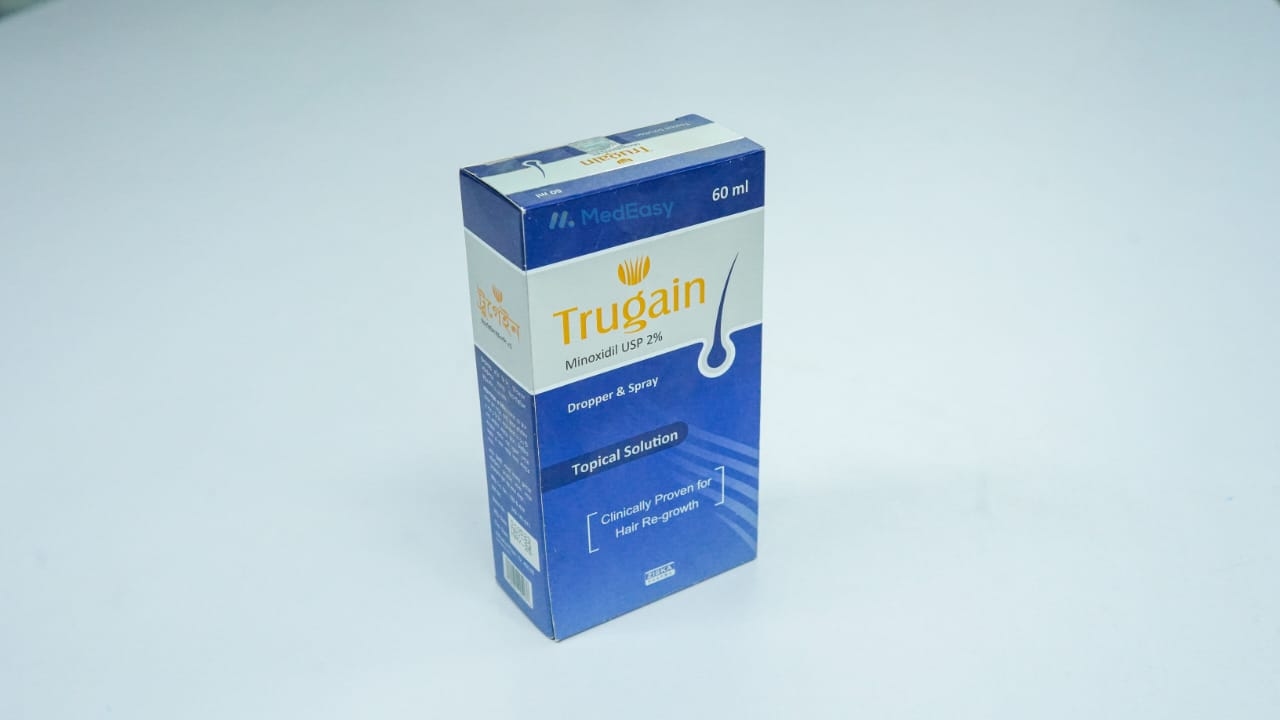
Trugain2%
Ziska Pharmaceuticals Ltd.
৳418.50
Add to cart

Hairgrow 2% Scalp Lotion is available on MedEasy for ৳465.00 per 60 ml bottle, with home delivery anywhere in Bangladesh. It is manufactured by Eskayef Bangladesh Ltd. Its generic name is Minoxidil.

Hairgrow is used in two distinct forms with different approved indications:
Topical Hairgrow is not indicated for other causes of hair loss (e.g. postpartum hair loss, alopecia areata, scarring alopecia, or hair loss of unclear cause) and should not be used for these without prior medical evaluation.
Minoxidil is available in more than one pharmaceutical form:
Topical formulations typically also contain alcohol and propylene glycol (solution) or similar vehicle ingredients that assist penetration into the scalp.
Hairgrow is a direct-acting peripheral vasodilator that was originally developed and remains approved as an oral antihypertensive for severe, treatment-resistant high blood pressure. During clinical use of the oral form, excessive hair growth (hypertrichosis) was observed as a side effect, which led to the development of a separate topical formulation of Hairgrow specifically for the treatment of androgenetic (pattern) hair loss.
The oral and topical forms of Hairgrow are used for entirely different purposes, have different strengths/formulations, and different risk profiles; they should not be considered interchangeable.
Antihypertensive agent (peripheral vasodilator) — oral form; Topical hair growth stimulant — topical form
Minoxidil itself is a prodrug that is metabolized (mainly by hepatic sulfotransferase, and by hair follicle sulfotransferase for the topical form) to its active metabolite, Minoxidil sulfate.
Minoxidil sulfate opens ATP-sensitive potassium channels in vascular smooth muscle cells, causing hyperpolarization of the cell membrane. This relaxes arteriolar smooth muscle and produces marked peripheral vasodilation, which lowers systemic vascular resistance and blood pressure. Minoxidil has little effect on venous capacitance vessels. The resulting fall in blood pressure triggers reflex sympathetic activation (tachycardia) and renal sodium/water retention, which is why oral Minoxidil must be co-administered with a beta-blocker and a diuretic.
The precise mechanism by which topical Minoxidil stimulates hair growth is not completely understood. Proposed mechanisms include vasodilation of scalp blood vessels increasing follicular blood flow and oxygen/nutrient delivery, direct stimulation of hair follicle cells, prolongation of the anagen (growth) phase of the hair cycle, and enlargement of miniaturized follicles. Systemic absorption from topical use is normally low (about 1–2%).
| Population | Dosing |
|---|---|
| Adults | Initial dose 5 mg once daily. May be increased to 10 mg, 20 mg, then 40 mg per day at intervals of at least 3 days, as needed for blood pressure control. Usual effective dose range is 10–40 mg/day, given as a single dose or in two divided doses. Maximum dose: 100 mg/day. |
| Children (< 12 years) | Initial dose approximately 0.2 mg/kg once daily, increased gradually as needed under close specialist supervision. Maximum 50 mg/day. |
Oral Hairgrow must always be given concurrently with a diuretic (to control fluid retention) and a beta-blocker or other sympatholytic agent (to control reflex tachycardia); see Precautions and Warnings.
| Product | Dosing |
|---|---|
| 2% or 5% topical solution | Apply 1 mL to the affected area of a dry scalp twice daily (morning and evening), regardless of the size of the area involved. Do not exceed 2 mL/day. |
| 5% topical foam | Apply approximately half a capful to the affected area of a dry scalp twice daily. Do not exceed 1 capful/day. |
Apply only to the scalp; wash hands thoroughly after application. Continued twice-daily use is required to maintain any benefit — hair loss typically resumes within a few months of stopping treatment.
Oral tablets: May be taken with or without food, at approximately the same time(s) each day. Swallow the tablet whole with water. Do not stop or change the dose without consulting a physician, even if blood pressure appears controlled, because of the risk of rebound hypertension.
Topical solution/foam: Apply to a completely dry scalp using the dropper/applicator (solution) or by dispensing onto fingers (foam), spreading evenly over the thinning area. Wash hands after application. Allow the product to dry completely (approximately 2–4 hours) before bedtime, swimming, use of other scalp/hair products, or applying heat (hair dryer). Avoid contact with the eyes, face, and other skin surfaces, as Hairgrow can stimulate unwanted hair growth wherever it contacts skin.
| Form | Common | Serious / less common |
|---|---|---|
| Oral | Fluid and sodium retention, weight gain, edema, tachycardia, palpitations, hypertrichosis (excessive growth of body/facial hair), breast tenderness | Pericardial effusion, cardiac tamponade (rare but serious), angina/worsening ischemic heart disease, congestive heart failure |
| Topical | Scalp itching, dryness, flaking, or irritation; contact dermatitis; initial temporary increase in hair shedding when starting treatment | Unwanted hair growth on the face or other skin areas if the product spreads beyond the scalp; rarely, chest pain, rapid heartbeat, dizziness, or swelling suggesting systemic absorption |
Data on the use of oral or topical Hairgrow in human pregnancy are limited. Hairgrow should be used during pregnancy only if clearly needed and if the potential benefit to the mother justifies the potential risk to the fetus; a physician should be consulted before use.
It is not known whether Hairgrow is excreted in breast milk in clinically significant amounts after topical use, though systemic absorption is low; oral Hairgrow is known to be excreted in breast milk. As a precaution, breastfeeding women should avoid both oral and topical Hairgrow unless specifically advised otherwise by a physician, and should avoid applying topical Hairgrow to areas that may contact the infant's skin or mouth.
Because of its potent effects, oral Hairgrow is reserved for severe hypertension that has not responded to other therapy, and requires close medical supervision:
Oral Hairgrow overdose can cause pronounced hypotension, dizziness or fainting, rapid heartbeat, and fluid retention. Accidental ingestion of topical Hairgrow can produce similar systemic effects (marked drop in blood pressure, fluid retention, tachycardia) because the entire topical dose becomes available for absorption if swallowed.
In either case, seek immediate medical attention or contact a poison control center / emergency services right away. Do not attempt home treatment. Take the product packaging with you if going to a hospital or calling for help, so treating clinicians know the exact formulation and strength involved.
Store at room temperature (below 30°C), away from light and moisture. Topical solutions and foams are typically flammable due to their alcohol content — keep away from open flame, cigarettes, and heat sources, and do not use while smoking or near an open flame. Keep the container tightly closed. Keep out of reach of children.
Oral: Used long-term as part of ongoing management of resistant hypertension, for as long as clinically indicated; blood pressure control and fluid status should be reassessed regularly by a physician, and the drug should not be stopped abruptly without medical advice.
Topical: A trial of at least 4 months of consistent twice-daily use is usually needed before hair regrowth benefit can be judged; some patients require 6–12 months. Continued use is necessary to sustain any benefit — newly grown hair is typically lost within a few months of discontinuing treatment.
Antihypertensives — peripheral vasodilators (oral); Dermatological agents — topical hair growth stimulants (topical)
Minoxidil is converted to its active form, Minoxidil sulfate, which opens ATP-sensitive potassium (K-ATP) channels in vascular smooth muscle. This hyperpolarizes the cell membrane, closes voltage-gated calcium channels, reduces intracellular calcium, and relaxes arteriolar smooth muscle — producing direct peripheral arteriolar vasodilation and a fall in blood pressure with little effect on veins.
On the scalp, local conversion to Minoxidil sulfate by follicular sulfotransferase is thought to increase blood flow to hair follicles and promote a shift of follicles into, and prolongation of, the anagen (active growth) phase, though the exact mechanism of hair regrowth is not fully established.
C
Oral Hairgrow: Has an established weight-based dosing regimen for severe hypertension in children (see Dosage), used under close specialist supervision given the risks of fluid retention and cardiac effects.
Topical Hairgrow: Safety and efficacy have not been established in individuals under 18 years of age; topical Hairgrow is not recommended for this age group.
Q: What is Hairgrow 2% Scalp Lotion used for?
A: Hairgrow 2% Scalp Lotion has two very different uses depending on the form: an oral tablet form used for severe, treatment-resistant high blood pressure (always combined with a diuretic and a beta-blocker), and a topical solution/foam form applied to the scalp to treat male and female pattern hair loss (androgenetic alopecia).
Q: How long does topical Hairgrow 2% Scalp Lotion take to work for hair loss?
A: Most people need to use topical Hairgrow 2% Scalp Lotion consistently, twice daily, for at least 4 months before noticing regrowth, and some need 6–12 months. Benefits are only maintained with continued use; hair loss usually resumes within a few months if treatment is stopped.
Q: Can I use oral Hairgrow 2% Scalp Lotion on its own for high blood pressure?
A: No. Oral Hairgrow 2% Scalp Lotion must always be prescribed together with a diuretic (to prevent fluid retention) and a beta-blocker or similar drug (to prevent a fast reflex heartbeat). Using it alone increases the risk of fluid overload, heart strain, and rarely, fluid buildup around the heart (pericardial effusion).
Q: Is it safe to use topical Hairgrow 2% Scalp Lotion during pregnancy or breastfeeding?
A: Hairgrow 2% Scalp Lotion (oral or topical) should be used in pregnancy only if clearly needed, after discussing the potential risks and benefits with a physician. As a precaution, breastfeeding women are generally advised to avoid Hairgrow 2% Scalp Lotion unless a physician says otherwise, since it can pass into breast milk.
Q: What side effects should prompt me to stop Hairgrow 2% Scalp Lotion and seek medical help?
A: With oral Hairgrow 2% Scalp Lotion, seek urgent medical attention for breathlessness, chest discomfort, rapid unexplained weight gain, or swelling, as these can signal fluid retention or fluid around the heart. With topical Hairgrow 2% Scalp Lotion, stop and seek medical advice for chest pain, rapid heartbeat, dizziness, fainting, or persistent scalp irritation.
Q: Can topical Hairgrow 2% Scalp Lotion cause unwanted hair growth elsewhere on the body?
A: Yes. If topical Hairgrow 2% Scalp Lotion spreads or drips onto the face or other skin areas, it can stimulate hair growth there too. Apply only to a dry scalp, wash your hands thoroughly afterward, and let the scalp dry fully before lying down or touching your face.
Disclaimer
The information provided is accurate to the best of our knowledge, but it does not replace professional medical advice. We cannot guarantee its completeness or accuracy, and the absence of specific information about a drug should not be taken as an endorsement. We are not responsible for any consequences arising from this information, so please consult a healthcare professional for any concerns or questions.

