

10% Off
Emurea25%
Ziska Pharmaceuticals Ltd.
৳135.00
Add to cart
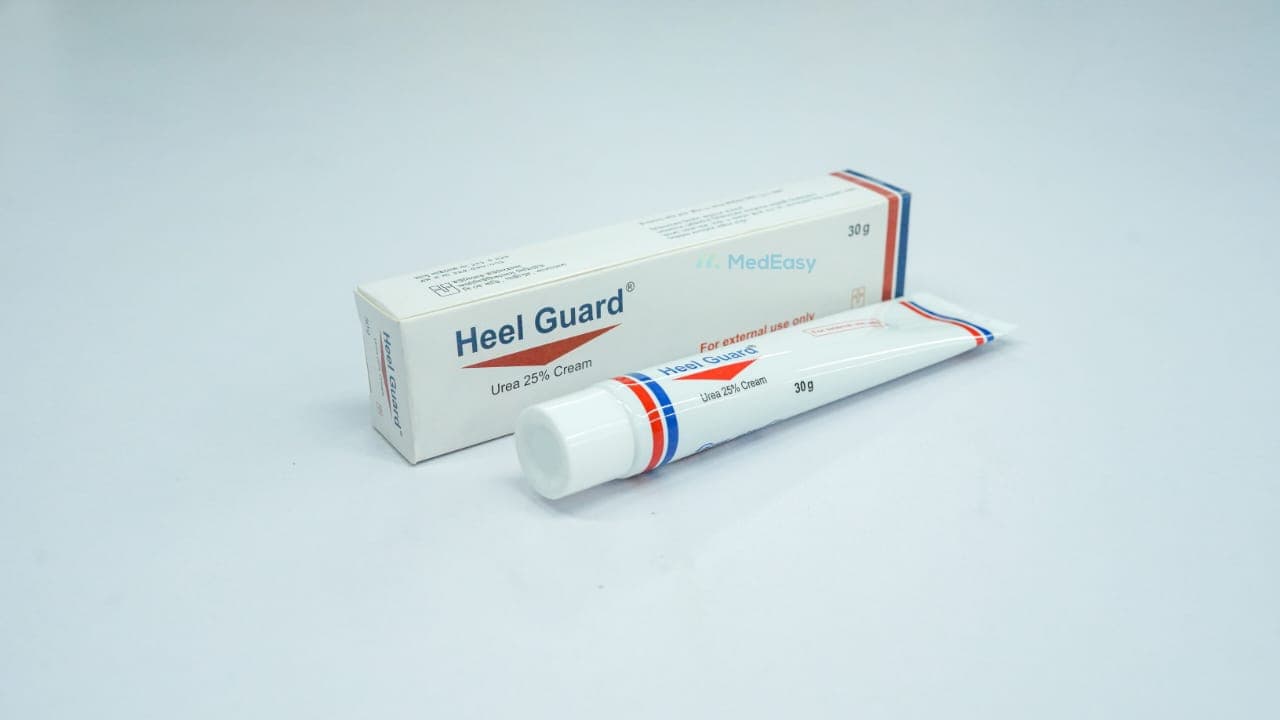

Heel Guard is a high-strength topical keratolytic and emollient preparation used for skin conditions involving excessive dryness, thickening, or scaling.
Heel Guard is for external use on intact, non-infected skin only; it is not a treatment for any underlying systemic disease.
Each pack of Urea [25%] contains Urea 25% w/w as the active ingredient in a suitable emollient cream/ointment base.
Heel Guard is a topical dermatological preparation containing urea at a 25% concentration, a strength that provides pronounced keratolytic (skin-softening/exfoliating) action in addition to the moisturizing (humectant) effect seen at lower urea concentrations.
It works by helping the outer skin layer (stratum corneum) hold more water and by loosening the bonds between hardened, dead skin cells, so that thickened, dry, rough or scaling skin becomes softer and easier to shed.
Topical keratolytic and emollient agent — Heel Guard belongs to the dermatological preparations used for hyperkeratotic and dry-skin conditions.
Urea [25%] acts through two complementary mechanisms:
Systemic absorption of topical urea through intact skin is minimal, so systemic pharmacologic effects are not expected with normal use of Urea [25%].
| Indication | Typical adult dosing/application |
|---|---|
| Dry, rough, scaling skin (xerosis, ichthyosis) | Apply a thin layer of Heel Guard to the affected area once or twice daily, or as directed by a physician. |
| Calluses, corns, thickened plaques | Apply Heel Guard to the affected area once or twice daily; a physician may advise short-term occlusion (covering) to enhance softening before gentle debridement. |
| Adjunct to other topical therapy (e.g., psoriasis plaques) | Apply Heel Guard first to soften hyperkeratotic scale, then apply the prescribed medicated product as directed by the physician. |
Wash and dry the area before application unless otherwise directed. Do not apply Heel Guard to open wounds, broken/fissured skin, or actively infected skin without medical guidance.
For external (topical) use only. Clean and dry the affected area, then gently massage a thin layer of Heel Guard into the skin until absorbed. Avoid contact with the eyes, lips, and other mucous membranes. Wash hands after application unless the hands are the treated area. Do not bandage or occlude the area unless specifically instructed by a physician.
No clinically significant systemic drug interactions have been well established for Heel Guard because systemic absorption through intact skin is minimal.
Urea [25%] is contraindicated in patients with known hypersensitivity to urea or to any other component of the formulation.
Heel Guard is generally well tolerated. Reported side effects are mostly local skin reactions:
Discontinue Heel Guard and seek medical advice if excessive irritation, rash, or signs of an allergic reaction occur.
There are no well-controlled studies of topical Heel Guard in pregnant or breastfeeding women. Because systemic absorption through intact skin is minimal, the risk from appropriate topical use is expected to be low; however, Heel Guard should be used during pregnancy and lactation only if clearly needed and only over limited body areas, and a physician should be consulted before use.
If used while breastfeeding, avoid application to the breast/nipple area to prevent inadvertent ingestion by the infant.
Topical overdose with Heel Guard is unlikely to cause serious systemic effects because absorption through intact skin is minimal, but excessive or prolonged application may worsen local skin irritation.
If Heel Guard is accidentally swallowed, or if signs of a severe reaction occur after use, seek immediate medical attention or contact a poison control center; do not attempt specific home treatment.
Store at room temperature (below 30°C), away from light and moisture. Keep the container tightly closed. Keep out of reach of children.
Renal/hepatic impairment: no dose adjustment is expected to be necessary for topical Heel Guard because systemic absorption is minimal; specific studies are lacking.
Pediatric patients: safety and efficacy of Heel Guard have not been formally established in infants and young children; use only under medical supervision and on limited areas.
Elderly patients: Heel Guard is commonly used for age-related dry skin (xerosis) in elderly patients and is generally well tolerated; monitor for skin irritation.
Pregnancy and lactation: see Pregnancy and lactation section above.
Heel Guard may be used for as long as needed to manage chronic dry, thickened, or scaling skin, and treatment can typically be continued or repeated as required. If there is no improvement within 2 to 4 weeks, or if the condition worsens, a physician should be consulted to reassess the diagnosis and treatment plan.
Keratolytics; Emollients/humectants; Topical dermatological preparations
Urea [25%] hydrates the skin by binding water in the stratum corneum (humectant action) and, at its 25% concentration, breaks hydrogen bonds within keratin to loosen and soften hyperkeratotic tissue (keratolytic action), promoting shedding of thickened, dry, or scaling skin.
Safety and efficacy of Heel Guard have not been formally established in infants and young children. If use in a child is considered necessary, it should be limited to small affected areas, used for the shortest effective duration, and only under the guidance of a physician, since children have a higher skin-surface-to-body-weight ratio and may be more susceptible to local irritation.
Q: What is Heel Guard 25% Cream used for?
A: Heel Guard 25% Cream is a topical keratolytic and moisturizing cream/ointment used to soften and treat dry, thickened, rough, or scaling skin conditions such as xerosis, ichthyosis, calluses, corns, and hyperkeratotic patches.
Q: How should I apply Heel Guard 25% Cream?
A: Clean and dry the affected area, then apply a thin layer of Heel Guard 25% Cream once or twice daily, or as directed by your physician. Avoid contact with the eyes and mucous membranes.
Q: Is it normal for Heel Guard 25% Cream to sting when applied?
A: Yes, a transient stinging or burning sensation can occur, especially if the skin is broken, fissured, or already irritated. If irritation is severe or persistent, stop use and consult your physician.
Q: Can I use Heel Guard 25% Cream on open wounds or infected skin?
A: No. Heel Guard 25% Cream should not be applied to open wounds or actively infected skin without medical guidance, as it is intended for intact, non-infected skin.
Q: Is Heel Guard 25% Cream safe to use during pregnancy or breastfeeding?
A: Systemic absorption of Heel Guard 25% Cream through intact skin is minimal, but there are no well-controlled studies in pregnant or breastfeeding women. It should be used during pregnancy and lactation only if clearly needed, over limited areas, and after consulting a physician; avoid the breast/nipple area if breastfeeding.
Q: Can children use Heel Guard 25% Cream?
A: Safety and efficacy of Heel Guard 25% Cream have not been formally established in infants and young children. Use in children should only be done under medical supervision, on limited areas, and for the shortest necessary duration.
Disclaimer
The information provided is accurate to the best of our knowledge, but it does not replace professional medical advice. We cannot guarantee its completeness or accuracy, and the absence of specific information about a drug should not be taken as an endorsement. We are not responsible for any consequences arising from this information, so please consult a healthcare professional for any concerns or questions.
