
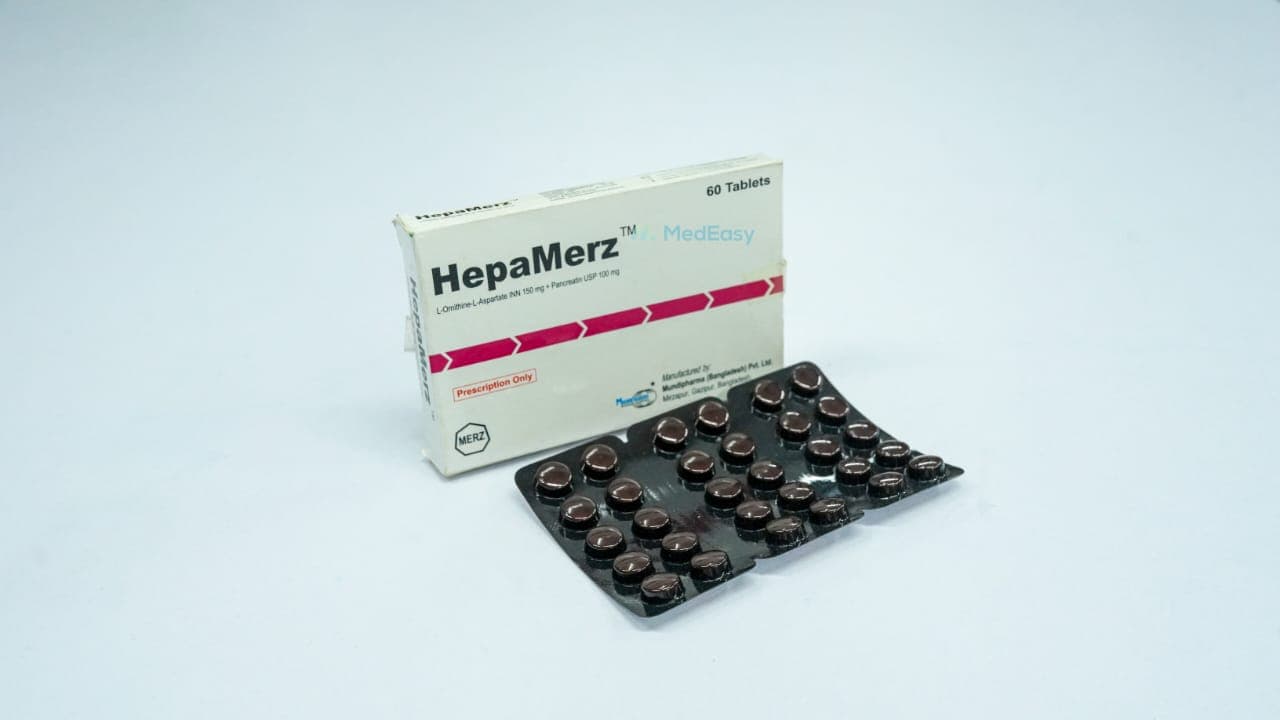

Medicine overview
Indications of HepaMerz
HepaMerz is a combination product that pairs an ammonia-lowering amino-acid formulation with a pancreatic digestive enzyme concentrate. It is used in patients with chronic liver disease, particularly where impaired ammonia clearance and reduced digestive enzyme output occur together.
Established / Guideline-Supported Uses
- Hyperammonemia associated with liver disease — the L-ornithine L-aspartate component is used to lower elevated blood ammonia levels in patients with chronic liver disease and cirrhosis.
- Hepatic encephalopathy (supportive/adjunct treatment) — HepaMerz is used as part of a broader treatment plan for latent and overt hepatic encephalopathy, always alongside other standard measures (e.g., lactulose, correction of precipitating factors) directed by a physician.
- Digestive enzyme replacement — the pancreatin component provides amylase, lipase, and protease to aid digestion of carbohydrates, fats, and proteins in patients with reduced pancreatic or digestive enzyme secretion, which is common in chronic liver and biliary disease.
Adjunct / Supportive Use
HepaMerz is also used as a supportive measure for dyspepsia and maldigestion symptoms (bloating, early satiety, fatty food intolerance) that frequently accompany chronic liver disease, in conjunction with dietary and lifestyle measures.
HepaMerz does not replace definitive treatment of the underlying liver disease and must be used under medical supervision.
Composition
L-Ornithine L-Aspartate + Pancreatin is formulated as a combination of two active components:
- L-Ornithine L-Aspartate — a stable salt of the amino acids ornithine and aspartate.
- Pancreatin — a standardized enzyme concentrate (typically of porcine origin) containing amylase, lipase, and protease activity.
Exact strengths (mg per tablet/sachet and enzyme activity units) vary by manufacturer and dosage form. Refer to the specific product's label or package insert for the precise composition of the L-Ornithine L-Aspartate + Pancreatin product dispensed.
Description
HepaMerz is a fixed-dose combination medicine used mainly in the setting of chronic liver disease. It brings together an ammonia-detoxifying amino acid combination with a pancreatic enzyme concentrate to address two problems that commonly coexist in liver disease: build-up of ammonia in the blood and impaired digestion due to reduced enzyme secretion.
HepaMerz is available as oral tablets, sachets/granules, or similar oral dosage forms, generally taken with or after meals. It is intended for use under the guidance of a physician managing chronic liver disease or related digestive complaints.
Therapeutic Class
Hepatic ammonia-detoxicant (amino acid combination) with Pancreatic Digestive Enzyme (Enzyme Replacement) — HepaMerz combines these two therapeutic classes.
Pharmacology
L-Ornithine L-Aspartate + Pancreatin combines two distinct mechanisms of action:
L-Ornithine L-Aspartate
Ornithine and aspartate are intermediates of the hepatic urea cycle. Ornithine stimulates two key enzymes of the urea cycle (carbamoyl phosphate synthetase and ornithine carbamoyltransferase), promoting conversion of ammonia to urea for renal excretion. Both ornithine and aspartate also act as substrates for glutamine synthesis in the liver, muscle, and brain, providing an additional route for ammonia detoxification. This lowers circulating blood ammonia levels, which is the key pathogenic factor in hepatic encephalopathy.
Pancreatin
Pancreatin supplies exogenous amylase, lipase, and protease, which supplement the body's own pancreatic enzyme output. These enzymes break down dietary starches, fats, and proteins respectively in the small intestine, improving digestion and nutrient absorption in patients with reduced enzyme secretion.
Together, L-Ornithine L-Aspartate + Pancreatin supports both ammonia clearance and digestive function in patients with chronic liver disease.
Dosage & Administration of HepaMerz
General Dosing Principles
The dose of HepaMerz must be individualized by the treating physician based on the indication, severity of liver disease, and the specific product's strength. The information below reflects typical labeling patterns for combination products of this type; always follow the prescribing physician's instructions and the product package insert.
| Indication | Typical Adult Dosing |
|---|---|
| Hyperammonemia / hepatic encephalopathy (adjunct) | 1–2 tablets or 1 sachet, 2–3 times daily with or after meals, adjusted by the physician based on ammonia levels and clinical response |
| Digestive enzyme support / dyspepsia | 1 tablet or 1 sachet with each main meal, or as directed |
Pediatric Dose
Safety and efficacy of HepaMerz in children are not well established; pediatric use should only occur under direct physician supervision (see Use in Special Populations).
Renal/Hepatic Adjustment
HepaMerz should be used with caution and closer monitoring in patients with hepatic impairment (its primary use setting) and is contraindicated in severe renal failure (see Contraindications). No standardized dose-reduction schedule is established; dosing decisions should be individualized by the physician.
Administration of HepaMerz
Take HepaMerz with or immediately after meals, swallowed with a full glass of water. If prescribed as a sachet or granule formulation, dissolve or mix as directed on the product label immediately before consumption; do not store the mixed dose for later use. Do not crush or chew enteric-coated tablet formulations, as this may reduce the effectiveness of the enzyme component. Take HepaMerz at evenly spaced intervals as directed by the physician, and complete the full course as advised.
Interaction of HepaMerz
Clinically significant interactions with HepaMerz include:
- Antacids/acid-reducing agents: Concurrent use of antacids or agents that alter gastric pH may reduce the enzyme activity of the pancreatin component if it is enteric-coated; separate dosing where possible.
- Folic acid: Pancreatin-containing products may reduce the absorption of folic acid with prolonged use; folate status should be monitored with long-term therapy.
- Iron preparations: Pancreatic enzyme products may reduce the absorption of oral iron supplements; separate administration times are advised if both are needed.
- Other ammonia-lowering therapies (e.g., lactulose, rifaximin): No significant interaction is expected; these are often used together as complementary therapy for hepatic encephalopathy under medical supervision.
Inform the prescribing physician of all other medicines being taken before starting HepaMerz.
Contraindications
L-Ornithine L-Aspartate + Pancreatin is contraindicated in:
- Known hypersensitivity to L-ornithine L-aspartate, pancreatin, pork/beef-derived proteins (pancreatin is typically of porcine origin), or any other component of the formulation.
- Severe renal failure — due to the risk of increased nitrogen/ammonia load from the amino acid component.
- Acute pancreatitis — per product labeling for pancreatin-containing formulations.
Side Effects of HepaMerz
Most patients tolerate HepaMerz well. Reported side effects include:
- Common: Nausea, vomiting, and other mild gastrointestinal upset, particularly at higher doses of the L-ornithine L-aspartate component.
- Uncommon: Hyperuricemia (elevated blood uric acid), usually asymptomatic and reversible on dose reduction or discontinuation.
- Rare: Hypersensitivity reactions such as skin rash, itching, or, rarely, more severe allergic reactions (see Contraindications).
Report any persistent or severe side effect to a physician promptly.
Pregnancy & Lactation
Data on the use of HepaMerz during pregnancy are limited. As a precaution, HepaMerz should be used during pregnancy only if clearly needed and if the potential benefit justifies the potential risk to the fetus; a physician should be consulted before use.
It is not well established whether the components of HepaMerz pass into breast milk in clinically significant amounts. Use during breastfeeding should only occur on the advice of a physician, weighing the benefit to the mother against any potential risk to the infant.
Precautions & Warnings
HepaMerz should be used under medical supervision, with the following precautions:
- Hepatic encephalopathy management: HepaMerz is a supportive/adjunct measure and does not replace comprehensive medical management of hepatic encephalopathy, which requires identification and treatment of precipitating factors, monitoring, and other standard therapies as directed by a physician.
- Renal function: Use with caution in patients with any degree of renal impairment; avoid in severe renal failure (see Contraindications).
- Uric acid monitoring: Periodic monitoring of serum uric acid is advisable with prolonged use, given the association with hyperuricemia.
- Gastrointestinal tolerance: Discontinue or reduce dose if significant nausea or vomiting develops, and consult a physician.
- Acute pancreatitis: Avoid use during an acute flare of pancreatitis (see Contraindications); use cautiously in patients with a history of pancreatitis once resolved, and only on physician advice.
Overdose Effects of HepaMerz
Limited specific data exist on overdose with HepaMerz. Excessive intake may worsen gastrointestinal symptoms (nausea, vomiting, diarrhea) or increase the risk of hyperuricemia. If an overdose of HepaMerz is suspected, seek immediate medical attention or contact a poison control center; do not attempt unsupervised home treatment. Supportive care will be provided by medical professionals as needed.
Storage Conditions
Store at room temperature (below 30°C), away from light and moisture. Keep out of reach of children.
Use In Special Populations
- Elderly: No specific dose adjustment is established for HepaMerz in elderly patients, but they should be monitored closely given the higher likelihood of coexisting renal or hepatic impairment.
- Renal impairment: Use with caution in mild-to-moderate renal impairment; contraindicated in severe renal failure (see Contraindications).
- Hepatic impairment: HepaMerz is primarily used in patients with hepatic impairment/chronic liver disease; dosing should be individualized and monitored by the treating physician.
- Pediatric patients: Safety and efficacy of HepaMerz in children have not been well established; use only under direct physician supervision (see Pediatric Uses).
Duration Of Treatment
The duration of HepaMerz therapy depends on the indication and clinical response. For hyperammonemia/hepatic encephalopathy, treatment is typically continued as part of ongoing liver disease management for as long as the physician determines it is needed, with periodic reassessment of ammonia levels and clinical status. For digestive enzyme support, HepaMerz may be used short-term for episodic dyspepsia or longer-term where chronic maldigestion persists. Do not continue or stop HepaMerz without medical advice.
Drug Classes
Ammonia-detoxicant amino acid combination (L-ornithine L-aspartate) + Pancreatic enzyme replacement (pancreatin) — the two drug classes combined in L-Ornithine L-Aspartate + Pancreatin.
Mode Of Action
L-Ornithine L-Aspartate + Pancreatin acts through two complementary mechanisms: the L-ornithine L-aspartate component stimulates the hepatic urea cycle and glutamine synthesis pathway to convert circulating ammonia into urea and glutamine for elimination, lowering blood ammonia; the pancreatin component supplies exogenous amylase, lipase, and protease to assist digestion of carbohydrates, fats, and proteins when the body's own pancreatic enzyme secretion is insufficient.
Pediatric Uses
The safety and efficacy of HepaMerz in pediatric patients have not been well established through controlled studies. Use in children should occur only when a physician determines it is clearly necessary, such as in the setting of pediatric liver disease with hyperammonemia or documented pancreatic enzyme insufficiency, with close monitoring and individualized, weight-based dosing determined by the treating specialist.
Frequently Asked Questions
Q: What is HepaMerz 150 mg+100 mg Tablet used for?
A: HepaMerz 150 mg+100 mg Tablet is used mainly in chronic liver disease to lower elevated blood ammonia levels (helpful in hyperammonemia and hepatic encephalopathy) and to support digestion through added pancreatic enzymes (amylase, lipase, protease) when the body's own enzyme output is reduced.
Q: How should I take HepaMerz 150 mg+100 mg Tablet?
A: HepaMerz 150 mg+100 mg Tablet is usually taken with or immediately after meals, as tablets, sachets, or granules, exactly as directed by your physician. Do not crush or chew enteric-coated tablet forms, and do not skip doses.
Q: Can HepaMerz 150 mg+100 mg Tablet be used alone to treat hepatic encephalopathy?
A: No. HepaMerz 150 mg+100 mg Tablet is a supportive/adjunct treatment. Hepatic encephalopathy requires comprehensive medical management, including treatment of underlying precipitating factors and other standard therapies, all directed by a physician.
Q: Who should not take HepaMerz 150 mg+100 mg Tablet?
A: HepaMerz 150 mg+100 mg Tablet should not be used by anyone with known hypersensitivity to its components (including pork/beef-derived proteins from the pancreatin), by patients with severe renal failure, or during an acute episode of pancreatitis.
Q: What are the common side effects of HepaMerz 150 mg+100 mg Tablet?
A: The most common side effects are mild nausea, vomiting, or other gastrointestinal upset. Less commonly, HepaMerz 150 mg+100 mg Tablet can raise blood uric acid levels (hyperuricemia). Rarely, allergic reactions such as rash or itching can occur. Tell your doctor if any side effect is severe or persistent.
Q: Is HepaMerz 150 mg+100 mg Tablet safe during pregnancy or breastfeeding?
A: Data are limited. HepaMerz 150 mg+100 mg Tablet should be used during pregnancy or breastfeeding only if a physician determines it is clearly needed and the benefit outweighs any potential risk.
Disclaimer
The information provided is accurate to the best of our knowledge, but it does not replace professional medical advice. We cannot guarantee its completeness or accuracy, and the absence of specific information about a drug should not be taken as an endorsement. We are not responsible for any consequences arising from this information, so please consult a healthcare professional for any concerns or questions.
