
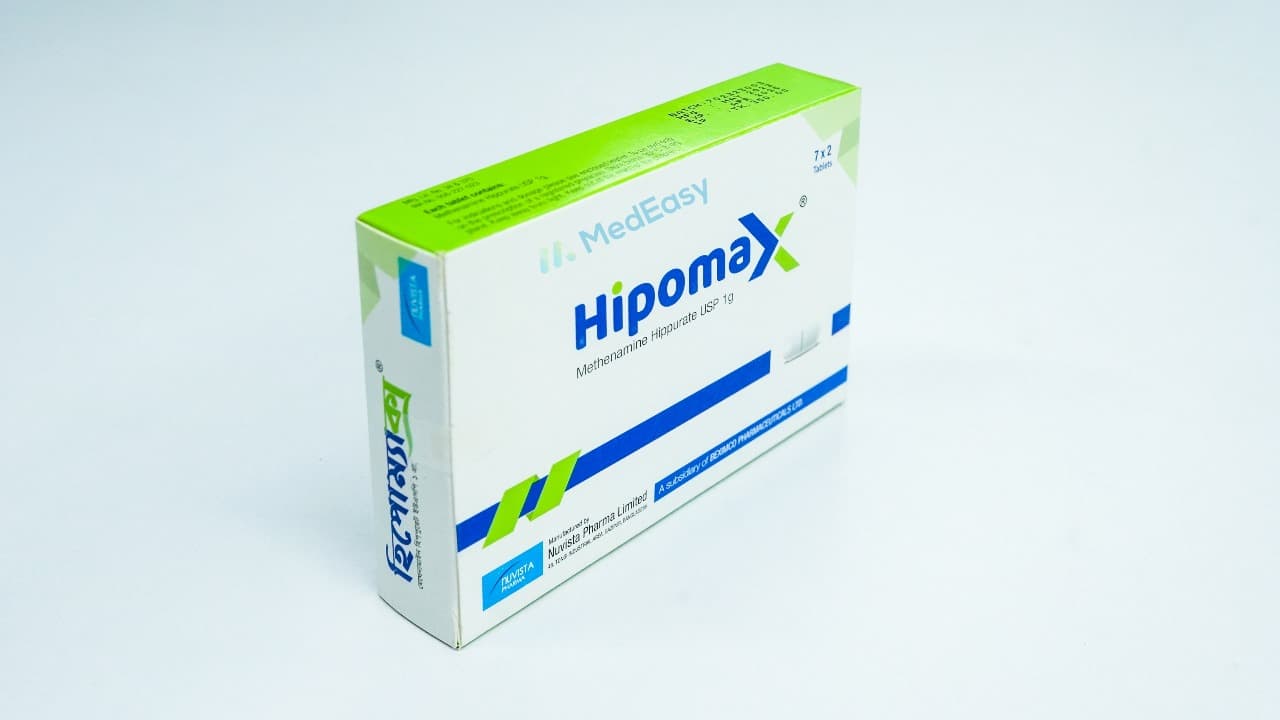

Medicine overview
Indications of Hipomax
Hipomax is a urinary tract antiseptic indicated for the prophylaxis and long-term suppressive management of recurrent urinary tract infections (UTIs), particularly in patients for whom prolonged conventional antibiotic therapy is undesirable.
- Established/FDA-approved use: Prophylaxis (prevention) of recurrent UTIs caused by susceptible organisms, especially in patients with residual urine, neurogenic bladder, or after urinary tract instrumentation.
- Chronic suppressive use: Long-term suppression of bacteriuria and reduction in the frequency of recurrent UTI episodes.
Hipomax is not indicated for the treatment of an established, active acute UTI; it does not replace antibiotic therapy for active infection and is generally used only for prevention or after an acute infection has already been controlled with an appropriate antibiotic.
Composition
Each tablet of Methenamine Hippurate typically contains 1 g of methenamine hippurate, the hippuric acid salt of methenamine, formulated as a film-coated oral tablet.
Description
Hipomax is a urinary antibacterial agent combining methenamine (hexamine) with hippuric acid. Unlike conventional antibiotics, it has no direct antibacterial activity in its intact form; instead it acts as a prodrug that is hydrolyzed in the acidic environment of the urine to release formaldehyde, the active antibacterial moiety, along with ammonia. This mechanism makes Hipomax useful for long-term prevention of recurrent urinary tract infections without contributing to antimicrobial resistance in the way conventional antibiotics do.
Therapeutic Class
Hipomax belongs to the therapeutic class of urinary tract antiseptics/anti-infectives. It is not classified as a conventional systemic antibiotic.
Pharmacology
Methenamine Hippurate dissociates into methenamine and hippuric acid. Methenamine has no intrinsic antibacterial activity; however, in acidic urine (pH 5.5 or below), it hydrolyzes to formaldehyde and ammonia. Formaldehyde is a nonspecific antibacterial agent that denatures bacterial proteins and nucleic acids, producing a local bactericidal/bacteriostatic effect within the urinary tract against most gram-positive and gram-negative uropathogens. Hippuric acid contributes a mild urinary acidifying effect that helps maintain the low pH needed for formaldehyde generation. Because activity depends on local urinary acidity rather than systemic absorption, Methenamine Hippurate does not promote antimicrobial resistance in the manner of conventional antibiotics.
Dosage & Administration of Hipomax
Hipomax should be taken exactly as prescribed by your physician, at the dose and for the duration recommended, since it is typically used for prolonged prophylactic therapy. Do not stop, extend, skip doses, or share this medicine with others without medical advice.
Tablets should be swallowed whole with a full glass of water, with or without food. Because efficacy depends on acidic urine, avoid excessive intake of alkalinizing foods, antacids, or citrus products around dosing time unless directed otherwise by a physician. Urinary pH may be checked periodically, and an acidifying agent may be added if the urine is not sufficiently acidic.
Administration of Hipomax
Hipomax tablets should be swallowed whole (not crushed or chewed) with water, and may be taken with or without food. Avoid concurrent intake of large amounts of alkalinizing agents (e.g., sodium bicarbonate, certain antacids) or a predominantly alkaline diet, as these reduce urinary acidity and diminish the drug's effect. Doses should be spaced evenly (e.g., every 12 hours) and taken consistently for the full prescribed duration.
Interaction of Hipomax
- Sulfonamides: Concurrent use of Hipomax with sulfonamide antibiotics should be avoided, as formaldehyde released from methenamine can react with certain sulfonamides in the urine to form an insoluble precipitate, increasing the risk of crystalluria.
- Urinary alkalinizers: Agents that alkalinize the urine (e.g., sodium bicarbonate, sodium/potassium citrate, acetazolamide, some antacids) reduce conversion of methenamine to formaldehyde and can significantly decrease the effectiveness of Hipomax; concurrent use should be avoided or minimized.
- Carbonic anhydrase inhibitors (e.g., acetazolamide): These alkalinize the urine and antagonize the antibacterial action of Hipomax; concurrent use is not recommended.
Contraindications
Methenamine Hippurate is contraindicated in:
- Patients with known hypersensitivity to methenamine, hippuric acid, or any component of the formulation.
- Patients with severe renal insufficiency.
- Patients with severe hepatic insufficiency (risk of ammonia toxicity from methenamine metabolism).
- Patients with severe dehydration.
Side Effects of Hipomax
Most patients tolerate Hipomax well. Reported adverse effects include:
- Gastrointestinal upset: nausea, vomiting, diarrhea, and abdominal discomfort.
- Bladder irritation, dysuria, and increased urinary frequency, particularly with high doses.
- Skin rash and pruritus (hypersensitivity reactions).
- Rarely, elevated liver enzymes with prolonged high-dose use.
Pregnancy & Lactation
Hipomax should be used during pregnancy only if clearly needed and if the potential benefit justifies the potential risk to the fetus; consult a physician before use. Small amounts of methenamine and formaldehyde metabolites are excreted in breast milk; caution is advised, and a physician should be consulted before use during breastfeeding.
Precautions & Warnings
Hipomax is intended for prophylaxis and suppressive management of recurrent UTIs and is not effective for treating an established, active acute urinary tract infection; it does not replace appropriate antibiotic therapy when active infection is present.
Efficacy requires sufficiently acidic urine (pH ≤5.5); avoid concurrent use of alkalinizing agents or a predominantly alkaline diet (see Interactions).
Use with caution in patients with renal or hepatic impairment (see Contraindications), and in patients prone to gout, since methenamine may precipitate urate crystallization in some individuals.
Take Hipomax exactly as prescribed by your physician; do not stop, extend, skip doses, or share this medicine with others without medical advice, as it is typically used for prolonged courses to prevent infection recurrence.
Overdose Effects of Hipomax
Overdose of Hipomax may cause bladder irritation, painful or frequent urination, hematuria, gastrointestinal upset, and in severe cases, signs of ammonia toxicity (especially in patients with hepatic impairment). If an overdose is suspected, seek immediate medical attention or contact a poison control center; do not attempt home treatment.
Storage Conditions
Store at room temperature (below 30°C), away from light and moisture. Keep out of reach of children.
Use In Special Populations
Renal impairment: Avoid use in patients with severe renal insufficiency (see Contraindications); use with caution and physician supervision in mild-to-moderate impairment.
Hepatic impairment: Contraindicated in severe hepatic insufficiency due to the risk of ammonia accumulation.
Elderly: No specific dose adjustment is generally required, but renal function should be assessed before starting therapy.
Pediatrics: Use with weight- and age-based dosing as directed by a physician; safety and efficacy in infants and very young children are not well established (see Pediatric Uses).
Duration Of Treatment
Because Hipomax is used mainly for prophylaxis and long-term suppression of recurrent UTIs, treatment duration is individualized by the prescribing physician and may extend from several weeks to many months, with periodic reassessment of continued need.
Drug Classes
Urinary tract antiseptic / urinary anti-infective (non-antibiotic class).
Mode Of Action
Methenamine Hippurate is hydrolyzed in acidic urine to formaldehyde, which exerts a nonspecific, local bactericidal effect within the urinary tract by denaturing bacterial proteins and nucleic acids, without producing systemic antibacterial activity or contributing to antimicrobial resistance.
Pregnancy
C
Pediatric Uses
Use of Hipomax in children 6 years and older follows established weight/age-based dosing (see Dosage). Safety and efficacy in children under 6 years of age are not well established, and use in this age group should be under close physician supervision only when clearly indicated.
Frequently Asked Questions
Q: What is Hipomax 1 gm Tablet used for?
A: Hipomax 1 gm Tablet is used to prevent and suppress recurrent urinary tract infections (UTIs), particularly in patients who need long-term protection but for whom prolonged antibiotic therapy is not desirable. It is not used to treat an active, acute UTI.
Q: How should I take Hipomax 1 gm Tablet?
A: Take Hipomax 1 gm Tablet exactly as prescribed by your physician, usually as one tablet twice daily, swallowed whole with water. Avoid large amounts of alkalinizing foods or antacids around dosing time, as these can reduce its effectiveness. Do not stop, extend, skip doses, or share this medicine with others without medical advice.
Q: Can Hipomax 1 gm Tablet be used during pregnancy?
A: Hipomax 1 gm Tablet should be used during pregnancy only if clearly needed and if the potential benefit outweighs the potential risk to the fetus. Always consult your physician before use during pregnancy or breastfeeding.
Q: What are the common side effects of Hipomax 1 gm Tablet?
A: Common side effects of Hipomax 1 gm Tablet include nausea, vomiting, diarrhea, bladder irritation, and skin rash. Most are mild, but contact your physician if they persist or worsen.
Q: Who should not take Hipomax 1 gm Tablet?
A: Hipomax 1 gm Tablet should not be used by patients with known hypersensitivity to the drug, severe renal insufficiency, severe hepatic insufficiency, or severe dehydration.
Q: What should I do if I miss a dose or take too much Hipomax 1 gm Tablet?
A: If you miss a dose of Hipomax 1 gm Tablet, take it as soon as you remember unless it is nearly time for your next dose. If you suspect an overdose, seek immediate medical attention or contact a poison control center.
Disclaimer
The information provided is accurate to the best of our knowledge, but it does not replace professional medical advice. We cannot guarantee its completeness or accuracy, and the absence of specific information about a drug should not be taken as an endorsement. We are not responsible for any consequences arising from this information, so please consult a healthcare professional for any concerns or questions.
