
5% Off
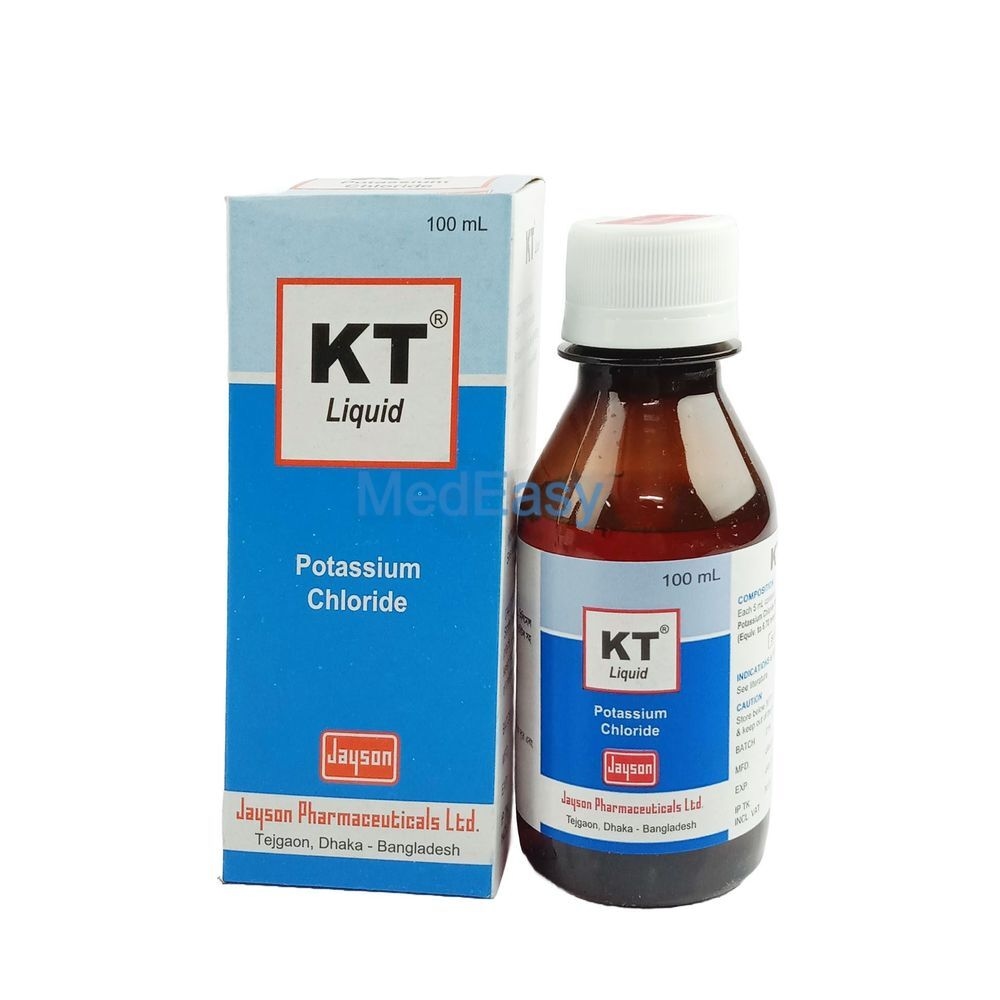
KT100 ml
Jayson Pharma Ltd.
৳28.59
Add to cart

KCL 100 ml Syrup is available on MedEasy for ৳21.16 per 100 ml bottle, with home delivery anywhere in Bangladesh. It is manufactured by Opsonin Pharma Ltd. Its generic name is Potassium Chloride.

KCL is not indicated for patients who are not potassium-deficient, and routine potassium supplementation is not recommended for all diuretic users without documented or anticipated hypokalemia.
Each unit of Potassium Chloride contains Potassium Chloride USP/BP as the sole active ingredient. It is formulated as extended-release tablets or capsules, immediate-release oral solution/powder, effervescent tablets, and as a sterile concentrated solution for intravenous infusion (which must always be diluted before use). Strength is generally expressed in milliequivalents (mEq) of potassium, with common oral strengths equivalent to 8 mEq, 10 mEq, or 20 mEq per unit, and injectable concentrates commonly supplied as 10%, 15%, or 20% w/v solutions (approximately 1.34–2.68 mEq/mL).
KCL is a mineral/electrolyte replacement product used to prevent and treat low levels of potassium in the blood (hypokalemia). Potassium is an essential intracellular cation required for normal nerve conduction, muscle contraction (including the heart), and maintenance of acid-base and fluid balance. KCL is available in oral (tablet, capsule, powder, liquid) and intravenous forms, and is widely used in both hospital and outpatient settings, particularly in patients on long-term diuretic therapy.
KCL belongs to the therapeutic class of Electrolytes and Minerals, specifically classified as a Potassium Replacement / Electrolyte Supplement.
Potassium is the principal intracellular cation in the body and plays a critical role in maintaining cell membrane electrical potential, nerve impulse conduction, skeletal and cardiac muscle contractility, renal tubular function, and intracellular osmolality. Potassium Chloride works by directly replenishing potassium and chloride ions that have been depleted, restoring normal serum potassium concentration (typically 3.5–5.0 mEq/L) and thereby normalizing the resting membrane potential of excitable tissues such as cardiac and skeletal muscle. Because potassium is actively transported into cells and excreted primarily by the kidneys, correction of a potassium deficit requires appropriate dosing over time along with monitoring, as extracellular (serum) levels do not always reflect the true total body deficit.
| Indication | Adult Dose | Pediatric Dose |
|---|---|---|
| Prevention of hypokalemia | 16–24 mEq/day orally in divided doses | 1 mEq/kg/day or per physician's calculation based on body surface area/weight |
| Treatment of hypokalemia | 40–100 mEq/day orally in divided doses, adjusted to serum potassium and clinical response | 2–4 mEq/kg/day orally in divided doses, under close monitoring; not to exceed adult dose |
| Severe hypokalemia / unable to tolerate oral (IV) | Intravenous infusion, diluted, typically 10 mEq/hour (up to 20 mEq/hour with continuous cardiac monitoring in an intensive care setting) | Intravenous infusion strictly individualized under specialist supervision, based on weight and serum potassium, with continuous cardiac monitoring |
Dose and duration must be individualized to the patient's serum potassium level, underlying cause of deficit, renal function, and clinical response, under the direction of a physician.
Take oral KCL tablets/capsules whole (do not crush or chew extended-release forms) with meals and a full glass of water to reduce stomach upset. Dissolve powder, effervescent, or liquid forms fully in water/juice before drinking. Intravenous KCL must always be diluted and infused slowly under medical supervision with cardiac monitoring — never given undiluted or by rapid injection.
Potassium Chloride is contraindicated in patients with the following conditions:
Patients experiencing any signs of hyperkalemia while taking KCL should seek immediate medical attention.
Pregnancy: Potassium is a normal dietary and physiological requirement during pregnancy, and KCL may be used when clinically indicated to correct documented hypokalemia. However, it should be used only under medical supervision, with the dose individualized and potential benefit weighed against risk, and serum potassium monitored, since both hypokalemia and hyperkalemia during pregnancy can be harmful. Consult a physician before use during pregnancy.
Lactation: Potassium is a normal constituent of breast milk, and KCL is generally considered acceptable during breastfeeding when used at recommended doses for a genuine clinical indication. Nonetheless, a physician should be consulted, and the nursing infant monitored, before initiating KCL during lactation.
Periodic monitoring of serum potassium, renal function, and acid-base status is recommended during KCL therapy, particularly during dose adjustments.
Overdose of KCL can cause hyperkalemia, which may be life-threatening. Symptoms and signs include tingling of extremities, muscle weakness or paralysis, confusion, and cardiac effects such as irregular heartbeat, heart block, or cardiac arrest, which can occur without significant warning signs. Overdose of KCL is a medical emergency — seek immediate medical attention or contact emergency services/poison control if an overdose is suspected. Do not attempt to manage a suspected overdose at home; treatment requires hospital-based monitoring (ECG) and may include specific medical interventions to lower serum potassium.
Store KCL at room temperature (below 30°C), away from light and moisture. Keep out of reach of children. Do not freeze injectable concentrate solutions. Discard any unused diluted intravenous solution as directed by a healthcare professional.
KCL should be used with caution and close monitoring in patients with renal impairment, as reduced potassium excretion increases the risk of hyperkalemia; it is contraindicated in severe renal impairment with oliguria/anuria (see Contraindications).
No specific dose adjustment is established for hepatic impairment alone; however, caution is warranted if hepatic disease is accompanied by fluid/electrolyte disturbances.
Elderly patients often have reduced renal function and may be more susceptible to hyperkalemia; use KCL cautiously with more frequent monitoring of serum potassium and renal function in this population.
See Pregnancy and Lactation section.
See Pediatric Uses section.
The duration of KCL therapy depends on the underlying cause and severity of hypokalemia. It may be required short-term (e.g., during an episode of acute potassium loss from vomiting/diarrhea) or long-term (e.g., in patients on chronic non-potassium-sparing diuretic therapy). Treatment should continue only as long as clinically indicated, guided by periodic serum potassium monitoring, and reassessed regularly by the prescribing physician; it should not be continued indefinitely without follow-up.
Electrolyte Replenishers; Potassium Supplements; Minerals and Electrolytes
Potassium Chloride acts by directly supplying potassium and chloride ions to replenish body stores and restore normal serum potassium concentration. Potassium is essential for maintaining the resting membrane potential across cell membranes via the Na⁺/K⁺-ATPase pump, which is fundamental to normal neuromuscular excitability, cardiac conduction and contractility, and renal tubular function. By correcting a potassium deficit, Potassium Chloride restores normal electrophysiological function in excitable tissues, particularly cardiac and skeletal muscle, and helps maintain acid-base and fluid balance.
C
The use of KCL in children is generally reserved for documented or high-risk hypokalemia and should be managed under pediatric specialist supervision. Pediatric oral dosing is typically individualized at approximately 1–4 mEq/kg/day (or by body surface area) in divided doses, adjusted to serum potassium levels. Safety and efficacy of extended-release tablet/capsule formulations of KCL have not been specifically established in pediatric patients, partly due to tablet size and swallowing considerations; liquid or powder formulations may be preferred in younger children. Intravenous KCL in children must be strictly individualized, diluted, and administered with continuous cardiac monitoring in a supervised setting.
Q: What is KCL 100 ml Syrup used for?
A: KCL 100 ml Syrup is used to prevent and treat low blood potassium levels (hypokalemia), which can occur due to diuretic use, vomiting, diarrhea, or inadequate dietary intake.
Q: Can I crush or chew KCL 100 ml Syrup tablets?
A: No. Extended-release KCL 100 ml Syrup tablets/capsules should be swallowed whole with a full glass of water and taken with food; crushing or chewing can cause a rapid release of potassium and increase the risk of gastrointestinal irritation or ulceration.
Q: Is it safe to take KCL 100 ml Syrup during pregnancy?
A: KCL 100 ml Syrup may be used during pregnancy when clinically needed to correct a documented potassium deficiency, but only under medical supervision with appropriate monitoring, as both low and high potassium levels can be harmful. Always consult a physician before use during pregnancy.
Q: What are the signs of too much potassium (hyperkalemia) from KCL 100 ml Syrup?
A: Signs of hyperkalemia from KCL 100 ml Syrup include tingling or numbness in the hands, feet, or lips, muscle weakness or paralysis, and an irregular or slow heartbeat. This is a medical emergency — seek immediate medical attention if these occur.
Q: Who should not take KCL 100 ml Syrup?
A: KCL 100 ml Syrup should not be used by patients with hyperkalemia, severe kidney impairment with reduced urine output, untreated Addison's disease, severe burns or major tissue injury, or known hypersensitivity to the medicine; solid oral forms should also be avoided in patients with conditions that delay or block passage through the gastrointestinal tract.
Q: Can KCL 100 ml Syrup be given as an intravenous injection directly?
A: No. Intravenous KCL 100 ml Syrup must always be diluted and given as a slow infusion with cardiac monitoring. Giving it undiluted or as a rapid injection can cause fatal heart rhythm problems and cardiac arrest, so it is only administered by trained healthcare professionals in a monitored setting.
Disclaimer
The information provided is accurate to the best of our knowledge, but it does not replace professional medical advice. We cannot guarantee its completeness or accuracy, and the absence of specific information about a drug should not be taken as an endorsement. We are not responsible for any consequences arising from this information, so please consult a healthcare professional for any concerns or questions.