

8% Off
Luradox40 mg
Incepta Pharmaceuticals Ltd.
৳322.00
Add to cart
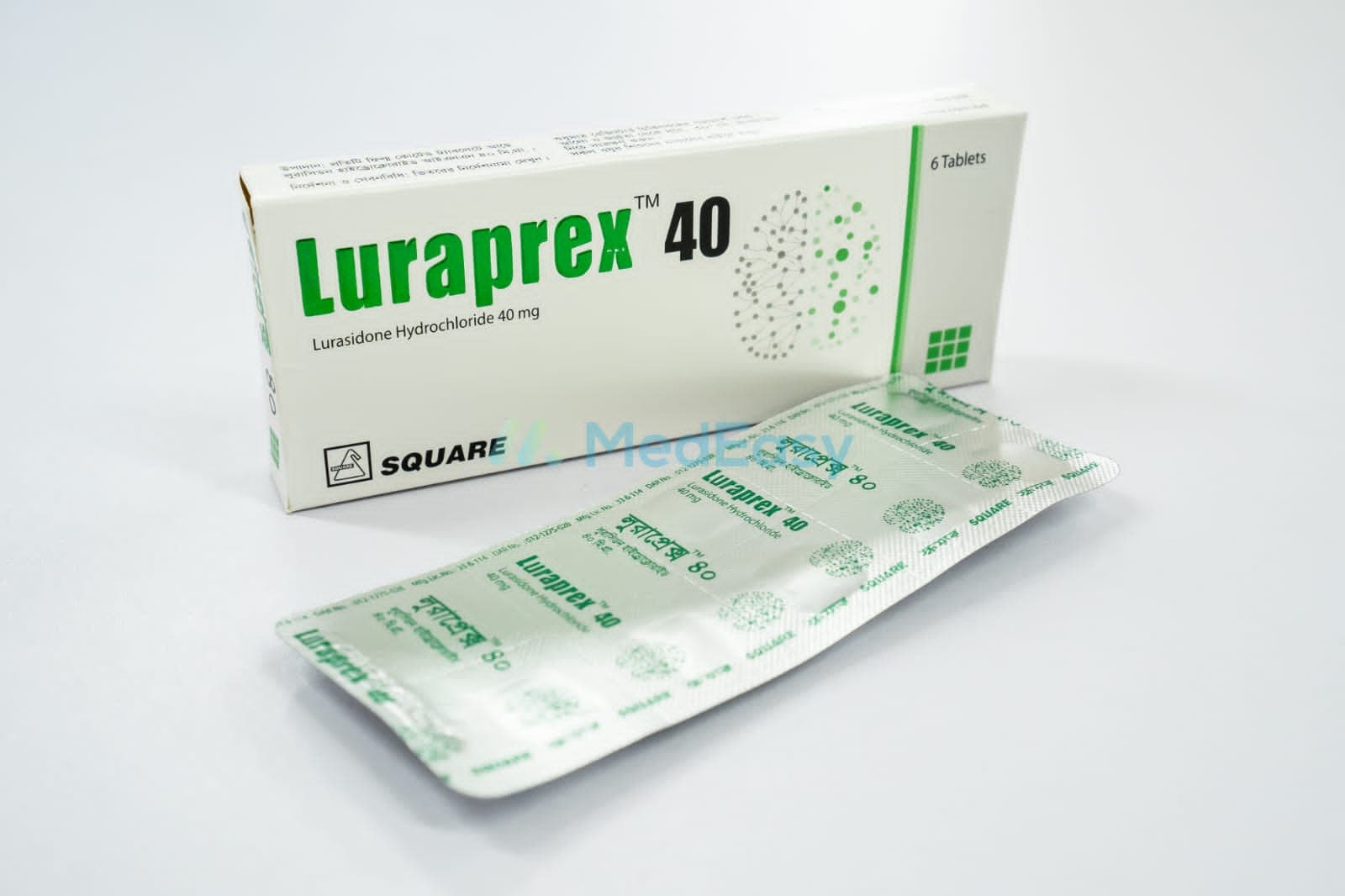
Luraprex 40 mg Tablet is available on MedEasy for ৳193.20 per 6's pack, with home delivery anywhere in Bangladesh. It is manufactured by Square Pharmaceuticals PLC. Its generic name is Lurasidone Hydrochloride.

Luraprex is an atypical (second-generation) antipsychotic with the following evidence-based indications:
Luraprex is not approved for the treatment of dementia-related psychosis in elderly patients (see Precautions and Warnings for boxed warning).
Off-label use of Luraprex for other psychiatric conditions has been reported in limited clinical experience but is not well established and should only be considered under specialist psychiatric supervision.
Each film-coated tablet contains Lurasidone Hydrochloride equivalent to lurasidone base, commonly available in strengths of 20 mg, 40 mg, 60 mg, 80 mg, and 120 mg (available strengths may vary by market/manufacturer).
Luraprex is an atypical antipsychotic agent belonging to the benzisothiazole derivative class. It is used in the management of schizophrenia and depressive episodes associated with bipolar I disorder. Luraprex works primarily by modulating dopamine and serotonin receptor activity in the brain, and is generally associated with a lower risk of weight gain and metabolic disturbance compared with some other atypical antipsychotics, although these effects can still occur.
Atypical (second-generation) antipsychotic; benzisothiazole derivative.
Lurasidone Hydrochloride exerts its therapeutic effect through antagonism of dopamine D2 and serotonin 5-HT2A receptors, along with high-affinity antagonism at serotonin 5-HT7 receptors and partial agonism at serotonin 5-HT1A receptors. This combined receptor profile is thought to underlie its efficacy in both positive/negative symptoms of schizophrenia and depressive symptoms of bipolar I disorder. Lurasidone Hydrochloride has minimal affinity for histamine H1 and muscarinic M1 receptors, which contributes to a comparatively lower propensity for sedation, weight gain, and anticholinergic side effects relative to some other atypical antipsychotics.
Lurasidone Hydrochloride is metabolized primarily via the hepatic CYP3A4 enzyme pathway, and its absorption is significantly increased (up to 3-fold) when taken with food (at least 350 calories), so it must be administered with a meal.
| Population | Starting Dose | Dose Range | Maximum Dose |
|---|---|---|---|
| Adults | 40 mg once daily | 40-160 mg/day | 160 mg/day |
| Adolescents (13-17 years) | 40 mg once daily | 40-80 mg/day | 80 mg/day |
| Population | Starting Dose | Dose Range | Maximum Dose |
|---|---|---|---|
| Adults | 20 mg once daily | 20-120 mg/day | 120 mg/day |
| Pediatric (10-17 years) | 20 mg once daily | 20-80 mg/day | 80 mg/day |
Luraprex must be taken once daily with food (a meal of at least 350 calories) to ensure adequate absorption. Dose adjustments, if needed, should be made gradually and no more often than every 24 hours, under physician supervision.
Moderate to severe renal impairment (CrCl less than 50 mL/min): starting dose 20 mg/day; maximum dose 80 mg/day.
Mild hepatic impairment: no dose adjustment needed. Moderate hepatic impairment: starting dose 20 mg/day, maximum 80 mg/day. Severe hepatic impairment: starting dose 20 mg/day, maximum 40 mg/day.
Luraprex is primarily metabolized by CYP3A4, and its blood levels are significantly affected by drugs that inhibit or induce this enzyme:
Lurasidone Hydrochloride is contraindicated in patients with:
Common side effects associated with Luraprex include:
Less common but serious effects include neuroleptic malignant syndrome, tardive dyskinesia, orthostatic hypotension/syncope, metabolic changes (hyperglycemia, dyslipidemia, weight gain - see Precautions and Warnings), and leukopenia/neutropenia. Seek prompt medical attention for severe muscle stiffness, high fever, confusion, irregular heartbeat, or fainting while taking Luraprex.
Pregnancy: Data on the use of Luraprex in pregnancy are limited. Antipsychotic use, including Luraprex, during the third trimester of pregnancy has been associated with a risk of extrapyramidal and/or withdrawal symptoms in newborns, such as agitation, abnormal muscle tone, tremor, and feeding difficulty. Luraprex should be used during pregnancy only if the potential benefit justifies the potential risk to the fetus, and only under close physician supervision. Enrollment in a pregnancy exposure registry (where available) should be discussed with the physician.
Lactation: It is not fully established whether Luraprex passes into human breast milk, but antipsychotics are generally assumed to be excreted in breast milk to some degree. Breastfeeding while using Luraprex should only be undertaken after consulting a physician, weighing the benefits of breastfeeding against the possible risk of infant exposure and the mother's clinical need for the medicine.
Boxed Warning: Elderly patients with dementia-related psychosis treated with antipsychotic drugs, including Luraprex, are at increased risk of death compared with placebo. Luraprex is not approved for the treatment of dementia-related psychosis.
Overdose with Luraprex may present with somnolence, sedation, tachycardia, hypotension, and extrapyramidal symptoms. There is no specific antidote for Luraprex overdose. In case of suspected overdose, seek immediate medical attention or contact a poison control center/emergency services right away. Management is supportive and symptomatic, and should be carried out under close medical supervision, including cardiovascular monitoring, in a hospital setting; do not attempt home treatment.
Store at room temperature (below 30°C), away from light and moisture. Keep out of reach of children.
Elderly: Use Luraprex with caution in elderly patients, particularly those with dementia-related psychosis, due to the boxed warning of increased mortality risk (see Precautions and Warnings); this population may also be more susceptible to orthostatic hypotension and sedation.
Renal Impairment: Dose adjustment of Luraprex is required in moderate to severe renal impairment (see Dosage and Administration).
Hepatic Impairment: Dose adjustment of Luraprex is required in moderate to severe hepatic impairment (see Dosage and Administration).
Pediatric: Safety and efficacy of Luraprex have been established for schizophrenia in adolescents 13-17 years and for bipolar depression in patients 10-17 years; safety and efficacy have not been established in children below these age ranges or for other indications.
Atypical antipsychotics; benzisothiazole derivatives.
Luraprex is approved for use in:
Safety and efficacy of Luraprex have not been established in children below these age ranges or for other psychiatric indications. Use in pediatric patients should be supervised by a specialist experienced in pediatric psychiatric disorders, with periodic monitoring for metabolic, movement-related, and behavioral changes.
Q: What is Luraprex 40 mg Tablet used for?
A: Luraprex 40 mg Tablet is used to treat schizophrenia and depressive episodes associated with bipolar I disorder (bipolar depression), either alone or together with other mood stabilizers.
Q: How should I take Luraprex 40 mg Tablet?
A: Luraprex 40 mg Tablet should be taken once daily, at the same time each day, with a meal of at least 350 calories, as food significantly improves its absorption. Taking it on an empty stomach can reduce its effectiveness.
Q: What are the common side effects of Luraprex 40 mg Tablet?
A: Common side effects of Luraprex 40 mg Tablet include restlessness (akathisia), drowsiness, nausea, and symptoms of parkinsonism such as tremor or stiffness. Contact your physician if these are severe or persistent.
Q: Can Luraprex 40 mg Tablet be used during pregnancy?
A: Luraprex 40 mg Tablet should be used during pregnancy only if clearly needed and if the potential benefit justifies the potential risk to the fetus, since antipsychotic use in the third trimester has been linked to movement and withdrawal symptoms in newborns. Always consult your physician before using Luraprex 40 mg Tablet during pregnancy.
Q: Is Luraprex 40 mg Tablet safe for elderly patients with dementia?
A: No. Luraprex 40 mg Tablet carries a boxed warning because elderly patients with dementia-related psychosis treated with antipsychotic drugs have an increased risk of death. Luraprex 40 mg Tablet is not approved for this use.
Q: What should I do if I miss a dose or overdose on Luraprex 40 mg Tablet?
A: If you miss a dose of Luraprex 40 mg Tablet, take it as soon as you remember unless it is close to the next dose; do not double the dose. If an overdose is suspected, seek immediate medical attention or contact emergency services/poison control right away, as there is no specific antidote for Luraprex 40 mg Tablet.
Disclaimer
The information provided is accurate to the best of our knowledge, but it does not replace professional medical advice. We cannot guarantee its completeness or accuracy, and the absence of specific information about a drug should not be taken as an endorsement. We are not responsible for any consequences arising from this information, so please consult a healthcare professional for any concerns or questions.
