
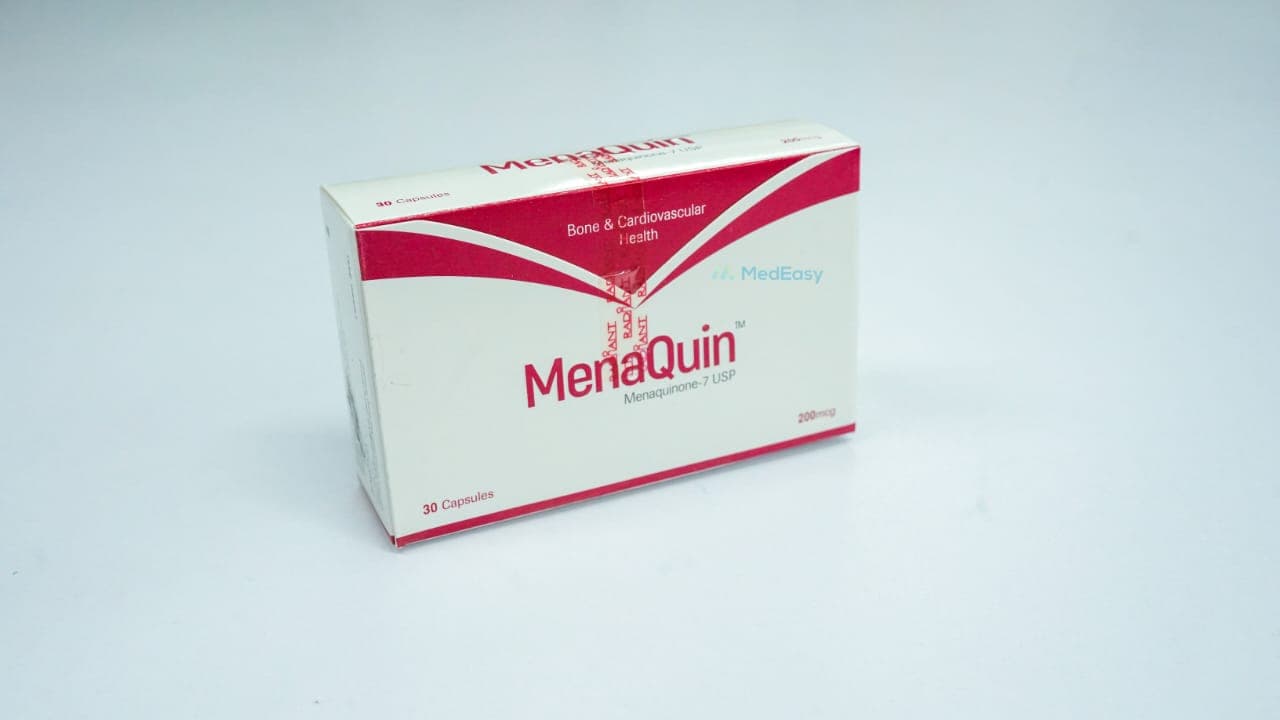

Medicine overview
Indications of Menaquin
Menaquin is a long-chain form of vitamin K2 used as a dietary supplement. Its use can be classified by strength of evidence as follows:
Established/Common Uses (Dietary Supplementation)
- Bone health support: Menaquin is commonly used, typically alongside calcium and vitamin D3, to support normal bone mineralization and maintenance of bone density in adults, particularly postmenopausal women and older adults at risk of low bone density.
- Cardiovascular/vascular health support: Menaquin is used as a supplement believed to support healthy arterial elasticity by helping regulate calcium deposition in blood vessel walls.
Evidence Status
The biological role of Menaquin in activating vitamin K-dependent proteins (osteocalcin and matrix Gla-protein) is well established. However, evidence that supplementation with Menaquin improves hard clinical outcomes such as fracture rates or cardiovascular events is still developing; several clinical trials show favorable biomarker changes (e.g., improved carboxylation of osteocalcin, arterial stiffness measures), but this is not yet uniformly confirmed as disease-preventing therapy. Menaquin is a nutritional supplement and is not a substitute for prescribed osteoporosis medication or anticoagulant/antiplatelet therapy.
Menaquin is not an antibiotic and has no antimicrobial indication.
Composition
Each tablet/capsule/softgel typically contains Menaquinone-7 (Vitamin K2, MK-7 form), commonly available in strengths ranging from about 45 mcg to 200 mcg. Menaquinone-7 is frequently formulated in combination with vitamin D3 and/or calcium in commercially available supplement products; the exact strength and combination should be confirmed on the specific product label.
Description
Menaquin is a natural, long-chain subtype of vitamin K2 (menaquinone), a fat-soluble vitamin. Compared with the shorter-chain menaquinones and vitamin K1 (phylloquinone), Menaquin has a longer biological half-life, allowing it to circulate longer in the bloodstream and reach extrahepatic tissues such as bone and blood vessel walls more effectively.
Menaquin is produced naturally by certain bacteria (including gut flora and fermentation, e.g., in natto) and is available as an over-the-counter dietary/nutritional supplement rather than a prescription drug in most markets, including Bangladesh, where it is marketed in tablet, capsule, and softgel forms, often combined with vitamin D3.
Therapeutic Class
Fat-soluble vitamin supplement – Vitamin K2 (menaquinone) group; Menaquin is the MK-7 subtype.
Pharmacology
Menaquinone-7 functions as a cofactor for the enzyme gamma-glutamyl carboxylase, which converts specific glutamate residues on certain proteins into gamma-carboxyglutamate (Gla) residues — a process called gamma-carboxylation. This activation is required for two key vitamin K-dependent proteins outside the liver:
- Osteocalcin: a bone matrix protein that, once carboxylated by Menaquinone-7, binds calcium and supports bone mineralization.
- Matrix Gla-protein (MGP): once activated, helps inhibit inappropriate calcium deposition in the walls of arteries and soft tissues, supporting vascular flexibility.
Menaquinone-7 is also a cofactor (like other forms of vitamin K) for carboxylation of hepatic clotting factors II, VII, IX, and X, which is why it can interact with vitamin K antagonist anticoagulants (see Interactions).
Pharmacokinetics: Being fat-soluble, absorption of Menaquinone-7 is enhanced when taken with a meal containing some dietary fat. It has a notably longer plasma half-life than vitamin K1, allowing sustained tissue delivery with once-daily dosing. It is metabolized in the liver and eliminated mainly via bile/feces, with a smaller portion via urine.
Dosage & Administration of Menaquin
General Dosing
| Population/Use | Typical Dose | Notes |
|---|---|---|
| Adults – bone/cardiovascular support | 45 mcg to 200 mcg of Menaquin once daily | Follow the specific product label; take with a meal containing some fat to aid absorption. |
| Older adults / postmenopausal women | Typically at the higher end of the standard range (e.g., 100–200 mcg/day), per product labeling | Often combined with calcium and vitamin D3 supplementation; use under physician guidance, especially if on bone-active medication. |
| Pediatric use | Not established | See Use in Special Populations. |
Administration
Take Menaquin orally, generally once daily with food. Swallow tablets/capsules/softgels whole with water; do not exceed the dose stated on the product label unless advised by a physician. If a dose is missed, take it when remembered unless it is close to the next scheduled dose; do not double the dose.
Administration of Menaquin
Give Menaquin by the oral route only, preferably with a meal containing some fat to enhance absorption of this fat-soluble vitamin. Do not crush or chew formulations not intended to be chewed unless the product is specifically designed as a chewable; follow the manufacturer's instructions for the specific dosage form.
Interaction of Menaquin
Clinically Significant Interactions
- Vitamin K antagonist anticoagulants (e.g., warfarin): Menaquin can reduce the anticoagulant effect of warfarin and similar vitamin K antagonists by promoting carboxylation of clotting factors, which may lower INR and increase the risk of clot formation or treatment failure. Patients on warfarin therapy should avoid Menaquin unless specifically directed and closely monitored (INR monitoring) by their physician.
- Antibiotics (broad-spectrum, especially those affecting gut flora, e.g., certain cephalosporins): may reduce gut bacterial synthesis of vitamin K, theoretically altering the overall vitamin K status; clinical significance with supplemental Menaquin specifically is limited but caution is reasonable in patients on prolonged antibiotic courses who are also on anticoagulants.
- Fat absorption-reducing agents (e.g., orlistat, bile acid sequestrants such as cholestyramine, mineral oil): may reduce absorption of fat-soluble vitamins, including Menaquin; consider spacing administration and monitoring if used long-term together.
Patients taking any anticoagulant or antiplatelet medication should consult their physician before starting Menaquin.
Contraindications
Menaquinone-7 is contraindicated in patients with known hypersensitivity to Menaquinone-7 or any component of the specific product formulation.
There are no other well-established absolute contraindications for Menaquinone-7 as a nutritional supplement. Use in patients on vitamin K antagonist anticoagulant therapy (e.g., warfarin) requires caution and close physician supervision rather than being an absolute contraindication in all cases (see Interactions and Precautions).
Side Effects of Menaquin
Menaquin is generally well tolerated when taken at recommended doses, as it is a naturally occurring nutrient. Reported adverse effects are uncommon and typically mild, and may include:
- Mild gastrointestinal upset (e.g., nausea, stomach discomfort, diarrhea)
- Headache (uncommon)
- Allergic reactions such as rash or itching (rare)
The most clinically important safety concern with Menaquin is its potential to interfere with vitamin K antagonist anticoagulant therapy rather than direct toxicity (see Interactions and Contraindications). Discontinue use and consult a physician if any unusual or persistent symptoms occur.
Pregnancy & Lactation
Vitamin K, including the Menaquin form, is a normal dietary nutrient required during pregnancy and lactation. However, formal safety data for Menaquin supplementation specifically (beyond typical dietary intake) during pregnancy and breastfeeding are limited. As a general precaution, Menaquin supplementation should be used only if clearly needed and after consulting a physician, who can weigh the potential benefit against any potential risk and advise on an appropriate dose. Routine neonatal vitamin K1 injection given at birth to prevent hemorrhagic disease of the newborn is a separate, distinct medical intervention and is not replaced by maternal Menaquin supplementation.
Precautions & Warnings
- Use Menaquin with caution in patients with known clotting disorders or those on any anticoagulant or antiplatelet therapy; consult a physician before use, as Menaquin may reduce the effectiveness of vitamin K antagonists such as warfarin (see Interactions).
- Menaquin is a dietary supplement, not a replacement for prescribed medications for osteoporosis, cardiovascular disease, or clotting disorders; do not discontinue any prescribed therapy in favor of Menaquin without medical advice.
- Do not exceed the labeled dose. Consult a physician before use if you have liver disease, as this may affect vitamin K metabolism.
- Keep out of reach of children; not intended as a substitute for a varied, balanced diet.
Overdose Effects of Menaquin
Menaquin has a low reported toxicity profile as a fat-soluble vitamin at typical supplement doses, and there is no well-established acute overdose syndrome. However, taking substantially more than the recommended dose is not advised, particularly in patients on vitamin K antagonist anticoagulant therapy, where excess Menaquin intake could meaningfully reduce anticoagulant efficacy and increase clotting risk. If an overdose is suspected, or if a patient on anticoagulant therapy has taken more Menaquin than directed, seek immediate medical attention or contact a poison control center/emergency services; do not attempt unsupervised home treatment.
Storage Conditions
Store at room temperature (below 30°C), away from light and moisture. Keep out of reach of children.
Use In Special Populations
Pediatric Use
Safety and efficacy of Menaquin as a supplement have not been well established in children. Use in children should only be under the guidance of a pediatrician, distinct from the standard neonatal vitamin K1 injection given at birth for a different, specific medical purpose.
Elderly
Menaquin is commonly used in older adults, often alongside calcium and vitamin D3, to support bone health; no specific dose adjustment is established for this population, but physician guidance is recommended, especially with polypharmacy or anticoagulant use.
Renal/Hepatic Impairment
No well-established dose adjustment is required for Menaquin in renal or hepatic impairment; however, patients with significant hepatic impairment should use Menaquin under physician supervision as liver disease can affect overall vitamin K-dependent clotting factor synthesis.
Patients on Anticoagulant Therapy
Patients on vitamin K antagonists (e.g., warfarin) should avoid Menaquin unless specifically directed and monitored by their physician (see Interactions and Contraindications).
Duration Of Treatment
Menaquin is typically used long-term as an ongoing dietary supplement for ongoing bone and cardiovascular health support, as directed by a physician or per the product label; there is no fixed short-course duration. Periodic reassessment with a physician is advisable, particularly for long-term use.
Drug Classes
Vitamin K2 (menaquinone) – long-chain MK-7 subtype; fat-soluble vitamin/dietary supplement.
Mode Of Action
Menaquinone-7 acts as an essential cofactor for the enzyme gamma-glutamyl carboxylase, enabling gamma-carboxylation (activation) of vitamin K-dependent proteins, notably osteocalcin (supporting bone mineralization) and matrix Gla-protein (supporting regulation of vascular calcium deposition), as well as hepatic clotting factors II, VII, IX, and X.
Pediatric Uses
Safety and efficacy of Menaquin supplementation have not been formally established in children. Menaquin is not the same as, and does not replace, the standard single-dose vitamin K1 injection given to newborns to prevent hemorrhagic disease of the newborn. Any pediatric use of Menaquin as a supplement should be guided by a pediatrician.
Frequently Asked Questions
Q: What is Menaquin 200 mcg Capsule used for?
A: Menaquin 200 mcg Capsule is a dietary supplement form of vitamin K2 used mainly to support bone health (often with calcium and vitamin D3) and cardiovascular/vascular health by helping regulate how the body uses calcium. It is not a prescription drug and is not intended to treat a diagnosed disease on its own.
Q: Can I take Menaquin 200 mcg Capsule if I am on warfarin (blood thinner)?
A: You should not take Menaquin 200 mcg Capsule while on warfarin or other vitamin K antagonist anticoagulants unless your physician specifically directs and closely monitors you (with INR testing), because Menaquin 200 mcg Capsule can reduce the effectiveness of these medicines and increase the risk of clotting problems.
Q: Is Menaquin 200 mcg Capsule safe during pregnancy or breastfeeding?
A: Vitamin K is a normal nutrient needed during pregnancy and breastfeeding, but specific supplementation with Menaquin 200 mcg Capsule beyond diet should only be used if clearly needed and after consulting a physician, who can weigh the potential benefit against any potential risk.
Q: How should I take Menaquin 200 mcg Capsule?
A: Take Menaquin 200 mcg Capsule by mouth, generally once daily with a meal containing some fat to improve absorption, following the dose on the product label or as directed by your physician, typically in the range of 45 to 200 mcg per day.
Q: What side effects can Menaquin 200 mcg Capsule cause?
A: Menaquin 200 mcg Capsule is generally well tolerated; mild gastrointestinal upset, headache, or rare allergic reactions such as rash may occur. The most important safety concern is its potential interaction with anticoagulant medicines like warfarin rather than direct toxicity.
Q: What should I do if I take too much Menaquin 200 mcg Capsule?
A: Menaquin 200 mcg Capsule has low reported toxicity, but if you suspect you have taken far more than directed, especially while on blood-thinning medication, seek immediate medical attention or contact a poison control center rather than treating it at home.
Disclaimer
The information provided is accurate to the best of our knowledge, but it does not replace professional medical advice. We cannot guarantee its completeness or accuracy, and the absence of specific information about a drug should not be taken as an endorsement. We are not responsible for any consequences arising from this information, so please consult a healthcare professional for any concerns or questions.
