10% Off
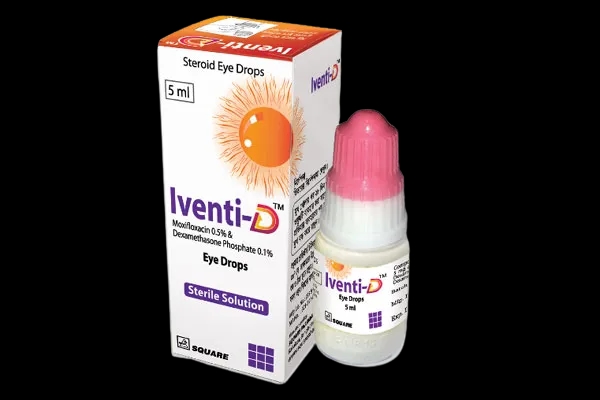
Iventi-D0.5%+0.1%
Square Pharmaceuticals PLC.
৳216.00
Add to cart


Moxquin D is a fixed-dose combination ophthalmic (eye) preparation containing a fourth-generation fluoroquinolone antibiotic (moxifloxacin) and a corticosteroid (dexamethasone). It is indicated for conditions where both anti-inflammatory action and antibacterial coverage are needed in the same eye condition.
Moxquin D is not intended for undiagnosed red eye or for infections not caused by susceptible bacteria, since the corticosteroid component may worsen untreated infections (see Contraindications).
Each mL of Moxifloxacin Hydrochloride + Dexamethasone Phosphate ophthalmic suspension/solution typically contains moxifloxacin hydrochloride equivalent to 5 mg (0.5%) moxifloxacin base and dexamethasone (as dexamethasone sodium phosphate) equivalent to 1 mg (0.1%) dexamethasone base, along with pharmaceutically approved excipients and preservative (e.g. benzalkonium chloride) as an ophthalmic vehicle.
Moxquin D is a sterile, multi-dose topical ophthalmic combination product. Moxifloxacin is a fourth-generation fluoroquinolone antibacterial that inhibits bacterial DNA gyrase and topoisomerase IV, providing broad-spectrum coverage against common ocular pathogens. Dexamethasone is a synthetic corticosteroid that suppresses the inflammatory response through multiple mechanisms, reducing edema, fibrin deposition, capillary leakage, and cellular infiltration.
The combination allows simultaneous control of ocular inflammation and reduction of infection risk, and is most commonly used in the peri-operative and post-operative period of ophthalmic surgery.
Moxquin D belongs to the therapeutic class of ophthalmic anti-infective and anti-inflammatory combinations — specifically a fluoroquinolone antibiotic combined with a corticosteroid, for topical ocular use.
Moxifloxacin is a fourth-generation fluoroquinolone that exerts bactericidal activity by inhibiting two essential bacterial enzymes, DNA gyrase (topoisomerase II) and topoisomerase IV, which are required for bacterial DNA replication, transcription, and repair. It has activity against a broad range of Gram-positive and Gram-negative ocular pathogens, including many strains resistant to earlier-generation fluoroquinolones.
Dexamethasone is a potent synthetic corticosteroid that inhibits the inflammatory response to a variety of inciting agents. It suppresses edema, fibrin deposition, capillary dilation, leukocyte migration, and capillary and fibroblast proliferation, deposition of collagen, and scar formation associated with inflammation.
Moxifloxacin Hydrochloride + Dexamethasone Phosphate combines these two mechanisms so that anti-inflammatory control does not come at the cost of unchecked bacterial proliferation.
Moxquin D is for ophthalmic (topical eye) use only — not for injection, oral, or inhalational use.
| Indication | Typical Adult Dosing |
|---|---|
| Post-operative inflammation with infection risk (e.g. after cataract surgery) | 1 drop in the operated eye(s) 4 times daily, usually starting 24 hours after surgery, continued for 2 weeks or as directed by the ophthalmic surgeon; some protocols taper the frequency during the second week. |
| Steroid-responsive inflammatory conditions with bacterial infection risk | 1–2 drops in the affected eye(s) every 4–6 hours, or as directed by the physician, adjusted to clinical response; do not exceed the prescribed duration. |
Important: Take exactly as prescribed by your physician; do not stop, extend, skip doses, or share this medicine with others without medical advice, even if symptoms improve before the course is finished.
Moxquin D is administered as a topical eye drop only. It must never be injected, swallowed, or applied to broken skin. Proper aseptic instillation technique (clean hands, avoiding contact between the dropper tip and the eye) should always be followed to prevent contamination of the bottle and secondary ocular infection.
Because Moxquin D is applied topically to the eye with minimal systemic absorption, clinically significant drug-drug interactions are uncommon. However:
No clinically significant systemic drug interactions (e.g. with warfarin, theophylline, or other oral medications) are expected at recommended ophthalmic doses, unlike systemic fluoroquinolone or corticosteroid therapy.
Moxifloxacin Hydrochloride + Dexamethasone Phosphate is contraindicated in the following situations:
These are well-established absolute contraindications for the corticosteroid component in particular, because corticosteroids can mask, prolong, or worsen these infections. Moxifloxacin Hydrochloride + Dexamethasone Phosphate should not be used to treat undiagnosed red eye without prior ophthalmologic evaluation.
Side effects of Moxquin D may relate to either the antibiotic or the corticosteroid component:
Patients should report any significant eye pain, marked visual change, or persistent redness promptly to their physician.
Pregnancy: There are no adequate and well-controlled studies of Moxquin D in pregnant women. Although systemic absorption after ophthalmic administration is low, Moxquin D should be used during pregnancy only if the potential benefit to the mother justifies the potential risk to the fetus, and only under a physician's advice.
Lactation: It is not known whether topically administered Moxquin D is excreted in human milk in clinically significant amounts. Caution should be exercised, and Moxquin D should be used during breastfeeding only if clearly needed and recommended by a physician, since systemic fluoroquinolones and corticosteroids can pass into milk.
Topical ocular overdose of Moxquin D is unlikely to cause systemic toxicity due to minimal absorption, but excessive or prolonged use may increase the risk of local adverse effects such as raised intraocular pressure, corneal thinning, or secondary infection. If a large amount is accidentally ingested or if it is instilled into the eye in excessive amounts, flush the eye with lukewarm water and seek immediate medical attention or contact a poison control center; do not attempt unsupervised home treatment for suspected overdose.
Store at room temperature (below 30°C), away from light and moisture. Keep the bottle tightly closed when not in use, shake well before each use if it is a suspension, and keep out of reach of children. Discard any unused portion after the period specified on the label (commonly 4 weeks after opening) or as directed by the pharmacist.
Safety and efficacy of Moxquin D in pediatric patients below the age evaluated in clinical studies for the individual components have not been fully established for this fixed combination; use in children should be under close ophthalmologist supervision and only when clearly indicated.
No overall differences in safety or efficacy have been observed between elderly and younger adult patients; no dose adjustment is generally required.
Because systemic absorption after ophthalmic administration is minimal, no dose adjustment is expected to be necessary in patients with renal or hepatic impairment; specific studies have not been conducted.
Duration of treatment with Moxquin D is determined by the treating ophthalmologist based on the indication. For post-operative prophylaxis and control of inflammation/infection risk (e.g. after cataract surgery), treatment is commonly continued for about 2 weeks. Treatment should not be continued beyond the prescribed duration, since prolonged corticosteroid exposure increases the risk of raised intraocular pressure, cataract, and secondary infection.
Moxifloxacin Hydrochloride + Dexamethasone Phosphate is classified as a combination of a fourth-generation fluoroquinolone antibiotic (moxifloxacin) and a synthetic corticosteroid (dexamethasone), formulated for ophthalmic (topical eye) use.
Moxifloxacin Hydrochloride + Dexamethasone Phosphate acts through two complementary mechanisms. Moxifloxacin inhibits bacterial DNA gyrase and topoisomerase IV, enzymes essential for bacterial DNA replication and repair, resulting in bactericidal activity against susceptible ocular pathogens. Dexamethasone binds to intracellular glucocorticoid receptors, ultimately reducing the synthesis of inflammatory mediators (such as prostaglandins and cytokines), stabilizing cell membranes, and reducing capillary permeability, leukocyte infiltration, and fibroblast proliferation. Together, these actions control ocular inflammation while reducing the risk of bacterial infection during the course of treatment.
The safety and efficacy of Moxquin D as a fixed combination have not been formally established in all pediatric age groups; individual components have been used in pediatric ophthalmic practice under specialist supervision. Moxquin D should be used in children only when clearly indicated by an ophthalmologist, at doses individualized to the child's age and condition, with attention to the same precautions regarding duration of use and monitoring for intraocular pressure elevation as in adults. Safety and efficacy in neonates and infants below the studied age range have not been established.
Q: What is Moxquin D 0.5%+0.1% Ophthalmic Solution eye drop used for?
A: Moxquin D 0.5%+0.1% Ophthalmic Solution is used to control inflammation and prevent or treat bacterial infection in the eye, most commonly after eye surgery such as cataract surgery, or in other steroid-responsive ocular inflammatory conditions where infection risk is also present.
Q: How long should I use Moxquin D 0.5%+0.1% Ophthalmic Solution?
A: Use Moxquin D 0.5%+0.1% Ophthalmic Solution for exactly the duration prescribed by your ophthalmologist, typically around 2 weeks after surgery. Do not stop early, extend the course, skip doses, or share the medicine with others without medical advice, even if your eye feels better.
Q: Can Moxquin D 0.5%+0.1% Ophthalmic Solution be used for any red or irritated eye?
A: No. Moxquin D 0.5%+0.1% Ophthalmic Solution should not be used for undiagnosed red eye without an eye examination, because the corticosteroid component can mask or worsen certain infections, including viral, fungal, and mycobacterial eye infections, which are absolute contraindications to this medicine.
Q: What are the main side effects of Moxquin D 0.5%+0.1% Ophthalmic Solution?
A: Common effects include mild stinging, burning, blurred vision, or eye redness after instillation. With prolonged use, Moxquin D 0.5%+0.1% Ophthalmic Solution can raise eye pressure (risking glaucoma), delay wound healing, or promote secondary infection, so treatment duration should not exceed what your doctor prescribes.
Q: Is Moxquin D 0.5%+0.1% Ophthalmic Solution safe during pregnancy or breastfeeding?
A: Data are limited. Moxquin D 0.5%+0.1% Ophthalmic Solution should be used during pregnancy or breastfeeding only if clearly needed and if your physician determines that the potential benefit outweighs the potential risk, since systemic absorption is low but not zero.
Q: What should I do if I accidentally use too much Moxquin D 0.5%+0.1% Ophthalmic Solution?
A: If you instill more than the prescribed amount or accidentally swallow the product, flush the eye with lukewarm water if applicable and seek immediate medical attention or contact a poison control center rather than treating it at home.
Disclaimer
The information provided is accurate to the best of our knowledge, but it does not replace professional medical advice. We cannot guarantee its completeness or accuracy, and the absence of specific information about a drug should not be taken as an endorsement. We are not responsible for any consequences arising from this information, so please consult a healthcare professional for any concerns or questions.