
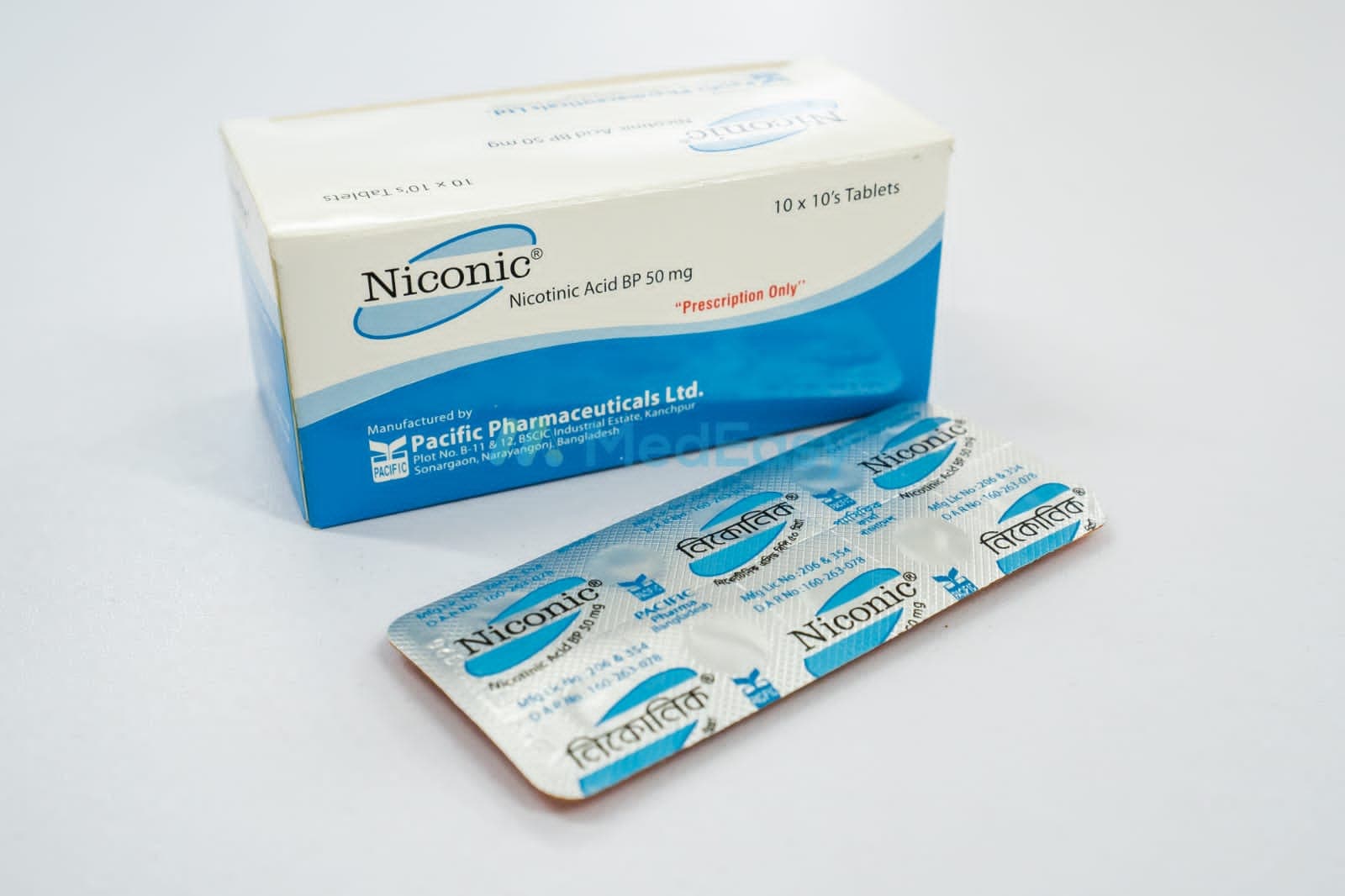

Medicine overview
Indications of Niconic
Niconic is a form of vitamin B3 used for two distinct purposes depending on the dose:
- Niacin deficiency and pellagra (established use): prevention and treatment of dietary niacin deficiency, including pellagra (characterized by dermatitis, diarrhea, and dementia), at nutritional/vitamin-range doses.
- Dyslipidemia (adjunct therapy) (established, prescription use): at pharmacologic doses, Niconic is used as an adjunct to diet, and often in combination with other lipid-lowering agents, to reduce elevated LDL-cholesterol and triglycerides and raise HDL-cholesterol in patients with primary hyperlipidemia or mixed dyslipidemia, including reducing the risk of pancreatitis in patients with very high triglycerides.
Use of Niconic specifically for cardiovascular event reduction has declined in recent years because large outcome trials did not show additional cardiovascular benefit when Niconic was added to statin therapy, and better-tolerated lipid-lowering options are now generally preferred; a physician should decide whether Niconic is appropriate for a given patient.
Composition
Each tablet of Nicotinic Acid [Niacin] contains Nicotinic Acid (Niacin) INN as the active ingredient, commonly available as immediate-release tablets (e.g., 50 mg, 100 mg, 250 mg, 500 mg) and, in some markets, extended/sustained-release tablets (e.g., 500 mg, 750 mg, 1000 mg). Strength and release type available may vary by manufacturer; the exact formulation of Nicotinic Acid [Niacin] should be confirmed on the product label.
Description
Niconic is a water-soluble B-complex vitamin (vitamin B3) that the body needs to convert food into energy and to maintain healthy skin, nerves, and digestion. At doses well above nutritional requirements, Niconic also has a distinct pharmacologic effect on lipid metabolism, lowering LDL-cholesterol and triglycerides while raising HDL-cholesterol, which is why it is also used as a prescription lipid-lowering agent in addition to being used as a vitamin supplement.
Therapeutic Class
Niconic belongs to the vitamin B-complex group (water-soluble vitamins) and, at pharmacologic doses, also belongs to the antihyperlipidemic (lipid-modifying) agents class.
Pharmacology
As a vitamin, Nicotinic Acid [Niacin] is a precursor of nicotinamide adenine dinucleotide (NAD) and its phosphate (NADP), coenzymes essential for tissue respiration, glycogenolysis, and lipid metabolism.
At pharmacologic (much higher than nutritional) doses, Nicotinic Acid [Niacin] reduces hepatic synthesis of very-low-density lipoprotein (VLDL) by inhibiting lipolysis in adipose tissue via the GPR109A receptor, which decreases free fatty acid flux to the liver, and by directly inhibiting hepatic diacylglycerol acyltransferase-2. Reduced VLDL synthesis lowers downstream LDL-cholesterol and triglycerides, while Nicotinic Acid [Niacin] separately increases HDL-cholesterol by reducing the hepatic clearance of apolipoprotein A-I.
Dosage & Administration of Niconic
Dosing of Niconic differs substantially depending on indication and must be individualized by a physician.
| Indication | Adult Dose | Notes |
|---|---|---|
| Niacin deficiency / pellagra | Typically 50–100 mg orally, 2–3 times daily (up to 500 mg/day in severe deficiency), as directed by a physician | Dose adjusted to clinical response |
| Dyslipidemia (adjunct) | Immediate-release: started low (e.g., 250 mg/day) and gradually titrated, typically up to 1.5–3 g/day in divided doses; Extended-release: usually started at 500 mg at bedtime and titrated up to a maintenance dose (commonly up to 1–2 g/day) | Slow titration reduces flushing and hepatotoxicity risk; do not switch abruptly between immediate-release and extended-release products without medical guidance |
Pediatric dosing of Niconic for deficiency states should be individualized by weight/age under medical supervision; pharmacologic (lipid-lowering) doses of Niconic are not established for routine pediatric use. See Use in Special Populations.
Administration of Niconic
Niconic is taken by mouth. To reduce flushing, it is often taken with food (avoiding hot beverages and alcohol around dosing time) and sometimes with a physician-directed dose of aspirin or another NSAID taken 30 minutes beforehand. Extended-release tablets of Niconic should be swallowed whole (not crushed or chewed) and are typically taken at bedtime. Dosing should be uptitrated gradually as directed, and doses should not be doubled if one is missed.
Interaction of Niconic
Niconic has clinically significant interactions with:
- Statins (HMG-CoA reductase inhibitors): combined use with Niconic increases the risk of myopathy and rhabdomyolysis; the combination requires careful monitoring.
- Bile acid sequestrants (e.g., cholestyramine, colestipol): can reduce absorption of Niconic; doses should be separated by at least 4–6 hours.
- Antihypertensive agents/vasodilators: additive risk of hypotension, especially early in Niconic therapy due to flushing-related vasodilation.
- Alcohol: may increase flushing and the risk of hepatotoxicity when taken with Niconic.
- Anticoagulants (e.g., warfarin): high-dose Niconic can prolong prothrombin time; monitor patients closely.
Contraindications
Nicotinic Acid [Niacin] is contraindicated in patients with:
- Known hypersensitivity to Nicotinic Acid [Niacin] or any component of the formulation.
- Active peptic ulcer disease.
- Significant or active hepatic (liver) disease, including unexplained persistent elevations in liver function tests.
- Active arterial bleeding/hemorrhage.
Side Effects of Niconic
Common side effects of Niconic:
- Flushing, warmth, itching, and tingling of the skin (very common, especially with immediate-release formulations; usually dose-related and diminishes over time).
- Gastrointestinal upset (nausea, vomiting, dyspepsia, diarrhea).
- Headache.
Less common but clinically important effects of Niconic:
- Hepatotoxicity, including elevated liver enzymes (risk is higher with sustained-release formulations at high doses).
- Hyperglycemia (may worsen glycemic control in diabetes).
- Hyperuricemia, which may precipitate gout.
- Myopathy, particularly when combined with statins (see Interactions).
- Hypotension.
Pregnancy & Lactation
At nutritional/dietary-supplement doses, Niconic is considered safe in pregnancy and breastfeeding, as niacin is an essential nutrient required in normal amounts. At pharmacologic (prescription lipid-lowering) doses, however, Niconic should be used during pregnancy only if clearly needed and if the potential benefit justifies the potential risk to the fetus, since dyslipidemia treatment is not usually a priority during pregnancy and safety data at high doses are limited. It is not established whether pharmacologic doses of Niconic pass into breast milk in clinically significant amounts; a physician should be consulted before use of pharmacologic-dose Niconic during breastfeeding.
Precautions & Warnings
Niconic should be used with caution and under medical supervision, with attention to:
- Liver function: periodic liver function tests are recommended during Niconic therapy, particularly with higher doses or sustained-release formulations, given the risk of hepatotoxicity (see Contraindications for active liver disease).
- Diabetes mellitus: Niconic may raise blood glucose; glucose monitoring is advised.
- Gout or hyperuricemia: use Niconic with caution as it can raise uric acid levels.
- History of peptic ulcer disease (inactive): use Niconic with caution, as it can cause GI irritation.
- Hypotension or use with antihypertensives: flushing-related vasodilation from Niconic may cause or worsen low blood pressure, particularly on standing.
- Concurrent statin use: increased risk of myopathy/rhabdomyolysis (see Interactions).
Flushing is common with Niconic, especially at the start of therapy or after a dose increase; taking Niconic with food, avoiding alcohol and hot beverages around dosing time, and physician-directed pretreatment with aspirin may reduce flushing.
Overdose Effects of Niconic
Overdose with Niconic may cause pronounced flushing, hypotension, dizziness, gastrointestinal upset, and, in severe or prolonged high-dose use, liver injury. If an overdose of Niconic is suspected, seek immediate medical attention or contact a poison control center; treatment is supportive and should be provided by a healthcare professional.
Storage Conditions
Store at room temperature (below 30°C), away from light and moisture. Keep out of reach of children.
Use In Special Populations
Pediatric use: Niconic may be used to treat documented niacin deficiency in children under medical supervision with age/weight-appropriate dosing. Safety and efficacy of pharmacologic (lipid-lowering) doses of Niconic have not been well established in children, and it is not generally recommended for pediatric dyslipidemia outside specialist guidance.
Elderly: No specific dose adjustment of Niconic is established for elderly patients, but they may be more susceptible to flushing, hypotension, and hepatotoxicity; use the lowest effective dose of Niconic with close monitoring.
Renal impairment: Use pharmacologic doses of Niconic with caution; specific dose adjustments are not well established, and clinical monitoring is advised.
Hepatic impairment: Niconic is contraindicated in significant/active hepatic disease (see Contraindications).
Duration Of Treatment
For niacin deficiency, Niconic is typically continued until symptoms resolve and adequate nutritional status is restored, usually a few weeks. For dyslipidemia, Niconic is generally used long-term as part of ongoing lipid management, with periodic physician review of lipid levels, liver function, and tolerability to determine whether continued treatment with Niconic is appropriate.
Drug Classes
Vitamin B-complex (water-soluble vitamin); Antihyperlipidemic / lipid-modifying agent. Nicotinic Acid [Niacin] belongs to both classes depending on the dose used.
Mode Of Action
As a vitamin, Nicotinic Acid [Niacin] is converted in the body to NAD and NADP, coenzymes required for cellular energy metabolism. At pharmacologic doses, Nicotinic Acid [Niacin] activates the GPR109A receptor on adipocytes, inhibiting lipolysis and reducing free fatty acid delivery to the liver; this, together with direct inhibition of hepatic diacylglycerol acyltransferase-2, decreases hepatic VLDL and, consequently, LDL-cholesterol and triglyceride production, while also increasing HDL-cholesterol by slowing its hepatic clearance.
Pregnancy
C (at pharmacologic/prescription lipid-lowering doses); nutritional/RDA-level doses are considered Category A
Pediatric Uses
Niconic may be used under medical supervision to treat confirmed niacin deficiency in children at age/weight-appropriate doses. However, safety and efficacy of pharmacologic (high-dose, lipid-lowering) Niconic therapy have not been established in pediatric patients, and such use is not generally recommended outside specialist care.
Frequently Asked Questions
Q: What is Niconic 50 mg Tablet (Extended Release) used for?
A: Niconic 50 mg Tablet (Extended Release) is used at nutritional doses to prevent or treat niacin deficiency (pellagra), and at higher, prescription (pharmacologic) doses as an adjunct treatment to help lower LDL-cholesterol and triglycerides and raise HDL-cholesterol in people with dyslipidemia.
Q: Why does Niconic 50 mg Tablet (Extended Release) cause flushing?
A: At pharmacologic doses, Niconic 50 mg Tablet (Extended Release) causes skin blood vessels to dilate, producing warmth, redness, and itching known as flushing. This is very common, especially with immediate-release products, and often lessens with continued use; taking it with food or a physician-directed dose of aspirin beforehand can reduce it.
Q: Can I take Niconic 50 mg Tablet (Extended Release) if I have liver disease?
A: No. Niconic 50 mg Tablet (Extended Release) is contraindicated in people with significant or active liver disease because it can be hepatotoxic, particularly at high or sustained-release doses. Periodic liver function testing is recommended during treatment with Niconic 50 mg Tablet (Extended Release).
Q: Is Niconic 50 mg Tablet (Extended Release) safe during pregnancy?
A: Nutritional/dietary-supplement doses of Niconic 50 mg Tablet (Extended Release) are considered safe in pregnancy since niacin is an essential nutrient. Higher, pharmacologic (prescription) doses of Niconic 50 mg Tablet (Extended Release) used for cholesterol should be used only if clearly needed and if the benefit outweighs potential risk to the fetus; a physician should be consulted.
Q: Can Niconic 50 mg Tablet (Extended Release) be taken with a statin?
A: It can be, but combining Niconic 50 mg Tablet (Extended Release) with a statin increases the risk of muscle problems, including myopathy and, rarely, rhabdomyolysis. Your doctor will monitor you closely if these medicines are combined.
Q: What should I do if I take too much Niconic 50 mg Tablet (Extended Release)?
A: Seek immediate medical attention or contact a poison control center. Overdose with Niconic 50 mg Tablet (Extended Release) can cause pronounced flushing, low blood pressure, gastrointestinal upset, and, with high sustained doses, liver injury.
Disclaimer
The information provided is accurate to the best of our knowledge, but it does not replace professional medical advice. We cannot guarantee its completeness or accuracy, and the absence of specific information about a drug should not be taken as an endorsement. We are not responsible for any consequences arising from this information, so please consult a healthcare professional for any concerns or questions.
