
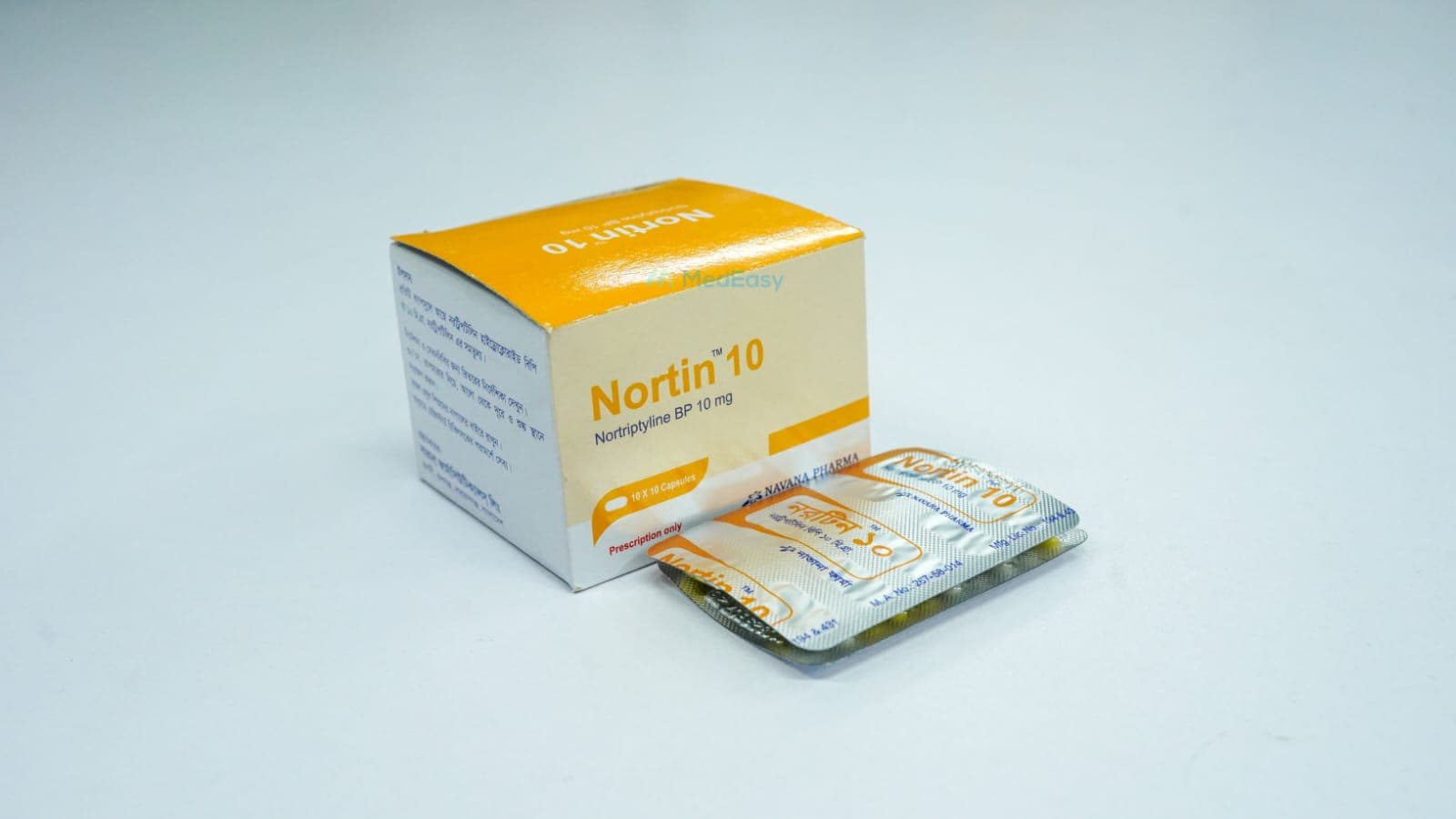

Medicine overview
Indications of Nortin
Nortin is a tricyclic antidepressant (TCA) with the following evidence-based uses:
Established / approved use
- Major depressive disorder (endogenous depression) in adults — Nortin is indicated for the relief of symptoms of depression.
Guideline-supported / commonly used off-label
- Chronic neuropathic pain (e.g. diabetic peripheral neuropathy, post-herpetic neuralgia) — Nortin is widely recommended in pain-management guidelines as a second/third-line agent, generally after first trying agents with a more favourable safety profile.
- Migraine prophylaxis — used off-label to reduce the frequency of migraine and chronic tension-type headache.
- Fibromyalgia-related pain — used off-label, sometimes as an adjunct to other therapies.
Use of Nortin for any indication should be initiated and supervised by a qualified physician, who will weigh the potential benefit against the risks described under Precautions and Warnings.
Composition
Each tablet/capsule contains Nortriptyline hydrochloride equivalent to the labelled strength of Nortriptyline base (commonly available as 10 mg, 25 mg, and 50 mg oral formulations, and as an oral solution in some markets). Refer to the specific product pack for exact strength and inactive ingredients.
Description
Nortin is a secondary-amine tricyclic antidepressant (TCA), chemically related to amitriptyline (it is, in fact, the major active metabolite of amitriptyline). It has been used for several decades in the management of depression and, more recently, as an off-label option for selected chronic pain syndromes.
Nortin is available orally as tablets or capsules, and in some markets as an oral solution.
Therapeutic Class
Pharmacology
Mechanism
Nortriptyline is believed to exert its antidepressant and analgesic effects primarily by inhibiting the reuptake of norepinephrine (noradrenaline) and, to a lesser extent, serotonin at the presynaptic neuronal membrane, thereby increasing the concentration of these neurotransmitters in the synaptic cleft. It also has anticholinergic (antimuscarinic), antihistaminic (H1), and alpha-1 adrenergic blocking properties, which account for many of its side effects.
Pharmacokinetics
- Absorption: Well absorbed from the gastrointestinal tract; peak plasma concentration in about 7–8.5 hours.
- Metabolism: Hepatic, mainly via CYP2D6 to 10-hydroxynortriptyline; subject to significant genetic (CYP2D6 polymorphism) and drug-interaction variability.
- Half-life: Approximately 18–44 hours (average ~26 hours), allowing once-daily dosing in many patients.
- Therapeutic window: Nortriptyline has a relatively narrow therapeutic plasma concentration range (roughly 50–150 ng/mL); levels above this range are not associated with better response and may increase toxicity risk. Therapeutic drug monitoring may be used to guide dosing.
- Excretion: Primarily renal, as metabolites.
Dosage & Administration of Nortin
Depression (adults)
| Population | Typical starting dose | Usual maintenance dose | Maximum dose |
|---|---|---|---|
| Adults | 25 mg 3–4 times daily (or 25 mg at bedtime, titrated) | 50–150 mg/day, in divided doses or once daily | 150 mg/day |
| Adolescents and elderly patients | 10 mg 3 times daily (or 25–50 mg total per day) | 30–50 mg/day | As advised by physician; lower than adult maximum |
Chronic neuropathic pain / migraine prophylaxis (off-label)
Typically started at a low dose (e.g. 10–25 mg at bedtime) and titrated gradually every 3–7 days according to response and tolerability, up to 75–100 mg/day in some patients, under close physician supervision. See Duration of Treatment.
Administration
Nortin may be taken with or without food. Taking it at bedtime can help reduce daytime sedation. Doses should not be adjusted, stopped abruptly, or shared with others without medical advice — discontinuation should be tapered gradually under physician guidance to reduce the risk of withdrawal symptoms.
Renal/hepatic impairment
No formal, well-established dose-adjustment schedule exists for renal or hepatic impairment; however, because Nortin is hepatically metabolised, physicians typically start at a lower dose and titrate slowly with closer monitoring in patients with hepatic impairment.
Administration of Nortin
Nortin is given orally, with or without food, generally once daily (often at bedtime) or in divided doses as directed by the physician. Do not change the dose or stop Nortin suddenly without medical advice.
Interaction of Nortin
- Monoamine oxidase inhibitors (MAOIs): Concomitant use, or use within 14 days of stopping an MAOI, is contraindicated due to risk of serotonin syndrome, hyperpyrexia, seizures, and hypertensive crisis.
- Other serotonergic drugs (SSRIs, SNRIs, tramadol, triptans): Increased risk of serotonin syndrome when combined with Nortin.
- CYP2D6 inhibitors (e.g. fluoxetine, paroxetine, quinidine, cimetidine, bupropion): Can significantly raise Nortin plasma levels, increasing risk of toxicity (including cardiotoxicity).
- QT-prolonging drugs (certain antiarrhythmics, antipsychotics, some antibiotics): Additive risk of QT prolongation and arrhythmia when combined with Nortin.
- CNS depressants and alcohol: Additive sedation and psychomotor impairment with Nortin.
- Other anticholinergic drugs: Additive anticholinergic burden (e.g. severe constipation, urinary retention, confusion) with Nortin.
- Clonidine and other antihypertensives: Nortin may blunt the antihypertensive effect of clonidine and related agents.
- Sympathomimetic agents (e.g. epinephrine, in local anaesthetics): Nortin may enhance the pressor (blood-pressure-raising) response.
Always inform your physician or pharmacist of all medicines, supplements, and herbal products being used before starting Nortin.
Contraindications
- Known hypersensitivity to Nortriptyline or other tricyclic antidepressants.
- Concomitant use of, or use within 14 days of discontinuing, a monoamine oxidase inhibitor (MAOI).
- Acute recovery phase following myocardial infarction (heart attack).
Side Effects of Nortin
Common
- Dry mouth, constipation, blurred vision, urinary hesitancy/retention (anticholinergic effects)
- Drowsiness, dizziness, weakness
- Orthostatic (postural) hypotension
- Weight gain, increased appetite
- Sweating, fine tremor
Serious (seek medical attention promptly)
- Cardiac arrhythmias, palpitations, QT prolongation (see Precautions and Warnings)
- Seizures
- Worsening depression, unusual changes in behaviour, or suicidal thoughts (see Precautions and Warnings)
- Serotonin syndrome (agitation, high fever, muscle rigidity, rapid heart rate) when combined with serotonergic drugs
- Signs of hyponatremia/SIADH (confusion, severe weakness, headache), particularly in elderly patients
- Severe allergic reaction (rash, swelling, difficulty breathing)
Pregnancy & Lactation
Pregnancy
Nortin should be used during pregnancy only if clearly needed and the potential benefit justifies the potential risk to the fetus. Third-trimester exposure to tricyclic antidepressants, including Nortin, has been associated in some reports with transient neonatal symptoms such as irritability, jitteriness, feeding difficulty, and, rarely, urinary retention or seizures in the newborn. Use of Nortin during pregnancy should always be discussed with, and supervised by, a physician; do not stop or start Nortin in pregnancy without medical advice.
Lactation
Nortin is excreted into breast milk in relatively small amounts. Among tricyclic antidepressants it is one of the more commonly used options during breastfeeding, but a physician should still be consulted before use, and breastfed infants should be monitored for sedation, poor feeding, or irritability.
Precautions & Warnings
Boxed warning: Suicidality
Antidepressants, including Nortin, may increase the risk of suicidal thinking and behaviour in children, adolescents, and young adults (up to age 24), particularly during the first few months of treatment or after dose changes. Nortin is not approved for use in pediatric patients. Patients of all ages started on Nortin should be monitored closely for worsening depression, unusual changes in behaviour, or emergence of suicidal thoughts, and family members/caregivers should be advised of the need for close observation.
Cardiac effects
Nortin can affect cardiac conduction and may cause QT-interval prolongation and arrhythmias. A baseline ECG is recommended before starting Nortin in older adults or patients with known or suspected cardiac disease. Use with caution in patients with a history of cardiovascular disease.
Narrow-angle glaucoma and urinary retention
Due to its anticholinergic activity, Nortin should be used with caution in patients with narrow-angle (angle-closure) glaucoma or conditions predisposing to urinary retention, such as benign prostatic hyperplasia (BPH).
Seizure disorder
Nortin can lower the seizure threshold; use with caution in patients with a history of seizures or conditions that predispose to seizures.
Overdose risk
Nortin has a narrow therapeutic index, and overdose can be particularly dangerous, even fatal, due to cardiotoxic effects (see Overdose Effects). Physicians should prescribe the smallest quantity consistent with good patient management, especially in patients at risk of overdose (e.g. those with suicidal ideation).
Discontinuation
Abrupt discontinuation of Nortin after prolonged use may cause withdrawal-type symptoms (nausea, headache, malaise); dose should be tapered gradually under medical supervision.
Overdose Effects of Nortin
Overdose of Nortin is a medical emergency and can be life-threatening, primarily due to cardiotoxicity (arrhythmias, conduction block), severe hypotension, seizures, and central nervous system depression progressing to coma. Symptoms may include confusion, dilated pupils, agitation, drowsiness progressing to unconsciousness, irregular heartbeat, low blood pressure, and seizures.
If overdose is suspected, seek immediate medical attention or contact emergency services / a poison control center right away. Do not attempt to treat an overdose at home. Continuous cardiac monitoring and hospital-based supportive care are typically required.
Storage Conditions
Store at room temperature (below 30°C), away from light and moisture. Keep out of reach of children.
Use In Special Populations
Pediatric patients
Safety and efficacy of Nortin for depression have not been established in patients under 18 years of age; Nortin is not approved for use in children and carries a boxed warning regarding increased suicidality risk in children, adolescents, and young adults on antidepressant therapy (see Precautions and Warnings).
Elderly patients
Elderly patients are generally more sensitive to the anticholinergic, sedative, and cardiac effects of Nortin and are usually started on lower doses with slower titration. A baseline ECG is recommended before starting Nortin in this age group.
Hepatic impairment
Nortin is metabolised in the liver; use with caution and consider lower starting doses with slow titration and closer monitoring in patients with hepatic impairment.
Renal impairment
No well-established specific dose adjustment exists; use with caution and monitor for accumulation of active metabolites.
Duration Of Treatment
For depression, an adequate trial of Nortin is generally at least 4–6 weeks before assessing full response, and treatment is typically continued for at least 6–12 months after remission to reduce relapse risk, as directed by the treating physician. For neuropathic pain or migraine prophylaxis, duration is individualised based on response and tolerability. Nortin should not be stopped abruptly; any change in duration or discontinuation should be guided by a physician.
Drug Classes
Mode Of Action
Nortriptyline works mainly by inhibiting the reuptake of norepinephrine and, to a lesser extent, serotonin at the presynaptic nerve terminal, increasing their availability in the synaptic cleft. This is thought to underlie both its antidepressant effect and its efficacy in modulating chronic pain pathways. Its anticholinergic, antihistaminic, and alpha-adrenergic blocking activity contributes to many of its side effects.
Pregnancy
D
Pediatric Uses
Nortin is not approved for the treatment of depression in pediatric patients; safety and efficacy in children and adolescents under 18 years have not been established. Nortin carries a boxed warning that antidepressants, including Nortin, may increase the risk of suicidal thinking and behaviour in children, adolescents, and young adults, especially early in treatment. If a physician determines that use in a young patient is necessary for an off-label indication, close monitoring for behavioural changes and cardiac effects is essential.
Frequently Asked Questions
Q: What is Nortin 10 mg Capsule used for?
A: Nortin 10 mg Capsule is a tricyclic antidepressant approved for treating depression in adults. It is also commonly used off-label, under physician supervision, for chronic neuropathic pain and to help prevent migraine headaches.
Q: How long does it take for Nortin 10 mg Capsule to work?
A: For depression, it can take 4–6 weeks of regular use at an adequate dose to see the full antidepressant effect, although some improvement in sleep or pain may be noticed sooner. Do not stop taking Nortin 10 mg Capsule early just because you don't feel a difference right away — discuss any concerns with your physician.
Q: Can I stop taking Nortin 10 mg Capsule suddenly?
A: No. Stopping Nortin 10 mg Capsule abruptly after regular use can cause withdrawal-type symptoms such as nausea, headache, and malaise. Your physician will usually taper the dose gradually when it is time to stop.
Q: Is Nortin 10 mg Capsule safe during pregnancy or breastfeeding?
A: Nortin 10 mg Capsule should be used in pregnancy only if clearly needed, since third-trimester exposure has been linked to transient symptoms in newborns such as irritability and feeding difficulty. In breastfeeding, Nortin 10 mg Capsule passes into breast milk in relatively small amounts and is one of the more commonly used tricyclic antidepressants in nursing mothers, but a physician should always be consulted first and the infant monitored for sedation or feeding problems.
Q: What are the serious risks I should know about with Nortin 10 mg Capsule?
A: Nortin 10 mg Capsule carries a boxed warning for increased risk of suicidal thoughts and behaviour in children, adolescents, and young adults, especially early in treatment. It can also affect heart rhythm (QT prolongation, arrhythmias), so a heart tracing (ECG) may be recommended before starting, particularly in older adults or those with heart disease. Overdose with Nortin 10 mg Capsule can be life-threatening due to effects on the heart, so it should be kept out of reach of children and taken exactly as prescribed.
Q: What should I do if someone takes too much Nortin 10 mg Capsule?
A: An overdose of Nortin 10 mg Capsule is a medical emergency that can cause dangerous heart rhythm problems, seizures, and loss of consciousness. Seek immediate medical attention or contact emergency services / a poison control center right away — do not wait for symptoms to appear or try to treat it at home.
Disclaimer
The information provided is accurate to the best of our knowledge, but it does not replace professional medical advice. We cannot guarantee its completeness or accuracy, and the absence of specific information about a drug should not be taken as an endorsement. We are not responsible for any consequences arising from this information, so please consult a healthcare professional for any concerns or questions.
