

10% Off
Cef-330 ml
Square Pharmaceuticals PLC.
৳130.50
Add to cart
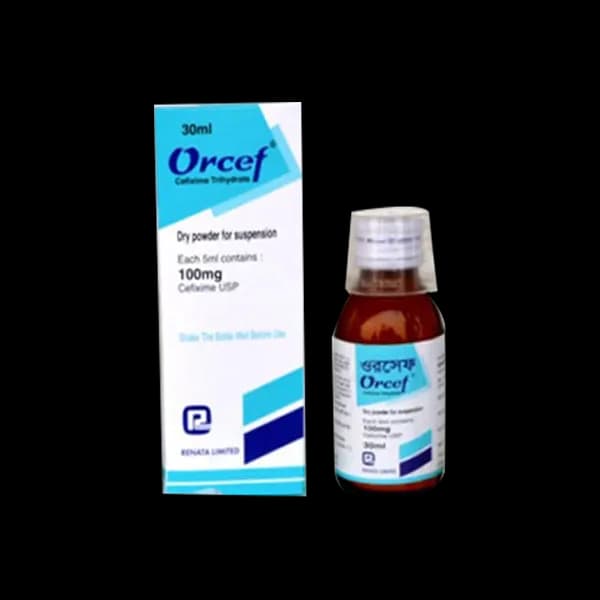

Orcef is a third-generation cephalosporin antibiotic used to treat infections caused by susceptible bacteria. Indications are classified below by strength of evidence:
Use of Orcef should be guided by culture and susceptibility information where possible, and by local antimicrobial resistance patterns, to ensure appropriate use of this antibiotic.
Each capsule/tablet contains Cefixime Trihydrate INN equivalent to Cefixime 200 mg or 400 mg. Cefixime Trihydrate is also available as a powder for oral suspension, providing Cefixime 100 mg per 5 mL (and other strengths such as 100 mg/mL) after reconstitution with water.
Orcef is an orally administered, semi-synthetic, third-generation cephalosporin antibiotic. It exerts a bactericidal effect by inhibiting bacterial cell wall synthesis and is notably stable against hydrolysis by many common bacterial beta-lactamase enzymes, giving it activity against a broad range of Gram-negative and certain Gram-positive organisms.
Orcef is well established and widely marketed in Bangladesh, available as capsules/tablets (100 mg, 200 mg, 400 mg) and as oral suspension for use in children and patients who cannot swallow solid dosage forms. It is commonly prescribed for respiratory tract infections, ear infections, urinary tract infections, gonorrhea, and typhoid fever.
Third-generation Cephalosporin antibiotic
Cefixime Trihydrate is a third-generation cephalosporin that exerts a bactericidal effect by binding to penicillin-binding proteins (PBPs) located on the bacterial cell wall, thereby inhibiting the final transpeptidation step of bacterial cell wall (peptidoglycan) synthesis. This leads to cell wall instability, lysis, and death of susceptible bacteria.
Cefixime Trihydrate is highly stable in the presence of many bacterial beta-lactamase enzymes, which broadens its activity against Gram-negative organisms such as Escherichia coli, Proteus mirabilis, Haemophilus influenzae, Moraxella catarrhalis, and Neisseria gonorrhoeae, as well as some Gram-positive organisms such as Streptococcus pyogenes and Streptococcus pneumoniae. Following oral administration, bioavailability is roughly 40-50%, largely unaffected by food, with peak plasma concentrations reached in 2-6 hours; a substantial proportion is excreted unchanged in the urine.
| Indication | Dose |
|---|---|
| Uncomplicated UTI, pharyngitis/tonsillitis, bronchitis, otitis media (general use) | Orcef 200 mg twice daily or 400 mg once daily, for 7–14 days depending on severity and site of infection (streptococcal pharyngitis requires at least 10 days) |
| Uncomplicated gonorrhea | Orcef 400 mg as a single oral dose |
| Typhoid fever | Orcef 200 mg twice daily for 10–14 days (higher weight-based doses used in children, see below) |
| Indication | Dose |
|---|---|
| General susceptible infections (UTI, otitis media, pharyngitis/tonsillitis, bronchitis) | Orcef 8 mg/kg/day, given once daily or as 4 mg/kg every 12 hours |
| Typhoid fever | Orcef 10–15 mg/kg/day in two divided doses for 10–14 days, as commonly used in guideline-supported regimens for multidrug-resistant typhoid |
Safety and efficacy of Orcef in infants below 6 months of age have not been established.
| Creatinine clearance | Dose adjustment |
|---|---|
| ≥ 60 mL/min (or on hemodialysis) | No adjustment necessary |
| 20–59 mL/min | Reduce dose by approximately 25% |
| < 20 mL/min | Reduce dose by approximately 50% (e.g. maximum 200 mg once daily) |
Administration: Orcef may be taken with or without food. The oral suspension should be shaken well before each use and measured with an accurate dosing device. Orcef should be taken exactly as prescribed by your physician; do not stop, extend, skip doses, or share this medicine with others without medical advice, and complete the full prescribed course even if symptoms improve early.
Orcef can be taken by mouth with or without food. Swallow capsules/tablets whole; shake the oral suspension well before measuring each dose with an accurate measuring device (not a household spoon). Take Orcef at evenly spaced intervals and complete the full course prescribed by your physician, even if you feel better before the course is finished.
Warfarin and other oral anticoagulants: Orcef may increase prothrombin time and enhance the effect of anticoagulants, raising bleeding risk; monitor coagulation status closely if co-administered.
Carbamazepine: Concurrent use with Orcef has been reported to increase plasma carbamazepine concentrations, which may increase the risk of carbamazepine toxicity.
Probenecid: Inhibits renal tubular excretion of Orcef, increasing and prolonging its plasma concentration.
Estrogen-containing oral contraceptives: Antibiotics, including Orcef, may theoretically reduce contraceptive efficacy; an additional non-hormonal contraceptive method is advisable during treatment.
Laboratory test interference: Orcef may cause false-positive results in urine glucose tests using copper-reduction methods (e.g. Clinitest) and a false-positive direct Coombs' test.
Cefixime Trihydrate is contraindicated in patients with a known history of hypersensitivity (e.g. anaphylaxis, serious skin reactions) to Cefixime Trihydrate, other cephalosporin antibiotics, or any component of the formulation. Because of the possibility of cross-reactivity, Cefixime Trihydrate should also not be given to patients with a history of a severe (e.g. anaphylactic) reaction to penicillins.
The most commonly reported side effects of Orcef are gastrointestinal:
Less common effects include headache, dizziness, and skin reactions such as rash, pruritus, and urticaria. Reversible hematologic changes (eosinophilia, thrombocytopenia, leukopenia) have been reported. Rare but serious effects include hypersensitivity reactions (including anaphylaxis and serious skin reactions), Clostridioides difficile-associated diarrhea/pseudomembranous colitis (see Precautions and Warnings), and reversible elevations in liver enzymes.
Pregnancy: There are no adequate and well-controlled studies of Orcef in pregnant women. Orcef should be used during pregnancy only if clearly needed, with the potential benefit justifying the potential risk to the fetus; consult a physician before use in pregnancy or suspected pregnancy.
Lactation: It is not known whether Orcef is excreted in human breast milk in clinically significant amounts. Caution is advised, and Orcef should be used while breastfeeding only if the treating physician considers it necessary, weighing the benefit to the mother against any potential risk to the infant (e.g. disturbance of infant gut flora).
Hypersensitivity and penicillin cross-reactivity: Serious, occasionally fatal, hypersensitivity reactions have been reported with cephalosporins, including Orcef. There is evidence of partial cross-allergenicity between penicillins and cephalosporins; use Orcef with caution in patients with a history of penicillin allergy that is not severe, and discontinue immediately if a hypersensitivity reaction occurs (see Contraindications).
Clostridioides difficile-associated diarrhea (CDAD): Orcef, like other broad-spectrum antibiotics, can permit overgrowth of C. difficile, ranging from mild diarrhea to fatal colitis. Consider this diagnosis in patients who develop diarrhea during or after treatment with Orcef.
Renal impairment: Dose adjustment is required in patients with significant renal impairment (see Dosage and Administration).
Antibiotic stewardship: Take Orcef exactly as prescribed by your physician; do not stop, extend, skip doses, or share this medicine with others without medical advice. Using Orcef in the absence of a proven or strongly suspected bacterial infection, or failing to complete the prescribed course, increases the risk of drug-resistant bacteria and reduces the future effectiveness of Orcef and other antibiotics.
See Interactions, Pregnancy and Lactation, and Use in Special Populations for further important safety information.
In case of a suspected overdose of Orcef, seek immediate medical attention or contact a poison control center/emergency services right away. There is no specific antidote for Orcef. Management is supportive and symptomatic; gastric lavage may be considered by a physician if presentation is early. Orcef is not significantly removed by hemodialysis or peritoneal dialysis.
Store at room temperature (below 30°C), away from light and moisture. If reconstituted as an oral suspension, store as directed on the label (typically at room temperature, and discard after 14 days). Keep out of reach of children.
Renal impairment: Dose reduction is required for patients with creatinine clearance below 60 mL/min; see Dosage and Administration for the specific adjustment schedule.
Hepatic impairment: No specific dose adjustment of Orcef is well established for hepatic impairment; use with routine clinical monitoring.
Elderly: No specific dose adjustment beyond assessment of renal function is generally required for Orcef in elderly patients, as renal function commonly declines with age.
Children: See Pediatric Uses.
Pregnancy and breastfeeding: See Pregnancy and Lactation.
Duration of Orcef therapy depends on the indication: a single dose for uncomplicated gonorrhea; 7 to 14 days for most respiratory tract, ear, and urinary tract infections (with streptococcal pharyngitis/tonsillitis requiring a minimum of 10 days to reduce the risk of rheumatic fever); and 10 to 14 days for typhoid fever. The full course of Orcef prescribed by the physician should always be completed.
Orcef powder for oral suspension should be reconstituted by adding the specified amount of water to the powder in the bottle, then shaking well until fully dispersed, following the instructions printed on the product label. The reconstituted suspension should be shaken well before each use, stored as directed (generally at room temperature), and any unused portion discarded after 14 days.
Cephalosporin antibiotic; Third-generation cephalosporin; Beta-lactam antibiotic
Cefixime Trihydrate inhibits bacterial cell wall synthesis. It binds to penicillin-binding proteins (PBPs) in the bacterial cell membrane, blocking the transpeptidation (cross-linking) step of peptidoglycan synthesis. This weakens the cell wall, leading to osmotic instability, lysis, and death of the susceptible bacterium. Cefixime Trihydrate is highly resistant to hydrolysis by many common bacterial beta-lactamase enzymes, broadening its spectrum of bactericidal activity.
B
Orcef is approved for use in children 6 months of age and older for susceptible infections such as otitis media, pharyngitis/tonsillitis, and urinary tract infections, dosed at 8 mg/kg/day using the oral suspension formulation, either once daily or divided every 12 hours. Orcef is also commonly used, at weight-based doses, in guideline-supported regimens for typhoid fever in children.
Safety and efficacy of Orcef have not been established in infants below 6 months of age; use in this age group is not recommended outside specific specialist guidance.
Q: What is Orcef 30 ml Powder for Suspension used for?
A: Orcef 30 ml Powder for Suspension is an antibiotic used to treat bacterial infections such as urinary tract infections, throat infections (pharyngitis/tonsillitis), middle ear infections (otitis media), bronchitis, uncomplicated gonorrhea, and typhoid fever caused by susceptible bacteria.
Q: How should I take Orcef 30 ml Powder for Suspension?
A: Take Orcef 30 ml Powder for Suspension exactly as prescribed by your physician, with or without food, at evenly spaced intervals. Do not stop, extend, skip doses, or share this medicine with others without medical advice, and always complete the full course even if you feel better before it is finished, to reduce the risk of antibiotic resistance and relapse.
Q: Can Orcef 30 ml Powder for Suspension be used during pregnancy or breastfeeding?
A: There are no adequate and well-controlled studies of Orcef 30 ml Powder for Suspension in pregnant women, so it should be used in pregnancy only if clearly needed, when the potential benefit justifies the potential risk to the fetus. It is not known whether Orcef 30 ml Powder for Suspension passes into breast milk in significant amounts, so it should be used while breastfeeding only if a physician considers it necessary. Always consult your doctor before using it in pregnancy or while breastfeeding.
Q: What are the common side effects of Orcef 30 ml Powder for Suspension?
A: The most common side effects of Orcef 30 ml Powder for Suspension are gastrointestinal, including diarrhea, nausea, abdominal pain, dyspepsia, and loose stools. Less commonly, headache, dizziness, or skin rash may occur. Seek medical attention if you develop severe or persistent diarrhea, signs of an allergic reaction (rash, swelling, difficulty breathing), or unusually severe illness.
Q: Who should not take Orcef 30 ml Powder for Suspension?
A: Orcef 30 ml Powder for Suspension should not be taken by anyone with a known allergy (hypersensitivity) to Orcef 30 ml Powder for Suspension, other cephalosporin antibiotics, or by anyone who has had a severe allergic reaction to penicillin antibiotics, because of the possibility of cross-reactivity between the two drug classes.
Q: What should I do if I miss a dose or take too much Orcef 30 ml Powder for Suspension?
A: If you miss a dose of Orcef 30 ml Powder for Suspension, take it as soon as you remember unless it is almost time for the next dose, in which case skip the missed dose; do not double up. If an overdose of Orcef 30 ml Powder for Suspension is suspected, seek immediate medical attention or contact a poison control center, as there is no specific antidote and treatment is supportive.
Disclaimer
The information provided is accurate to the best of our knowledge, but it does not replace professional medical advice. We cannot guarantee its completeness or accuracy, and the absence of specific information about a drug should not be taken as an endorsement. We are not responsible for any consequences arising from this information, so please consult a healthcare professional for any concerns or questions.

