
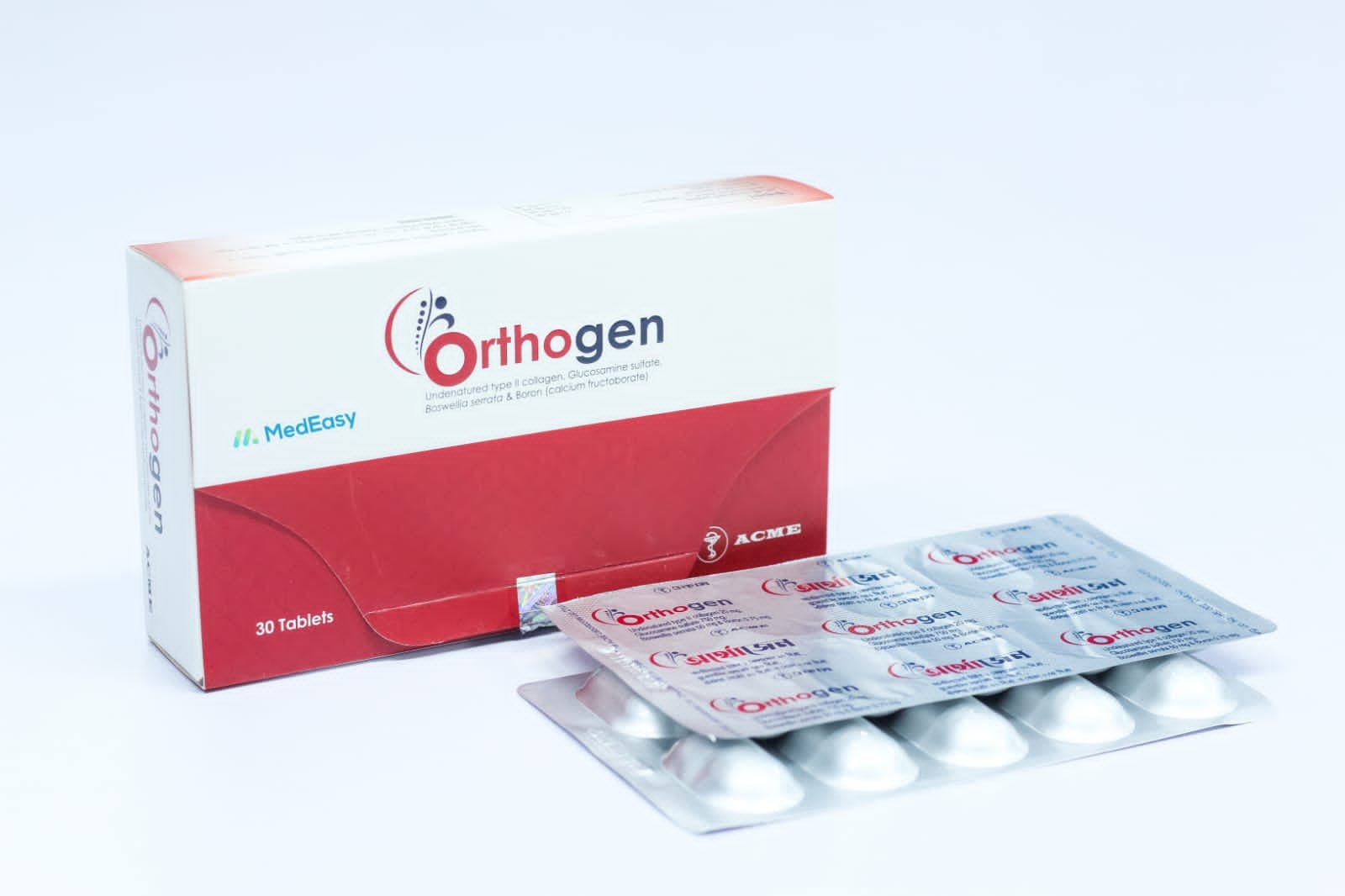
Orthogen
Key facts
Orthogen Tablet is available on MedEasy for ৳276.00 per 10's Strip, with home delivery anywhere in Bangladesh. It is manufactured by ACME Laboratories Ltd. Its generic name is Undenatured Type II Collagen + Glucosamine sulfate + Boswellia serrata + Boron.
- Pack sizes
- 10's Strip, 30's Pack
- Prescription
- Required. Upload a valid doctor's prescription at checkout; a MedEasy pharmacist verifies it before dispatch.
- Delivery
- Home delivery across Bangladesh. Same-day delivery in Dhaka, Chattogram, Sylhet and Bogura city areas; 2-3 days elsewhere.
- Payment
- Cash on delivery, bKash, cards and mobile banking.
- Brand
- Orthogen
- Manufacturer
- ACME Laboratories Ltd.
- Form & strength
- Tablet
- Availability
- In stock
- Authenticity
- Sourced from licensed suppliers and the manufacturer's authorised distributors in Bangladesh.

Medicine overview
Indications of Orthogen
Orthogen is a multi-ingredient nutraceutical (dietary supplement) combination marketed for joint health support, most commonly in adults with mild-to-moderate osteoarthritis (OA) symptoms such as joint stiffness and discomfort. It is not an FDA-approved prescription drug; it is regulated as a dietary supplement in most markets, including Bangladesh, and is not intended to diagnose, treat, cure, or prevent disease in the way a conventional pharmaceutical is.
- Evidence-supported, adjunctive use: Small-to-moderate clinical trials suggest that regular use of Orthogen may modestly reduce joint pain and stiffness and improve joint function scores in knee/hip osteoarthritis over several weeks to months, when used alongside standard measures (weight management, exercise/physiotherapy, and physician-directed analgesics/NSAIDs as needed) rather than in place of them.
- Evidence-limited / evolving: Evidence for the individual components (undenatured type II collagen, glucosamine sulfate, Boswellia serrata extract, and boron) and for this specific combination is modest, heterogeneous across studies, and not as robust as evidence for conventional OA pharmacotherapy. Results vary by product formulation and dose, and not all trials show benefit.
- Not established: Orthogen is not established as effective for rheumatoid arthritis, other inflammatory/autoimmune joint diseases, or for preventing structural joint damage; it should not replace disease-modifying treatment prescribed for those conditions.
Patients with persistent, worsening, or severe joint symptoms, or with suspected inflammatory arthritis, should be evaluated by a physician rather than relying on Orthogen alone.
Composition
Undenatured Type II Collagen + Glucosamine sulfate + Boswellia serrata + Boron is a combination nutraceutical product; exact strengths vary by brand/manufacturer, but typical label amounts include:
- Undenatured type II collagen — commonly around 40 mg per dose, sourced from cartilage and processed to preserve its native (undenatured) molecular structure, which is believed to underlie its proposed immune-modulating mechanism (distinct from hydrolyzed/denatured collagen used for skin/hair products).
- Glucosamine sulfate — commonly 500–1500 mg per day, an amino sugar involved in cartilage matrix synthesis; some sources are derived from shellfish shells (chitin), while others are synthetic/non-shellfish — the source should be confirmed on the specific product label.
- Boswellia serrata extract — commonly 100–250 mg per day of an extract standardized to boswellic acids, derived from the resin of the Boswellia serrata tree, used for its anti-inflammatory properties.
- Boron — commonly 1–3 mg per day, a trace mineral with proposed roles in bone and joint metabolism.
Because exact ratios differ between brands of Undenatured Type II Collagen + Glucosamine sulfate + Boswellia serrata + Boron, always check the specific product label for the precise strength of each component.
Description
Orthogen is a fixed combination of four ingredients marketed together as a joint-health dietary supplement rather than as a single regulated drug substance. Undenatured type II collagen is proposed to act through a distinct, immune-modulating (oral tolerance) mechanism rather than by directly supplying cartilage building blocks, differentiating it from ordinary (hydrolyzed/denatured) collagen supplements. Glucosamine sulfate is an amino sugar and a natural constituent of cartilage matrix. Boswellia serrata is an herbal extract long used in traditional medicine for inflammatory joint conditions. Boron is an essential trace mineral. Together, Orthogen is intended as an adjunctive option for people seeking to support joint comfort and mobility, particularly in age-related or mechanical (osteoarthritic) joint wear, with an evidence base that is encouraging but still evolving compared to conventional OA pharmacotherapy.
Therapeutic Class
Orthogen is classified as a multi-ingredient nutraceutical/dietary supplement for joint health, not a conventional pharmaceutical therapeutic class. It combines a collagen-based immune-modulating agent, an amino-sugar cartilage-matrix constituent, a herbal anti-inflammatory extract, and a trace mineral cofactor.
Pharmacology
Undenatured Type II Collagen
Unlike hydrolyzed collagen (which is broken down and thought to supply amino acid building blocks), the undenatured type II collagen component of Undenatured Type II Collagen + Glucosamine sulfate + Boswellia serrata + Boron is proposed to act via oral tolerance: small intact collagen fragments interact with gut-associated lymphoid tissue, potentially down-regulating the immune/inflammatory response directed against native joint cartilage collagen. This is a distinct mechanism from simple structural supplementation.
Glucosamine Sulfate
Glucosamine is a natural amino sugar and precursor for glycosaminoglycans and proteoglycans that make up cartilage matrix. Supplementation is proposed to support cartilage matrix synthesis and may have mild anti-inflammatory effects in joint tissue, although whether oral glucosamine achieves relevant concentrations at the joint is debated.
Boswellia Serrata
Boswellic acids in Boswellia serrata extract are thought to inhibit 5-lipoxygenase (5-LOX), reducing production of pro-inflammatory leukotrienes, which may contribute to reduced joint inflammation and pain.
Boron
Boron is proposed to influence calcium, magnesium, and vitamin D metabolism and may modulate inflammatory markers relevant to bone and joint health, though its independent contribution within this combination is not well isolated in clinical studies.
Pharmacokinetics
As an oral nutraceutical combination, absorption and bioavailability of each component of Undenatured Type II Collagen + Glucosamine sulfate + Boswellia serrata + Boron vary by formulation; clinical benefit, when observed, typically develops gradually over several weeks of consistent daily use rather than producing an immediate effect.
Dosage & Administration of Orthogen
Adult Dose (Osteoarthritis / Joint Health Support)
| Component | Typical Dose | Frequency |
|---|---|---|
| Undenatured type II collagen | ~40 mg | Once daily |
| Glucosamine sulfate | 500 mg three times daily, or 1500 mg | In divided doses or once daily |
| Boswellia serrata extract (standardized) | 100–250 mg | Once or twice daily |
| Boron | 1–3 mg | Once daily |
Exact per-tablet/capsule amounts and dosing schedule of Orthogen depend on the specific product formulation; always follow the product label or a physician's advice. Consistent daily use for at least 8–12 weeks is usually needed before assessing benefit.
Pediatric Dose
Safety and efficacy of Orthogen have not been established in children; it is not recommended for pediatric use outside specific medical guidance.
Renal/Hepatic Impairment
No well-established dose adjustment exists for renal or hepatic impairment; limited data are available, so caution and physician guidance are advised in these populations.
Administration of Orthogen
Orthogen is taken orally, typically with meals to reduce the chance of stomach upset and to support consistent daily use. Tablets/capsules should be swallowed whole with a full glass of water unless the label indicates otherwise. Consistent, uninterrupted daily use is important, since benefit (if any) develops gradually over weeks rather than immediately.
Interaction of Orthogen
Well-verified, clinically significant interactions with Orthogen are limited, reflecting its status as a nutraceutical combination rather than a potent pharmacological agent, but the following should be noted:
- Anticoagulants/antiplatelet drugs (e.g., warfarin, aspirin, clopidogrel): The Boswellia serrata component has mild reported antiplatelet activity, and glucosamine has been rarely associated with altered anticoagulant response; concurrent use with anticoagulant or antiplatelet therapy warrants monitoring for increased bruising/bleeding and, for warfarin users, closer INR monitoring.
- Antidiabetic medicines (insulin, oral hypoglycemics): Glucosamine has a theoretical effect on insulin sensitivity/resistance; patients with diabetes should monitor blood glucose more closely when starting Orthogen and inform their physician.
No other well-established, clinically significant drug interactions have been established for Orthogen; nonetheless, patients should inform their physician or pharmacist about its use, especially alongside other prescription medicines.
Contraindications
- Known hypersensitivity/allergy to Undenatured Type II Collagen + Glucosamine sulfate + Boswellia serrata + Boron or any of its individual components.
- Known shellfish allergy, if the glucosamine sulfate component of the specific product is shellfish-derived (verify source on the product label); non-shellfish-derived formulations may not carry this restriction.
Side Effects of Orthogen
Reported side effects of Orthogen are generally mild and infrequent:
- Gastrointestinal upset — nausea, heartburn, diarrhea, constipation, or abdominal discomfort
- Headache
- Mild skin rash or allergic reaction in sensitive individuals
- Drowsiness (uncommonly reported)
Serious adverse effects are rare; significant allergic reactions or bleeding-related symptoms should prompt medical attention (see Contraindications and Interactions).
Pregnancy & Lactation
Safety data for Orthogen in human pregnancy and lactation are limited, as is typical for combination nutraceutical products. It should be used during pregnancy or breastfeeding only if clearly needed, and only after consulting a physician, weighing potential benefit against potential unknown risk to the fetus or infant, rather than assuming it is safe by default.
Precautions & Warnings
- Autoimmune conditions: The undenatured type II collagen component is proposed to work through an immune-modulating (oral tolerance) mechanism; its effect in people with autoimmune disease (e.g., rheumatoid arthritis, other autoimmune joint or systemic disease) is not well established, so Orthogen should be used with caution and only after consulting a physician in these patients.
- Diabetes: Because glucosamine may theoretically affect insulin sensitivity, people with diabetes should monitor blood glucose closely when using Orthogen and discuss use with their physician (see Interactions).
- Bleeding risk / anticoagulant or antiplatelet use: Boswellia serrata's mild antiplatelet activity means Orthogen should be used cautiously, with monitoring, in people taking blood thinners or with bleeding disorders, and ideally stopped before planned surgery after discussion with the treating physician (see Interactions).
- Shellfish allergy: Confirm the source of the glucosamine sulfate component before use if there is a known shellfish allergy (see Contraindications).
- Evidence-limited efficacy: Clinical evidence for symptom benefit from Orthogen is modest and still evolving; it should be regarded as an adjunct to, not a replacement for, physician-directed osteoarthritis management (weight control, exercise/physiotherapy, and prescribed analgesics/NSAIDs as needed).
- Product quality/standardization: As a dietary supplement, potency, purity, and standardization of Orthogen can vary between manufacturers; choose products from reputable manufacturers where possible.
Overdose Effects of Orthogen
Reports of serious toxicity from excessive intake of Orthogen are limited, given its nutraceutical nature; taking substantially more than the recommended dose may increase the likelihood of gastrointestinal side effects (nausea, diarrhea, abdominal pain) or, theoretically, bleeding-related or blood-glucose effects (see Precautions and Interactions). If overdose is suspected, or if severe symptoms occur (persistent vomiting, unusual bleeding/bruising, severe abdominal pain, or allergic reaction), seek immediate medical attention or contact a poison control center/emergency services rather than attempting home treatment.
Storage Conditions
Store at room temperature (below 30°C), away from light and moisture. Keep out of reach of children.
Use In Special Populations
- Elderly: This is a common population for osteoarthritis; use is generally acceptable, but review concurrent medicines (especially anticoagulants and antidiabetic drugs) before starting Orthogen given potential interactions.
- Hepatic impairment: No well-established dosing guidance exists; limited data are available, so use with caution.
- Renal impairment: No well-established dosing guidance exists; limited data are available, so use with caution.
- Patients with diabetes, bleeding disorders, autoimmune disease, or on anticoagulant/antiplatelet therapy: Use only after specific medical advice (see Precautions and Interactions).
Duration Of Treatment
Clinical benefit from Orthogen, when present, typically develops gradually; a trial of at least 8–12 weeks of consistent daily use is generally recommended before judging effectiveness. If used long-term, periodic review with a healthcare provider is advisable to reassess ongoing benefit, tolerability, and continued need.
Drug Classes
Undenatured Type II Collagen + Glucosamine sulfate + Boswellia serrata + Boron belongs to the category of multi-ingredient joint-health nutraceuticals/dietary supplements, combining an immune-modulating collagen-based agent, an amino-sugar cartilage-matrix constituent, a 5-LOX-inhibiting herbal anti-inflammatory extract, and an essential trace mineral.
Mode Of Action
The components of Undenatured Type II Collagen + Glucosamine sulfate + Boswellia serrata + Boron act through complementary, distinct mechanisms: undenatured type II collagen is proposed to induce oral immune tolerance to native joint cartilage collagen, potentially reducing autoimmune-mediated cartilage breakdown; glucosamine sulfate supplies a building block for cartilage glycosaminoglycan/proteoglycan synthesis; Boswellia serrata extract inhibits 5-lipoxygenase, reducing pro-inflammatory leukotriene production; and boron supports calcium, magnesium, and vitamin D metabolism relevant to bone and joint tissue. The combined, cumulative effect on joint comfort and function is the basis for combining these ingredients in Undenatured Type II Collagen + Glucosamine sulfate + Boswellia serrata + Boron, although the precise contribution of each component within the fixed combination is not fully isolated in clinical trials.
Pediatric Uses
Safety and efficacy of Orthogen have not been established in pediatric patients. Osteoarthritis and the joint conditions this supplement targets are uncommon in children, and there are no established pediatric dosing recommendations; use in children is not recommended outside specific medical guidance.
Frequently Asked Questions
Q: What is Orthogen Tablet used for?
A: Orthogen Tablet is a joint-health nutraceutical combination most commonly used as an adjunct for mild-to-moderate osteoarthritis symptoms such as joint stiffness and discomfort. It is a dietary supplement, not a substitute for physician-directed osteoarthritis treatment.
Q: How long does it take to notice a benefit from Orthogen Tablet?
A: Benefit, if any, typically develops gradually. Most people need at least 8–12 weeks of consistent daily use of Orthogen Tablet before judging whether it is helping their joint symptoms.
Q: Can I take Orthogen Tablet if I have a shellfish allergy?
A: Caution is needed. If the glucosamine sulfate in a particular product is shellfish-derived, it should be avoided in people with a known shellfish allergy; check the specific product label to confirm the source before use.
Q: Is Orthogen Tablet safe with blood thinners like warfarin or aspirin?
A: Use with caution and medical supervision. The Boswellia serrata component has mild antiplatelet activity, so combining Orthogen Tablet with anticoagulant or antiplatelet medicines may increase bruising or bleeding risk; closer monitoring (and INR checks for warfarin users) is advised.
Q: Can people with diabetes take Orthogen Tablet?
A: Generally yes, but with monitoring. Glucosamine may theoretically affect insulin sensitivity, so people with diabetes should monitor their blood glucose more closely after starting Orthogen Tablet and discuss use with their physician.
Q: Can pregnant or breastfeeding women use Orthogen Tablet?
A: Safety data are limited. Orthogen Tablet should be used during pregnancy or breastfeeding only if clearly needed and after consulting a physician, since potential risks to the fetus or infant have not been fully established.
Disclaimer
The information provided is accurate to the best of our knowledge, but it does not replace professional medical advice. We cannot guarantee its completeness or accuracy, and the absence of specific information about a drug should not be taken as an endorsement. We are not responsible for any consequences arising from this information, so please consult a healthcare professional for any concerns or questions.