
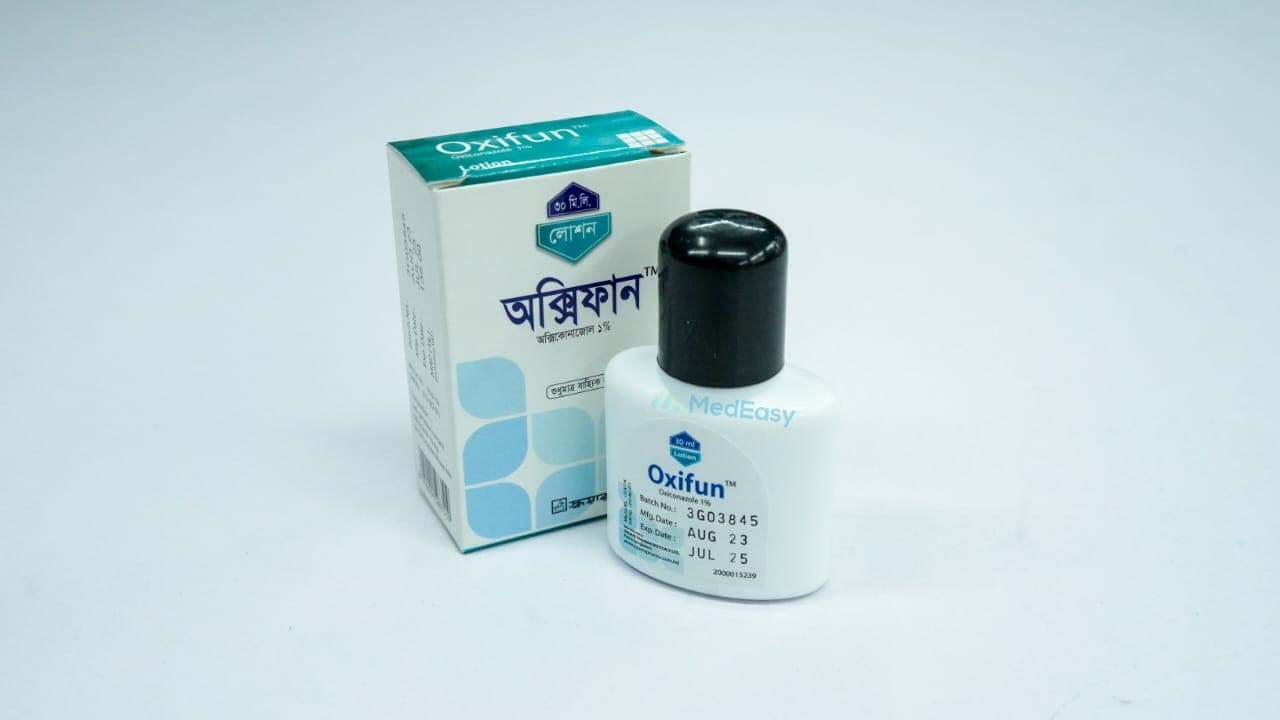

Medicine overview
Indications of Oxifun
Oxifun is a topical (skin-applied) antifungal medicine used to treat certain fungal skin infections.
Established / FDA-approved uses
- Tinea pedis (athlete's foot)
- Tinea cruris (jock itch)
- Tinea corporis (ringworm of the body)
- Cutaneous candidiasis (skin infection caused by Candida yeast)
Other supported use
- Tinea (pityriasis) versicolor — a superficial fungal skin infection caused by Malassezia species; some Oxifun cream formulations are also labeled for this indication.
Oxifun is not intended for infections of the nails, scalp, eyes, mouth, or vagina.
Composition
Each formulation of Oxiconazole typically contains Oxiconazole nitrate as the active ingredient, most commonly as a 1% w/w topical cream or lotion. Inactive ingredients (bases, emulsifiers, preservatives) vary by manufacturer and formulation.
Description
Oxifun is a synthetic imidazole-derivative antifungal agent formulated for topical (on-the-skin) use. It is applied directly to the affected area of skin to treat superficial fungal infections caused by dermatophytes and yeasts.
Oxifun is available as a topical cream and lotion and is intended for external use only.
Therapeutic Class
Oxifun belongs to the topical antifungal therapeutic class, specifically the imidazole group of antifungal agents.
Pharmacology
Mechanism of action: Oxiconazole is an imidazole antifungal that inhibits the cytochrome P450-dependent enzyme 14-α-demethylase, which is required for conversion of lanosterol to ergosterol, an essential component of the fungal cell membrane.
By blocking ergosterol synthesis, Oxiconazole disrupts fungal cell membrane structure and function, leading to increased membrane permeability, leakage of cellular contents, and inhibition of fungal cell growth and replication. Depending on concentration and organism, Oxiconazole can be fungistatic or fungicidal against susceptible dermatophytes (Trichophyton rubrum, Trichophyton mentagrophytes, Epidermophyton floccosum) and yeasts (Candida albicans, Malassezia furfur).
Pharmacokinetics: Systemic absorption of Oxiconazole through intact skin after topical application is minimal, which limits systemic pharmacologic and toxicologic effects.
Dosage & Administration of Oxifun
Adults
| Indication | Frequency | Typical duration |
|---|---|---|
| Tinea corporis, tinea cruris, cutaneous candidiasis | Cream: once or twice daily. Lotion: once daily. | About 2 weeks |
| Tinea pedis | Cream: once or twice daily. Lotion: once daily. | Up to 4 weeks (1 month) |
| Tinea (pityriasis) versicolor | Once daily | About 2 weeks |
Children
See Use in Special Populations — safety and effectiveness in pediatric patients have not been formally established for all age groups; use only under medical supervision.
General instructions
- Clean and dry the affected area before applying Oxifun.
- Apply a thin layer of Oxifun to cover the affected area and immediate surrounding skin.
- For external (topical) use only — avoid contact with eyes, mouth, and intravaginal use unless a specific product is labeled for that route.
- Complete the full recommended treatment course even if symptoms improve early, to reduce the risk of recurrence.
- If there is no improvement after the labeled treatment duration, or if symptoms worsen, seek medical evaluation, as diagnosis confirmation or alternative therapy may be needed.
Administration of Oxifun
Oxifun is for topical (skin) use only. Wash and dry the affected area, then apply a thin layer of cream or lotion to cover the affected skin and a small margin of surrounding healthy skin. Wash hands after application unless the hands are the area being treated. Avoid occlusive dressings unless directed by a physician.
Interaction of Oxifun
Because Oxifun is applied topically and has minimal systemic absorption through intact skin, clinically significant drug-drug interactions are not well established.
As a general precaution, avoid simultaneous use of other topical products (including other antifungals, corticosteroids, or irritant skin preparations) on the same skin area unless directed by a physician, since this may alter local skin tolerance or effectiveness.
Contraindications
Oxiconazole is contraindicated in patients with known hypersensitivity to Oxiconazole nitrate or to any other imidazole antifungal agent, or to any component of the formulation.
Side Effects of Oxifun
Oxifun is generally well tolerated when used as directed. The most commonly reported side effects are local reactions at the site of application, including:
- Burning or stinging sensation
- Itching
- Redness (erythema) or irritation
- Skin peeling or dryness
- Rash
These effects are usually mild and transient. Rarely, an allergic contact dermatitis reaction can occur (see Contraindications). If severe irritation, blistering, or signs of an allergic reaction develop, discontinue use and seek medical advice.
Pregnancy & Lactation
Pregnancy: There are no adequate and well-controlled studies of Oxifun in pregnant women. Because systemic absorption after topical use is minimal, risk to the fetus is expected to be low, but Oxifun should be used during pregnancy only if clearly needed and the potential benefit justifies the potential risk; consult a physician before use.
Lactation: It is not known whether topically applied Oxifun passes into breast milk in clinically significant amounts. Caution is advised, and breastfeeding mothers should avoid applying Oxifun directly to the breast/nipple area or consult a physician before use.
Precautions & Warnings
Oxifun is for external use only. Avoid contact with the eyes, inside of the nose or mouth, and other mucous membranes; if accidental contact occurs, rinse thoroughly with water.
- If irritation, burning, or sensitivity worsens or does not improve, discontinue use and consult a physician.
- Complete the full prescribed course of treatment even if symptoms improve early, to reduce the risk of recurrence (see Dosage and Administration).
- If there is no improvement after the recommended treatment duration, or symptoms worsen, seek medical evaluation, as the diagnosis may need to be reconfirmed or alternative therapy considered.
- Do not use Oxifun on broken, infected (bacterial), or severely inflamed skin unless directed by a physician.
- Keep out of reach of children.
Overdose Effects of Oxifun
Oxifun is intended for topical use, and significant systemic toxicity from accidental topical overdose is unlikely due to minimal skin absorption. Excessive or prolonged application may increase the likelihood of local skin irritation.
If Oxifun is accidentally ingested (swallowed) or if a large amount is applied and systemic symptoms are suspected, seek immediate medical attention or contact a poison control center/emergency services rather than attempting home treatment.
Storage Conditions
Store at room temperature (below 30°C), away from light and moisture. Keep out of reach of children.
Use In Special Populations
Pediatric use
Safety and effectiveness of Oxifun in pediatric patients below the studied age range have not been formally established in all cases. When used in children, it should be under medical supervision, applied sparingly, and only for the labeled duration.
Geriatric use
No specific dose adjustment is generally required in elderly patients using topical Oxifun, as systemic absorption is minimal; general precautions for topical antifungal use apply.
Renal/hepatic impairment
Because systemic absorption of topically applied Oxifun is minimal, no specific dose adjustment is established or generally required for renal or hepatic impairment.
Duration Of Treatment
Duration of Oxifun treatment depends on the infection being treated: typically about 2 weeks for tinea corporis, tinea cruris, cutaneous candidiasis, and tinea versicolor, and up to 4 weeks for tinea pedis. The full course should be completed even if symptoms resolve earlier, to reduce recurrence risk (see Dosage and Administration).
Drug Classes
Oxiconazole belongs to the imidazole antifungal class of medicines, used topically for dermatophyte and yeast skin infections.
Mode Of Action
Oxiconazole works by inhibiting fungal ergosterol synthesis through blockade of the cytochrome P450-dependent 14-α-demethylase enzyme. This disrupts the fungal cell membrane, increasing its permeability and ultimately inhibiting growth of, or killing, susceptible dermatophytes and yeasts.
Pediatric Uses
Safety and effectiveness of Oxifun in pediatric patients have not been formally established across all age groups. Use in children should be guided by a physician, applied only to the affected area, for the shortest effective duration, with close monitoring for local irritation.
Frequently Asked Questions
Q: What is Oxifun 1% Lotion used for?
A: Oxifun 1% Lotion is a topical antifungal cream/lotion used to treat fungal skin infections such as athlete's foot (tinea pedis), jock itch (tinea cruris), ringworm (tinea corporis), tinea versicolor, and cutaneous candidiasis.
Q: How long does it take for Oxifun 1% Lotion to work?
A: Improvement is often noticed within the first 1-2 weeks, but the full treatment course (about 2 weeks for most infections, up to 4 weeks for athlete's foot) should be completed to prevent the infection from returning, even if the skin looks better sooner.
Q: Can I use Oxifun 1% Lotion during pregnancy or while breastfeeding?
A: There is limited data on Oxifun 1% Lotion use in pregnancy, and although systemic absorption through the skin is minimal, Oxifun 1% Lotion should be used during pregnancy only if clearly needed and if the potential benefit justifies the potential risk; consult a physician first. While breastfeeding, avoid applying it to the breast/nipple area and consult a physician before use.
Q: What are the common side effects of Oxifun 1% Lotion?
A: The most common side effects are local skin reactions at the application site, including burning, stinging, itching, redness, dryness, or peeling. These are usually mild. Discontinue and seek medical advice if severe irritation, blistering, or an allergic reaction occurs.
Q: Who should not use Oxifun 1% Lotion?
A: Oxifun 1% Lotion should not be used by anyone with a known hypersensitivity (allergy) to Oxifun 1% Lotion nitrate or to other imidazole antifungal medicines.
Q: How should Oxifun 1% Lotion be applied?
A: Clean and dry the affected skin, then apply a thin layer of Oxifun 1% Lotion to cover the affected area and a small margin of surrounding skin, as directed by a physician or the product label. It is for external use only — avoid the eyes, mouth, and (unless specifically labeled) intravaginal use.
Disclaimer
The information provided is accurate to the best of our knowledge, but it does not replace professional medical advice. We cannot guarantee its completeness or accuracy, and the absence of specific information about a drug should not be taken as an endorsement. We are not responsible for any consequences arising from this information, so please consult a healthcare professional for any concerns or questions.
