
8% Off
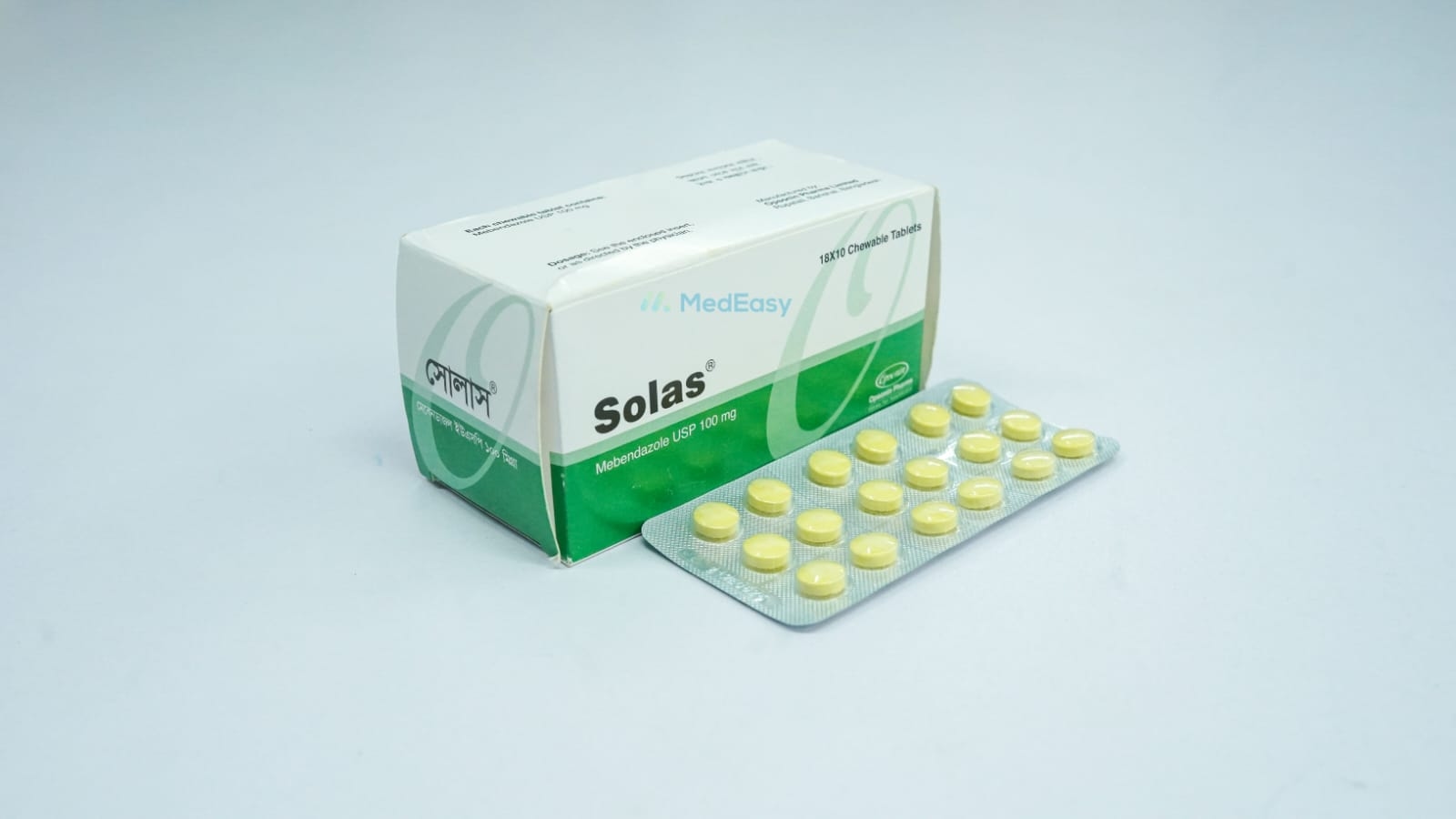
Solas100 mg
Opsonin Pharma Ltd.
৳6.44
Add to cart

Panamox 100 mg Chewable Tablet is available on MedEasy for ৳0.90 per piece, with home delivery anywhere in Bangladesh. It is manufactured by Jayson Pharma Ltd. Its generic name is Mebendazole.

Panamox is a broad-spectrum anthelmintic used to treat intestinal (gastrointestinal) worm infections.
Panamox is used in community mass deworming (soil-transmitted helminth control) programmes supported by WHO in areas of high infection prevalence, using standard single- or short-course dosing.
At much higher doses and for a prolonged period, Panamox is used off-label under specialist supervision for cystic hydatid disease (Echinococcus granulosus) and, less commonly, other tissue-invasive or unusual helminth infections, when surgery is not possible or as an adjunct to surgery. This high-dose use carries a distinctly higher risk of side effects than standard short-course dosing (see Precautions).
Each chewable tablet contains Mebendazole 100 mg.
Also available as an oral suspension containing Mebendazole 100 mg/5 mL.
Exact strengths and formulations (chewable tablet, oral suspension) may vary by manufacturer and market; check the product label of the specific brand dispensed.
Panamox is a synthetic benzimidazole-derivative anthelmintic (antiparasitic) medicine used to eliminate intestinal worm (helminth) infections. It acts primarily within the gastrointestinal tract, where it is only minimally absorbed into the bloodstream at standard doses, which contributes to its generally favorable tolerability profile when used as directed for common worm infections.
Anthelmintic (Antiparasitic) — Benzimidazole derivative; Panamox is a broad-spectrum anti-worm agent.
Mebendazole works by selectively binding to the colchicine-sensitive site on β-tubulin within the cells of susceptible helminths, inhibiting microtubule polymerization. This disrupts several tubulin-dependent processes in the parasite, most notably glucose uptake, leading to progressive depletion of the worm's glycogen stores, reduced ATP formation, and eventual immobilization and death of the parasite over several days.
At standard oral doses, Mebendazole is poorly and erratically absorbed from the gastrointestinal tract (generally under 10% systemic bioavailability), which concentrates its action within the intestinal lumen where the worms reside and limits systemic exposure. Absorption is increased when the drug is taken with a fatty meal — a property exploited in the higher-dose, prolonged regimens used for tissue-invasive disease such as hydatid disease, where greater systemic drug levels are required. Absorbed drug is extensively metabolized in the liver and excreted mainly in bile/feces, with a smaller portion via urine.
Dosing of Panamox depends on the specific worm infection being treated. The same dose applies to adults and children aged 2 years and older unless otherwise directed by a physician.
| Infection | Standard Dose |
|---|---|
| Pinworm (Enterobius vermicularis) | One 100 mg dose as a single administration; a repeat dose after 2–3 weeks may be advised by the physician because reinfection is common |
| Whipworm, common roundworm, hookworm, or mixed infections | 100 mg twice daily (morning and evening) for 3 consecutive days |
| Hydatid disease (off-label, specialist-directed, high dose) | Weight-based high-dose regimen (typically in the range of 40–50 mg/kg/day in divided doses, taken with fatty food) continued for several months, only under specialist supervision with regular blood count and liver function monitoring |
If treatment fails to clear symptoms or the infection recurs, consult a physician; a repeat course or an alternative agent may be needed.
Complete the full course exactly as prescribed. Do not stop, extend, skip doses, or share this medicine with others without medical advice. For pinworm infection, a physician may also recommend treating close household/family contacts and simultaneous hygiene measures to prevent reinfection.
Panamox chewable tablets may be chewed, swallowed whole, or crushed and mixed with food. The oral suspension should be shaken well before use and measured with an appropriate dosing device.
Panamox may be taken with or without food for standard short-course treatment of common intestinal worms; no fasting or laxative is required. For the high-dose regimen used in hydatid disease, taking the dose with a fatty meal increases absorption, as directed by the treating specialist.
Metronidazole: Concurrent use of Panamox with metronidazole has been associated with rare but serious skin reactions (Stevens-Johnson syndrome/toxic epidermal necrolysis); this combination should generally be avoided.
CYP3A4 inducers (e.g., carbamazepine, phenytoin): May lower blood levels of Panamox, which is mainly relevant during the high-dose, prolonged regimen used for hydatid disease and may reduce efficacy; dose adjustment or level monitoring may be needed by the specialist.
Cimetidine: May increase blood levels of Panamox by inhibiting its metabolism; relevant mainly during high-dose therapy, where it may increase the risk of side effects.
Inform the physician or pharmacist of all other medicines being taken before starting Panamox, particularly for the high-dose/prolonged regimen.
Mebendazole is contraindicated in patients with known hypersensitivity to Mebendazole or to other benzimidazole anthelmintics.
At standard short-course doses, Panamox is generally well tolerated because systemic absorption is low. When side effects do occur, they are usually mild and self-limiting.
Seek prompt medical attention for signs of severe skin reaction, unusual bleeding/bruising, persistent fever, yellowing of the skin/eyes, or severe allergic reaction while taking Panamox.
Pregnancy: Panamox should be used in pregnancy only if clearly needed and the potential benefit justifies the potential risk to the fetus; consult a physician before use, particularly during the first trimester, when many product labels advise avoiding Panamox unless no suitable alternative exists. This individual-patient caution is distinct from public-health mass deworming programmes, where WHO guidance may support use of Panamox in pregnant women (typically after the first trimester) in areas of high worm-infection burden, based on a population-level risk-benefit assessment; such use should still follow local health authority guidance rather than self-medication.
Lactation: Small amounts of Panamox pass into breast milk. It is generally considered compatible with breastfeeding at standard short-course doses, but a physician should be consulted, and the developmental and health benefits of breastfeeding should be weighed alongside the mother's clinical need for treatment.
Take Panamox exactly as prescribed by your physician; do not stop, extend, skip doses, or share this medicine with others without medical advice.
Reported overdose with Panamox has generally caused gastrointestinal symptoms such as abdominal pain, nausea, vomiting, and diarrhea. There is no specific antidote; management is supportive and symptomatic.
In cases of prolonged, high-dose exposure, overdose-related toxicity (such as hair loss, liver injury, or blood count abnormalities) is more likely.
If an overdose of Panamox is suspected, seek immediate medical attention or contact a poison control center/emergency services right away; do not attempt to treat an overdose at home.
Store at room temperature (below 30°C), away from light and moisture. Keep out of reach of children.
Renal impairment: No dose adjustment is generally required for standard short-course treatment with Panamox, as systemic absorption and renal excretion are minimal at these doses.
Hepatic impairment: Use Panamox with caution in patients with liver disease, particularly if the high-dose, prolonged regimen (e.g., for hydatid disease) is used, since this raises systemic exposure and hepatotoxicity risk; liver function should be monitored.
Elderly: No specific dose adjustment is established; the standard adult dose is generally used, with the same precautions as for other adults.
Pregnancy and breastfeeding: See Pregnancy and Lactation above.
Children: See Pediatric Uses below.
For pinworm infection, Panamox is typically given as a single dose, occasionally repeated after 2–3 weeks if advised by a physician, due to the risk of reinfection.
For whipworm, roundworm, hookworm, or mixed infections, the standard course is 3 consecutive days of twice-daily dosing.
For hydatid disease (specialist, off-label use), treatment with Panamox may continue for several months (commonly cited ranges are roughly 3–6 months), with regular monitoring, under the direct supervision of a specialist.
Mebendazole belongs to the benzimidazole class of anthelmintic (antiparasitic) agents.
Mebendazole selectively binds to β-tubulin in susceptible helminths, blocking microtubule assembly required for normal cell structure and function within the parasite. This impairs glucose uptake and transport in the worm, progressively depleting its glycogen energy stores and reducing ATP production. The resulting energy failure immobilizes the parasite and leads to its death and clearance from the gastrointestinal tract over the following days. Mebendazole has much higher affinity for helminth tubulin than for mammalian tubulin, which underlies its selective antiparasitic action at standard doses.
Category C (FDA legacy pregnancy classification)
Panamox is approved for use in children aged 2 years and older for standard intestinal worm infections, using the same dose as adults (100 mg per dose, per the schedule appropriate to the infection).
Safety and efficacy of Panamox in children under 2 years of age have not been formally established for routine individual treatment, and product labeling generally advises caution in this age group; rare seizures have been reported specifically in infants under 1 year. Use in children under 2 should only be under a physician's direction.
Separately, in community mass deworming programmes in areas of high soil-transmitted helminth prevalence, WHO guidance may support use of Panamox in children as young as 12 months as a public-health measure; this is a distinct, population-level recommendation and does not replace individualized physician guidance for a specific child.
Q: What is Panamox 100 mg Chewable Tablet used for?
A: Panamox 100 mg Chewable Tablet is an anthelmintic (antiparasitic) medicine used to treat intestinal worm infections such as pinworm, whipworm, common roundworm, and hookworm. At a much higher, prolonged dose, it is also used off-label under specialist care for hydatid disease.
Q: How is Panamox 100 mg Chewable Tablet taken?
A: Panamox 100 mg Chewable Tablet tablets can be chewed, swallowed whole, or crushed and mixed with food, with or without food, for standard treatment. The dose and number of days depend on the specific worm infection — often a single 100 mg dose for pinworm, or 100 mg twice daily for 3 days for whipworm, roundworm, hookworm, or mixed infections. Always follow your physician's specific instructions and complete the full course; do not stop, extend, skip doses, or share this medicine with others without medical advice.
Q: Can Panamox 100 mg Chewable Tablet be taken during pregnancy?
A: Panamox 100 mg Chewable Tablet should be used in pregnancy only if clearly needed and the potential benefit justifies the potential risk to the fetus, especially in the first trimester; consult a physician first. This is different from public-health mass deworming programmes, where health authorities may use Panamox 100 mg Chewable Tablet in pregnant women under specific guidance — individual use should still be decided with a physician.
Q: What are the common side effects of Panamox 100 mg Chewable Tablet?
A: At standard doses, Panamox 100 mg Chewable Tablet is generally well tolerated. The most common side effects are mild abdominal pain, diarrhea, flatulence, nausea, or vomiting. Serious effects such as liver problems or low blood cell counts are rare and are more associated with high-dose, prolonged use (for example, in hydatid disease treatment) rather than standard short-course dosing.
Q: Do other family members need to take Panamox 100 mg Chewable Tablet too?
A: For pinworm infection in particular, a physician may recommend that close household or family contacts also be treated with Panamox 100 mg Chewable Tablet at the same time, along with hygiene measures, because pinworm spreads easily between household members and reinfection is common.
Q: What should I do if I miss a dose or accidentally take too much Panamox 100 mg Chewable Tablet?
A: If a dose of the multi-day regimen is missed, take it as soon as you remember and continue the course as directed; do not double the dose. If you suspect you or someone else has taken too much Panamox 100 mg Chewable Tablet, seek immediate medical attention or contact a poison control center or emergency services right away rather than attempting to manage it at home.
Disclaimer
The information provided is accurate to the best of our knowledge, but it does not replace professional medical advice. We cannot guarantee its completeness or accuracy, and the absence of specific information about a drug should not be taken as an endorsement. We are not responsible for any consequences arising from this information, so please consult a healthcare professional for any concerns or questions.