
5% Off
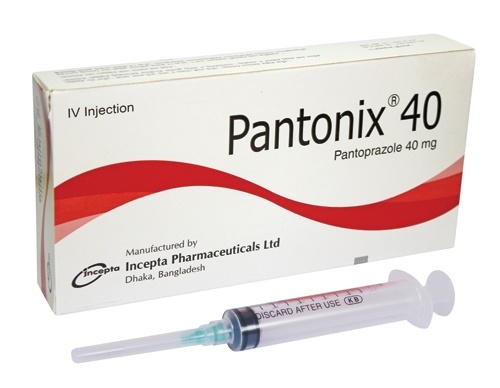
Pantonix40 mg/vial
Incepta Pharmaceuticals Ltd.
৳95.00
Add to cart

Pantex 40 mg/vial IV Injection is available on MedEasy for ৳63.42 per 40 mg vial, with home delivery anywhere in Bangladesh. It is manufactured by ACI Limited. Its generic name is Pantoprazole.

Pantex is a proton pump inhibitor (PPI) used to reduce excess stomach acid production in the conditions above.
Each tablet/vial contains Pantoprazole (as pantoprazole sodium sesquihydrate) as the active ingredient. Available strengths marketed include 20 mg and 40 mg delayed-release (enteric-coated) tablets, and 40 mg powder for injection (IV) for use when oral therapy is not possible. Inactive ingredients vary by manufacturer and formulation.
Pantex is a substituted benzimidazole that belongs to the proton pump inhibitor (PPI) class of medicines. It works by irreversibly blocking the hydrogen-potassium ATPase ("proton pump") in the gastric parietal cells, which is the final step in stomach acid secretion. By reducing acid production, Pantex relieves symptoms and promotes healing in acid-related disorders such as GERD, erosive esophagitis, peptic ulcer disease and hypersecretory conditions like Zollinger-Ellison syndrome. It is formulated as a delayed-release (enteric-coated) oral tablet, and also as an intravenous injection for patients unable to take oral medication.
Proton Pump Inhibitor (PPI) - Anti-ulcerant / Gastric acid-reducing agent.
Pantoprazole is a prodrug that is activated in the acidic environment of the gastric parietal cell canaliculus. Once activated, it covalently and irreversibly binds to cysteine residues on the H+/K+-ATPase (proton pump) enzyme, blocking the final step of gastric acid secretion regardless of the stimulus (histamine, acetylcholine, or gastrin). Because the binding is irreversible, acid suppression persists until new proton pump molecules are synthesized (typically 24-48 hours), giving Pantoprazole a duration of action longer than its plasma half-life would suggest.
| Indication | Usual Adult Dose |
|---|---|
| Erosive esophagitis (acute treatment) | 40 mg orally once daily for up to 8 weeks; an additional 8-week course may be considered if not healed |
| Maintenance of healed erosive esophagitis | 40 mg orally once daily |
| Gastroesophageal reflux disease (symptomatic) | 40 mg orally once daily for 4-8 weeks |
| Benign gastric or duodenal ulcer | 40 mg orally once daily, usually for 4-8 weeks |
| H. pylori eradication (combination therapy) | 40 mg twice daily combined with appropriate antibiotics for 7-14 days, per local treatment guidelines |
| NSAID-associated ulcer prevention | 20-40 mg orally once daily while NSAID therapy continues |
| Zollinger-Ellison syndrome / other hypersecretory conditions | Initially 40 mg orally twice daily; dose individualized thereafter based on acid output, with doses up to 240 mg/day used in some patients |
| Intravenous therapy (when oral route not feasible) | 40 mg IV once daily, or 80 mg IV every 8-12 hours in hypersecretory states, for a limited duration until oral therapy can resume |
No dosage adjustment is generally required for renal impairment. In severe hepatic impairment, a reduced dose (e.g. 20 mg once daily) and monitoring of liver enzymes is advised, since Pantex is extensively metabolized by the liver.
Pantex delayed-release tablets should be swallowed whole with water, without crushing, splitting or chewing, generally in the morning before a meal. It may be taken with or without food. The injectable form is given intravenously by a healthcare provider for patients who cannot take oral medication.
Pregnancy: Available human data have not established a clear association between Pantex use and major birth defects or miscarriage; however, animal studies have shown bone changes in offspring at high doses. Pantex should be used during pregnancy only if clearly needed and if the potential benefit justifies the potential risk to the fetus; a physician should be consulted before use.
Lactation: Pantex passes into breast milk in small amounts. Available data have not shown adverse effects in breastfed infants, but caution is advised; a physician should be consulted to weigh the benefits of treatment against any potential risk to the infant.
Long-term use (especially at high doses for one year or more) of Pantex and other PPIs is associated with an increased risk of osteoporosis-related fractures of the hip, wrist, and spine. Use the lowest effective dose for the shortest duration appropriate to the condition.
Prolonged treatment (three months or longer) with Pantex may cause low serum magnesium, which can present as tetany, arrhythmias, or seizures. Magnesium levels may be checked before and periodically during prolonged therapy, especially with concurrent diuretics or other drugs that lower magnesium.
Daily use of Pantex for longer than 3 years may reduce absorption of vitamin B12 due to hypo- or achlorhydria, potentially resulting in deficiency.
Pantex therapy, like other PPIs, may increase the risk of C. difficile-associated diarrhea, particularly in hospitalized patients. Consider this diagnosis in patients who develop persistent diarrhea that does not improve.
Symptomatic relief with Pantex does not exclude the presence of gastric malignancy. Consider further evaluation in patients with alarm symptoms (e.g. weight loss, recurrent vomiting, dysphagia, hematemesis) or those with an inadequate or non-durable response to therapy.
Discontinuing Pantex after prolonged use may lead to a temporary increase in acid-related symptoms (rebound acid hypersecretion). Consider tapering under medical advice rather than stopping abruptly after long-term therapy.
Rare cases of new-onset or exacerbated lupus erythematosus have been reported with PPI use, including Pantex; discontinue and refer to a specialist if lesions develop.
Pantex is not an antibiotic and does not carry antimicrobial stewardship requirements; however, it should still be taken exactly as prescribed by a physician, without altering the dose or duration on one's own.
There is limited clinical experience with deliberate Pantex overdose. Doses well above the usual therapeutic range have generally been tolerated without severe symptoms. There is no specific antidote for Pantex overdose, and it is not effectively removed by hemodialysis. In case of suspected overdose, seek immediate medical attention or contact a poison control center; treatment is supportive and symptomatic, based on clinical presentation.
Store at room temperature (below 30°C), away from light and moisture. Keep out of reach of children.
The safety and effectiveness of Pantex for short-term treatment of erosive esophagitis due to GERD have been established in children aged 5 years and older; dosing is weight-based (see Pediatric Uses). Safety and efficacy in children under 1 year of age have not been established, and studies in infants did not demonstrate efficacy.
No overall dosage adjustment is required for elderly patients, although they may be at higher baseline risk for some long-term PPI-associated effects (e.g. bone fracture); use the lowest effective dose for the shortest necessary duration.
No dosage adjustment of Pantex is generally required in renal impairment, including patients on hemodialysis.
In patients with severe hepatic impairment, consider a reduced dose and monitor liver enzymes periodically during treatment with Pantex.
Duration depends on indication: typically 4-8 weeks for GERD/erosive esophagitis or ulcer healing (occasionally extended for another 8 weeks if not fully healed); ongoing maintenance dosing for chronic erosive esophagitis or hypersecretory conditions; and 7-14 days when used as part of combination therapy for H. pylori eradication. Pantex should not be used for longer than medically advised without reassessment, given the risks associated with long-term PPI therapy.
The 40 mg powder for injection is reconstituted with 10 mL of 0.9% Sodium Chloride Injection to a concentration of approximately 4 mg/mL, and may be further diluted for infusion per the product's prescribing information; reconstitution should only be performed by a trained healthcare professional.
Proton pump inhibitor (PPI); substituted benzimidazole; gastric acid-reducing / anti-secretory agent.
Pantoprazole selectively and irreversibly inhibits the H+/K+-ATPase (proton pump) enzyme system located on the secretory surface of gastric parietal cells. This enzyme is responsible for the final step of gastric acid production. By blocking it, Pantoprazole suppresses both basal and stimulated gastric acid secretion, irrespective of the stimulating agent (gastrin, histamine, or acetylcholine), producing a profound and long-lasting reduction in stomach acid.
B
Pantex is approved for short-term (up to 8 weeks) treatment of erosive esophagitis associated with GERD in children aged 5 to 16 years, using weight-based dosing: 20 mg once daily for children weighing 15 kg to less than 40 kg, and 40 mg once daily for children weighing 40 kg or more. Safety and efficacy for other indications, and use in children under 5 years of age (including infants), have not been established; studies conducted in infants younger than 1 year did not show efficacy for GERD symptoms. Use in children should be guided and supervised by a pediatrician.
Q: What is Pantex 40 mg/vial IV Injection used for?
A: Pantex 40 mg/vial IV Injection is used to treat conditions caused by excess stomach acid, including gastroesophageal reflux disease (GERD), erosive esophagitis, peptic ulcers, and Zollinger-Ellison syndrome. It is also used together with antibiotics to help eradicate H. pylori infection.
Q: How should I take Pantex 40 mg/vial IV Injection?
A: Pantex 40 mg/vial IV Injection delayed-release tablets should be swallowed whole with water, without crushing or chewing, usually once daily in the morning, with or without food. Always follow your physician's specific instructions.
Q: Can Pantex 40 mg/vial IV Injection be taken during pregnancy or breastfeeding?
A: Pantex 40 mg/vial IV Injection should be used during pregnancy only if clearly needed, as available data have not shown a clear link to birth defects but animal studies raise a theoretical concern; it also passes into breast milk in small amounts. Consult your physician before using Pantex 40 mg/vial IV Injection if you are pregnant or breastfeeding, so the benefits and risks can be weighed for your situation.
Q: What are the common side effects of Pantex 40 mg/vial IV Injection?
A: The most common side effects of Pantex 40 mg/vial IV Injection are headache, diarrhea, nausea, abdominal pain, and flatulence. Long-term use has been linked to bone fracture risk, low magnesium, vitamin B12 deficiency, and C. difficile-associated diarrhea, so it should be used at the lowest effective dose for the shortest necessary time.
Q: Is Pantex 40 mg/vial IV Injection safe for children?
A: Pantex 40 mg/vial IV Injection is approved for short-term treatment of erosive esophagitis in children aged 5 years and older, using weight-based dosing decided by a pediatrician. It is not recommended for infants under 1 year of age, as studies did not show it to be effective in this age group.
Q: What should I do if I miss a dose or take too much Pantex 40 mg/vial IV Injection?
A: If you miss a dose of Pantex 40 mg/vial IV Injection, take it as soon as you remember unless it is almost time for the next dose; do not double the dose. If an overdose is suspected, seek immediate medical attention or contact a poison control center, as no specific antidote exists.
Disclaimer
The information provided is accurate to the best of our knowledge, but it does not replace professional medical advice. We cannot guarantee its completeness or accuracy, and the absence of specific information about a drug should not be taken as an endorsement. We are not responsible for any consequences arising from this information, so please consult a healthcare professional for any concerns or questions.
