
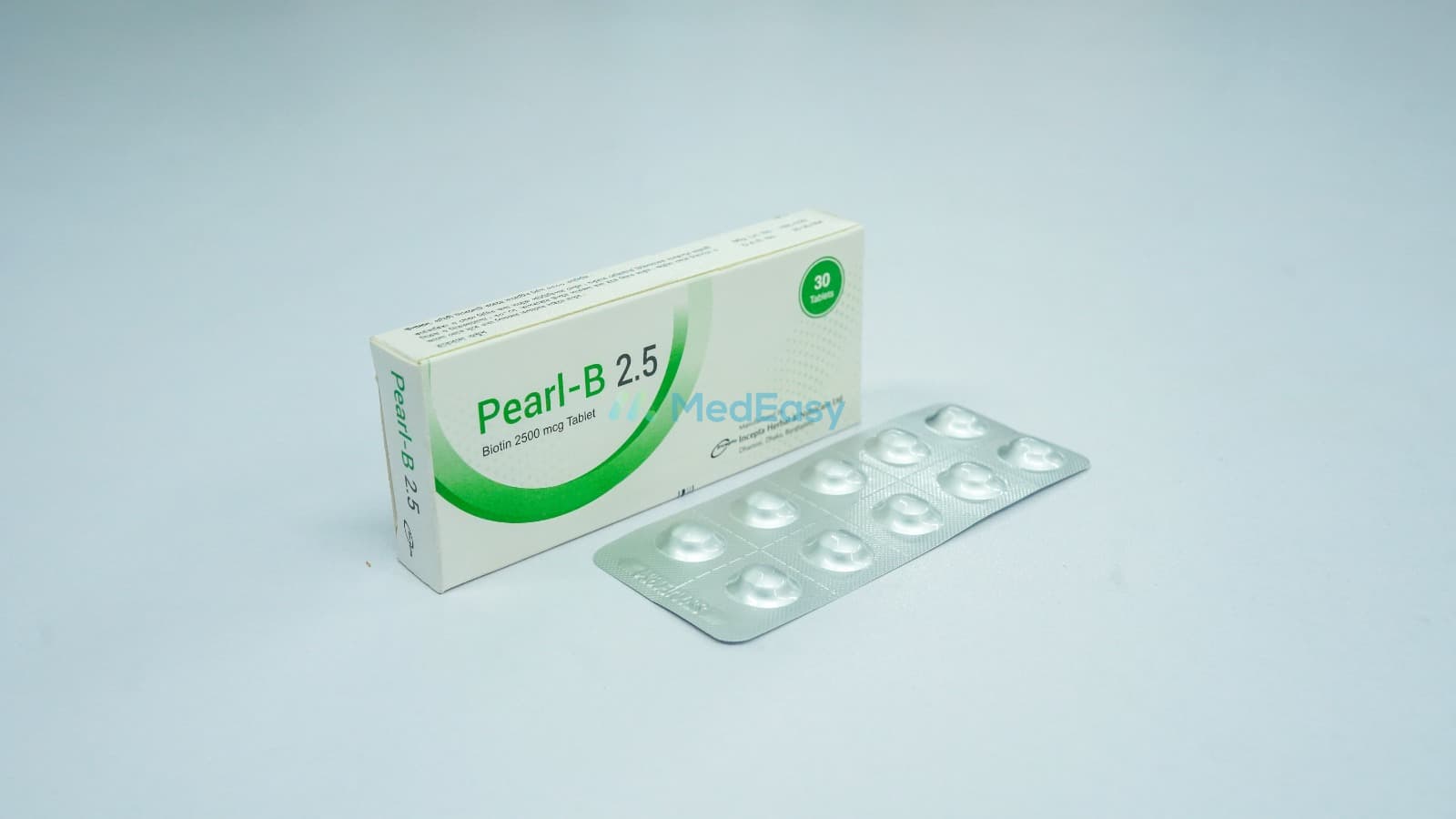

Medicine overview
Indications of Pearl-B
Pearl-B (Vitamin B7, Vitamin H) is a water-soluble B-complex vitamin used for the following indications:
Established/Guideline-supported uses
- Pearl-B deficiency (dietary, or due to prolonged anticonvulsant therapy, Pearl-Bidase deficiency, prolonged raw egg-white consumption, or prolonged parenteral nutrition without Pearl-B supplementation) — established use with clinical and biochemical evidence.
- Inherited Pearl-B-responsive metabolic disorders, such as Pearl-Bidase deficiency and holocarboxylase synthetase deficiency (multiple carboxylase deficiency) — requires medical supervision and higher prescription-level doses.
Widely used supplement/adjunct indications (evidence more limited)
- Support for hair thinning/hair loss, brittle nails, and certain dermatitis conditions when associated with Pearl-B deficiency — commonly used as a dietary supplement in Bangladesh and elsewhere, though evidence of benefit in people who are not Pearl-B-deficient is limited.
- General nutritional supplementation as part of a multivitamin regimen.
Pearl-B is not indicated as a treatment for hair loss or nail/skin conditions unrelated to Pearl-B deficiency, and should not replace evaluation of the underlying cause of such symptoms.
Composition
Each tablet/capsule of Biotin contains Biotin (Vitamin B7/Vitamin H) as the active ingredient, commonly available in strengths such as 1000 mcg, 5000 mcg, and 10000 mcg, with standard pharmaceutical excipients. Strength and dosage form vary by manufacturer/brand.
Description
Pearl-B is a water-soluble vitamin belonging to the B-complex group (Vitamin B7), naturally found in foods such as egg yolk, liver, nuts, and whole grains, and also produced by intestinal bacteria. It functions as an essential coenzyme for carboxylase enzymes involved in fatty acid synthesis, amino acid catabolism, and gluconeogenesis. Pearl-B is available as an oral supplement in various strengths and is used to correct or prevent deficiency and to support hair, skin, and nail health in deficient individuals.
Therapeutic Class
Vitamin B-complex supplement (Vitamin B7 / Pearl-B); water-soluble vitamin.
Pharmacology
Biotin acts as an essential cofactor for five carboxylase enzymes (acetyl-CoA carboxylase, pyruvate carboxylase, propionyl-CoA carboxylase, and two forms of methylcrotonyl-CoA carboxylase) that catalyze key steps in fatty acid synthesis, gluconeogenesis, and amino acid catabolism. It also plays a role in histone modification and gene regulation. Biotin is absorbed in the small intestine via a sodium-dependent multivitamin transporter, circulates largely unbound in plasma, and is excreted mainly in urine as unmetabolized biotin and its metabolites. Endogenous synthesis by intestinal bacteria also contributes to biotin status.
Dosage & Administration of Pearl-B
Adult Dose
| Indication | Typical Dose |
|---|---|
| General supplementation / mild deficiency | 30–100 mcg/day (Adequate Intake for adults: 30 mcg/day) |
| Hair/nail/skin support (deficiency-associated) | 1000–10,000 mcg (1–10 mg) once daily, per product labeling |
| Pearl-Bidase deficiency (specialist-directed) | 5–20 mg/day orally, adjusted by a metabolic specialist based on response |
Pediatric Dose
Adequate Intake: infants 5–6 mcg/day, children 1–3 years 8 mcg/day, 4–8 years 12 mcg/day, 9–13 years 20 mcg/day. Higher, individualized doses of Pearl-B are used under specialist supervision for inherited Pearl-B-responsive disorders. Do not give supplement-strength doses to children without medical advice.
Renal/Hepatic Impairment
No well-established dose adjustment is required for typical supplemental doses of Pearl-B in renal or hepatic impairment; use standard clinical judgment and consult a physician for patients with significant organ impairment.
Administration
Take Pearl-B orally, with or without food, as directed on the product label or by a physician. Swallow tablets/capsules whole with water; do not exceed the labeled or prescribed dose.
Administration of Pearl-B
Pearl-B is administered orally, typically once daily, with or without food. Tablets should be swallowed whole with a glass of water. Follow the specific product label or physician's instructions, as strengths vary widely between brands (commonly 1000–10,000 mcg per tablet in Bangladesh).
Interaction of Pearl-B
- Anticonvulsants (phenytoin, carbamazepine, phenobarbital, primidone): long-term use (≥1 year) is associated with reduced serum Pearl-B levels due to increased catabolism and impaired absorption; clinical significance is usually modest but should be monitored.
- Alpha-lipoic acid: may compete with Pearl-B for intestinal absorption and cellular uptake at high doses; clinical relevance is generally limited.
- Antibiotics: prolonged broad-spectrum antibiotic use can reduce Pearl-B-producing intestinal flora, potentially lowering endogenous Pearl-B levels.
- Raw egg white (avidin): chronic consumption of large amounts of raw egg whites binds Pearl-B and prevents its absorption, which is a dietary/food interaction rather than a drug interaction.
Important note: Pearl-B does not have significant pharmacodynamic drug interactions causing altered efficacy of other medicines, but it has a well-documented interference with certain laboratory immunoassay tests — see Precautions and Warnings.
Contraindications
Biotin is contraindicated only in patients with known hypersensitivity to Biotin or any excipient in the specific formulation.
Side Effects of Pearl-B
Pearl-B is generally very well tolerated at typical supplement doses, and no established toxicity syndrome has been reported even at high intakes. Reported adverse effects are uncommon and may include:
- Mild gastrointestinal upset (nausea, cramping)
- Skin rash or acne-like breakouts (occasionally reported with high-dose supplementation)
- Rare hypersensitivity reactions
A key safety concern with Pearl-B is not direct toxicity but interference with certain laboratory blood tests — see Precautions and Warnings for details.
Pregnancy & Lactation
Pearl-B is a normal dietary component, and the Adequate Intake during pregnancy (30 mcg/day) and lactation (35 mcg/day) is higher than for non-pregnant adults, reflecting increased physiological need; a notable proportion of pregnant women develop marginal Pearl-B deficiency even with normal intake. However, safety data for supplemental (higher than dietary) doses of Pearl-B in pregnancy and lactation are limited. Pearl-B supplementation above typical dietary/Adequate Intake levels should be used during pregnancy or breastfeeding only if clearly needed and if potential benefit justifies potential risk; consult a physician before use.
Precautions & Warnings
Laboratory Test Interference (Important FDA Safety Communication)
Pearl-B can interfere with many laboratory immunoassays that use Pearl-B-streptavidin technology, including thyroid function tests (TSH, T3, T4), cardiac troponin tests, and certain hormone assays (e.g., hCG). This interference can cause falsely high or falsely low results, potentially leading to missed diagnoses or inappropriate treatment — the FDA has documented a death associated with a falsely low troponin result caused by high-dose Pearl-B supplementation. Even a single high dose of Pearl-B can interfere with certain tests for up to 24 hours or longer, especially at doses used for hair/nail/skin support (mg-range) rather than typical dietary intake (mcg-range).
Patients should inform their doctor and laboratory staff if they are taking Pearl-B supplements before any blood test, and may be advised to stop Pearl-B for a period (commonly at least 24–72 hours, per laboratory/assay-specific guidance) before testing.
General Precautions
Avoid doses far exceeding labeled/recommended amounts without medical guidance. There is no established Tolerable Upper Intake Level for Pearl-B, but megadosing without medical need is not recommended.
Overdose Effects of Pearl-B
No well-established toxicity or overdose syndrome has been reported with Pearl-B, even at high supplemental doses, and it has a wide margin of safety as a water-soluble vitamin. However, high doses can cause significant interference with laboratory test results (see Precautions and Warnings), which carries indirect clinical risk. If a large accidental overdose is taken or if any unusual symptoms occur, seek immediate medical attention or contact a poison control center/emergency services rather than attempting home treatment.
Storage Conditions
Store at room temperature (below 30°C), away from light and moisture. Keep out of reach of children.
Use In Special Populations
Renal Impairment
No well-established dose adjustment is required for typical supplemental doses of Pearl-B; use clinical judgment in significant renal impairment.
Hepatic Impairment
No well-established dose adjustment is required for typical supplemental doses of Pearl-B in hepatic impairment.
Elderly
Pearl-B is generally well tolerated in elderly patients at standard supplemental doses; no specific dose adjustment is established, though clinicians should be mindful of lab test interference if elderly patients undergo frequent monitoring blood tests.
Patients Undergoing Lab Testing
Any patient taking Pearl-B, particularly at mg-range supplement doses, should inform their healthcare provider before blood tests due to the risk of test interference (see Precautions and Warnings).
Duration Of Treatment
Duration of Pearl-B use depends on the indication. For general nutritional supplementation, it may be used long-term as part of a daily regimen. For treatment of confirmed deficiency, duration is guided by clinical and biochemical response and physician follow-up. For inherited Pearl-B-responsive metabolic disorders, Pearl-B is typically required lifelong under specialist supervision. Reassess ongoing need periodically with a physician.
Drug Classes
Water-soluble vitamin; B-complex vitamin (Vitamin B7 / Vitamin H); dietary supplement.
Mode Of Action
Biotin functions as an essential coenzyme covalently bound to carboxylase enzymes (via biotinylation by holocarboxylase synthetase), enabling carbon dioxide transfer in key metabolic reactions including fatty acid synthesis (acetyl-CoA carboxylase), gluconeogenesis (pyruvate carboxylase), and amino acid catabolism (propionyl-CoA carboxylase, methylcrotonyl-CoA carboxylase). It also participates in histone biotinylation, influencing chromatin structure and gene expression, and supports normal keratin structure relevant to hair, skin, and nail integrity.
Pediatric Uses
Dietary Pearl-B intake at Adequate Intake levels (5–20 mcg/day depending on age) is appropriate and safe for infants and children as part of normal nutrition. Supplement-strength or prescription doses of Pearl-B for confirmed deficiency or inherited Pearl-B-responsive disorders (e.g., Pearl-Bidase deficiency) should be used only under pediatric/metabolic specialist supervision, with dosing individualized to the child's condition, weight, and response. Safety and efficacy of high-dose Pearl-B supplementation for cosmetic (hair/nail) indications in children have not been established, and such use is not recommended without medical advice.
Frequently Asked Questions
Q: What is Pearl-B 2500 mcg capsul used for?
A: Pearl-B 2500 mcg capsul is a B-complex vitamin (Vitamin B7) used mainly to treat or prevent Pearl-B 2500 mcg capsul deficiency, and to support hair, skin, and nail health in people who are deficient. It is also used as part of general nutritional supplementation. It is not a proven treatment for hair loss or nail problems that are not caused by Pearl-B 2500 mcg capsul deficiency.
Q: Can I take Pearl-B 2500 mcg capsul every day?
A: Yes, typical supplemental doses of Pearl-B 2500 mcg capsul (commonly 1000–10,000 mcg daily) are generally well tolerated for daily use. However, you should follow the dose on the product label or as advised by your physician, and avoid megadosing without medical guidance, since there is no established upper safe limit and unnecessary high doses can interfere with lab tests.
Q: Does Pearl-B 2500 mcg capsul affect blood test results?
A: Yes. This is an important safety point: Pearl-B 2500 mcg capsul can interfere with certain laboratory immunoassay tests, including thyroid function tests, cardiac troponin tests, and some hormone tests, causing falsely high or falsely low results. This is especially likely with high-dose supplements. Always tell your doctor and the laboratory if you are taking Pearl-B 2500 mcg capsul before any blood test, and ask whether you should pause it beforehand.
Q: Are there any serious side effects of Pearl-B 2500 mcg capsul?
A: Pearl-B 2500 mcg capsul is generally very well tolerated, and no established toxicity has been reported even at high doses. Mild side effects such as stomach upset or skin breakouts are uncommon. The main safety concern is not direct toxicity but interference with certain lab test results (see above), which can indirectly affect medical care if not disclosed to your doctor.
Q: Can pregnant or breastfeeding women take Pearl-B 2500 mcg capsul?
A: Pearl-B 2500 mcg capsul is a normal part of the diet, and requirements are slightly higher during pregnancy and breastfeeding. However, supplemental (higher-than-dietary) doses of Pearl-B 2500 mcg capsul should be used during pregnancy or breastfeeding only if clearly needed, since safety data for higher doses are limited; consult your physician before use.
Q: What should I do if I take too much Pearl-B 2500 mcg capsul?
A: Pearl-B 2500 mcg capsul has a wide margin of safety and no established overdose toxicity, but if you have taken a very large amount accidentally or notice any unusual symptoms, seek immediate medical attention or contact a poison control center/emergency services rather than treating it at home.
Disclaimer
The information provided is accurate to the best of our knowledge, but it does not replace professional medical advice. We cannot guarantee its completeness or accuracy, and the absence of specific information about a drug should not be taken as an endorsement. We are not responsible for any consequences arising from this information, so please consult a healthcare professional for any concerns or questions.
