

10% Off
Nutrum PN
ACME Laboratories Ltd.
৳135.81
Add to cart
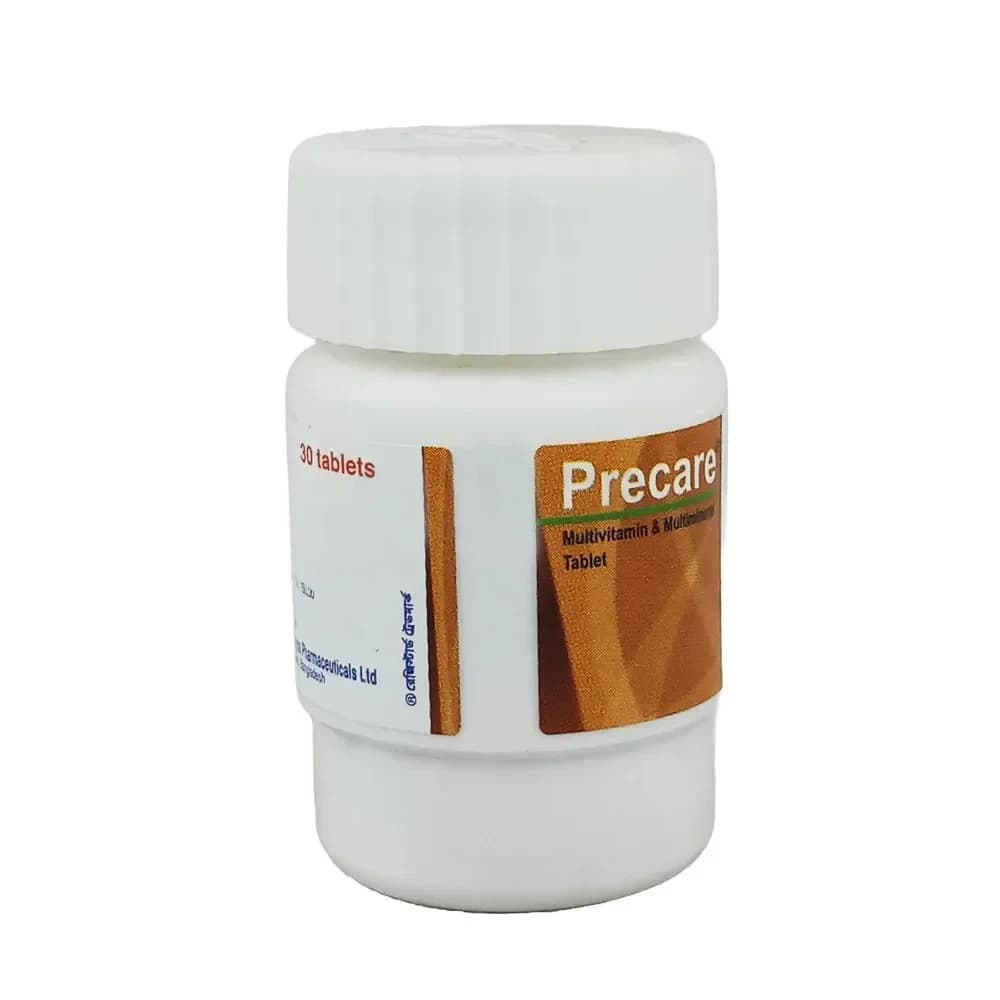

Precare is a prenatal nutritional supplement indicated for improving the nutritional status of women prior to conception, throughout pregnancy, and in the postnatal period, for both lactating and non-lactating mothers.
Precare is intended as an adjunct to, and not a substitute for, a balanced diet and routine prenatal medical care.
Multivitamins and Multiminerals [A-Z prenatal preparation] is a fixed-dose combination supplement formulated to provide a broad ("A-Z") spectrum of vitamins and minerals at levels appropriate for pregnancy and lactation. Representative composition per tablet (formulations vary by manufacturer/brand):
| Nutrient | Representative Amount |
|---|---|
| Vitamin A (as beta-carotene/controlled dose) | ~2700 IU |
| Folic Acid | ~800 mcg |
| Vitamin C | ~120 mg |
| Vitamin D3 | ~400-800 IU |
| Vitamin E | ~30 IU |
| Vitamin K | ~65 mcg |
| B-complex vitamins (B1, B2, B3, B6, B12) | Various, RDA-based |
| Iron (as ferrous salt) | ~27-30 mg |
| Calcium | ~200-250 mg |
| Zinc | ~15-25 mg |
| Iodine, Copper, Manganese, Selenium, Chromium, Molybdenum | Trace amounts |
| Docosahexaenoic acid (DHA), in some formulations | Variable |
Exact quantities differ between brands; the specific label of the dispensed brand should be consulted for the precise composition of the marketed Multivitamins and Multiminerals [A-Z prenatal preparation] product.
Precare is a comprehensive multivitamin and multimineral supplement specifically formulated to meet the increased nutritional requirements of pregnancy. The "A-Z" designation reflects its broad-spectrum nutrient profile, combining essential vitamins (including folic acid, vitamin D, vitamin C, vitamin E, and B-complex vitamins) with essential minerals (including iron, calcium, zinc, and iodine) in a single once-daily formulation.
It is designed to support both maternal and fetal nutritional needs, including neural tube development, increased maternal blood volume, and fetal bone mineralization, while typically limiting vitamin A to non-teratogenic levels (often as beta-carotene) given the known risks of vitamin A excess in pregnancy.
Precare belongs to the therapeutic class of prenatal vitamin and mineral nutritional supplements, a subclass of multivitamin/multimineral combination products formulated specifically for the nutritional demands of pregnancy and lactation.
Multivitamins and Multiminerals [A-Z prenatal preparation] works by replenishing and maintaining adequate levels of essential vitamins and minerals whose requirements rise substantially during pregnancy and lactation.
As a nutritional supplement rather than a pharmacologic agent, Multivitamins and Multiminerals [A-Z prenatal preparation] does not have a receptor-mediated mechanism of action; its effect is nutritional repletion and maintenance of adequate micronutrient status.
| Population | Dose |
|---|---|
| Pre-conception (planning pregnancy) | One tablet daily, ideally started at least 1 month before conception, or as directed by a physician |
| Throughout pregnancy | One tablet daily, or as directed by a physician |
| Postpartum / lactation | One tablet daily, continued as advised by a physician, typically for the duration of breastfeeding |
Take Precare orally, preferably with food to reduce gastrointestinal upset, and with plenty of water. If nausea occurs, taking the tablet with a small snack or at bedtime may help. Do not chew or crush film-coated/enteric-coated tablets unless the product labeling states otherwise.
There is no well-established renal or hepatic dose adjustment for this supplement; patients with significant renal or hepatic impairment should use it only under physician supervision because of altered handling of vitamin A, vitamin D, and certain minerals.
Precare should be taken orally, once daily, preferably with food and a full glass of water to minimize gastrointestinal side effects such as nausea or constipation. It should be swallowed whole and not crushed or chewed unless specifically formulated as a chewable tablet.
Precare contains iron, calcium, and zinc, which can interact with several medications through reduced absorption (chelation) or altered pharmacokinetics:
Patients should inform their physician of all medications being taken so that dosing can be separated appropriately.
Multivitamins and Multiminerals [A-Z prenatal preparation] is contraindicated in:
Precare is generally well tolerated when taken as directed. Reported side effects include:
Taking the tablet with food, and using dietary measures for constipation (increased fluids and fiber), can help manage common gastrointestinal side effects without needing to discontinue therapy, since adequate nutrient intake remains important during pregnancy. Persistent or severe side effects should be reported to a physician.
Precare is specifically formulated for use during pregnancy and lactation and is recommended as part of routine prenatal and postnatal care when taken at the labeled dose. However, doses above the recommended one tablet daily should not be taken without medical advice, since excessive intake of certain nutrients (particularly vitamin A) is teratogenic and can cause fetal harm.
Patients should not take additional multivitamin, single-nutrient, or vitamin A/retinoid-containing supplements on top of Precare without consulting a physician, to avoid cumulative overdosing. Use during lactation is generally recommended to help meet the increased nutrient demands of breastfeeding, but should continue only under physician guidance regarding duration and dose.
Overdose of Precare, particularly from its iron content, is a medical emergency. Acute iron overdose can cause vomiting, abdominal pain, diarrhea (which may be bloody), lethargy, and in severe cases, shock, metabolic acidosis, liver damage, and death — this risk is especially high in young children who may accidentally ingest the tablets.
Excessive chronic intake of fat-soluble vitamins (particularly vitamin A and vitamin D) can also cause toxicity, with symptoms such as headache, blurred vision, bone pain, or hypercalcemia.
In case of suspected overdose, seek immediate medical attention or contact a poison control center/emergency services right away. Do not attempt specific home treatment; keep the product container available to show medical personnel.
Store at room temperature (below 30°C), away from light and moisture. Keep out of reach of children.
Precare is specifically indicated for this population; use as directed by a physician (see Pregnancy and Lactation).
May be continued postpartum to support lactation-related nutrient needs, as advised by a physician.
Recommended to begin folic-acid-containing supplementation before conception where pregnancy is planned, to maximize protection against neural tube defects.
Not intended for use in children or persons under 18 years; safety and efficacy in this population have not been established (see Pediatric Uses).
Not typically indicated in this population, as this product is formulated specifically for pregnancy/lactation-related nutrient requirements.
No well-established dose adjustment exists; such patients should use only under physician supervision due to altered handling of vitamin A, vitamin D, and minerals.
Precare is typically taken throughout the entire duration of pregnancy, ideally starting before conception (when planned) and continuing through the postpartum period, including during breastfeeding, as advised by a physician. It is intended for continuous daily use rather than short-term or as-needed dosing, with duration guided by antenatal and postnatal care recommendations.
Multivitamins and Multiminerals [A-Z prenatal preparation] falls under the drug/product classes: Nutritional supplement, Prenatal vitamin/mineral combination, and Multivitamin and multimineral preparation.
Multivitamins and Multiminerals [A-Z prenatal preparation] acts through nutrient repletion rather than a pharmacologic receptor mechanism. Each vitamin and mineral component acts via its own physiological pathway — for example, folic acid supports one-carbon metabolism and DNA synthesis important for neural tube closure; iron is incorporated into hemoglobin and myoglobin for oxygen transport; calcium and vitamin D regulate bone mineralization; and antioxidant vitamins (C, E) and B-complex vitamins support cellular energy metabolism and reduce oxidative stress during pregnancy.
Precare is formulated for adult women during pregnancy and lactation and is not intended for pediatric use. Safety and efficacy in children and adolescents under 18 years have not been established, and this product should not be given to children. Accidental ingestion by a child is a medical emergency due to the risk of acute iron toxicity (see Overdose Effects).
Q: Who should take Precare Tablet?
A: Precare Tablet is intended for women who are planning pregnancy, currently pregnant, or breastfeeding, to help meet the increased nutritional demands of these periods. It should be taken as advised by a physician or antenatal care provider.
Q: Can I take extra vitamin supplements along with Precare Tablet?
A: Additional vitamin supplements, especially those containing vitamin A or retinoids, should not be taken alongside Precare Tablet without medical advice, because excess vitamin A intake during pregnancy is teratogenic and can harm the fetus. Always check with a physician before adding other supplements.
Q: What should I do if Precare Tablet causes constipation or nausea?
A: Mild nausea and constipation are common with Precare Tablet due to its iron content. Taking the tablet with food, drinking plenty of water, and increasing dietary fiber can help. Do not stop the supplement without consulting a physician, since adequate nutrient intake remains important during pregnancy.
Q: Is Precare Tablet safe throughout pregnancy and while breastfeeding?
A: When taken at the recommended dose of one tablet daily, Precare Tablet is recommended for use throughout pregnancy and, per physician guidance, during breastfeeding. It should not be taken in doses higher than recommended, and any concerns should be discussed with a physician.
Q: What happens if a child accidentally swallows Precare Tablet?
A: Accidental ingestion of Precare Tablet by a child is a medical emergency because of the iron content, which can cause serious or fatal poisoning in young children. Seek immediate medical attention or contact a poison control center/emergency services right away, and keep the product out of children's reach at all times.
Q: Can Precare Tablet be taken with antibiotics or thyroid medication?
A: Precare Tablet contains iron, calcium, and zinc that can reduce the absorption of certain antibiotics (such as tetracyclines and fluoroquinolones) and of levothyroxine (thyroid medication). These should generally be taken at least 2-4 hours apart from Precare Tablet; consult a physician or pharmacist for individual timing advice.
Disclaimer
The information provided is accurate to the best of our knowledge, but it does not replace professional medical advice. We cannot guarantee its completeness or accuracy, and the absence of specific information about a drug should not be taken as an endorsement. We are not responsible for any consequences arising from this information, so please consult a healthcare professional for any concerns or questions.
