8% Off
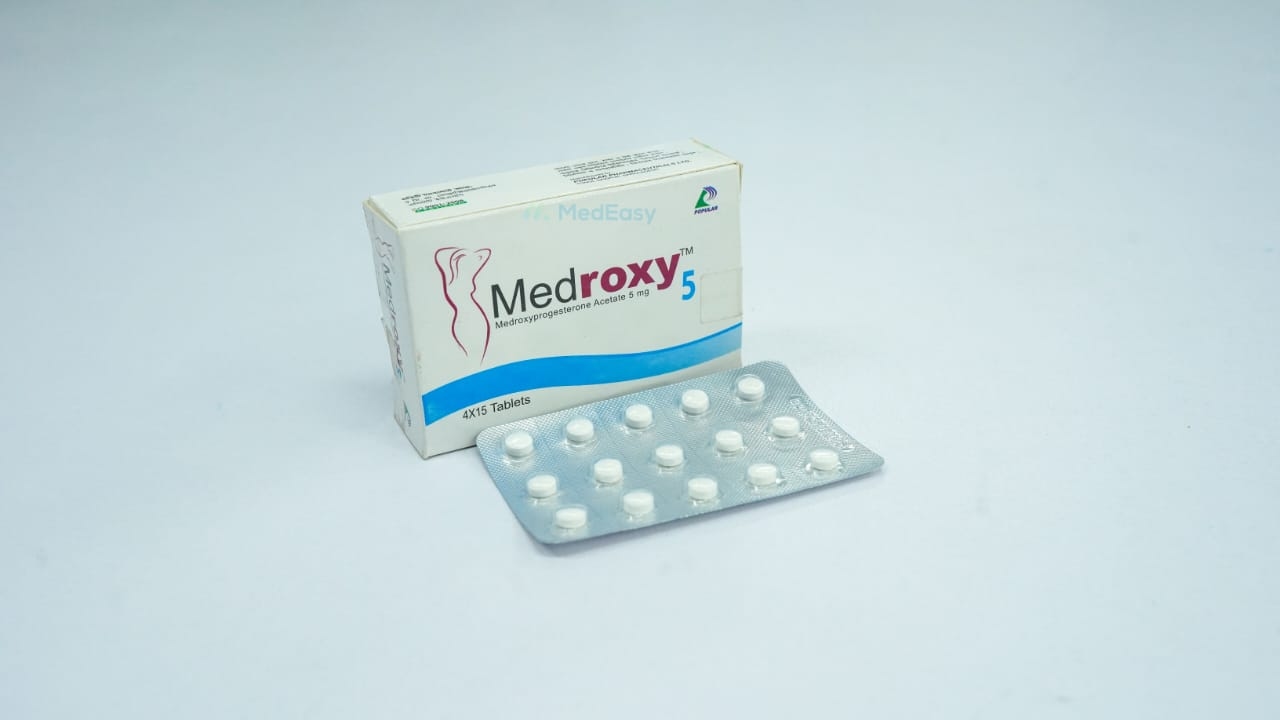
Medroxy5 mg
Popular Pharmaceuticals Ltd.
৳4.97
Add to cart

Provenor 5 mg Tablet is available on MedEasy for ৳4.50 per piece, with home delivery anywhere in Bangladesh. It is manufactured by Eskayef Bangladesh Ltd. Its generic name is Medroxyprogesterone Acetate.

Provenor is a synthetic progestin used for the following indications, classified by strength of evidence:
The specific approved indication depends on the formulation (oral tablet vs. intramuscular/subcutaneous depot injection); a physician will select the appropriate form and regimen.
Each formulation contains Medroxyprogesterone Acetate as the active ingredient. Oral tablets are commonly available in 2.5 mg, 5 mg, and 10 mg strengths; the depot injectable suspension is commonly available as 150 mg/mL (intramuscular) or 104 mg/0.65 mL (subcutaneous). Strength and dosage form should be confirmed on the product label, as inactive ingredients (e.g. polyethylene glycol, polysorbate, sodium chloride for the injectable suspension) vary by manufacturer.
Provenor is a synthetic derivative of progesterone (a progestin) used in contraception and in the management of certain menstrual and hormonal disorders. It is available as oral tablets and as an intramuscular or subcutaneous depot (long-acting) injectable suspension.
As a progestin, Provenor works by suppressing ovulation, thickening cervical mucus, and altering the endometrial lining, which underlies both its contraceptive effect and its use in abnormal uterine bleeding and endometrial protection.
Provenor belongs to the class of progestins (synthetic progestogens), a subclass of steroid hormones used in hormonal contraception and gynecologic hormone therapy.
Medroxyprogesterone Acetate is a progestational steroid that binds to progesterone receptors in target tissues (endometrium, hypothalamus, pituitary).
Doses and duration must be individualized by the treating physician based on indication and clinical response. Do not alter the dose or discontinue without medical advice.
Oral tablets of Provenor may be taken with or without food, swallowed whole with water. The depot injectable suspension must be administered by a trained healthcare professional via deep intramuscular injection (gluteal or deltoid muscle) or subcutaneous injection depending on formulation; the vial must be shaken vigorously before each dose to resuspend the medication uniformly. Do not self-inject unless specifically trained and directed by a physician.
Provenor has the following well-established, clinically significant interactions:
Always inform your physician or pharmacist of all medicines, supplements, and herbal products you are taking before starting Provenor.
Medroxyprogesterone Acetate is contraindicated in patients with any of the following:
Common and important side effects of Provenor include:
Report any severe, persistent, or concerning symptoms to your physician promptly.
Pregnancy: Provenor is contraindicated in known or suspected pregnancy. It is not indicated for the treatment of threatened or habitual abortion, and it should not be used during pregnancy to attempt to maintain a pregnancy. If pregnancy occurs or is suspected during use, Provenor should be discontinued and the patient should consult her physician promptly; available data do not indicate an increased risk of birth defects from inadvertent exposure early in pregnancy, but this should be confirmed with a physician on a case-by-case basis.
Lactation: Provenor is detectable in breast milk in small amounts. Available data have not shown adverse effects on breastfed infants or on milk production/quality, but it should be used only if clearly needed, and initiation of the depot injection in exclusively breastfeeding women is typically delayed until at least 6 weeks postpartum. Consult a physician before use while breastfeeding.
Use of the depot injectable form of Provenor is associated with significant loss of bone mineral density, which increases with duration of use and may not be completely reversible after discontinuation, particularly in adolescents who have not yet reached peak bone mass. This form should generally not be used for longer than 2 years unless other contraceptive methods are inadequate, and the risks and benefits should be reassessed periodically by the treating physician.
See Contraindications for situations where Provenor must not be used at all.
There is limited clinical experience with acute overdose of Provenor, and no specific antidote exists. In case of suspected overdose, seek immediate medical attention or contact a poison control center. Management is supportive and symptomatic, based on the patient's clinical condition, and should be directed by a qualified healthcare professional or emergency medical service.
Store at room temperature (below 30°C), away from light and moisture. Keep out of reach of children. The injectable suspension should not be frozen; shake well before use as directed by a healthcare professional.
Provenor depot injection is not recommended for use in adolescents as a first-line contraceptive due to the risk of bone mineral density loss during a critical period of bone accretion; it should be considered only after other contraceptive methods have been found inadequate, and used for the shortest duration necessary. Safety and efficacy of oral Provenor in pre-menarcheal children have not been established.
Provenor is not typically indicated for use in elderly populations outside of specific oncologic or hormone-therapy contexts under specialist supervision; there is limited specific dosing data for this age group, so use should be individualized and supervised.
No well-established dose adjustment is defined; use with caution and clinical monitoring.
Provenor is contraindicated in significant hepatic impairment or active liver disease (see Contraindications).
Duration of Provenor therapy depends on the indication: contraceptive depot injections are repeated every 3 months and are generally recommended for a maximum of 2 years of continuous use unless alternative methods are inadequate, given the risk of bone mineral density loss; oral courses for abnormal uterine bleeding or secondary amenorrhea are typically 5–14 days per cycle, as directed by the physician; use with estrogen replacement for endometrial protection is typically ongoing on a cyclic monthly basis for as long as estrogen therapy continues. Duration should always be reassessed periodically by the prescribing physician.
Progestins / Progestogens; Hormonal contraceptives; Gynecologic hormone therapy agents
Medroxyprogesterone Acetate acts as a synthetic progestin that binds progesterone receptors, suppressing gonadotropin release to inhibit ovulation, thickening cervical mucus, and inducing endometrial atrophy — mechanisms that together provide contraceptive efficacy and therapeutic control of abnormal uterine bleeding and endometrial protection.
X (contraindicated in pregnancy per FDA legacy pregnancy category system)
Use of Provenor depot injection in adolescents should be limited due to concerns about bone mineral density loss during a period of bone mass accrual; it is generally reserved for cases where other contraceptive options are inadequate, and for the shortest duration consistent with treatment goals. Safety and efficacy of oral Provenor for menstrual indications in pediatric patients below the age of menarche have not been established; use in adolescents with abnormal uterine bleeding should be guided by a pediatric or adolescent gynecology specialist.
Q: What is Provenor 5 mg Tablet used for?
A: Provenor 5 mg Tablet is a progestin hormone used mainly as a long-acting injectable contraceptive, and also to treat abnormal uterine bleeding and secondary amenorrhea due to hormonal imbalance, and to protect the uterine lining (endometrium) when taken with estrogen replacement therapy.
Q: Is Provenor 5 mg Tablet safe to use during pregnancy?
A: No. Provenor 5 mg Tablet is contraindicated in known or suspected pregnancy and should not be used to try to maintain a pregnancy. If pregnancy occurs while using Provenor 5 mg Tablet, stop the medicine and consult your physician promptly; consult a physician before use if you are or may become pregnant.
Q: Can I use Provenor 5 mg Tablet while breastfeeding?
A: Provenor 5 mg Tablet passes into breast milk in small amounts. Available data do not show harm to breastfed infants, but it should be used only if clearly needed and, for the injectable form, is usually started at least 6 weeks after delivery in exclusively breastfeeding mothers. Always consult your physician before use while breastfeeding.
Q: What are the main risks of long-term use of the Provenor 5 mg Tablet injection?
A: The most important risk is significant loss of bone mineral density, which increases the longer the depot injection is used and may not fully reverse after stopping. Because of this, the injectable form of Provenor 5 mg Tablet is generally not recommended for continuous use beyond 2 years unless other contraceptive options are inadequate; your physician should reassess the risks and benefits periodically.
Q: How quickly can I get pregnant after stopping the Provenor 5 mg Tablet injection?
A: Return of fertility after stopping the Provenor 5 mg Tablet depot injection can be delayed, sometimes for several months up to about a year, even though the contraceptive effect itself lasts about 3 months per dose. Discuss family planning timelines with your physician if you are considering stopping Provenor 5 mg Tablet to conceive.
Q: What should I do if I miss my scheduled Provenor 5 mg Tablet injection?
A: Contact your physician or clinic as soon as possible. If the interval since your last dose has extended beyond the recommended window, your doctor may need to rule out pregnancy before giving the next dose of Provenor 5 mg Tablet, and you may need backup contraception in the meantime.
Disclaimer
The information provided is accurate to the best of our knowledge, but it does not replace professional medical advice. We cannot guarantee its completeness or accuracy, and the absence of specific information about a drug should not be taken as an endorsement. We are not responsible for any consequences arising from this information, so please consult a healthcare professional for any concerns or questions.