
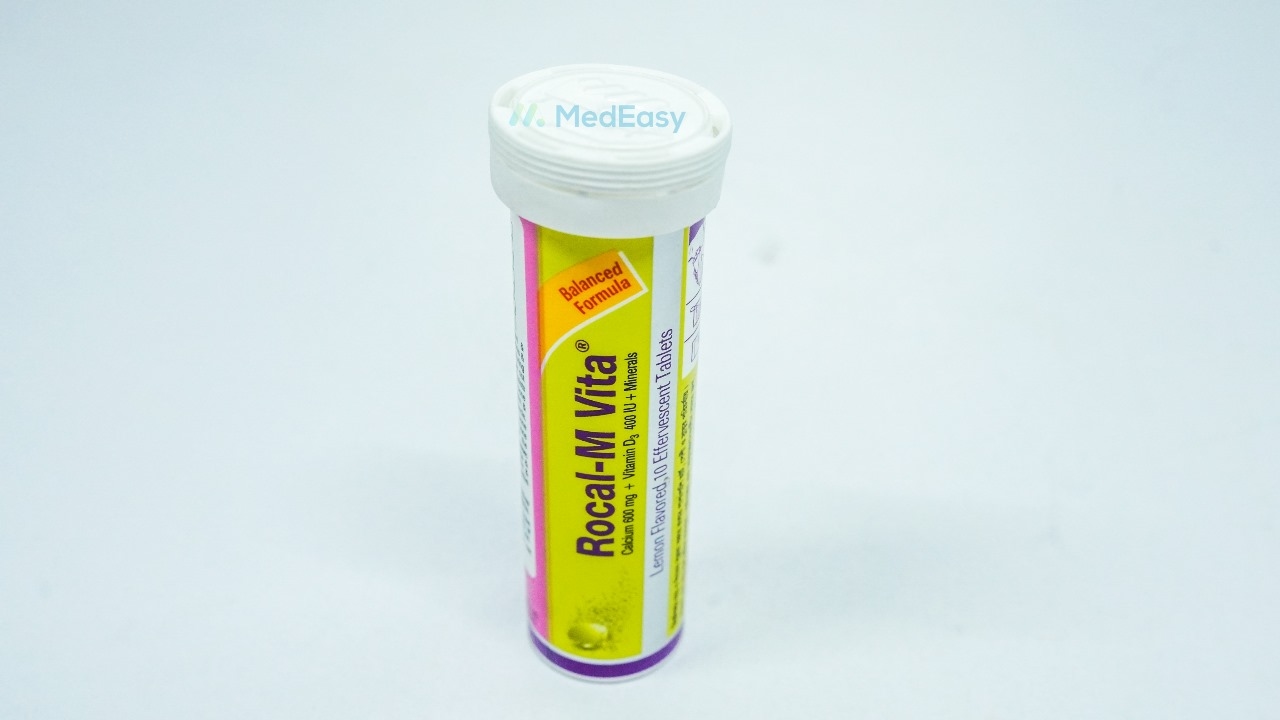
8% Off
Rocal-M Vita.
Healthcare Pharmaceuticals Ltd.
৳184.00
Add to cart
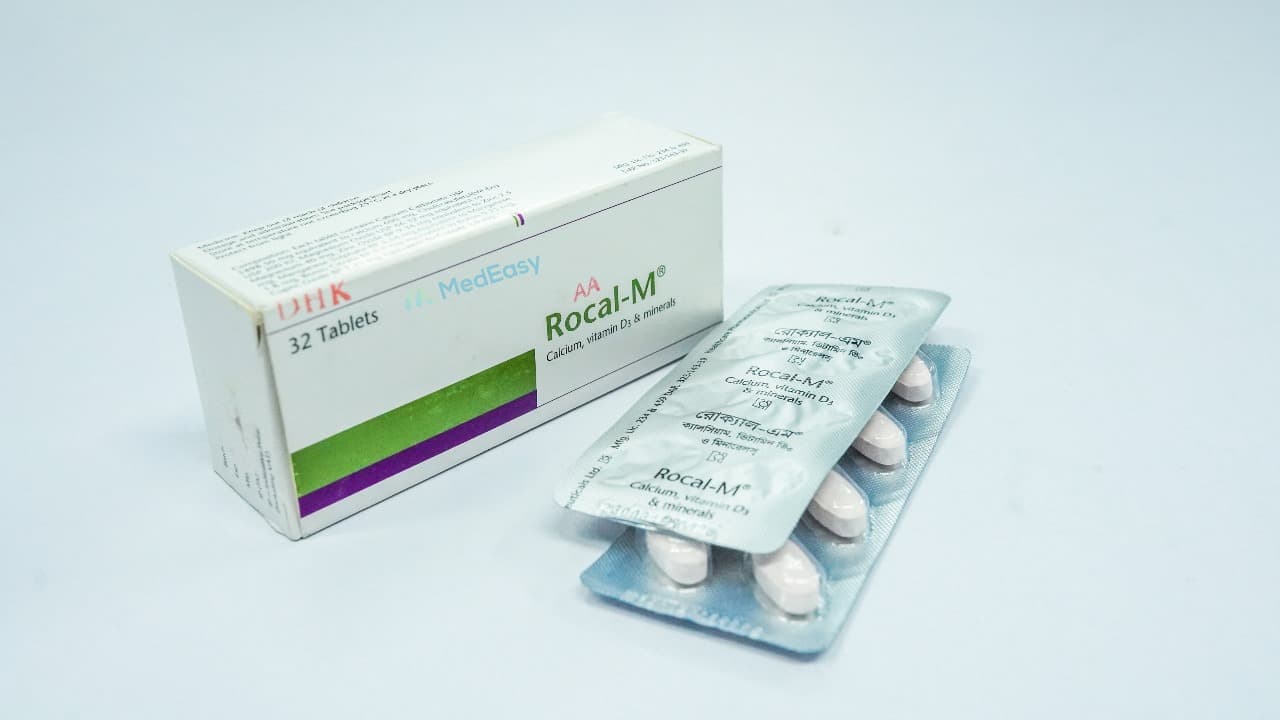

Rocal-M is a multi-ingredient nutritional supplement used for the prevention and management of calcium, vitamin D, and trace mineral deficiencies. Established/guideline-supported uses include:
Rocal-M is a supportive/adjunct therapy and does not replace prescribed treatment for diagnosed bone disease.
Each film-coated tablet of Calcium Carbonate + Vitamin D3 + Multimineral typically contains:
Exact strengths vary by brand and dosage form (film-coated tablet, effervescent tablet, or chewable tablet); refer to the specific product label for exact composition.
Rocal-M is a fixed-dose combination nutritional supplement formulated to support bone health. Calcium carbonate provides elemental calcium, the principal mineral required for bone mineralization; vitamin D3 (cholecalciferol) enhances intestinal absorption of calcium and supports calcium homeostasis; and the accompanying trace minerals (magnesium, zinc, copper, manganese, and boron) act as cofactors in bone matrix formation and remodeling.
Rocal-M is available in Bangladesh in film-coated and effervescent tablet forms and is commonly used for the prevention and adjunct management of calcium/vitamin D deficiency and bone-related conditions such as osteoporosis.
Rocal-M belongs to the therapeutic class of calcium and vitamin D combination supplements with trace minerals, used in bone metabolism and mineral supplementation.
Calcium Carbonate + Vitamin D3 + Multimineral combines several agents that act together on bone mineral metabolism:
Together, these components help maintain adequate serum calcium levels and support normal bone density and strength.
Dosage of Rocal-M should be individualized based on age, dietary calcium/vitamin D intake, and clinical indication. The following is general guidance; follow the specific product label and physician's advice.
| Population | Typical Dose |
|---|---|
| Adults (film-coated tablet) | One tablet twice daily, taken with meals and a full glass of water |
| Adults (effervescent tablet) | One tablet dissolved in water, once daily, taken with or after a meal |
| Children 3–7 years | One effervescent tablet daily, as directed by a physician |
| Children above 7 years | One to two effervescent tablets daily, as directed by a physician |
| Pregnancy/lactation | As advised by the treating physician, based on individual calcium/vitamin D requirements |
Doses should be spaced at least 2–4 hours apart from tetracycline or fluoroquinolone antibiotics, levothyroxine, bisphosphonates, and iron supplements (see Interactions) to avoid reduced absorption. Renal function and serum calcium should be monitored with prolonged use, particularly in patients with renal impairment.
Rocal-M film-coated tablets should be swallowed whole with a full glass of water, preferably with or after meals to improve calcium absorption and reduce gastrointestinal discomfort. Effervescent tablets should be fully dissolved in a glass of water before drinking. Doses should not be taken at the same time as tetracycline/fluoroquinolone antibiotics, levothyroxine, bisphosphonates, or iron supplements; separate administration by at least 2–4 hours.
Rocal-M has the following clinically significant interactions:
Calcium Carbonate + Vitamin D3 + Multimineral is contraindicated in patients with:
Rocal-M is generally well tolerated at recommended doses. Reported side effects include:
Calcium and vitamin D requirements increase during pregnancy and lactation, and Rocal-M may be used under medical supervision when dietary intake is insufficient. However, Rocal-M should be used only if clearly needed, at doses that do not exceed recommended daily allowances, since excessive vitamin D intake has shown teratogenic effects in animal studies and maternal hypercalcemia has been associated with fetal harm. The potential benefit should justify the potential risk, and a physician should be consulted before use.
Calcium and vitamin D3 are excreted into breast milk; doses within the recommended range are generally considered compatible with breastfeeding, but a physician should be consulted, and excessive maternal intake should be avoided.
Use Rocal-M with caution in the following situations:
Discontinue and seek medical advice if symptoms of hypercalcemia (nausea, vomiting, constipation, confusion, excessive thirst, or frequent urination) develop.
Overdose of Rocal-M can cause hypercalcemia and hypervitaminosis D, with symptoms including nausea, vomiting, loss of appetite, metallic taste, constipation, abdominal pain, excessive thirst, frequent urination, muscle weakness, confusion, and, in severe cases, cardiac arrhythmias or renal impairment. In case of suspected overdose, discontinue the product immediately and seek immediate medical attention or contact a poison control center; do not attempt specific home treatment. Management is generally supportive and may include intravenous fluids and monitoring of serum calcium under medical supervision.
Store at room temperature (below 30°C), away from light and moisture. Keep out of reach of children.
Elderly: Rocal-M is commonly used in the elderly to support bone health and reduce fracture risk; renal function should be periodically assessed given the higher likelihood of age-related renal impairment.
Renal impairment: Use with caution; contraindicated in severe renal failure (see Contraindications). In mild-to-moderate renal impairment, use only under close medical supervision with periodic monitoring of serum calcium, urinary calcium, and renal function.
Hepatic impairment: No specific dose adjustment is established; vitamin D3 activation requires hepatic hydroxylation, so caution and medical supervision are advised in significant hepatic impairment.
Pediatric use: see Pediatric Uses.
Pregnancy and lactation: see Pregnancy and Lactation.
Duration of Rocal-M therapy depends on the indication. For correction of a diagnosed deficiency, treatment is typically continued for several weeks to months until deficiency is corrected, as guided by clinical response and, where available, laboratory monitoring. For long-term bone health maintenance (e.g. in osteoporosis prevention or the elderly), Rocal-M may be used on an ongoing basis under periodic medical review, with regular monitoring of serum and urinary calcium during prolonged use.
Calcium Carbonate + Vitamin D3 + Multimineral is classified under calcium supplements, vitamin D analogues, and multimineral/trace-element supplements used in bone and mineral metabolism.
Calcium Carbonate + Vitamin D3 + Multimineral works through complementary mechanisms: calcium carbonate supplies elemental calcium for absorption and use in bone mineralization and physiological calcium-dependent processes; vitamin D3 is converted to active calcitriol, which upregulates intestinal calcium-binding protein synthesis to enhance calcium absorption and works with parathyroid hormone to maintain calcium homeostasis; and the trace minerals (magnesium, zinc, copper, manganese, boron) act as enzymatic cofactors supporting collagen cross-linking and bone matrix formation, contributing to bone strength and density.
Rocal-M (effervescent tablet form) may be used in children above 3 years of age for calcium/vitamin D supplementation under medical guidance, at a dose of one tablet daily for ages 3–7 years and one to two tablets daily for children above 7 years. Use in children below 3 years is not established, and safety and efficacy of Rocal-M in this age group have not been established; a pediatrician should be consulted for appropriate calcium/vitamin D dosing in infants and young children. Total intake from diet, other supplements, and fortified foods should be considered to avoid exceeding the tolerable upper intake level for the child's age.
Q: What is Rocal-M . Tablet used for?
A: Rocal-M . Tablet is a nutritional supplement used to prevent and treat calcium and vitamin D deficiency, support bone health, and serve as an adjunct in the prevention and management of osteoporosis, along with providing essential trace minerals like magnesium, zinc, copper, manganese, and boron.
Q: Can I take Rocal-M . Tablet with antibiotics?
A: Rocal-M . Tablet should not be taken at the same time as tetracycline or fluoroquinolone antibiotics, because calcium binds to these drugs and significantly reduces their absorption. Separate the doses by at least 2–4 hours, and consult your physician or pharmacist for the exact timing.
Q: Is Rocal-M . Tablet safe during pregnancy?
A: Rocal-M . Tablet may be used during pregnancy under medical supervision when dietary calcium/vitamin D intake is insufficient, but it should be used only if clearly needed and at doses that do not exceed recommended limits, since excessive vitamin D intake has shown teratogenic effects in animal studies. Always consult your physician before use in pregnancy.
Q: What happens if I take too much Rocal-M . Tablet?
A: Taking more than the recommended dose of Rocal-M . Tablet can cause hypercalcemia and hypervitaminosis D, with symptoms such as nausea, vomiting, constipation, excessive thirst, frequent urination, and confusion. If overdose is suspected, stop the product and seek immediate medical attention or contact a poison control center.
Q: Can Rocal-M . Tablet be taken with thyroid medicine (levothyroxine)?
A: No, Rocal-M . Tablet should not be taken at the same time as levothyroxine, as calcium carbonate reduces its absorption and can make thyroid hormone replacement less effective. Take levothyroxine at least 4 hours apart from Rocal-M . Tablet.
Q: Who should avoid taking Rocal-M . Tablet?
A: People with hypercalcemia, hypercalciuria, hypervitaminosis D, severe renal impairment, active kidney stones, or known hypersensitivity to any ingredient of Rocal-M . Tablet should avoid it unless specifically directed and monitored by a physician.
Disclaimer
The information provided is accurate to the best of our knowledge, but it does not replace professional medical advice. We cannot guarantee its completeness or accuracy, and the absence of specific information about a drug should not be taken as an endorsement. We are not responsible for any consequences arising from this information, so please consult a healthcare professional for any concerns or questions.
