
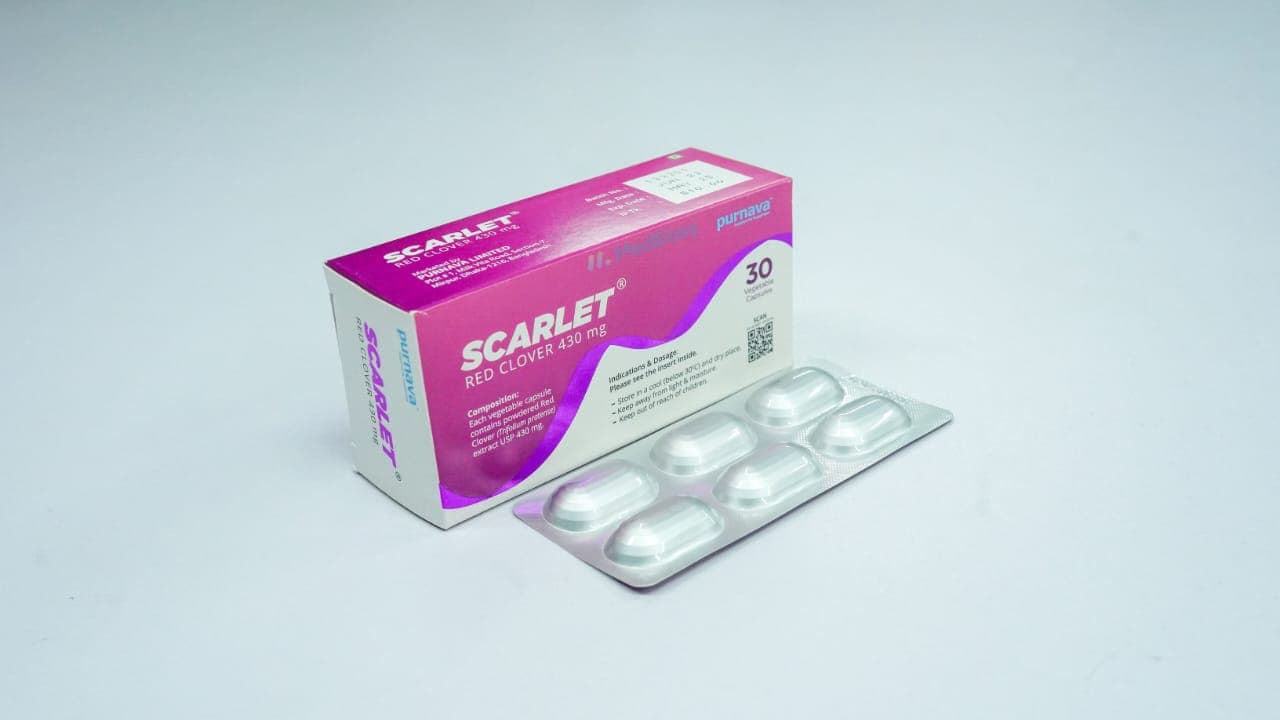
Key facts
Scarlet 430 mg Capsule is available on MedEasy for ৳145.80 per 6's Strip, with home delivery anywhere in Bangladesh. It is manufactured by Renata Limited. Its generic name is Red Clover [Trifolium Pratense].
- Pack sizes
- 6's Strip, 30's Pack
- Prescription
- Required. Upload a valid doctor's prescription at checkout; a MedEasy pharmacist verifies it before dispatch.
- Delivery
- Home delivery across Bangladesh. Same-day delivery in Dhaka, Chattogram, Sylhet and Bogura city areas; 2-3 days elsewhere.
- Payment
- Cash on delivery, bKash, cards and mobile banking.
- Brand
- Scarlet
- Generic name
- Red Clover [Trifolium Pratense]
- Manufacturer
- Renata Limited
- Form & strength
- Capsule 430 mg
- Availability
- Currently out of stock
- Authenticity
- Sourced from licensed suppliers and the manufacturer's authorised distributors in Bangladesh.

Medicine overview
Indications of Scarlet
Scarlet is a herbal (dietary supplement) preparation derived from the red clover plant, standardized for its isoflavone content. It is used for the following indications, presented according to the strength of supporting evidence:
Adjunct / Supplement Use (Modest, Mixed Clinical Evidence)
- Menopausal symptom relief: Scarlet is most commonly used as an adjunct, over-the-counter supplement for symptomatic relief of mild menopausal symptoms such as hot flashes (vasomotor symptoms) and night sweats. Clinical trial evidence for this use is mixed and generally modest; some trials show a small benefit over placebo, while others show no significant difference.
Traditional / Limited-Evidence Uses
- Traditionally used for general "cleansing," skin conditions, and cough, but these uses are not supported by robust modern clinical evidence and are not recommended as primary treatment.
Important: Scarlet is not a proven treatment or cure for menopause, osteoporosis, or any hormone-sensitive condition, and it is not a substitute for medical evaluation and management of menopausal symptoms. It should not be used in place of hormone replacement therapy or other physician-directed treatment without medical advice.
Composition
Red Clover [Trifolium Pratense] products are typically standardized dried extracts of the aerial (flowering) parts of the red clover plant, providing a defined amount of total isoflavones (mainly biochanin A, formononetin, genistein, and daidzein) per dose. Formulations available as a dietary/herbal supplement include tablets, capsules, and standardized extracts; exact isoflavone content varies by brand/manufacturer, so the product label should always be checked.
Description
Scarlet is a flowering plant whose aerial parts are used to prepare herbal dietary supplements. It is rich in isoflavones, which are plant-derived compounds (phytoestrogens) that have weak, estrogen-like activity in the body. Scarlet is marketed as an herbal supplement rather than as a prescription drug, and is commonly used by women seeking non-hormonal options for mild menopausal symptoms. It is not FDA-approved as a drug for any indication; regulatory oversight for such products is generally as a dietary supplement, not a medicine with proven efficacy.
Therapeutic Class
Herbal Supplement / Phytoestrogen (Isoflavone-containing botanical) — Scarlet
Pharmacology
Mechanism of Action
Red Clover [Trifolium Pratense] contains isoflavones (biochanin A, formononetin, genistein, daidzein) that structurally resemble endogenous estrogen. These compounds bind weakly to estrogen receptors (particularly estrogen receptor-beta), producing mild estrogen-agonist or, in some tissues, estrogen-antagonist (selective estrogen receptor modulator-like) effects. This weak phytoestrogenic activity is proposed to underlie the modest reduction in vasomotor symptoms (hot flashes) reported in some studies, though the exact clinical significance remains uncertain given mixed trial results.
Pharmacokinetics
Isoflavones from Red Clover [Trifolium Pratense] are absorbed after oral intake, undergo hepatic and gut-microbiota metabolism (including conversion of formononetin and biochanin A to daidzein and genistein, respectively), and are eliminated mainly via urine and feces after conjugation. Individual variability in gut flora can affect isoflavone bioavailability and metabolite profile.
Dosage & Administration of Scarlet
General Dosing Overview
Scarlet is available as a standardized herbal/dietary supplement, most commonly dosed by total isoflavone content rather than by raw herb weight. There is no single FDA-approved dosing regimen because Scarlet is not regulated as a prescription drug; the dosing below reflects commonly used amounts in clinical trials and standard supplement labeling.
| Indication | Typical Adult Dose | Notes |
|---|---|---|
| Menopausal symptom relief (adjunct) | Standardized extract providing approximately 40–80 mg total isoflavones per day, orally, usually taken once daily or in divided doses | Duration of use in trials generally 3–12 months; see Duration of Treatment |
See Dosage and Administration sub-fields below, and always follow the specific product label, as isoflavone content varies by brand.
Administration of Scarlet
Scarlet supplements are usually taken orally as tablets or capsules, with or without food, as directed on the product label or by a healthcare provider. Consistent daily timing may help maintain steady isoflavone levels. Scarlet should be taken exactly as directed and not combined with other estrogenic or hormonal supplements without medical advice.
Interaction of Scarlet
The following clinically significant interactions have been reported or are theoretically expected with Scarlet, based on its mild antiplatelet and phytoestrogenic activity:
- Anticoagulants and antiplatelet agents (e.g., warfarin, aspirin, clopidogrel): Scarlet has been reported to have mild antiplatelet activity; concurrent use may theoretically increase the risk of bleeding. Use with caution and under medical supervision.
- Hormonal therapies and hormone-sensitive cancer treatments (e.g., tamoxifen, oral contraceptives, hormone replacement therapy): Due to its estrogen-like activity, Scarlet may theoretically interfere with the action of these medicines or add to their hormonal effects. Concurrent use should be avoided or undertaken only with physician guidance.
- Surgery: Because of its antiplatelet and phytoestrogenic effects, Scarlet should generally be discontinued at least two weeks before elective surgery.
Contraindications
Red Clover [Trifolium Pratense] is contraindicated in the following situations:
- Known hypersensitivity to Red Clover [Trifolium Pratense], red clover, or any component of the formulation.
- Current or past history of hormone-sensitive cancers, including breast, uterine (endometrial), and ovarian cancer, due to the phytoestrogenic/estrogen-like activity of Red Clover [Trifolium Pratense].
- Pregnancy and breastfeeding, due to insufficient safety data and theoretical hormonal effects on the fetus or infant. See Pregnancy and Lactation.
Side Effects of Scarlet
Scarlet is generally well tolerated when used as directed, but the following side effects have been reported:
- Mild gastrointestinal upset (nausea, bloating)
- Headache
- Skin rash or allergic reaction
- Breast tenderness (mastalgia) and menstrual changes, related to its estrogen-like activity
Serious adverse effects are uncommon with typical supplement use; patients should stop use and seek medical advice if unusual bleeding, breast lumps, or allergic reactions occur.
Pregnancy & Lactation
Scarlet is not recommended during pregnancy or breastfeeding. Data on the safety of Scarlet in pregnancy and lactation are insufficient, and its phytoestrogenic activity raises a theoretical concern for hormonal effects on the fetus or nursing infant. Scarlet should be avoided in pregnancy and breastfeeding unless specifically advised and supervised by a physician, and only if no safer alternative is appropriate.
Precautions & Warnings
Scarlet should be used only under professional guidance, with the following precautions:
- Use with caution in people with bleeding disorders or those taking anticoagulant/antiplatelet medicines, due to reported mild antiplatelet activity. See Interactions.
- Avoid or use only with physician supervision in people with, or with a history of, hormone-sensitive conditions (e.g., breast, uterine, or ovarian cancer, endometriosis, uterine fibroids), due to estrogen-like activity. See Contraindications.
- Discontinue at least two weeks before elective surgery because of bleeding-risk and hormonal concerns.
- Data on long-term safety and use in people with liver or kidney disease are limited; use with caution and medical supervision in these groups.
- Scarlet is not a substitute for prescribed hormone therapy or other physician-directed treatment for menopausal symptoms; consult a physician for persistent or severe symptoms.
Overdose Effects of Scarlet
Specific data on Scarlet overdose in humans are limited. In case of suspected overdose or accidental ingestion of a large amount of Scarlet, seek immediate medical attention or contact a poison control center/emergency services. Do not attempt unsupervised home treatment. Bring the product packaging to the healthcare facility if possible.
Storage Conditions
Store at room temperature (below 30°C), away from light and moisture. Keep out of reach of children.
Use In Special Populations
- Pregnant women: Not recommended; see Pregnancy and Lactation.
- Breastfeeding women: Not recommended; see Pregnancy and Lactation.
- Children and adolescents: Not recommended; safety and efficacy of Scarlet have not been established in this population. See Pediatric Uses.
- Elderly: May be used with caution; increased vigilance is advised for bleeding risk and hormone-sensitive conditions, which are more common in this age group.
- Renal or hepatic impairment: No well-established dose adjustment exists; use with caution and medical supervision due to limited safety data.
- Hormone-sensitive conditions: Avoid use; see Contraindications.
Duration Of Treatment
Clinical trials of Scarlet for menopausal symptoms have generally used treatment durations of about 3 to 12 months. There is limited data on safety beyond 12 months of continuous use. Use should be periodically reviewed with a physician, and Scarlet should not be continued indefinitely without medical reassessment of ongoing need and safety.
Drug Classes
Herbal supplements; Phytoestrogens; Isoflavone-containing botanicals — Red Clover [Trifolium Pratense]
Mode Of Action
Red Clover [Trifolium Pratense] exerts its effects mainly through its isoflavone content (biochanin A, formononetin, genistein, daidzein), which act as phytoestrogens by binding weakly to estrogen receptors, predominantly estrogen receptor-beta. This produces mild, tissue-selective estrogen-like (or in some tissues, estrogen-modulating) activity, which is proposed to reduce the frequency and severity of vasomotor symptoms such as hot flashes in some users, although clinical trial results supporting this mechanism's efficacy are mixed and modest.
Pediatric Uses
Scarlet is not recommended for use in children or adolescents. Safety and efficacy of Scarlet have not been established in the pediatric population, and its phytoestrogenic activity raises theoretical concerns about effects on hormonal development. Scarlet should not be given to children without specific medical advice.
Frequently Asked Questions
Q: What is Scarlet 430 mg Capsule used for?
A: Scarlet 430 mg Capsule is a herbal supplement most commonly used as an adjunct to help relieve mild menopausal symptoms such as hot flashes and night sweats. Evidence for this use is mixed and modest, and Scarlet 430 mg Capsule is not a proven cure or a substitute for medical evaluation of menopausal symptoms.
Q: Can Scarlet 430 mg Capsule be taken during pregnancy or breastfeeding?
A: No. Scarlet 430 mg Capsule is not recommended during pregnancy or breastfeeding because there is insufficient safety data, and its estrogen-like (phytoestrogenic) activity raises a theoretical risk of hormonal effects on the fetus or nursing infant. Use only if specifically advised and supervised by a physician.
Q: Who should not take Scarlet 430 mg Capsule?
A: Scarlet 430 mg Capsule should not be used by anyone with a known hypersensitivity to it, or by people with current or past hormone-sensitive cancers such as breast, uterine, or ovarian cancer, because of its estrogen-like activity. It should also be avoided in pregnancy and breastfeeding.
Q: Does Scarlet 430 mg Capsule interact with blood thinners or hormone medicines?
A: Yes. Scarlet 430 mg Capsule has mild antiplatelet activity and may increase bleeding risk when taken with anticoagulants or antiplatelet medicines such as warfarin or aspirin. It may also theoretically interfere with hormone therapies or tamoxifen due to its estrogenic activity. Use only under medical supervision if you take these medicines.
Q: What are the common side effects of Scarlet 430 mg Capsule?
A: Most people tolerate Scarlet 430 mg Capsule well, but mild side effects such as nausea, bloating, headache, skin rash, or breast tenderness have been reported. These are related to its phytoestrogenic (estrogen-like) activity. Seek medical advice if you notice unusual bleeding, breast lumps, or signs of an allergic reaction.
Q: How long can Scarlet 430 mg Capsule be safely used?
A: Clinical studies of Scarlet 430 mg Capsule for menopausal symptoms have generally used it for about 3 to 12 months. There is limited safety data beyond this period, so use should be periodically reviewed with a physician rather than continued indefinitely without medical reassessment.
Disclaimer
The information provided is accurate to the best of our knowledge, but it does not replace professional medical advice. We cannot guarantee its completeness or accuracy, and the absence of specific information about a drug should not be taken as an endorsement. We are not responsible for any consequences arising from this information, so please consult a healthcare professional for any concerns or questions.