10% Off
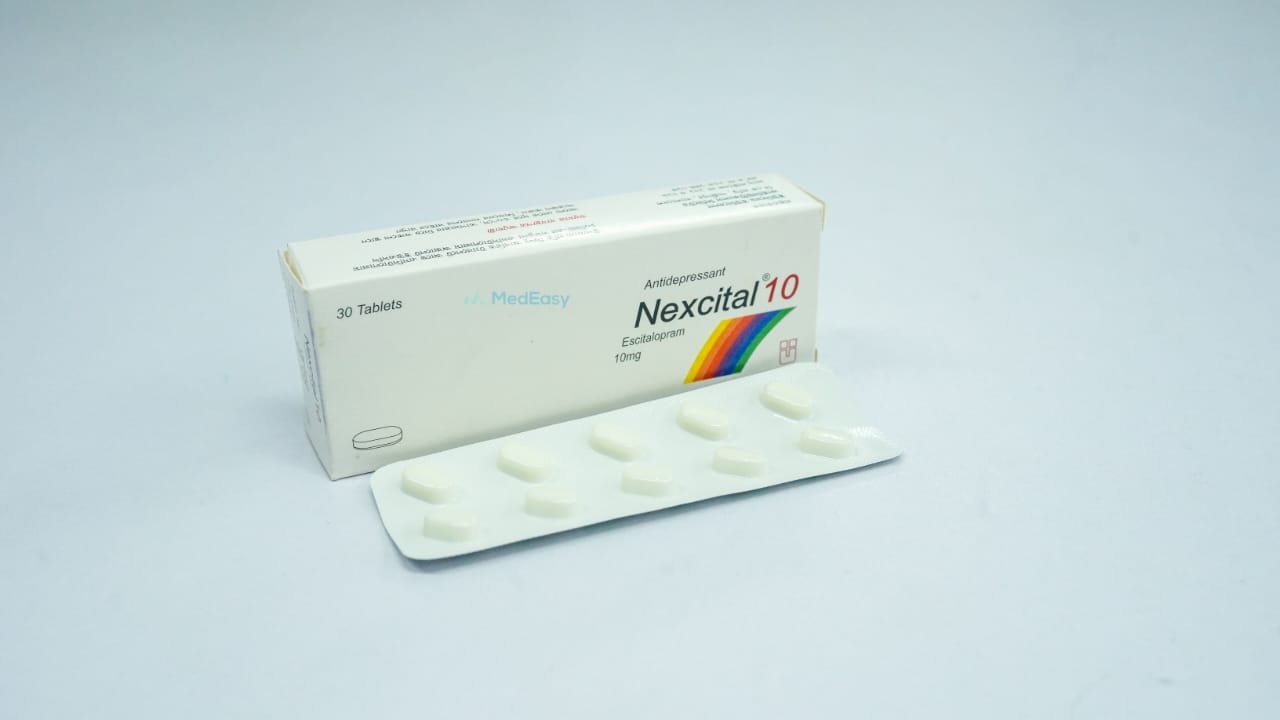
Nexcital10 mg
Unimed Unihealth MFG. Ltd.
৳117.00
Add to cart

Serotal 10 mg Tablet is available on MedEasy for ৳9.00 per piece, with home delivery anywhere in Bangladesh. It is manufactured by Globe Pharmaceuticals Ltd. Its generic name is Escitalopram.

Serotal is approved for the treatment of Major Depressive Disorder (MDD) in adults and in adolescents 12 years of age and older. Serotal is also approved for the treatment of Generalized Anxiety Disorder (GAD) in adults and in children and adolescents 7 years of age and older.
Serotal is used, and is approved in many countries including Bangladesh and across Europe, for panic disorder (with or without agoraphobia) and for social anxiety disorder (social phobia) in adults, based on clinical trial evidence, although these uses are not FDA-approved indications in the United States.
Serotal is sometimes prescribed off-label for obsessive-compulsive disorder (OCD) in adults, based on the general antidepressant/anti-obsessional effect of SSRIs as a class, although Serotal does not carry a specific regulatory approval for OCD in most markets and other SSRIs have stronger evidence in this indication. Any off-label use of Serotal should be decided by a qualified physician after weighing individual benefits and risks.
Escitalopram is the S-enantiomer of the racemic antidepressant citalopram and is a selective serotonin reuptake inhibitor (SSRI). Escitalopram selectively inhibits the neuronal reuptake of serotonin (5-HT) in the central nervous system, with minimal effect on norepinephrine or dopamine reuptake, thereby increasing serotonergic neurotransmission.
Absorption: Escitalopram is well absorbed after oral administration, with peak plasma concentrations reached in about 5 hours; absolute bioavailability is approximately 80%, and food does not significantly affect absorption.
Distribution: Escitalopram is approximately 56% bound to plasma proteins.
Metabolism: Escitalopram is extensively metabolized in the liver, mainly via the CYP3A4 and CYP2C19 enzymes, to the less active metabolites S-desmethylcitalopram (S-DCT) and S-didesmethylcitalopram (S-DDCT).
Elimination: The elimination half-life of Escitalopram is approximately 27-32 hours with once-daily dosing, and steady-state concentrations are reached in about one week. A small proportion (roughly 7-8%) of an administered dose of Escitalopram is excreted unchanged in the urine.
Serotal should be used during pregnancy only if the potential benefit justifies the potential risk to the fetus. Use of Serotal and other SSRIs late in the third trimester of pregnancy has been associated with poor neonatal adaptation, including respiratory distress, feeding difficulty, jitteriness, and the need for prolonged hospitalization in the newborn; some data have also raised a possible association with persistent pulmonary hypertension of the newborn (PPHN), although the overall evidence on this link is not conclusive. Untreated depression or anxiety during pregnancy also carries risks to both mother and baby, so the decision to continue, adjust, or stop Serotal during pregnancy should be individualized and made together with a doctor, and Serotal should never be stopped abruptly without medical advice.
Serotal passes into breast milk in small amounts. Breastfed infants of mothers taking Serotal should be monitored for possible effects such as excessive sleepiness, poor feeding, irritability, or inadequate weight gain. The decision to breastfeed during treatment with Serotal should be made by the mother and her doctor after weighing the benefits of breastfeeding against the infant's potential drug exposure.
Overdose of Serotal most commonly causes dizziness, sweating, nausea, vomiting, tremor, and drowsiness. In more severe overdose, or when Serotal is taken together with alcohol or other drugs, effects can include seizures (which may be delayed in onset), altered level of consciousness or coma, abnormal heart rhythm including QT/QRS prolongation, changes in blood pressure, and serotonin syndrome. Anyone suspected of having taken an overdose of Serotal should seek emergency medical attention or contact a poison control service immediately; vomiting should not be induced unless specifically directed by a healthcare professional or poison control. Management in a medical facility is generally supportive and may include monitoring of heart rhythm and vital signs.
Serotal is approved for Major Depressive Disorder in adolescents 12 years and older and for Generalized Anxiety Disorder in children and adolescents 7 years and older; safety and effectiveness have not been established for other pediatric indications or younger ages. The boxed warning on suicidal thoughts and behavior applies especially to this age group (see Precautions and Warnings and Pediatric Uses).
Elderly patients generally require a lower maximum dose of Serotal (usually 10 mg once daily) because of reduced drug clearance and increased sensitivity to side effects such as hyponatremia and QT prolongation.
No dose adjustment of Serotal is generally needed in mild-to-moderate renal impairment; Serotal should be used with caution in patients with severe renal impairment, for whom data are limited.
A maximum dose of 10 mg once daily of Serotal is recommended in patients with hepatic impairment, as clearance of Serotal is reduced.
Patients who are known or suspected to be poor CYP2C19 metabolizers, or who are taking a CYP2C19-inhibiting drug, may have higher blood levels of Serotal and may need a lower dose; this should be assessed individually by the prescribing doctor.
The duration of treatment with Serotal depends on the condition being treated and individual response, and should be decided by the prescribing doctor. For depression and anxiety disorders, Serotal typically needs to be taken for at least 2-4 weeks before a noticeable improvement occurs, and full benefit may take longer. Once a good response is achieved, treatment with Serotal is generally continued for a period of months to help prevent relapse, with the exact duration reassessed periodically by the doctor based on the patient's progress and history. Serotal should not be stopped as soon as symptoms improve, and any decision to reduce or stop Serotal should be made gradually and under medical supervision.
Serotal is approved for the treatment of Major Depressive Disorder in adolescents 12 years of age and older, and for Generalized Anxiety Disorder in children and adolescents 7 years of age and older. Serotal has not been established as safe and effective for other psychiatric indications in children, or for use below these age thresholds. As with other antidepressants, Serotal carries a boxed warning regarding an increased risk of suicidal thoughts and behavior in children, adolescents, and young adults, particularly during the early weeks of treatment and after dose changes (see Precautions and Warnings for full details). Pediatric patients taking Serotal should have their weight and growth monitored, since decreased appetite and weight changes have been reported. Any use of Serotal in a child or adolescent should be closely supervised by a physician, with regular follow-up visits.
Serotal 10 mg Tablet is used to treat Major Depressive Disorder (MDD) and Generalized Anxiety Disorder (GAD), and is also used in many countries, including Bangladesh, for panic disorder and social anxiety disorder. A doctor will determine whether Serotal 10 mg Tablet is the right choice for a particular condition.
Serotal 10 mg Tablet is usually taken once daily, by mouth, with or without food, at a dose determined by a doctor based on the condition being treated. Serotal 10 mg Tablet should be taken consistently at around the same time each day.
Serotal 10 mg Tablet typically takes about 2-4 weeks to produce a noticeable improvement in mood or anxiety symptoms, and full benefit may take longer. It is important to keep taking Serotal 10 mg Tablet as prescribed even if improvement is not immediately obvious, and to discuss any concerns with a doctor rather than stopping on one's own.
Serotal 10 mg Tablet may generally be taken with or without food, including with milk, since food does not significantly affect the absorption of Serotal 10 mg Tablet. Patients should follow their doctor's or pharmacist's specific instructions regarding food and drink.
Serotal 10 mg Tablet should be used in pregnancy only if a doctor determines that the benefits outweigh the risks, since use late in pregnancy has been linked to poor neonatal adaptation and possibly other effects in the newborn. Because untreated depression or anxiety in pregnancy also carries risks, any decision about using Serotal 10 mg Tablet during pregnancy should be made together with a doctor, and Serotal 10 mg Tablet should never be stopped abruptly without medical advice.
Serotal 10 mg Tablet is approved for Major Depressive Disorder in adolescents 12 years and older and for Generalized Anxiety Disorder in children and adolescents 7 years and older; it is not approved for other pediatric uses or younger children. Because of an increased risk of suicidal thoughts and behavior in children, adolescents, and young adults taking antidepressants, any child or adolescent taking Serotal 10 mg Tablet needs close medical monitoring.
Common side effects of Serotal 10 mg Tablet include nausea, insomnia or drowsiness, fatigue, increased sweating, dry mouth, decreased appetite, and sexual side effects such as delayed ejaculation or decreased libido. Most side effects of Serotal 10 mg Tablet are mild, but any severe or persistent symptom should be reported to a doctor.
Serotal 10 mg Tablet must not be combined with monoamine oxidase inhibitors (MAOIs) or pimozide, and should be used cautiously with other serotonergic drugs, NSAIDs, aspirin, or blood thinners because of interaction risks including serotonin syndrome and bleeding. Always tell the doctor or pharmacist about all other medicines, supplements, or herbal products before starting Serotal 10 mg Tablet.
No, Serotal 10 mg Tablet should not be stopped suddenly, as this can cause a discontinuation syndrome with symptoms such as dizziness, irritability, and mood disturbance. Any decision to reduce or stop Serotal 10 mg Tablet should be made gradually and under the supervision of a doctor.
Disclaimer
The information provided is accurate to the best of our knowledge, but it does not replace professional medical advice. We cannot guarantee its completeness or accuracy, and the absence of specific information about a drug should not be taken as an endorsement. We are not responsible for any consequences arising from this information, so please consult a healthcare professional for any concerns or questions.