
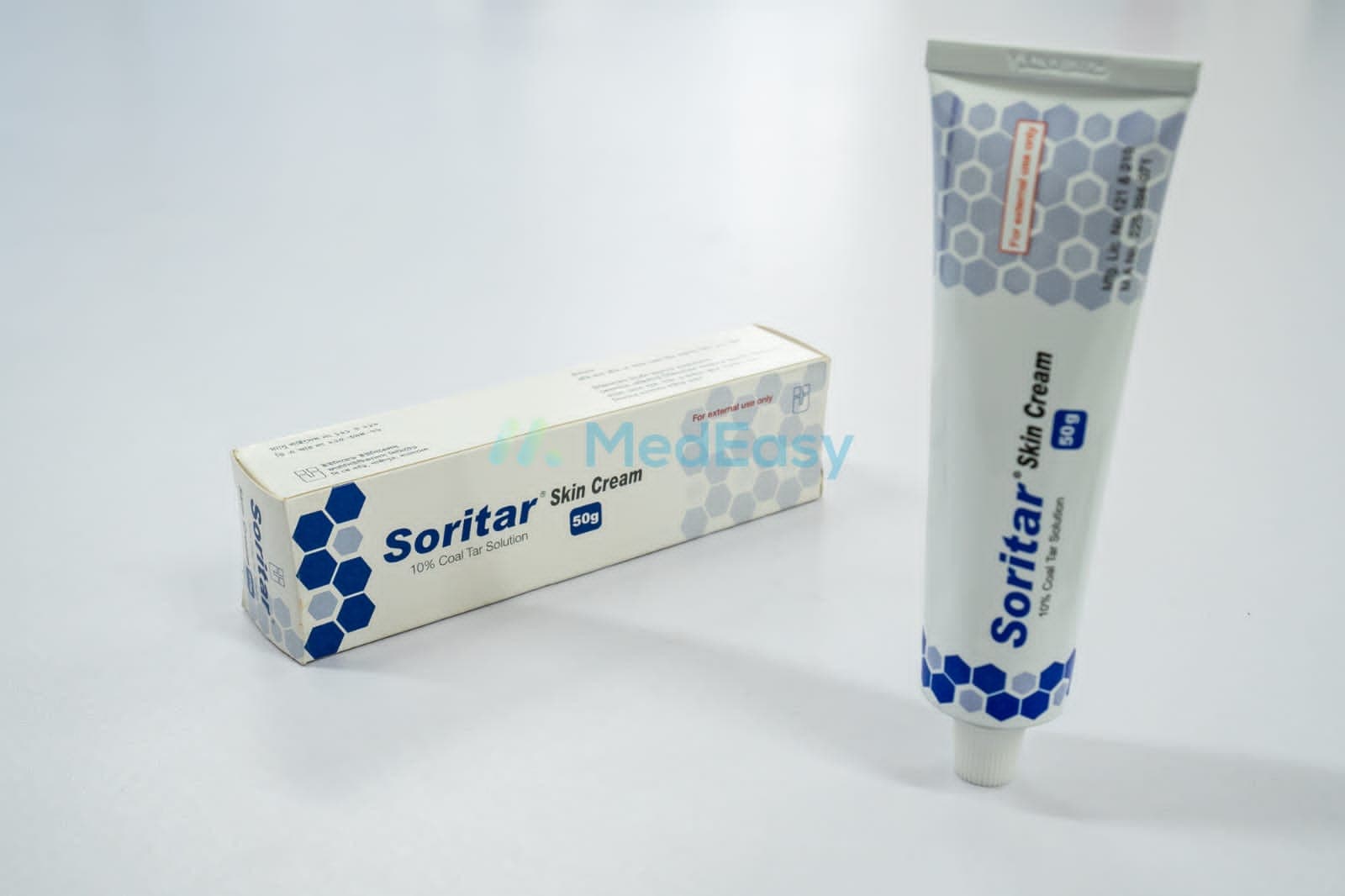

Medicine overview
Indications of Soritar
Soritar is a topical keratoplastic and anti-inflammatory agent used in the management of chronic scaling skin conditions.
- Established/guideline-supported uses: Chronic plaque psoriasis of the scalp and body; seborrheic dermatitis of the scalp; dandruff (seborrheic scaling).
- Adjunct use: As an adjunct in chronic atopic dermatitis/eczema to reduce scaling, itching, and lichenification when standard therapies are insufficient.
- Combination therapy: Used together with prescribed ultraviolet-B (UVB) phototherapy (the Goeckerman regimen) for moderate-to-severe psoriasis, under direct medical/dermatologic supervision.
- Symptomatic relief: Reduction of pruritus (itching) associated with the above scaling dermatoses.
Soritar is generally available as an over-the-counter monograph ingredient (shampoos, low-concentration lotions) and as prescription-strength preparations for more extensive disease; use for indications beyond scaling dermatoses is not established.
Composition
Topical preparations of Coal Tar (crude coal tar or purified/refined coal tar distillate) are formulated as shampoos, lotions, solutions, creams, ointments, gels, and bath additives, typically at concentrations ranging from about 0.5% to 5% (higher-strength crude preparations up to 20% are used in specialist/hospital settings). Coal Tar is sometimes combined with salicylic acid, sulfur, or other keratolytics in fixed-dose topical products.
Description
Soritar is a complex mixture of hydrocarbons obtained by the distillation of bituminous coal. It has been used for well over a century as a topical dermatologic agent for chronic, scaling, inflammatory skin conditions such as psoriasis and seborrheic dermatitis. It is available in a range of formulations and strengths, from mild over-the-counter dandruff shampoos to higher-concentration prescription preparations used under medical supervision, sometimes in combination with ultraviolet phototherapy.
Therapeutic Class
Soritar belongs to the class of topical antipsoriatic and keratolytic (keratoplastic) agents, also used as an anti-seborrheic and antipruritic agent.
Pharmacology
The precise mechanism of action of Coal Tar is not completely understood, but it is believed to act through several complementary effects on the skin:
- Keratoplastic effect: Normalizes the abnormally rapid epidermal cell turnover and keratinocyte proliferation seen in psoriasis and other scaling dermatoses, reducing scale, plaque thickness, and hyperkeratosis.
- Anti-inflammatory effect: Suppresses cutaneous inflammation and reduces erythema.
- Antipruritic effect: Reduces itching associated with scaling dermatoses.
- Photosensitizing effect: Enhances the skin's response to ultraviolet light, which is exploited therapeutically when Coal Tar is combined with supervised UVB phototherapy, but which also increases the risk of sunburn with ordinary sun exposure.
Dosage & Administration of Soritar
General principles
Soritar products are applied topically only, exactly as directed on the product label or by the prescribing physician. Dosage form, strength, frequency, and contact/leave-on time vary widely by product and indication, so the specific manufacturer's instructions should always be followed.
Psoriasis / chronic plaque disease (body)
Cream, ointment, gel, or solution applied to affected areas once to a few times daily, or as directed; when used with supervised phototherapy (Goeckerman-type regimen), application and UVB exposure schedules are determined by the treating physician.
Scalp psoriasis / seborrheic dermatitis / dandruff
Shampoo or scalp solution massaged into wet scalp and hair, left in contact for the time stated on the label (commonly a few minutes), then rinsed thoroughly; usually used 2 to 3 times weekly, or as directed, until symptoms are controlled, followed by less frequent maintenance use.
Table: typical application frequency by formulation
| Formulation | Typical frequency |
|---|---|
| Shampoo | 2–3 times weekly, or as directed |
| Cream/ointment/gel/solution | 1–3 times daily, or as directed |
| Bath additive | As directed, typically a few times weekly |
Duration of treatment and re-evaluation intervals should follow medical advice; Soritar should not be applied to widespread body-surface areas for prolonged periods without physician guidance.
Administration of Soritar
Soritar is for external/topical use only.
- Apply only to the intended affected skin or scalp areas; avoid healthy surrounding skin where possible to limit irritation and staining.
- Wash hands thoroughly before and after application (unless hands are the area being treated).
- Avoid contact with the eyes, eyelids, lips, and mucous membranes; rinse immediately with water if accidental contact occurs.
- Do not apply to acutely inflamed, broken, weeping, or infected skin unless specifically directed by a physician.
- For shampoos/scalp solutions, follow the stated contact time before rinsing.
- Not for oral, ophthalmic, vaginal, or rectal use.
Interaction of Soritar
Clinically significant interactions with Soritar are related mainly to its photosensitizing effect and additive skin irritation:
- Photosensitizing agents: Concurrent use with other photosensitizing drugs (e.g., tetracyclines, thiazide diuretics, sulfonamides, some retinoids) or with prescribed ultraviolet phototherapy can increase the risk of exaggerated sunburn-like reactions; UVB regimens combined with Soritar must be medically supervised and dose-adjusted.
- Other topical keratolytics/irritants: Concomitant use with other topical agents such as salicylic acid, retinoids, or benzoyl peroxide may increase local skin irritation; stagger application or use under medical guidance.
No clinically significant systemic drug interactions are established for Soritar when used topically as directed, due to minimal systemic absorption.
Contraindications
- Known hypersensitivity to Coal Tar or any component of the formulation.
- Use on acutely inflamed, broken, infected, or weeping skin, or in combination with extensive ultraviolet light exposure, without direct medical supervision.
Other cautions (photosensitivity, irritation, use on large body-surface areas) are important but are precautions rather than absolute contraindications — see Precautions and Warnings.
Side Effects of Soritar
Local skin reactions are the most common effects with Soritar:
- Local skin irritation, burning, or stinging at the application site
- Folliculitis or acne-like (acneiform) eruptions with regular use
- Photosensitivity reactions (exaggerated sunburn) — see Precautions and Warnings
- Staining/discoloration of skin, hair, and fabrics, particularly with crude or higher-concentration preparations
- Strong, persistent odor with some formulations
- Allergic contact dermatitis (uncommon)
Pregnancy & Lactation
Data on the use of Soritar in human pregnancy are limited. Topical Soritar should be used during pregnancy only if clearly needed and if the potential benefit justifies the potential risk to the fetus; a physician should be consulted before use, and use over large body-surface areas or for prolonged periods should be avoided.
It is not established whether Soritar or its constituents are excreted in breast milk. As a precaution, breastfeeding mothers should avoid applying Soritar to the breast/nipple area and should consult a physician before use, particularly for extensive application.
Precautions & Warnings
- Photosensitivity: Soritar significantly increases skin sensitivity to sunlight and ultraviolet light. Avoid excessive sun or UV exposure during treatment and for some time afterward; use sun-protective clothing and sunscreen on treated and adjacent skin.
- Local irritation: Skin irritation, folliculitis, or acneiform eruptions can occur with regular use; discontinue and seek medical advice if severe irritation develops.
- Staining: Soritar can stain skin, hair, and fabrics (clothing, bedding); this is a recognized cosmetic effect, especially with crude or higher-concentration preparations, and is not a sign of harm.
- Odor: A strong, characteristic odor is common with some Soritar formulations.
- Eyes/mucous membranes: Avoid contact; rinse with water if contact occurs.
- Extent of use: Do not use on widespread or extensive body-surface areas without medical guidance, given cumulative exposure considerations.
- Long-term extensive use: Some animal and occupational-exposure data have raised a theoretical concern about carcinogenicity with long-term, extensive Soritar exposure. This concern remains debated for typical dermatologic therapeutic use of Soritar at labeled concentrations and durations, and is not established as a proven risk in standard clinical use; nonetheless, prolonged use over large areas without periodic medical review is not recommended.
Overdose Effects of Soritar
Topical overdose (excessive or too-frequent application) of Soritar may increase local irritation, folliculitis, or photosensitivity reactions but is unlikely to cause systemic toxicity given minimal percutaneous absorption. If accidental ingestion occurs, or if significant skin reaction develops after application, seek immediate medical attention or contact a poison control center/emergency services rather than attempting specific home treatment.
Storage Conditions
Store at room temperature (below 30°C), away from light and moisture. Keep out of reach of children.
Use In Special Populations
- Pediatric patients: Use with caution; some Soritar products are labeled as not for use in children under 2 years without physician guidance. See Pediatric Uses.
- Elderly patients: No specific dose adjustment is established; skin may be more fragile, so monitor for irritation.
- Renal/hepatic impairment: Soritar is applied topically with minimal systemic absorption; no dedicated dose adjustment is established for renal or hepatic impairment, but extensive application should still be used cautiously.
- Pregnancy/lactation: See Pregnancy and Lactation.
Duration Of Treatment
Duration of treatment with Soritar depends on the indication and response. Dandruff/seborrheic dermatitis shampoos are typically used until symptoms are controlled, then continued intermittently for maintenance. Psoriasis is a chronic condition; Soritar is generally used in defined courses as directed by a physician, with periodic reassessment of skin condition and cumulative exposure, particularly when used over large areas or combined with phototherapy. Prolonged, unsupervised, extensive use is not recommended.
Drug Classes
Coal Tar — Topical antipsoriatic / keratolytic (keratoplastic) agent; anti-seborrheic and antipruritic agent.
Mode Of Action
Coal Tar exerts keratoplastic, anti-inflammatory, antipruritic, and photosensitizing effects on the skin; it normalizes abnormal keratinocyte proliferation and turnover in scaling dermatoses such as psoriasis and seborrheic dermatitis, reduces associated inflammation and itching, and increases cutaneous sensitivity to ultraviolet light (exploited in supervised phototherapy regimens).
Pediatric Uses
Safety and efficacy of Soritar have not been well established for all age groups and product strengths in children. Many over-the-counter Soritar shampoo/scalp products advise caution or physician consultation before use in children under 2 years of age. When used in older children under medical guidance, the lowest effective concentration and shortest necessary duration should be used, with close monitoring for local irritation, folliculitis, and photosensitivity. Parents/caregivers should consult a pediatrician or dermatologist before using Soritar in children.
Frequently Asked Questions
Q: What is Soritar 10% Cream used for?
A: Soritar 10% Cream is a topical treatment used for chronic scaling skin conditions such as psoriasis, seborrheic dermatitis, and dandruff. It helps reduce scaling, inflammation, and itching, and is sometimes used together with supervised ultraviolet (UVB) light therapy for psoriasis.
Q: Can I use Soritar 10% Cream every day?
A: Frequency depends on the specific product and formulation — shampoos are often used 2–3 times weekly, while some creams or ointments may be used daily. Always follow the product label or your physician's instructions for Soritar 10% Cream, and avoid using it on widespread body areas for prolonged periods without medical guidance.
Q: Why does my skin, hair, or clothing get stained after using Soritar 10% Cream?
A: Staining of skin, hair, and fabrics is a well-recognized cosmetic effect of Soritar 10% Cream, especially with crude or higher-concentration preparations. It is not a sign of harm, but you may wish to wear old clothing and use dedicated towels during treatment.
Q: Does Soritar 10% Cream make my skin more sensitive to sunlight?
A: Yes. Soritar 10% Cream significantly increases skin sensitivity to sunlight and ultraviolet light (photosensitivity). Avoid excessive sun or UV exposure during treatment and for some time afterward, and use sun protection on treated skin unless you are undergoing supervised phototherapy that specifically uses this effect.
Q: Is Soritar 10% Cream safe to use during pregnancy or while breastfeeding?
A: Data are limited. Soritar 10% Cream should be used during pregnancy only if clearly needed, with the potential benefit outweighing potential risk, and after consulting a physician; large-area or prolonged use should be avoided. While breastfeeding, avoid applying Soritar 10% Cream to the breast/nipple area and consult a physician, especially before extensive use.
Q: Is there a cancer risk with long-term Soritar 10% Cream use?
A: Some animal and occupational-exposure studies have raised a theoretical concern about carcinogenicity with long-term, extensive Soritar 10% Cream exposure. This concern remains debated for typical dermatologic therapeutic use of Soritar 10% Cream at labeled concentrations, and is not established as a proven risk in standard clinical practice. As a precaution, avoid using Soritar 10% Cream on widespread areas for prolonged periods without periodic medical review.
Disclaimer
The information provided is accurate to the best of our knowledge, but it does not replace professional medical advice. We cannot guarantee its completeness or accuracy, and the absence of specific information about a drug should not be taken as an endorsement. We are not responsible for any consequences arising from this information, so please consult a healthcare professional for any concerns or questions.
