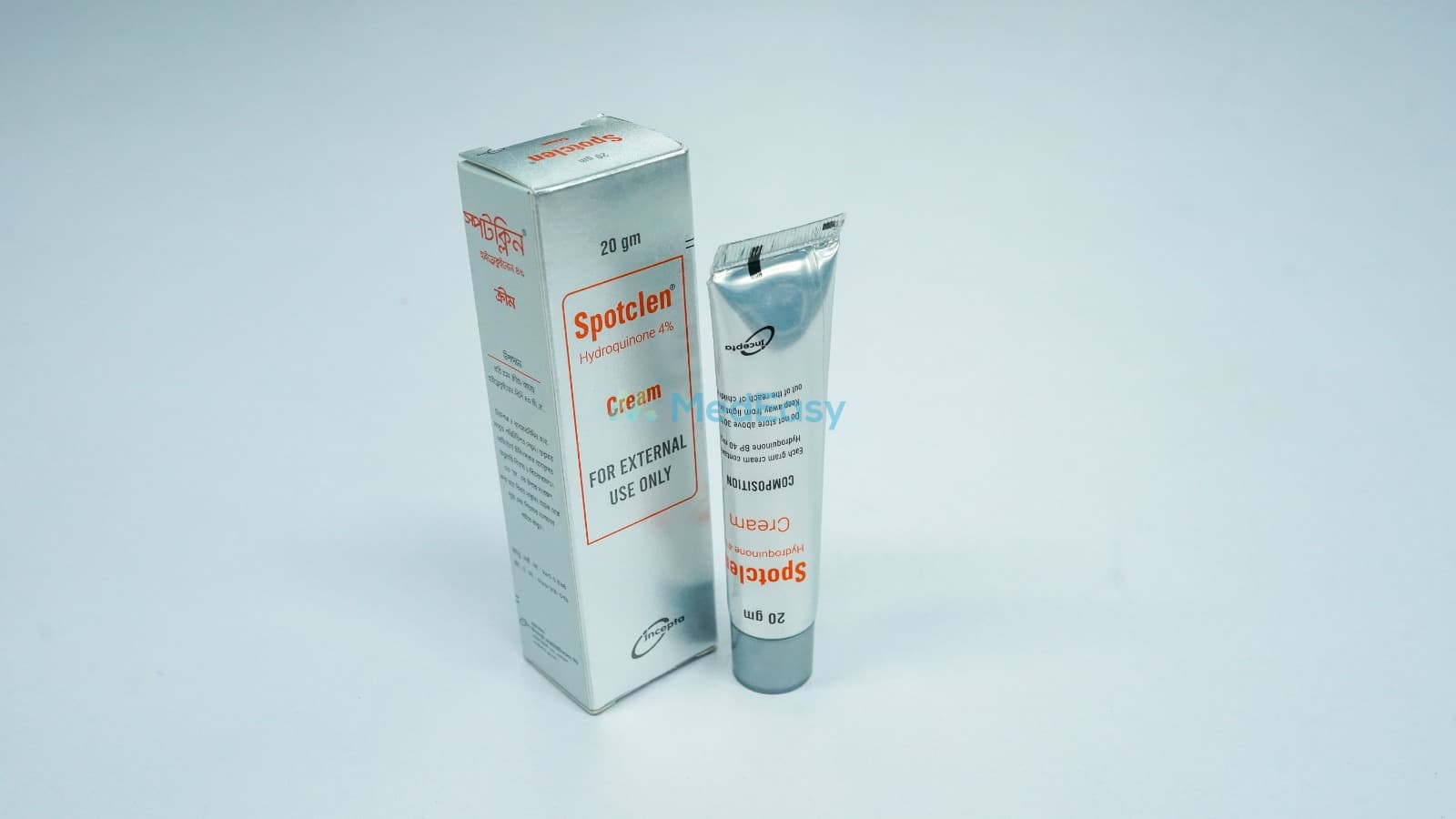
Medicine overview
Indications of Spotclen
Spotclen is a topical skin-depigmenting (bleaching) agent used to gradually lighten areas of excess skin pigmentation (hyperpigmentation).
Established / Commonly Used Indications
- Melasma (chloasma): patchy facial hyperpigmentation, often related to pregnancy, hormonal contraceptives, or sun exposure.
- Post-inflammatory hyperpigmentation: dark marks left behind after acne, eczema, injury, or other skin inflammation.
- Solar/senile lentigines and freckles: sun-induced or age-related dark spots.
- Other localized areas of unwanted melanin hyperpigmentation as assessed and directed by a physician or dermatologist.
Guideline-Supported Combination Use
- For melasma, Spotclen is frequently combined with a topical retinoid (e.g., tretinoin) and a mild-to-moderate topical corticosteroid (the "triple combination" or Kligman-Willis regimen) under physician supervision, which is better supported by clinical evidence than Spotclen used alone in resistant cases.
Spotclen is a cosmetic/dermatologic treatment and is not intended to treat any underlying medical condition causing pigmentation; if hyperpigmentation is new, spreading, or of uncertain cause, a physician should evaluate the skin before treatment.
Composition
Topical preparations typically contain Hydroquinone 2% or 4% w/w in a cream, lotion, or gel base intended for external use on the skin. Some prescription combination products contain Hydroquinone together with a retinoid and/or a topical corticosteroid; the exact composition of a specific product should always be checked on its label.
Description
Spotclen is a synthetic phenolic compound used topically as a skin-lightening (hypopigmenting) agent. It works at the level of the melanocyte (the pigment-producing cell in the skin) to reduce the formation of new melanin, allowing existing pigment to fade gradually as skin cells turn over.
Spotclen is used cosmetically and dermatologically for localized hyperpigmentation and is available both as a lower-strength product and, in many countries, as a prescription-strength cream, sometimes combined with other actives for melasma.
Therapeutic Class
Topical Depigmenting / Skin-Bleaching Agent (Tyrosinase Inhibitor)
Pharmacology
Mechanism of action: Hydroquinone inhibits the enzyme tyrosinase, which catalyzes the conversion of tyrosine to dopaquinone, a rate-limiting step in melanin synthesis. By blocking this enzyme, Hydroquinone reduces the production of new melanin within melanocytes.
Hydroquinone may also be directly cytotoxic to melanocytes and can inhibit the formation and increase the degradation of melanosomes (the pigment-containing organelles), further reducing pigment deposition in the skin.
Effects are gradual: because Hydroquinone reduces new melanin formation rather than removing existing pigment instantly, visible lightening typically develops over several weeks of regular use as pigmented skin cells are naturally shed and replaced.
Pharmacokinetics: Systemic absorption through intact skin is generally low with correct topical use, but increases with application to larger surface areas, broken skin, or prolonged occlusive use; absorbed drug is metabolized and excreted mainly via the kidneys.
Dosage & Administration of Spotclen
Spotclen should be used exactly as directed by a physician or as labeled on the specific product, since strength (commonly 2% or 4%) and instructions vary by product.
| Use | Typical Regimen |
|---|---|
| Localized hyperpigmentation (melasma, PIH, lentigines, freckles) | Apply a thin layer to the affected area(s) only, once or twice daily (commonly morning and bedtime), and rub in gently until absorbed. |
| Combination melasma regimen | Used as one component of a physician-directed combination regimen (e.g., with a retinoid and a corticosteroid); follow the prescriber's specific schedule rather than the standalone label. |
- Wash and dry the area before application; avoid contact with eyes, mouth, nostrils, and open wounds.
- A broad-spectrum sunscreen must be applied daily during treatment (see Precautions and Warnings) and unnecessary sun exposure avoided.
- If no improvement is seen after about 2 months of consistent use, treatment should be reassessed with a physician.
- Continuous use is generally limited to a defined course (commonly a few months) followed by a treatment-free interval; see Duration of Treatment.
- Not recommended for unsupervised use in children 12 years of age and under.
Administration of Spotclen
For external (topical) use on the skin only. Apply a thin film of Spotclen using clean fingertips to cover only the darkened/affected area, avoiding surrounding normal skin where possible to reduce the risk of uneven lightening. Do not apply to the eyes, lips, mucous membranes, sunburned skin, or open cuts/abrasions. Wash hands after application unless the hands are the treated area. Not for oral, ophthalmic, or vaginal use.
Interaction of Spotclen
Well-established topical interactions with Spotclen include:
- Benzoyl peroxide and other oxidizing agents: concurrent use can cause temporary staining/discoloration of the skin; these products are usually not applied at the same time as Spotclen.
- Other topical irritants (retinoids, alpha-hydroxy acids, exfoliants, astringents, products containing alcohol or spices): combined use may increase local irritation, dryness, or redness; a physician may still combine Spotclen with a retinoid deliberately for melasma but will adjust frequency to manage irritation.
- Photosensitizing products or excessive sun exposure: not a drug-drug interaction, but sun exposure without adequate sunscreen can worsen or reverse the depigmenting effect and increase the risk of paradoxical darkening (see Precautions and Warnings).
There are no clinically significant systemic drug interactions expected with correctly used topical Spotclen due to its low systemic absorption, but patients should inform their physician of all other topical products used on the same skin area.
Contraindications
Hydroquinone is contraindicated in:
- Patients with known hypersensitivity to Hydroquinone or to any excipient in the specific product.
- Application to sunburned, broken, chapped, or otherwise irritated skin.
Hydroquinone should not be used on children 12 years of age and under except under direct physician supervision, as safety and effectiveness in this age group have not been established.
Side Effects of Spotclen
Local skin reactions are the most common side effects of topical Spotclen:
- Mild redness (erythema), dryness, stinging, or a burning sensation at the application site, especially when treatment starts.
- Fissuring/cracking of the skin, particularly around the nose (paranasal areas).
- Localized contact dermatitis or allergic reaction in sensitized individuals - discontinue use and consult a physician if this occurs.
With prolonged or high-concentration use, a rare but important adverse effect is exogenous ochronosis (a gradual blue-black darkening of the treated skin); see Precautions and Warnings for details on minimizing this risk.
Pregnancy & Lactation
Pregnancy: Data on topical Spotclen in human pregnancy are limited, and systemic absorption can occur, particularly with use over larger areas or for prolonged periods. Spotclen is generally not recommended during pregnancy; it should be used only if clearly needed and the potential benefit justifies the potential risk to the fetus, and only after consulting a physician.
Breastfeeding: It is not known whether topically applied Spotclen is excreted in human breast milk. As a conservative precaution, Spotclen is generally not recommended during breastfeeding, and if use is considered necessary, it should be limited to small areas away from the breast and only under medical advice.
Precautions & Warnings
Exogenous ochronosis: Prolonged use of Spotclen, especially at higher concentrations, has been associated with exogenous ochronosis - a gradual, sometimes disfiguring, blue-black darkening of the treated skin that can be paradoxical and difficult to reverse. This risk increases with continuous long-term use, so treatment duration should be limited as directed (commonly with breaks after several months of continuous therapy), and treatment should be stopped and a physician consulted if unusual darkening develops.
Photosensitivity / sun protection is mandatory: Spotclen does not contain sunscreen. Sun exposure without strict daily use of a broad-spectrum sunscreen (and protective clothing/shade where possible) can reverse the lightening effect and worsen hyperpigmentation; consistent sun protection is essential throughout and after treatment.
Limit treated surface area: Spotclen should be applied only to the specific hyperpigmented areas and not used over large areas of the body, to minimize systemic absorption and the risk of ochronosis.
Patch test: A test application to a small area of skin is recommended before starting full treatment; mild redness is expected, but itching, swelling, or blistering means the product should not be used.
Limited long-term safety data: Long-term safety of continuous Spotclen use beyond several months is not well established; use should follow the prescribed course and periodic breaks rather than indefinite continuous application.
Do not apply to broken, sunburned, or irritated skin (see Contraindications).
Overdose Effects of Spotclen
Topical overuse of Spotclen (applying too much, too often, or to too large an area) may increase the risk of local irritation, transient redness, burning, or the skin changes described under Precautions and Warnings, rather than causing systemic toxicity, since absorption through intact skin is normally low.
If Spotclen cream is accidentally swallowed or applied extensively to broken skin/mucous membranes, or if a severe allergic reaction (swelling of the face/lips/throat, difficulty breathing, widespread rash) occurs, seek immediate medical attention or contact a poison control center/emergency services rather than attempting home treatment.
Storage Conditions
Store Spotclen cream/gel at room temperature (below 30°C) in a tightly closed, light-resistant (opaque) container, protected from direct light, heat, and moisture, as Spotclen can darken/oxidize on exposure to air and light. Do not use if the product has turned brown. Keep out of reach of children.
Use In Special Populations
Pediatric use: Safety and effectiveness of Spotclen in children 12 years of age and under have not been established; use in this age group should only occur under direct physician supervision.
Elderly: No specific dose adjustment is established for older adults; Spotclen is commonly used for age-related lentigines under normal precautions.
Renal/hepatic impairment: Because systemic absorption from correctly used topical Spotclen is low, no specific dose adjustment is established; however, patients with significant renal or hepatic impairment should use Spotclen cautiously and inform their physician, particularly if treating large body areas.
Pregnancy and lactation: See Pregnancy and Lactation section above.
Darker skin tones: Patients with more deeply pigmented skin (e.g., Fitzpatrick skin types IV-VI) may have a higher reported risk of exogenous ochronosis with prolonged use and should be monitored closely; see Precautions and Warnings.
Duration Of Treatment
Spotclen is typically used for a defined, physician-directed course rather than indefinitely. A common approach is continuous use for approximately 2-4 months, with reassessment if no improvement is seen after about 2 months. Because prolonged continuous use raises the risk of exogenous ochronosis (see Precautions and Warnings), many prescribers recommend a treatment-free interval after each course before resuming if further lightening is needed. The exact duration should follow the prescribing physician's instructions or the specific product's labeling.
Drug Classes
Topical Depigmenting Agents; Tyrosinase Inhibitors; Dermatologic Agents
Mode Of Action
Hydroquinone works by inhibiting tyrosinase, the key enzyme melanocytes use to produce melanin, thereby reducing new pigment formation in treated skin; it may also reduce melanosome formation and have a direct effect on melanocytes. Full mechanistic and pharmacokinetic detail is provided under Pharmacology.
Pregnancy
C
Pediatric Uses
Spotclen has not been established as safe and effective for children 12 years of age and under; it should not be used in this age group without direct physician supervision and a clear clinical indication. Where a physician does prescribe Spotclen for a child, the lowest effective strength, a limited treatment area, strict sun protection, and close monitoring for irritation or ochronosis are recommended.
Frequently Asked Questions
Q: What is Spotclen 20 gm Cream used for?
A: Spotclen 20 gm Cream is a topical cream used to gradually lighten areas of dark skin (hyperpigmentation) such as melasma, dark marks left after acne or skin injury, and age-related or sun-related dark spots.
Q: How long does it take Spotclen 20 gm Cream to work?
A: Visible lightening usually takes several weeks of consistent, correct use; if there is no improvement after about 2 months, a physician should reassess the treatment.
Q: Can I use Spotclen 20 gm Cream during pregnancy or while breastfeeding?
A: Spotclen 20 gm Cream is generally not recommended during pregnancy or breastfeeding because safety data are limited and some systemic absorption is possible. It should be used only if a physician judges it clearly necessary and the potential benefit outweighs the potential risk.
Q: Do I need to use sunscreen with Spotclen 20 gm Cream?
A: Yes. Spotclen 20 gm Cream contains no sunscreen, and unprotected sun exposure can reverse its lightening effect and worsen dark spots. A broad-spectrum sunscreen should be applied daily, along with sun-protective measures such as a hat or shade, throughout and after treatment.
Q: Is it safe to use Spotclen 20 gm Cream for a long time without stopping?
A: No. Continuous long-term use of Spotclen 20 gm Cream, especially at higher strengths, increases the risk of a condition called exogenous ochronosis, a paradoxical blue-black darkening of the skin. Spotclen 20 gm Cream should be used for a limited course as directed by a physician, with breaks between courses.
Q: What should I do if my skin becomes irritated or turns darker instead of lighter?
A: Stop using Spotclen 20 gm Cream and contact a physician promptly. Unusual darkening, persistent redness, itching, swelling, or blistering may indicate irritation, allergic contact dermatitis, or ochronosis and needs medical evaluation.
Disclaimer
The information provided is accurate to the best of our knowledge, but it does not replace professional medical advice. We cannot guarantee its completeness or accuracy, and the absence of specific information about a drug should not be taken as an endorsement. We are not responsible for any consequences arising from this information, so please consult a healthcare professional for any concerns or questions.