
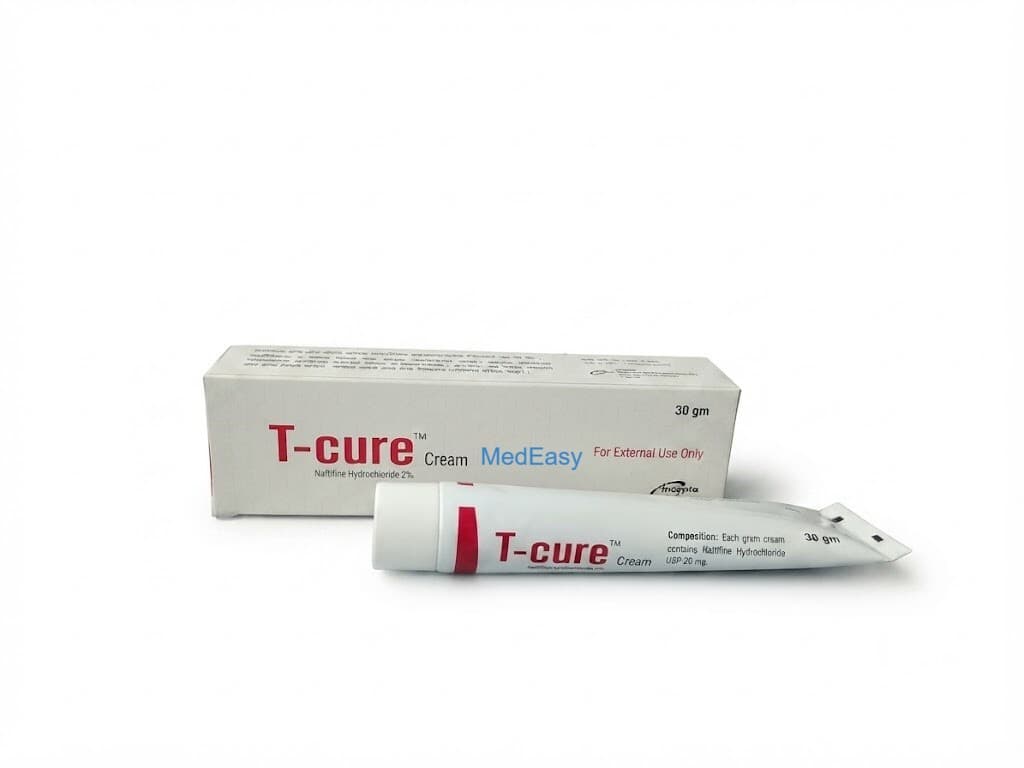

Medicine overview
Indications of T-cure
T-cure is a topical allylamine antifungal indicated for the treatment of superficial fungal skin infections.
FDA-Approved Indications
- Interdigital tinea pedis (athlete's foot) caused by Trichophyton rubrum, Trichophyton mentagrophytes, and Epidermophyton floccosum, in patients 12 years of age and older.
- Tinea cruris (jock itch) caused by the same organisms, in patients 12 years of age and older.
- Tinea corporis (ringworm) caused by the same organisms, in patients 12 years of age and older.
Other Reported Activity (Not an Approved Indication)
T-cure also demonstrates fungistatic activity against some Candida species in vitro; however, it is not FDA-approved for treatment of candidal skin infections and should not be relied upon for that purpose.
Composition
Each formulation of Naftifine Hydrochloride topical cream or gel contains Naftifine Hydrochloride 1% w/w or 2% w/w as the active ingredient, in a base containing pharmaceutically acceptable excipients such as cetyl alcohol, stearyl alcohol, propylene glycol, and preservatives, depending on the specific formulation.
Description
T-cure is a synthetic allylamine-class antifungal agent formulated for topical application. It is fungicidal against common dermatophytes responsible for tinea infections and is available as a 1% or 2% cream or gel for once- or twice-daily use depending on strength.
Therapeutic Class
Topical Antifungal — Allylamine derivative. T-cure is a representative agent of this class.
Pharmacology
Naftifine Hydrochloride is an allylamine antifungal that inhibits squalene epoxidase, an enzyme required for the conversion of squalene to ergosterol in the fungal cell membrane. This leads to squalene accumulation and ergosterol depletion, disrupting fungal cell membrane synthesis.
The result is a fungicidal effect against dermatophytes (Trichophyton, Epidermophyton species) and a fungistatic effect against Candida species. Following topical application, systemic absorption of Naftifine Hydrochloride is minimal.
Dosage & Administration of T-cure
Dosing of T-cure depends on the strength and formulation used. For external/topical use only.
| Strength/Form | Indication | Frequency | Duration |
|---|---|---|---|
| 1% Cream/Gel | Tinea pedis, tinea cruris, tinea corporis | Twice daily | Up to 4 weeks |
| 2% Cream/Gel | Interdigital tinea pedis | Once daily | 2 weeks |
| 2% Cream | Tinea cruris, tinea corporis | Once daily | 2 weeks |
Apply a thin layer to cover the affected area and immediate surrounding skin. Do not use occlusive dressings unless directed by a physician.
Administration of T-cure
Wash and dry the affected area before applying T-cure. Apply a thin layer to cover the affected skin and the immediately surrounding area, then gently rub in. Wash hands after application unless the hands are the area being treated. Avoid contact with eyes, nose, mouth, and other mucous membranes.
Interaction of T-cure
Because T-cure is applied topically and has minimal systemic absorption, no clinically significant systemic drug interactions have been well established.
Avoid concurrent application of other topical medications, cosmetics, or irritant skin products on the same area unless advised by a physician, as this may affect drug delivery or increase local irritation.
Contraindications
Naftifine Hydrochloride is contraindicated in patients with known hypersensitivity to naftifine hydrochloride or to any component of the formulation.
Side Effects of T-cure
Adverse reactions to T-cure are generally mild and localized to the application site.
- Burning or stinging sensation
- Dryness of the skin
- Erythema (redness)
- Itching (pruritus)
- Rarely, contact dermatitis or allergic sensitization
Discontinue use and consult a physician if irritation or signs of sensitization develop (see Precautions and Warnings).
Pregnancy & Lactation
T-cure should be used during pregnancy only if clearly needed and if the potential benefit justifies the potential risk to the fetus. Adequate and well-controlled studies in pregnant women are not available; a physician should be consulted before use.
It is not known whether T-cure is excreted in human breast milk. Caution is advised, and a physician should be consulted before use while breastfeeding, particularly if applied near the breast/nipple area.
Precautions & Warnings
T-cure is for external/topical use only and must not be taken orally or used systemically.
- Avoid contact with the eyes, nose, mouth, and other mucous membranes; if accidental contact occurs, rinse thoroughly with water.
- Do not apply to open wounds or broken skin.
- Discontinue use and consult a physician if signs of irritation, worsening redness, or sensitization occur.
- Complete the full prescribed course of treatment even if symptoms improve before completion; stopping early may lead to incomplete eradication of the fungal infection and recurrence.
- Some gel formulations contain alcohol and are flammable; keep away from open flame or heat during and immediately after application.
Overdose Effects of T-cure
T-cure is intended for topical use only, and systemic toxicity from topical overdose is unlikely. If accidental ingestion occurs, or if excessive application leads to a significant local reaction, seek immediate medical attention or contact a poison control center. Do not attempt unsupervised home treatment for suspected ingestion.
Storage Conditions
Store at room temperature (below 30°C), away from light and moisture. Keep out of reach of children. Gel formulations containing alcohol should be kept away from heat and open flame.
Use In Special Populations
Renal/Hepatic Impairment: No dose adjustment is established or generally required, as systemic absorption of T-cure after topical use is minimal.
Elderly: No specific dose adjustment is established; clinical studies did not identify differences in response relative to younger adults.
Pediatric: Safety and efficacy in patients younger than 12 years of age have not been established (see Pediatric Uses).
Duration Of Treatment
Treatment duration with T-cure depends on strength: typically up to 4 weeks for 1% formulations, and 2 weeks for 2% formulations. The full course should be completed as directed even if symptoms resolve earlier, to reduce the risk of relapse.
Drug Classes
Allylamine antifungal (topical).
Mode Of Action
Naftifine Hydrochloride acts by inhibiting fungal squalene epoxidase, blocking conversion of squalene to ergosterol, an essential component of the fungal cell membrane. This results in ergosterol depletion and toxic squalene accumulation, producing a fungicidal effect against dermatophytes.
Pregnancy
Category B (FDA legacy pregnancy classification)
Pediatric Uses
The safety and efficacy of T-cure 1% and 2% formulations have been established in patients 12 years of age and older for the approved indications. Safety and efficacy in pediatric patients younger than 12 years of age have not been established, and use in this age group should only be considered under medical supervision.
Frequently Asked Questions
Q: What is T-cure 2% Cream used for?
A: T-cure 2% Cream is a topical antifungal cream or gel used to treat fungal skin infections such as athlete's foot (tinea pedis), jock itch (tinea cruris), and ringworm (tinea corporis).
Q: How should I apply T-cure 2% Cream?
A: Wash and dry the affected area, then apply a thin layer of T-cure 2% Cream to cover the area and surrounding skin, once or twice daily depending on the strength prescribed. Avoid contact with eyes and mucous membranes.
Q: How long do I need to use T-cure 2% Cream?
A: Treatment typically lasts 2 to 4 weeks depending on the strength and infection being treated. It is important to complete the full course of T-cure 2% Cream even if your symptoms improve earlier, as stopping too soon can allow the infection to return.
Q: Can T-cure 2% Cream be used during pregnancy?
A: T-cure 2% Cream should be used during pregnancy only if clearly needed, after consulting a physician, since adequate human safety data are not available.
Q: What are the common side effects of T-cure 2% Cream?
A: The most common side effects of T-cure 2% Cream are mild, localized reactions at the application site, including burning, stinging, dryness, redness, and itching.
Q: Is T-cure 2% Cream safe for children?
A: The safety and efficacy of T-cure 2% Cream have been established for patients 12 years of age and older. Use in children younger than 12 has not been established and should only occur under medical supervision.
Disclaimer
The information provided is accurate to the best of our knowledge, but it does not replace professional medical advice. We cannot guarantee its completeness or accuracy, and the absence of specific information about a drug should not be taken as an endorsement. We are not responsible for any consequences arising from this information, so please consult a healthcare professional for any concerns or questions.
